
Imagine you've finally secured a home in a growth corridor like Aura, only to realize two years later that your co-owner needs to sell their share while you aren't ready to move. With the median house price on the Sunshine Coast exceeding $1.08 million, many buyers are choosing to pool their resources to enter the market. However, without a formal property co-ownership agreement sunshine coast, this exciting milestone can quickly become a source of significant stress. You aren't alone if you worry about potential financial defaults or the confusion of complex Queensland property terminology.
We understand that these transitions are deeply personal and often high-pressure. You deserve a clear roadmap that protects your investment and ensures a low-friction path to settlement. This guide provides the clarity you need to safeguard your equity and maintain harmony with your co-owners. We will break down how to document your respective shares, establish fair exit strategies, and ensure your legal rights are protected from the very start. By addressing these details now, you can focus on enjoying your new property with total confidence.
Key Takeaways
- Understand the critical legal differences between joint tenancy and tenants in common to ensure your property shares are held in a way that reflects your long-term intentions.
- Learn how a formal property co-ownership agreement sunshine coast protects your equity and provides a low-friction roadmap for future decisions or potential property sales.
- Discover why documenting all financial contributions, including initial deposits and ongoing maintenance costs, is essential for maintaining harmony among all co-owners.
- Prepare for the future by establishing clear exit strategies and agreed valuation methods to prevent conflict during high-pressure life transitions.
- Benefit from 30 years of local expertise to navigate complex Queensland property regulations with the calm confidence of a seasoned professional partner.
Understanding Property Co-Ownership on the Sunshine Coast
The Sunshine Coast property market has transformed significantly over the last few years. In high-demand pockets like Noosa and Maroochydore, the barrier to entry is higher than ever before. Pooling resources isn't just a financial choice; it's a strategic move to secure a slice of the coastal lifestyle. However, moving from a shared dream to a shared deed requires more than just goodwill. You need a framework that respects the personal significance of this milestone while providing professional security.
Many people rely on "handshake deals" because they trust their siblings or lifelong friends. While this trust is a beautiful starting point, it doesn't account for the unpredictable nature of life. A child's education costs, a sudden career change, or a relationship breakdown can shift priorities overnight. Trust isn't a legal strategy. Without a property co-ownership agreement sunshine coast, these personal transitions can lead to avoidable friction and financial loss. We focus on removing that friction so your relationships stay as strong as your investment.
Why Shared Ownership is Trending in 2026
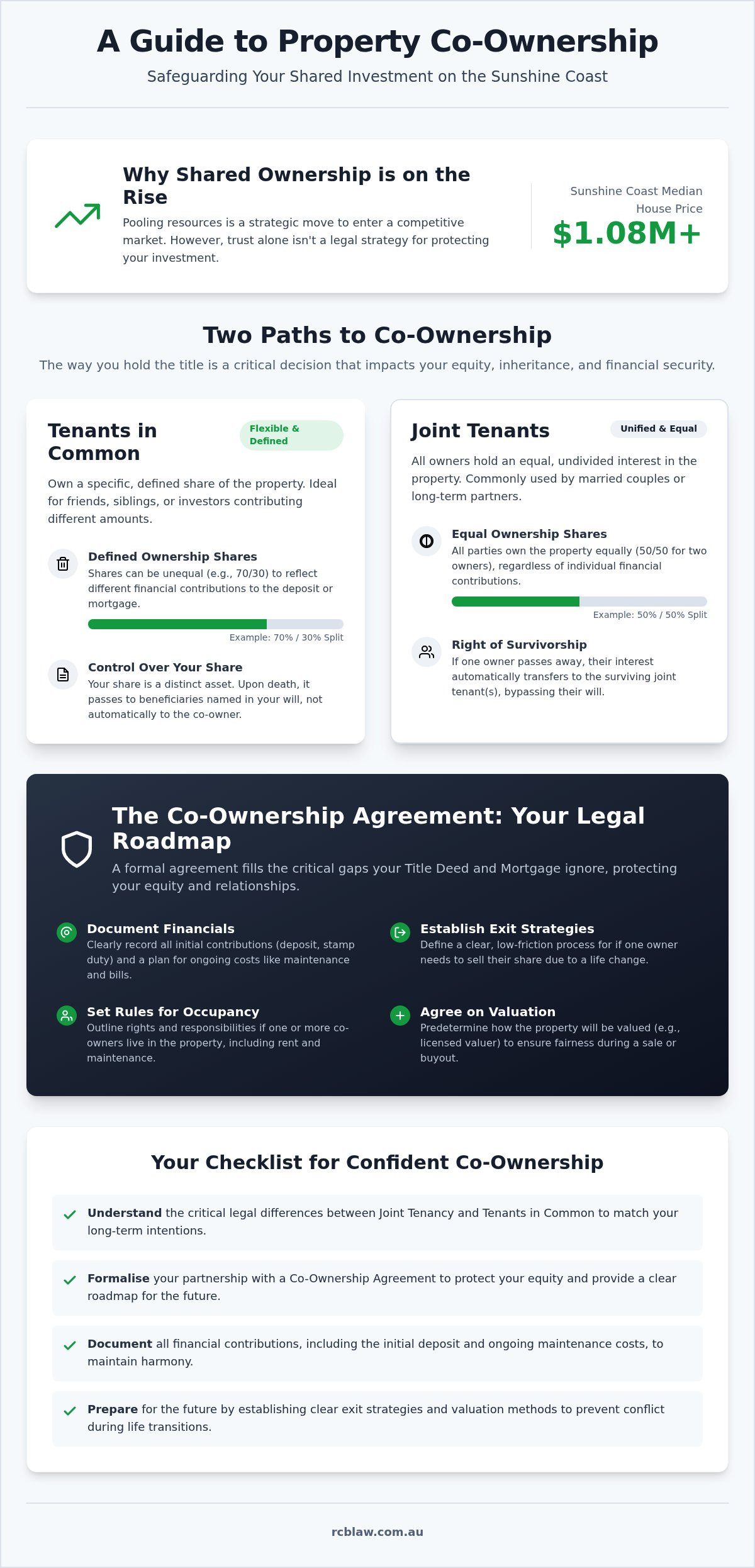
Market affordability remains a primary driver for local buyers. With median house prices on the Coast exceeding $1.08 million in late 2025, "rentvesting" has become a popular strategy. This involves buying an investment property with others while continuing to rent where you want to live. Siblings and friends are teaming up to utilize the $30,000 First Home Owner Grant for new builds in growth corridors like Aura or Palmview. Having a local specialist who understands the conveyancing landscape is vital. We've seen how regional nuances, such as the Sunshine Coast Council's Arts and Heritage Levy, can surprise those who aren't prepared for the total cost of ownership.
The Legal Foundation of Your Agreement
At its core, your agreement defines the legal relationship between all parties involved. In legal terms, this is often referred to as a Concurrent estate, where multiple people hold interest in the same land. While your title deed shows who owns the property and your mortgage shows who owes the bank, the co-ownership agreement fills the critical gaps. It outlines the "what ifs" that these other documents ignore. Professional legal drafting of a property co-ownership agreement sunshine coast ensures your equity is protected by a document that works in harmony with Queensland law. It transforms a complex transaction into a structured, manageable roadmap. This preparation provides the calm confidence you need to focus on your new home rather than legal anxieties.
Joint Tenants vs Tenants in Common: Which is Right for You?
When you decide to purchase property with another person, the way you hold the title dictates how your equity is managed both now and in the future. It's a foundational choice that deserves careful consideration. In Queensland, you must choose between being Joint Tenants or Tenants in Common. This decision isn't just a legal formality; it impacts your financial security and your family's future. For those entering into a property co-ownership agreement sunshine coast, understanding these differences is the first step toward a low-friction investment journey.
We understand that these choices can feel overwhelming, especially when you're trying to balance personal relationships with financial logic. Our role is to act as a steady guide, ensuring you choose the structure that provides the most security for your specific situation. Whether you are buying with a partner, a sibling, or a business associate, the legal framework you choose today will define your rights for years to come.
Deep Dive: Tenants in Common
Tenants in Common is often the preferred choice for co-investors, friends, or business partners on the Sunshine Coast. This structure allows you to own specific, defined shares of the property. For example, if you contributed more to the initial deposit, you might hold a 70 percent share while your partner holds 30 percent. Crucially, your share does not automatically pass to the other owner if you pass away. Instead, it becomes part of your estate. This flexibility makes it essential to update your wills to ensure your intentions are clear. This structure is ideal for those who want their property interest to remain a distinct asset that they can control and bequeath independently.
Deep Dive: Joint Tenants
Joint Tenants operate under the concept of unified ownership. In this scenario, no individual owns a specific percentage; you own the whole property together. The most significant feature of this arrangement is the Right of Survivorship. If one owner passes away, their interest in the property automatically transfers to the surviving owner, regardless of what their will says. This is why many spouses or long-term domestic partners choose this path. It simplifies the transition during a difficult time, providing a sense of security for the surviving partner. However, it offers less flexibility if you intend to leave your portion of the property to children from a previous relationship or other beneficiaries.
Choosing the right structure depends entirely on your personal circumstances and long-term goals. While Joint Tenants offers simplicity for couples, the defined nature of Tenants in Common provides the protection many modern investors require when signing a property co-ownership agreement sunshine coast. If you're feeling uncertain about which path aligns with your investment strategy, seeking professional legal advice can provide the clarity you need to move forward with confidence.
Essential Clauses for a Robust Co-Ownership Agreement
A well-drafted agreement acts as a silent partner in your investment. It provides a clear framework for daily life and long-term financial management. While the title deed confirms who owns the property, a property co-ownership agreement sunshine coast details how that ownership works in practice. This document is your best tool for maintaining harmony and preventing the confusion that often leads to legal friction.
Your agreement must address more than just the initial purchase. It should outline how ongoing costs are shared. On the Sunshine Coast, this includes specific regional factors like the Arts and Heritage Levy or body corporate fees for coastal apartments. Since the Sunshine Coast Council calculates interest on overdue rates at 8% per annum as of July 2026, having a clear schedule for payments is essential. Additionally, you should define usage rights. If one owner lives in the property while another uses it for holiday rental income, the agreement must specify how those benefits are balanced.
One of the most vital protections is the "First Right of Refusal" clause. If one co-owner decides to sell their share, this clause requires them to offer it to the existing owners before putting it on the open market. This ensures you maintain control over who you own property with and protects your long-term investment goals.
Managing Financial Contributions
Clarity begins at settlement. Your agreement should include a precise record of every dollar contributed toward the deposit, stamp duty, and legal fees. We recommend linking these records directly to your conveyancing file. This ensures that if the property is sold years later, there is no dispute over who is entitled to what portion of the proceeds. It's also important to account for "sweat equity." If one owner spends their weekends renovating a home in Buderim while the other provides the funding, the agreement should reflect how that labor increases their share of the equity.
Maintenance and Decision Making
Disagreements often arise from small details rather than large ones. To avoid this, set clear thresholds for maintenance decisions. For example, you might agree that emergency repairs under a certain dollar amount can be handled immediately, while cosmetic upgrades require unanimous consent. This structured approach removes the emotional burden of constant negotiation. By pre-defining these processes, you create a low-friction environment where everyone feels heard and the property remains well-maintained. This proactive communication is the hallmark of a successful shared investment.
Navigating Potential Disputes and Exit Strategies
Even the most harmonious partnerships can face unexpected turbulence. Life moves quickly, and personal circumstances often change in ways we can't predict at the time of purchase. While it's uncomfortable to think about a relationship breakdown or financial hardship, addressing these possibilities early is an act of mutual respect. A property co-ownership agreement sunshine coast serves as a pre-negotiated resolution. It ensures that if the time comes to part ways, the process is defined by logic rather than high-pressure emotions.
We believe that legal protection should provide a sense of calm. Instead of focusing solely on worst-case scenarios, we view these agreements as a supportive framework for your future. When you have a clear plan for the "what ifs," you can focus on enjoying your investment with total confidence. Our goal is to remove friction from these complex transitions, positioning you for a smooth path regardless of what the future holds.
Planning for the "What Ifs"
Identifying trigger events is the first step in creating a secure exit strategy. These are specific situations that allow one or all parties to call for a sale or buyout. For instance, if a co-owner can no longer meet their mortgage repayments, your property co-ownership agreement sunshine coast should outline a grace period followed by a clear path to resolution. In Queensland, handling the death or incapacity of a co-owner requires a sensitive, structured approach. By pre-defining these steps, you ensure the exit strategy is as stress-free as the initial purchase. This proactive preparation protects everyone's equity and provides security during difficult transitions.
The Role of Mediation
Disputes don't have to lead to a courtroom. Most disagreements regarding property management or sale price can be resolved through professional mediation. We've found that professional guidance is far more effective than informal arguments. A well-drafted agreement includes a mediation clause, requiring parties to sit down with a neutral third party before escalating to litigation. This approach maintains relationships and minimizes legal costs. We act as your steady guide, helping you move from a state of uncertainty to a feeling of security through clear, direct communication.
Agreeing on a fair price is often the biggest hurdle in a property settlement. Your agreement should specify a valuation process, such as using an independent registered valuer, to remove guesswork. If communication completely breaks down and you worry about your co-owner making unilateral decisions, you may need to protect your interest with a caveat. This legal tool prevents certain dealings with the property until the dispute is resolved. To ensure your investment is protected from every angle, contact our property law specialists today for a tailored agreement.
How RCB Law Secures Your Shared Property Investment
Choosing the right legal partner is about more than just finding a firm to process paperwork. It's about finding a steady guide who understands the high-pressure nature of shared property investments. At RCB Law, we bring over 30 years of experience in residential conveyancing and property law to your transaction. We recognize that every partnership is unique. That's why we don't offer generic templates. Instead, we provide a tailored property co-ownership agreement sunshine coast that reflects your specific financial contributions and long-term goals.
Our approach is built on creating a sense of calm and confidence. We handle the technical complexities of Queensland property law so you can focus on the excitement of your new home or investment. By positioning ourselves as a supportive partner rather than a distant corporate entity, we ensure that your legal journey is as smooth and low-friction as possible. You deserve a professional who listens to your concerns and provides clear, direct assistance every step of the way.
Our Specialist Conveyancing Approach
Managing a shared purchase requires a high level of precision. We integrate your property co-ownership agreement sunshine coast directly into our specialist residential conveyancing services. This ensures that all Queensland property law requirements are met from the moment you sign the contract until the day of settlement. Our team possesses deep regional knowledge of Sunshine Coast councils and regulations. This local expertise allows us to identify potential issues before they arise, providing you with the security that comes from three decades of industry mastery. We make sure the legal foundation of your shared purchase is solid, so your investment can grow without unnecessary hurdles.
Getting Started with Your Agreement
Formalizing your shared ownership doesn't have to be a source of stress. We've designed a structured process to help you move from uncertainty to security in just a few simple steps. Our goal is to provide a low-friction path to property settlement that leaves everyone feeling protected. We recommend starting this process as early as possible to ensure your interests are secured from day one.
- Schedule a supportive consultation with our Sunshine Coast or Brisbane teams to discuss your goals.
- Share your unique situation and financial contributions with an empathetic property law expert.
- Review a draft agreement tailored to your specific needs and potential "what if" scenarios.
- Finalize and sign your document before settlement to ensure immediate legal protection.
Seeking early legal advice is the most effective way to soothe future anxieties. It allows you to establish a clear roadmap while everyone is in agreement, preventing friction later on. Whether you're buying in the growth corridors of Palmview or a coastal apartment in Noosa, we're here to provide the direct assistance you need. Contact us today to begin your journey with a dependable partner by your side.
Protecting Your Coastal Investment and Your Peace of Mind
Entering the Sunshine Coast property market with a partner or friend is a powerful way to build wealth. However, the success of your journey depends on having a clear, supportive framework in place from the start. Choosing the correct title structure and formalizing a property co-ownership agreement sunshine coast ensures that every owner's equity is legally secured. By addressing the "what ifs" today, you create a low-friction path for whatever the future holds.
Our team brings over 30 years of Queensland property law experience and deep local knowledge of the Sunshine Coast and Brisbane markets. We focus on removing the emotional burden of legal transitions through fixed-price residential conveyancing and empathetic, direct assistance. You deserve a dependable partner who understands the personal significance of your investment. Secure your shared investment with RCB Law—Contact our Sunshine Coast specialists today. We look forward to helping you build your future with total confidence and clarity.
Frequently Asked Questions
Do we really need a co-ownership agreement if we are family?
Yes, a formal document is essential even among family members. Financial disputes can strain the closest relationships, and a written agreement provides a clear record of everyone's intentions. It removes the emotional burden of "handshake deals" and ensures that if someone's circumstances change, there's a pre-agreed roadmap to follow. This professional approach helps maintain family harmony while protecting everyone's significant financial investment in the Sunshine Coast market.
Can we change the terms of our agreement after the property is purchased?
You can certainly update your agreement at any time, provided all parties agree to the changes in writing. It's common to amend the document if one person contributes extra funds for renovations or if the property's use changes from a primary residence to a rental. We recommend having these changes professionally drafted to ensure they remain legally sound and reflect your current situation with total clarity and precision.
How does a co-ownership agreement affect our mortgage with the bank?
The agreement doesn't usually change your "joint and several" liability to the lender. While the bank views every owner as responsible for the full debt, your private agreement manages how you handle those payments between yourselves. It provides a structured way to track who is paying what portion of the mortgage. This record is vital for ensuring a fair distribution of equity if the property is eventually sold.
What is the difference between a co-ownership agreement and a partnership agreement?
A co-ownership agreement specifically manages the rights and obligations regarding a particular piece of real estate. A partnership agreement is typically a broader document used for a business entity formed to generate profit. While there's some overlap if you're investing together, a property co-ownership agreement sunshine coast is tailored to the specific nuances of Queensland property law and regional dynamics rather than general commercial partnership statutes.
Is a co-ownership agreement legally binding in Queensland?
Yes, a properly drafted and signed agreement is a legally binding contract under Queensland law. It provides a clear legal framework that courts can rely on if a dispute ever arises. Having this property co-ownership agreement sunshine coast in place significantly reduces the friction of potential legal proceedings. It establishes pre-agreed rules for property management, financial contributions, and exit strategies right from the start of your investment journey.
What happens if one person wants to sell the property but the other doesn’t?
Your agreement should outline a specific process for this scenario, often including a "First Right of Refusal" clause. This allows the remaining owner to buy out the departing owner's share at a price determined by an independent valuer. If a buyout isn't possible, the agreement typically dictates how and when the property will be listed on the open market. This ensures a low-friction exit that respects everyone's financial interests.
How much does it cost to draft a property co-ownership agreement on the Sunshine Coast?
Costs depend on the complexity of your shared ownership structure and the specific requirements of each party. While we offer fixed-price residential conveyancing for the property transfer, drafting a tailored co-ownership agreement is a separate specialist service. We recommend contacting our team for a supportive consultation. We'll listen to your unique needs and provide clear information on the professional assistance required to secure your shared coastal investment.
Can I use a DIY template for my property agreement?
While DIY templates exist, they often fail to account for specific Queensland regulations or regional Sunshine Coast factors. Generic forms may leave out critical details regarding maintenance thresholds or exit triggers, which can lead to confusion and stress later. Professional legal drafting by a firm with 30 years of experience ensures your document is robust. It provides the calm confidence that only a tailored legal solution can offer.


