
A family property transfer is a tactical financial move that requires the same legal rigour as an arms-length sale to protect everyone's future. While transferring property between family members in QLD often feels like a simple gesture of support or a logical step in estate planning, the reality involves a complex web of Queensland Revenue Office (QRO) and ATO regulations. You might worry about triggering an unexpected tax bill or causing a rift in the family, and that's a completely natural response to such a high-stakes transition.
We understand that these personal milestones can feel high-pressure, but they don't have to be. This 2026 guide will help you navigate these complexities with clarity and confidence, ensuring you meet every legal requirement while protecting your family's interests. We'll break down the latest 2026 transfer duty rates, explain the crucial difference between gifting and selling, and explore specific exemptions for spouses. You'll also learn how to manage market value assessments and Capital Gains Tax implications to ensure your legacy remains a gift, not a burden.
Key Takeaways
- Learn the legal distinction between gifting property for "natural love and affection" and selling at a discounted price to ensure your documentation matches your intentions.
- Discover how to navigate the specific 2026 QRO requirements for transferring property between family members qld, including when you can claim a full spouse exemption.
- Follow a structured five-step path from independent professional valuations to final digital settlement to avoid common administrative friction.
- Understand the long-term impacts of "early inheritance" on your land tax obligations and how to safeguard your family's broader estate plan.
- See why 30 years of local Brisbane and Sunshine Coast expertise is vital for managing the emotional and legal nuances of family property transitions.
Gift vs. Sale: Choosing the Right Path for Your Family
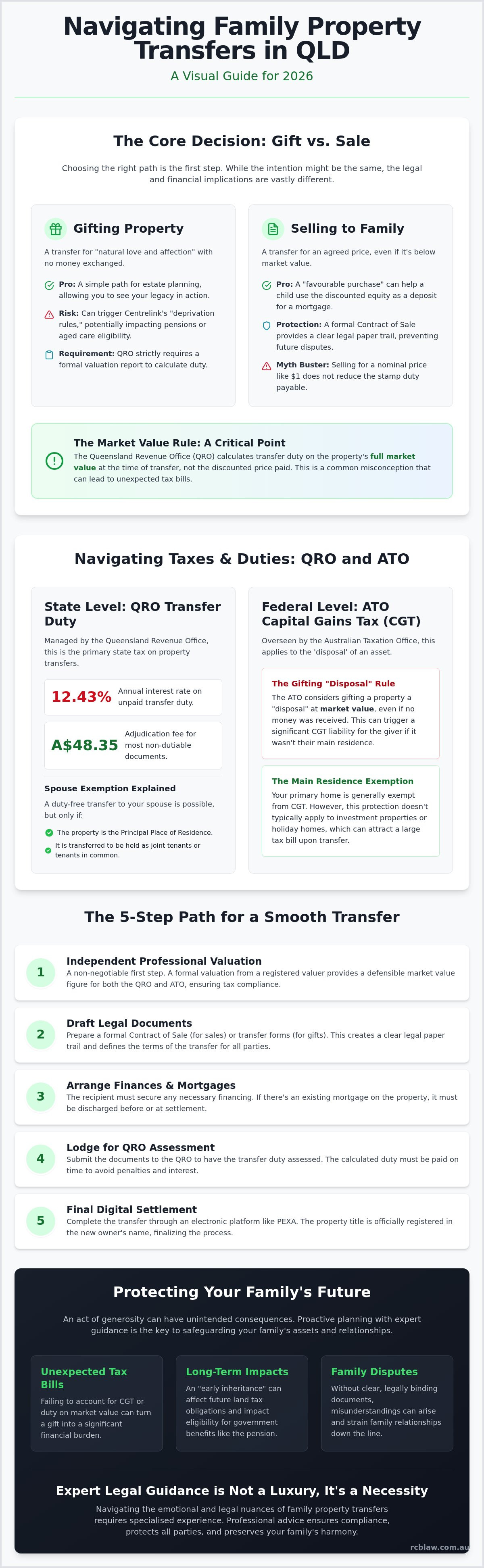
Deciding how to hand over the keys to a loved one is a significant life event that carries both emotional and legal weight. When transferring property between family members qld, you generally choose between a "gift" or a "sale." A gift is legally defined as a transfer for "natural love and affection" where no money changes hands. A sale involves a specific purchase price; even if that price is significantly lower than what you'd find on the open market. Understanding these definitions is the first step in creating a low-friction transition for your family.
Many people believe that selling a home to a child for a nominal amount, like $1, will drastically reduce the stamp duty bill. This is a common misconception that can lead to unexpected financial stress. Under the broader framework of Australian property law, the Queensland Revenue Office (QRO) applies a "Market Value" rule. This means the QRO assesses transfer duty based on the property's actual worth at the time of the transfer, not the discounted price you've agreed upon. Offering "mate's rates" to a relative might be a kind gesture, but it won't lower the government's tax take.
The Pros and Cons of Gifting Property
Gifting is often the simplest path for estate planning. It allows you to see your children enjoy their inheritance while you're still around. However, it isn't without risks. If you're approaching retirement, gifting a significant asset can trigger Centrelink's deprivation rules. This might reduce your pension or impact your aged care eligibility for several years. Since there's no sale price to reference, the QRO will strictly require a formal valuation report from a registered valuer to determine the duty owed.
Selling to Family: Strategic Considerations
Even if you're selling to your own brother or daughter, a formal Contract of Sale is vital. It provides a clear legal paper trail that protects both parties if circumstances change. A strategic benefit of a sale is the "favourable purchase" model. This allows a child to use the equity in the discounted price as a deposit, which can help them secure a mortgage without a massive cash savings. Clear, documented terms prevent future family disputes by ensuring everyone knows exactly what was agreed upon during the transfer.
Stamp Duty and Tax: Navigating the QRO and ATO
Navigating the tax landscape when transferring property between family members qld requires balancing state obligations with federal tax rules. While the Queensland Revenue Office (QRO) manages transfer duty, the Australian Taxation Office (ATO) oversees Capital Gains Tax (CGT). This dual layer of compliance often creates friction for families who simply want to help each other out. Understanding these rules early protects you from unexpected bills and ensures the transition remains a positive experience for everyone involved. It's about moving from a state of uncertainty to one of total security.
In 2026, transfer duty is calculated on the property's market value, regardless of the price paid. If you transfer a home worth A$800,000 to a relative, the QRO expects duty based on that A$800,000 figure. Failing to pay on time can lead to significant costs, as the unpaid tax interest rate currently sits at 12.43%. For documents that aren't subject to duty, an adjudication fee of A$48.35 usually applies to obtain a formal assessment from the QRO. A professional valuation is not just a recommendation; it's a necessary tool for tax compliance that provides a clear, defensible figure for both the QRO and the ATO.
Queensland Transfer Duty Exemptions
Exemptions are quite narrow in Queensland. A common relief is the spouse exemption, which allows a duty-free transfer of an interest in a home to a partner. This only applies if the property is the principal place of residence (PPR) for both parties and is held as joint tenants or tenants in common. Other exemptions exist for probate and estate distribution following a death. Most other family transfers, such as moving a title from a parent to a child, don't qualify for exemptions and attract standard duty rates. This is why getting the right advice early is so important.
Capital Gains Tax (CGT) Pitfalls
The federal tax implications are just as critical as the state-level ones. According to the ATO guidelines on property transfers, gifting a property is viewed as a "disposal" at market value. If the property was an investment or a holiday home, the giver may face a substantial CGT liability even if they didn't receive a cent. The "Main Residence" exemption usually protects your primary home, but investment properties are a different story. It's vital to consult an accountant to calculate these liabilities while working with a conveyancing lawyer to handle the legal transfer. Our team can help you identify these risks early, ensuring your family's financial security isn't compromised by avoidable tax traps.
The 5-Step Process for a Family Property Transfer
A family transfer isn't just about signing a piece of paper; it's a structured legal journey that requires precision. While the emotional side of the transaction is personal, the administrative side must be clinical to satisfy regulators. Following a logical, five-step process helps remove the friction often associated with transferring property between family members qld. This structured approach ensures that no detail is overlooked and that the transition remains a source of security rather than stress.
- Step 1: Obtain a Professional Valuation. Before drafting any documents, you must secure a valuation from a registered valuer to establish the market value for tax purposes.
- Step 2: Draft the Legal Documents. Depending on your strategy, your lawyer will prepare either a formal Contract of Sale or a Deed of Gift to anchor the transaction.
- Step 3: Verification of Identity (VOI) and PEXA Setup. All parties must have their identities verified to prevent fraud. We then create a secure digital workspace in PEXA.
- Step 4: QRO Assessment. We lodge the Form 1 Transfer and relevant declarations with the Queensland Revenue Office for duty assessment.
- Step 5: Digital Settlement. On the scheduled day, the digital "handshake" occurs. Funds (if any) are transferred, and the title is registered with Titles Queensland.
Why a Professional Valuation is Non-Negotiable
You might be tempted to use a real estate agent's "appraisal" to save time. However, the QRO and ATO generally don't accept these for family transfers. An agent's appraisal is an estimate for marketing, whereas a registered valuer's report is a legal document that provides a defensible market value. Having an accurate valuation protects you from future audits. If the authorities ever question the duty paid, this report serves as your primary evidence, ensuring you don't face unexpected penalties years down the line.
Digital Settlement via PEXA
The days of lawyers meeting in a room to swap physical paper titles are over. In Queensland, all property settlements now occur through PEXA, a secure digital platform. This shift has significantly increased the security of transferring property between family members qld by ensuring that the transfer of ownership and the payment of duty happen simultaneously. Using a specialist conveyancer to manage this workspace is essential for a smooth settlement. On the day, you don't need to be present; the system automatically updates the Titles Office records, providing you with immediate confirmation of the successful transfer.
Protecting Your Assets: Risks and Future Planning
Transferring property between family members qld is often driven by a desire to provide for the next generation. While the intent is generous, "early inheritance" comes with risks that go beyond simple tax calculations. You need to ensure the asset stays within the family and serves its intended purpose without creating unintended friction. This stage of the process is about looking past the immediate transfer and securing your family's long-term financial health.
How you choose to hold the title is one of the most critical decisions you'll make. Joint tenancy means the property passes automatically to the survivor, whereas tenants in common allows you to leave your specific share to a chosen beneficiary in your Will. This choice directly affects your land tax obligations and future flexibility. We focus on helping you select the structure that aligns with your broader estate planning strategies, ensuring the transfer doesn't conflict with your legacy goals.
The 'What If' Scenarios: Divorce and Creditors
A common worry for parents is what happens to a gifted property if a child's marriage breaks down. In many cases, the family court may view the property as part of the divisible asset pool. Similarly, if the recipient is a business owner who faces financial trouble, the home could be at risk from creditors. Understanding the role of caveats in protecting interests during a transition can provide a layer of security. These legal markers act as a shield, ensuring that your intentions for the property are documented and defended.
Centrelink and Gifting Rules
If you're approaching retirement or already receiving a pension, Centrelink's "Deprivation of Assets" rules are a vital consideration. There's a strict five-year lookback period for any significant gifts. Generally, if you gift more than A$10,000 in a single financial year or A$30,000 over five years, the excess is still counted as your asset for five years. This can lead to a reduction in your Age Pension payments, even though you no longer own the property. Timing your transfer correctly is essential to avoid a sudden drop in your retirement income. To ensure your transfer is handled with the care it deserves, speak with our property law team today for tailored guidance.
Why Expert Legal Guidance is Essential for Family Transfers
Choosing the right legal partner is the final step in securing your family's legacy. At RCB Law, we bring over 30 years of Queensland property law experience to every transaction. We understand that transferring property between family members qld is rarely just a business deal; it's a deeply personal transition that can carry significant emotional weight. Our role is to act as a steady guide, removing the friction from complex legal requirements so you can focus on your family. With local offices in Brisbane and the Sunshine Coast, we provide the regional knowledge necessary to navigate the specific expectations of the Queensland Revenue Office.
Our low-friction approach is built on mastering modern tools like PEXA digital settlements. This ensures that the transfer of ownership is fast, secure, and transparent. We recognize that these transitions can be high-pressure for clients, especially when balancing family dynamics with strict tax deadlines. By providing a structured breakdown of every step, we transform a state of uncertainty into a feeling of security. You can trust that our mastery of industry standards will protect your interests throughout the entire process.
The Cost of 'DIY' Property Transfers
Attempting a self-lodged transfer might seem like a way to save money, but the risks often outweigh the benefits. Small errors in documentation or incorrect duty declarations can lead to heavy QRO penalties and interest charges. Perhaps more concerning is the risk of creating a "defective title." This occurs when the legal chain of ownership isn't perfectly established, which can halt future sales or refinances until the error is corrected through expensive legal proceedings. Professional fees are a small investment when compared to the total legal security and peace of mind they provide. We ensure your title is robust and your tax obligations are met accurately from the start.
Book Your Consultation with RCB Law
Clear communication and empathetic service are the foundations of our practice. We don't just process paperwork; we listen to your specific circumstances to provide a tailored resolution. If your property transfer involves business assets or commercial titles, we can seamlessly integrate your needs with our expertise in commercial law needs. This holistic approach ensures every aspect of your financial world is protected. Secure your family's future today by reaching out for a professional review of your property transfer plans.
Secure Your Family's Legacy with Confidence
Successfully transferring property between family members qld is about more than just changing a name on a title. It's a strategic step that balances your generous intentions with the practical realities of tax compliance and asset protection. By understanding the QRO's market value rules and the ATO's capital gains implications, you can prevent your gift from becoming a financial burden. Whether you're helping a child enter the market or restructuring your estate, a methodical approach ensures every legal detail is handled with precision.
At RCB Law, we've spent over 30 years acting as a steady guide for families across Brisbane and the Sunshine Coast. We recognize that these transitions are high-pressure; therefore, we focus on a low-friction process that prioritizes your emotional well-being and legal security. Our local specialists combine technical mastery with an empathetic approach to help you move forward with total clarity. You don't have to navigate these complexities alone.
Secure your family property transfer with RCB Law today and take the first step toward a seamless transition. We're here to help you protect what matters most.
Frequently Asked Questions
Do I have to pay stamp duty if I gift property to my child in QLD?
Yes, you typically must pay transfer duty when gifting property to a child. The Queensland Revenue Office calculates this duty based on the property’s current market value rather than the purchase price. While specific exemptions exist for spouses, parent to child transfers generally attract standard rates. It is essential to obtain a registered valuation to ensure you're paying the correct amount and avoiding future penalties or interest charges from the QRO.
How long does it take to transfer property between family members?
A standard property transfer usually takes between 30 and 60 days to complete from start to finish. This timeframe allows for necessary steps such as professional valuations, contract drafting, and identity verification. Using digital platforms like PEXA helps streamline the process, but the overall duration often depends on how quickly all parties sign documents and satisfy any bank requirements. Our team focuses on a low friction approach to keep your timeline efficient.
Can I transfer property to my spouse duty-free in Queensland?
Yes, you can often transfer an interest in your home to a spouse duty-free under the specific spouse exemption. To qualify, the property must be your principal place of residence, and the transfer must result in the home being held as joint tenants or tenants in common. This exemption is a valuable tool for families, but it requires precise documentation to satisfy the QRO’s specific eligibility criteria and avoid unexpected tax liabilities.
Do I need a formal contract if I am gifting the property?
Yes, a formal legal document is essential for transferring property between family members qld. While a standard Contract of Sale is used for sales, a Deed of Gift is often prepared for gifting scenarios. These documents provide a clear legal record of the transition and protect both parties if personal circumstances change. Without a formal agreement, you risk creating a defective title that could complicate future sales or your broader estate planning.
What is the difference between a real estate appraisal and a legal valuation?
A real estate appraisal is an informal estimate provided by an agent for marketing purposes. In contrast, a legal valuation is a formal report prepared by a registered valuer. For property transfers, the QRO and ATO require a legal valuation because it provides a defensible market value based on strict professional standards. Relying on a simple appraisal can lead to audits or disputes regarding the correct amount of transfer duty paid during the process.
Will transferring my house affect my Centrelink pension?
It might. Centrelink applies "Deprivation of Assets" rules with a strict five year lookback period for any significant gifts. If you gift an asset worth more than A$10,000 in a single financial year, or A$30,000 over five years, the excess amount is still counted as your asset for five years. This can reduce your Age Pension payments. Timing your transfer correctly is vital to ensure your retirement income remains secure while helping your family.
Can I transfer property if there is still a mortgage on it?
Yes, but you must involve your lender early in the process to gain their consent. The bank will need to approve the transfer, and the existing mortgage must usually be discharged or refinanced by the new owner. This often involves a new loan application and a formal release of the property as security. We coordinate directly with your financial institution to ensure the mortgage transition happens smoothly alongside the legal transfer of ownership.
Is Capital Gains Tax payable on a family property gift?
Yes, Capital Gains Tax (CGT) may apply if the property is not your primary residence. When transferring property between family members qld as a gift, the ATO treats the transaction as a disposal at market value. If the property has increased in value since you first acquired it, you might face a CGT liability. However, if the property is your principal place of residence, you can generally claim the main residence exemption to avoid this cost.


