
We understand that planning for the future, especially for a time when you're no longer here, is a deeply personal and often uncomfortable task. It’s a conversation many of us delay. Yet, leaving these crucial decisions to chance can create significant stress and uncertainty for the very people you want to protect. The questions can be overwhelming: Who will care for my children? How can I prevent disputes over my hard-earned assets? For many Queenslanders, the legal process of creating a will can seem complicated and daunting.
This guide is here to provide clear, practical answers. We will walk you through exactly why a Will is essential in Queensland, demystifying the process so you can move forward with confidence. You will gain the peace of mind that comes from knowing your wishes are legally protected, your loved ones are provided for, and your legacy is secure. Let's make this vital step a simple and stress-free one for you and your family.
Key Takeaways
- Understand the significant risks of dying 'intestate' in Queensland, where the law-not you-decides who inherits your assets.
- Discover the essential legal elements every Queensland Will must contain to ensure your final wishes are legally binding and protected.
- Weigh the true costs and hidden dangers of DIY kits before creating your will, and learn when professional guidance is non-negotiable.
- Learn which major life events signal it's time to update your Will to ensure it always reflects your current circumstances and protects your loved ones.
What is a Will and Why is it Essential in Queensland?
A Last Will and Testament is a legal document that clearly outlines your final wishes for your assets and loved ones. We understand that thinking about this can be stressful and uncomfortable, which is why so many people put it off. However, understanding what is a will is the first step in seeing it not as a difficult task, but as a profound act of care for your family. It is your legal voice after you pass away, providing clear guidance during a difficult time.
In Queensland, having a professionally prepared will is essential for everyone, regardless of your age or how much you own. It ensures your legacy is handled exactly as you intend, protecting the people you care about most.
The Core Purpose of a Will
A valid Will provides clarity and legal authority, giving you control over several critical decisions. Its primary functions are to:
- Clearly name who inherits your assets (your beneficiaries).
- Appoint a trusted person or trustee company to manage your estate (your Executor).
- Nominate guardians to care for your minor children, ensuring they are looked after by someone you choose.
- Minimise the potential for family disputes, emotional stress, and unnecessary legal costs for your loved ones.
Common Myths About Wills Debunked
Many common misconceptions prevent people from creating this vital document. Let's address a few of them.
Myth: 'I'm not rich, so I don't need one.'
Your estate includes everything you own-your car, your superannuation, your bank accounts, and even sentimental items. Without a Will, the process of distributing these assets can become complicated and costly, regardless of their monetary value.
Myth: 'My partner will automatically get everything.'
This is not always the case in Queensland. Without a Will, the laws of intestacy apply. These rigid formulas dictate who inherits your estate, which may not align with your wishes, especially in cases of blended families or if you have other surviving relatives.
Myth: 'I'm too young to worry about it.'
Life is unpredictable. An accident or unexpected illness can happen at any age. Having a Will in place is an act of responsibility that provides security and peace of mind for you and your family, no matter what stage of life you are in.
The Consequences of Dying Without a Will in QLD (Intestacy)
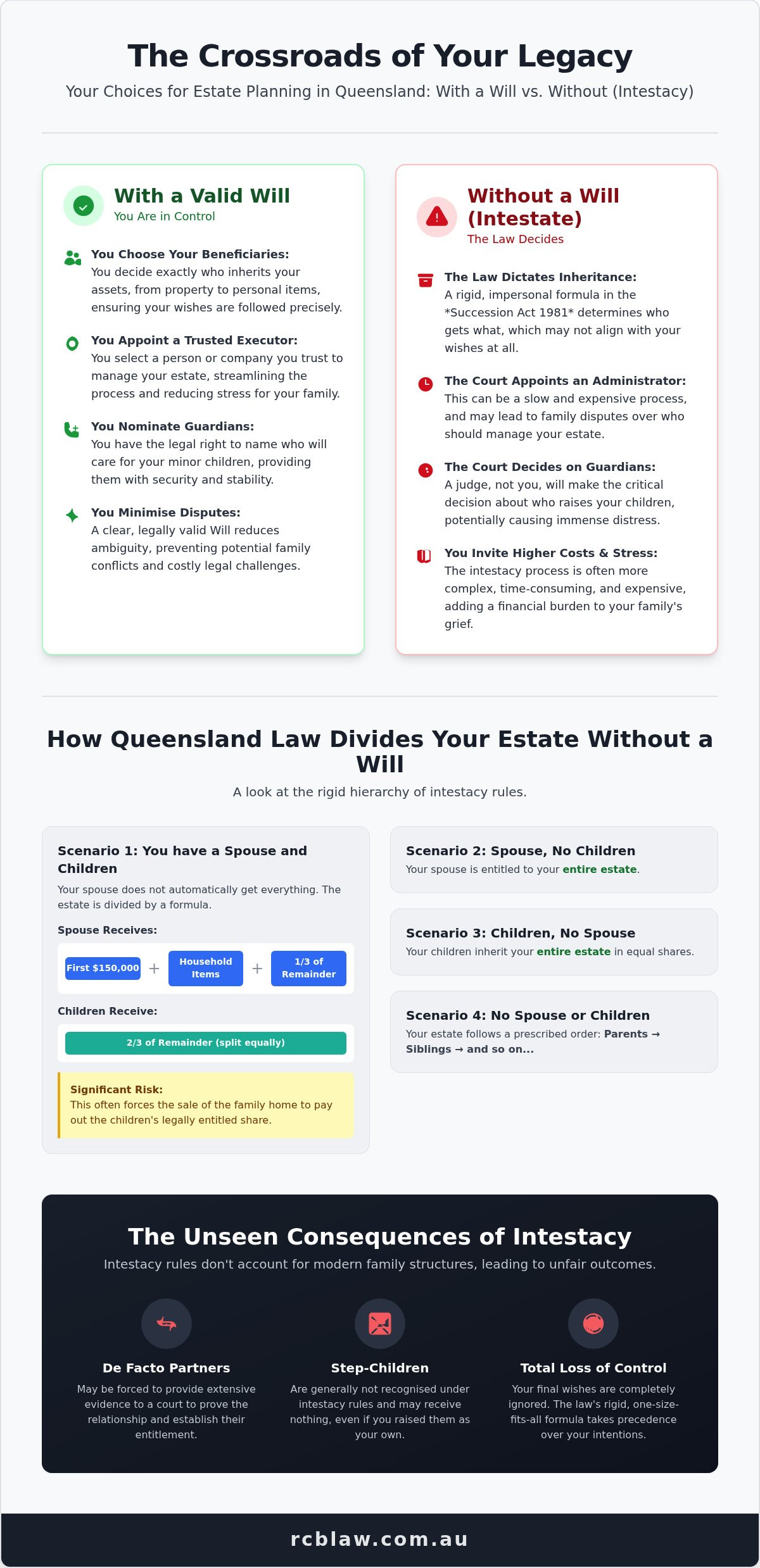
When a person passes away without a valid Will in Queensland, they are said to have died 'intestate'. This is a situation we see all too often, and it can create significant stress and uncertainty for loved ones left behind. Instead of your wishes guiding the process, the government steps in and distributes your assets according to a rigid, predetermined formula set out in the Succession Act 1981. This legal framework doesn't account for your unique family dynamics, relationships, or intentions, turning a difficult time into a complicated legal process. Understanding the basics of estate planning in Queensland is the first step to avoiding this outcome.
How Your Assets are Distributed Under Intestacy Rules
The rules of intestacy follow a strict hierarchy that may not reflect how you would have chosen to provide for your family. Here are a few common scenarios:
- You have a spouse and children: Your spouse does not automatically receive everything. They are entitled to the first A$150,000, all household belongings, and one-third of the remaining estate. Your children receive the other two-thirds. This can force the sale of the family home to pay the children their share.
- You have a spouse but no children: Your spouse is entitled to your entire estate.
- You have children but no spouse: Your children will inherit your entire estate in equal shares.
- You have no spouse or children: Your estate passes to your parents, then your siblings, and so on, according to a prescribed list of next-of-kin.
The Hidden Costs and Stresses of Intestacy
Beyond the strict distribution formula, dying intestate introduces preventable emotional and financial burdens. Without a clear executor named in a will, the court must appoint an administrator to manage your estate-a process that can be slow, expensive, and open the door to family disputes over who is best suited for the role. Most importantly, if you have young children, you lose the opportunity to appoint a guardian, leaving that critical decision to the courts.
Losing Control of Your Legacy
Intestacy means you have no control over who benefits from your life's work. A de facto partner may have to provide extensive evidence to a court just to prove the nature of your relationship and establish their entitlement. Step-children, who you may have raised as your own, are generally not recognised under the rules and may receive nothing. Any plans you had to leave a specific gift to a close friend, a godchild, or a favourite charity will be completely disregarded.
Key Elements Every Valid Queensland Will Must Include
We understand that the idea of a formal legal document can seem intimidating. Moving from why you need a Will to what it actually contains can feel like a big step. However, a professionally drafted document is much more than a simple list of who gets what; it’s a clear set of instructions that provides security and peace of mind for your loved ones. Getting these core elements right is crucial for ensuring your wishes are respected and helps your family avoid the stressful legal complexities that can arise from dying without a will in Queensland.
Appointing Your Executor: The Most Important Job
Your Executor is the person (or people) you entrust to carry out the instructions in your Will. This is arguably the most critical appointment you will make. Their key responsibilities include:
- Locating your final Will and other important documents
- Applying for probate (the court's official recognition of the Will)
- Identifying and collecting all of your assets
- Paying any outstanding debts, taxes, and funeral expenses
- Distributing the remaining assets to your beneficiaries
You can choose a capable family member, a trusted friend, or a professional such as your solicitor. It is vital to select someone who is trustworthy, organised, and able to handle these duties during what is already a difficult time.
Identifying Beneficiaries and Distributing Assets
Your beneficiaries are the individuals or organisations who will inherit from your estate. Your assets include everything you own, such as property, money in bank accounts, shares, superannuation death benefits, and personal belongings. You can leave specific gifts (e.g., "my vintage watch to my nephew, John Smith") or distribute your ‘residuary estate’-what's left after all debts and gifts are handled-by percentage (e.g., "50% to each of my two children"). Being precise and clear in your descriptions helps prevent any confusion or potential disputes.
Appointing a Guardian for Your Children
For parents with children under the age of 18, this is one of the most essential decisions you will make in your Will. Appointing a legal guardian ensures that if the unthinkable happens, a person you know and trust will be legally responsible for your children's day-to-day care, welfare, and upbringing. This provides immense stability for your children during a time of upheaval. We always advise discussing this profound responsibility with your chosen guardian beforehand to ensure they are willing and prepared to accept the role.
Creating Your Will: DIY Kits vs. Professional Legal Advice
When deciding how to create your Will, the convenience and low cost of Do-It-Yourself (DIY) kits and online templates can be tempting. We understand the appeal of a quick, seemingly simple solution. However, this approach carries significant risks that can unfortunately create immense stress and financial hardship for your family when they are most vulnerable.
A Will is one of the most important legal documents you will ever sign. While a small saving now seems practical, it can be a costly mistake in the long run.
The Hidden Dangers of DIY and Online Wills
A generic template cannot grasp the unique complexities of your life and assets. The primary risks of using a DIY kit in Queensland include:
- Vagueness and Errors: Ambiguous language or simple mistakes can lead to family disputes or make parts of your Will unenforceable.
- Invalid Execution: Queensland has strict legal requirements for how a Will must be signed and witnessed. A minor procedural error can invalidate the entire document.
- One-Size-Fits-All Approach: These kits often fail to adequately address complex situations like blended families, self-managed super funds, business assets, or establishing trusts for vulnerable beneficiaries.
Ultimately, a small saving today could cost your estate thousands of dollars in legal fees later as your loved ones are forced to ask a court to interpret an unclear or invalid document.
The Benefits of Using a Specialist Solicitor
Engaging an experienced solicitor is an investment in certainty. It’s about ensuring your final wishes are honoured without creating a burden for your family. Professional guidance provides:
- Legally Valid Assurance: We ensure your Will is drafted, signed, and witnessed correctly according to Queensland law, guaranteeing its validity.
- Expert, Tailored Advice: We listen to your specific circumstances and provide clear, practical advice to protect your assets and provide for your beneficiaries.
- Comprehensive Planning: Our experts help you consider scenarios you may not have thought of, safeguarding your estate against potential claims or challenges.
- True Peace of Mind: Knowing your affairs are in order and your wishes are legally secure provides invaluable comfort for both you and your family.
Making the Right Choice for Your Family's Security
The decision comes down to a trade-off: a small upfront saving versus the long-term security and protection of your legacy. A professionally drafted Will can also be structured to be more tax-effective, preserving more of your hard-earned assets for your beneficiaries. Don't leave your family's future to chance. Let our experts provide the peace of mind you deserve.
Keeping Your Will Current: When and Why to Update It
Creating a Will is a vital step, but it’s not a one-time task. It is best to think of your Will as a living document that should grow and change alongside you. We understand that life is dynamic, and your final wishes should always reflect your current circumstances. Regularly reviewing your estate plan is a simple piece of legal housekeeping that ensures your assets are protected and your loved ones are cared for exactly as you intend. As a general guide, we recommend a quick review every 3-5 years, or whenever a major life event occurs.
Major Life Events That Require a Will Review
Certain personal and financial milestones can significantly impact your estate plans. It is crucial to reassess your Will after events such as:
- Marriage or a new de facto relationship: In Queensland, getting married automatically revokes any existing Will you have, unless it was made in specific contemplation of that marriage.
- Separation or divorce: While marriage revokes a Will, divorce does not. A divorce will void any gifts made to your former spouse and their appointment as executor, which can create unintended consequences for the rest of your estate.
- The birth of children or grandchildren: You will likely want to update your beneficiaries to include new family members and appoint guardians for any minor children.
- A significant change in assets: This includes buying or selling a home, acquiring a business, or receiving an inheritance that alters the structure of your estate.
How to Legally Update Your Will
When you need to make a change, there are two proper legal methods. A 'Codicil' is a separate legal document that amends a specific part of your existing Will. While suitable for very minor changes, Codicils can sometimes create confusion or get lost, complicating the administration of your estate.
For this reason, creating a completely new Will is often the safest and clearest approach. It ensures all your wishes are consolidated into one definitive document, revoking all previous versions and reducing the risk of ambiguity or a legal challenge.
Crucially, you must never handwrite changes directly onto your original document. Amending the Will yourself, such as crossing out a name or adding a note, can invalidate the entire document, leaving your estate to be handled as if you had no Will at all.
Keeping your instructions up-to-date is a straightforward process that provides lasting peace of mind. If your circumstances have changed, our team can provide clear, concise guidance to ensure your Will accurately reflects your wishes. For professional support, please contact RCB Law.
Take Control of Your Legacy with a Queensland Will
Thinking about the future can be daunting, but creating a Will is one of the most empowering steps you can take for your loved ones. As we've explored, this essential document ensures your assets are distributed precisely according to your wishes, protecting your family from the stress and uncertainty of Queensland's intestacy laws. It provides absolute clarity during a difficult time, preventing potential disputes and ensuring the people you care about are looked after.
Navigating the legal requirements doesn't have to be complex. With over 30 years of legal experience, the team at RCB Law provides specialist advice tailored specifically for Queenslanders. We offer reassuring, clear, and practical guidance to help you craft a legally sound will that secures your legacy and provides you with complete peace of mind.
Secure your family's future. Contact RCB Law for a confidential discussion about your Will. Taking this important step today is a profound act of care for the ones you love.
Frequently Asked Questions
How much does it cost to make a Will in Queensland?
The cost of preparing a Will in Queensland varies. While DIY kits are inexpensive, they can lead to costly errors. A professionally drafted Will from an experienced solicitor typically ranges from A$400 to A$800 for a straightforward document. For more complex situations involving trusts or businesses, the cost will be higher. Investing in professional advice ensures your Will is legally sound and accurately reflects your wishes, providing peace of mind and preventing future complications for your loved ones.
Can my Will be challenged or contested after I die?
Yes, even a legally valid Will can be challenged in Queensland. A challenge may occur if someone believes the Will-maker lacked mental capacity or was unduly influenced. More commonly, an eligible person (such as a spouse, child, or dependent) can make a 'family provision application' if they feel they were not adequately provided for. A carefully structured, professionally drafted Will can significantly reduce the risk of a successful challenge by clearly outlining your intentions and addressing potential claims.
Do I need a lawyer to witness my Will for it to be valid?
No, a lawyer does not need to be one of the witnesses for your Will to be valid in Queensland. However, the signing requirements are very strict. You must sign in the presence of two witnesses, who must also sign in your presence. Crucially, these witnesses cannot be beneficiaries in the Will. Having a solicitor oversee the signing process is highly recommended to ensure all legal formalities are met correctly, preventing your Will from being invalidated due to a simple mistake.
What happens to my superannuation and life insurance when I die?
Superannuation and life insurance policies generally do not form part of your estate and are not automatically controlled by your Will. These assets are managed by the trustee of your super fund. To direct where these funds go, you must complete a 'Binding Death Benefit Nomination' (BDBN) with your fund. Without a valid BDBN, the trustee has the discretion to decide which of your dependents receives the payout, which may not align with your wishes.
Where is the best place to store my original Will?
Your original Will is a vital legal document and should be stored somewhere safe yet accessible. Storing it with your solicitor in their safe custody facility is an excellent option, as is a bank safe deposit box. While you can keep it at home, it risks being lost, damaged in a fire or flood, or accidentally discarded. Most importantly, ensure your executor knows exactly where to find the original document to avoid stressful delays and complications when the time comes.
What is the difference between a Will and an Enduring Power of Attorney?
These are two distinct but equally important estate planning documents. A Will only takes effect after you pass away, outlining how your assets are to be distributed. An Enduring Power of Attorney (EPOA) operates while you are still alive but have lost the mental capacity to make your own decisions. It appoints a trusted person to manage your financial, personal, and health matters on your behalf. One prepares for after your death, the other for during your lifetime.
Is a Will made online or from a post office kit legally binding?
A Will from a kit or online service can be legally binding, but only if it is completed and signed perfectly according to strict legal requirements. The primary risk is that these generic templates often fail to address your unique personal and financial circumstances. Simple errors in wording or witnessing can invalidate the entire document or invite a legal challenge, creating significant stress and expense for your family. Professional guidance ensures your Will is robust, valid, and tailored to your specific needs.


