
Could agreeing to fence work before the facts are clear leave you facing an avoidable cost or a more difficult neighbour dispute? If the disagreement involves a leased commercial site, a commercial lease lawyer sunshine coast businesses consult can help clarify what the lease says about responsibilities between landlord and tenant. Those terms are separate from the Queensland rules for dividing fences.
It’s understandable to feel unsure about who is responsible, whether proposed work is reasonable, or how to respond to a notice. A calm, evidence-led approach can help you understand the issue before discussions escalate. The next step depends on what is disputed: the boundary, the existing fence, the proposed work, or the documents exchanged.
This guide explains what to check before agreeing to work, what evidence may help clarify the disagreement, and how Queensland’s notice and dispute-resolution pathways operate. It also explains when legal advice may help you weigh your options. RCB Law advises on commercial and retail leases for landlords and tenants, as well as property and business law in Queensland.
Key Takeaways
- Work out whether the disagreement concerns a dividing fence or the land boundary, as the issue can affect which options are relevant.
- Keep a clear record of dates, conversations, photos, quotes and proposed work to make the situation easier to assess.
- Compare direct discussion, facilitated resolution, legal advice and formal determination to choose a proportionate next step.
- If the property is leased for business, a commercial lease lawyer sunshine coast businesses consult may help clarify how lease terms relate to responsibilities between landlord and tenant.
- Separate urgent safety or property-protection concerns from ordinary disagreements, then consider whether tailored legal guidance would help clarify your options.
Fence disputes on the Sunshine Coast: what is actually in dispute?
A fence disagreement can seem straightforward: one neighbour wants repairs, while the other questions the price or design. Before deciding who should act or pay, identify the actual issue. Is it about maintaining or replacing a dividing fence, or are you disputing where the property boundary lies? These questions can involve different evidence and legal considerations.
A dividing-fence dispute is a disagreement about a fence that separates neighbouring properties, including its repair, replacement, position, design or cost. Common points of conflict include whether a fence needs work, which materials or height are appropriate, whether proposed work crosses the boundary, and how expenses should be shared. Responsibility isn’t automatic. It depends on the circumstances and the applicable Queensland rules.
When is a disagreement about the fence also a boundary issue?
A fence’s physical position and the legal boundary aren’t necessarily the same. Relevant property information, such as title and survey records, can help identify the boundary. An existing fence provides context, but its age or long-standing position alone may not establish the precise legal line.
If either neighbour says the fence is misplaced, avoid treating an assumption as a settled boundary. Check the available title and survey information before making a precise claim or agreeing to move the fence. If the records don’t resolve the issue, further professional assessment may be needed. Clarifying the location first can help prevent a repair discussion from becoming a broader boundary dispute.
Which Queensland rules may apply to dividing fences?
The Neighbourhood Disputes (Dividing Fences and Trees) Act 2011 (Qld) is the main Queensland statute relevant to dividing-fence disputes. It addresses matters including fencing work and contributions. The Act uses a broad concept of a fence, which can include more than a conventional timber or metal structure. Whether a particular feature falls within the rules depends on its circumstances.
The Act doesn’t mean every neighbour must automatically pay half of any amount proposed, or that one fence height or material is right for every property. The condition and type of fence, the work proposed and the relevant legal requirements all matter. A retaining wall, for example, isn’t generally treated as a dividing fence under the Act, although its connection to fence work can complicate a particular dispute.
Some disputes also raise questions about a high or deliberately obstructive structure. The general term spite fence describes a fence built to annoy or obstruct a neighbour, but that description alone doesn’t determine the outcome under Queensland law.
For a commercial property, lease terms may affect responsibilities between landlord and tenant. They don’t, by themselves, settle the adjoining owners’ obligations under fencing law. A commercial lease lawyer sunshine coast businesses consult can help interpret the relevant lease terms. RCB Law advises landlords and tenants on commercial and retail leases, which can help clarify the lease issues alongside the separate fence dispute.
Before work begins: clarify responsibility, evidence, and communication
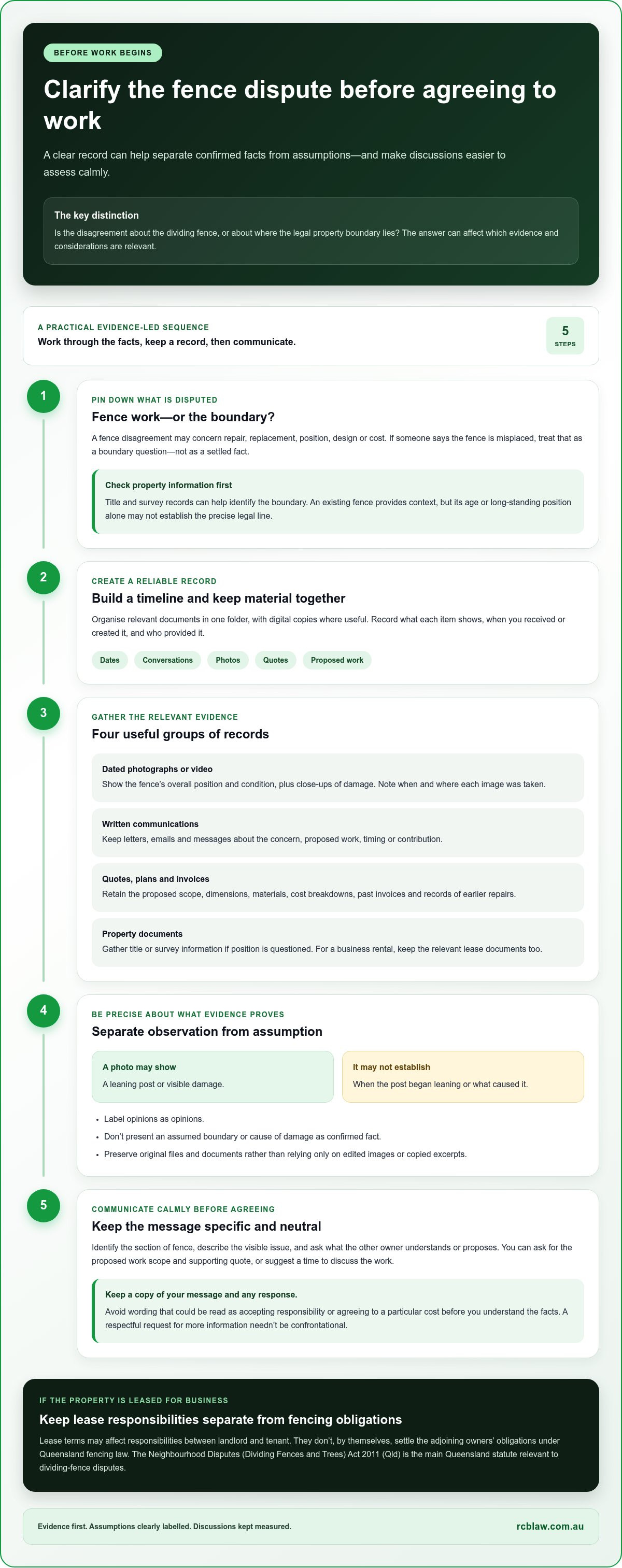
Before agreeing to a fence repair, replacement or contribution, create a reliable record of what has happened and what’s proposed. A timeline and organised documents can help separate confirmed facts from assumptions, making it easier to discuss the issue calmly or seek advice.
What evidence should you gather about a fence dispute?
Keep the material together in one folder, with digital copies where useful. Record what each item shows, when you received or created it, and who provided it. Relevant information may include:
- Dated photographs or video: Capture the fence’s overall position and condition, as well as close-ups of damage. Note the date and where each image was taken.
- Written communications: Save letters, emails and messages about the concern, proposed work, timing or contribution.
- Quotes, plans and invoices: Keep any scope of work, dimensions, materials, cost breakdowns, past invoices and records of earlier repairs.
- Property documents: Gather relevant title or survey information if the fence’s position is questioned, and lease documents if the property is rented for business.
Be precise about what the evidence establishes. A photograph may show a leaning post, for example, but not necessarily when it began leaning or what caused it. Label opinions as opinions, and don’t present an assumed boundary or cause of damage as confirmed fact. Preserve original files and documents rather than relying only on edited images or copied excerpts.
How can neighbours discuss the issue without escalating it?
A measured written message can describe the concern and invite a practical conversation. Keep it specific and neutral: identify the section of fence, describe the visible issue, and ask what the other owner understands or proposes. You could suggest a time to discuss the work or ask for the proposed scope and supporting quote. Keep a copy of your message and any response.
Avoid wording that could be read as accepting responsibility or agreeing to a particular cost before you understand the facts. A respectful request for more information needn’t be confrontational. You can acknowledge receipt of a proposal while making clear that you’re reviewing it, rather than agreeing to proceed.
Don’t assume each neighbour must pay an equal share, or that an informal message meets any formal notice requirement. Requirements depend on the issue and applicable law. For a proposed contribution, check the process under the Neighbourhood Disputes (Dividing Fences and Trees) Act 2011 before relying on a particular notice or starting disputed work.
If the property is leased, the lease may also be relevant to maintenance responsibilities between landlord and tenant. A commercial lease lawyer sunshine coast businesses consult can help interpret those terms alongside the fence records. RCB Law provides commercial property law advice to help landlords and tenants understand their lease documents.
Informal agreement, mediation, or legal advice: compare your options
There isn’t one best route for every fence disagreement. If communication is safe and both neighbours are willing to engage, a direct conversation may resolve a practical issue. Where positions have hardened, an independent facilitator or legal advice may help clarify the choices. Formal determination is another possibility, but it involves a defined process and may not suit every dispute.
Getting legal advice doesn’t mean you’re committing to a tribunal or court. Advice can help you understand the documents, identify questions that need resolving and decide whether a conversation, mediation or formal step is proportionate. The right approach depends on the facts, the outcome sought and the current rules.
| Option | When it may suit | Purpose and limits |
|---|---|---|
| Direct discussion | Communication is constructive and the disagreement is specific. | Lets neighbours explore a practical agreement. It may not settle a disputed boundary or clarify legal responsibilities. |
| Facilitated resolution | Neighbours are willing to engage but struggle to reach agreement alone. | A neutral facilitator can support a focused discussion. Participation doesn’t guarantee agreement or determine legal rights. |
| Legal advice | Responsibility, documents, proposed costs or legal obligations are unclear. | Helps assess the position and possible next steps. Advice is based on the available information and doesn’t itself resolve the dispute. |
| Formal determination | Other efforts haven’t resolved an issue that falls within a tribunal’s jurisdiction. | A decision-maker may determine matters within their authority. Eligibility, procedure and possible outcomes depend on current law and the dispute. |
When might neighbours try to reach an agreement directly?
A direct conversation can be sensible when both parties can discuss the issue calmly and the scope of work is clear. Focus on the practical points: what work is proposed, when it might happen, and how any contribution is understood. Put any agreement in writing so each person can refer to the same terms. An informal agreement may still leave a separate boundary question or legal issue unresolved.
When may Queensland legal advice or formal resolution help?
Consider getting advice if responsibility remains disputed, the boundary is contested, work is threatened or discussions have stalled. For a contribution to fencing work, Queensland’s process includes a formal Notice to Contribute for Fencing Work, with at least one quote. The recipient has one month to respond; if there’s no agreement, an application to QCAT must be made within two months of the notice being given. Check the current requirements before acting.
QCAT can hear dividing-fence disputes up to a value of A$25,000. Applications over A$1,500 require mediation as a first step under the current process. Whether QCAT is the right forum depends on the type and value of the claim, and procedural rules can change. Where landlord and tenant responsibilities overlap with the neighbour dispute, a commercial lease lawyer sunshine coast businesses consult can help assess the lease documents. No pathway guarantees agreement or a particular result.
A practical checklist for deciding your next step
A clear sequence can make a fence disagreement feel more manageable. Start by pinning down the issue, then decide whether it needs a practical conversation, technical clarification or legal guidance. The right response depends on what’s disputed and whether proposed work creates an immediate concern.
- Define the issue. Is the concern about damage, proposed work, contribution, fence position or a separate boundary question? Keep separate issues distinct.
- Collect the records. Bring together relevant photographs, correspondence, quotes, plans and property documents. Note dates and identify what each item does and doesn’t establish.
- Communicate clearly. If it’s safe and constructive, ask the other owner to explain their position or proposed work. Keep the tone neutral and retain a copy of the exchange.
- Assess urgency. A routine disagreement about materials differs from a visibly unstable structure or work that may soon alter the property. Prioritise immediate safety and property-protection concerns, and avoid putting yourself at risk.
- Consider advice. If responsibility is unclear, discussions have stalled, or there’s a deadline or proposed work you’re unsure how to respond to, get advice on the available options.
Organised records help a lawyer assess a property dispute more efficiently. They make it easier to identify what’s known, what remains uncertain and which questions need attention first.
What should you prepare before seeking legal advice?
Prepare a short timeline, the other owner’s contact details, relevant photographs and copies of key messages or letters. Include any quote, plan, notice or proposed work date. Write down the outcome you hope to achieve, such as clarifying responsibility or resolving a disagreement about the scope of work. List your questions, and label unverified details as assumptions rather than facts.
If the boundary itself is in question, gather available title and survey information. A survey or other technical assessment may help clarify the location if existing records and the fence’s position don’t answer the question. It isn’t necessary in every dispute; its usefulness depends on what’s contested. Keep any technical findings with the rest of your records.
How do you decide whether the matter needs further help?
Consider further guidance if communication has stopped, work appears imminent, the disagreement affects access or use of the property, or a written notice raises questions you can’t confidently answer. If the property is leased, the lease may also be relevant to responsibilities between landlord and tenant. A commercial lease lawyer sunshine coast businesses consult can help explain the lease terms alongside the wider property circumstances.
Formal proceedings aren’t inevitable. The appropriate next step depends on the evidence, the issue in dispute and current Queensland requirements. If you’re uncertain how to respond or what a document means, seek property-law guidance before deciding how to proceed.
Getting clear, local property-law guidance on a Sunshine Coast fence dispute
A fence disagreement can involve more than the structure itself. There may be questions about documents, responsibility for proposed work, a lease, the legal boundary or how to respond. Property-law advice can help organise those questions, explain how the relevant Queensland framework may apply and identify practical next steps. It can also help you understand potential risks without assuming that formal proceedings are necessary.
For commercial premises, the lease may set out responsibilities between landlord and tenant, while the dividing-fence issue may involve neighbouring owners as well. A commercial lease lawyer sunshine coast business owners consult can help interpret lease terms in context. RCB Law advises landlords and tenants on commercial and retail leases. The appropriate response depends on the documents, the facts and what you’re hoping to achieve.
How can property-law advice help with a neighbour fence disagreement?
A lawyer can review relevant correspondence, notices, property documents and lease terms, then help identify what’s clear and what still needs investigation. Legal guidance can explain the issues and possible options, but it isn’t a technical boundary assessment. If the precise location of a boundary is disputed, a surveyor’s technical opinion may be useful. The right next step depends on the evidence and your objectives.
That distinction matters. A survey may help clarify where a boundary lies, while legal advice can help you understand the significance of that information and how it relates to the disagreement. If the issue is about the scope of repairs or a proposed contribution rather than location, different documents and questions may be more relevant.
What happens when you contact RCB Law?
You can outline what has happened, what the other owner or landlord has proposed, and what you’re uncertain about. Sharing relevant records, such as correspondence, photographs, notices, lease documents or survey information, can help frame the discussion. You don’t need to arrive with every answer. A clear account of the issue and the outcome you want can help focus the conversation.
RCB Law serves clients across the Sunshine Coast and Brisbane, with more than 30 years of experience across Queensland residential, commercial and business law. The firm’s experience can help put relevant lease and property documents into context, while recognising that each dispute has its own facts. Advice can clarify options, not guarantee a particular result.
If you’re unsure how a lease or property document affects your next step, discuss the circumstances and relevant records with RCB Law. Discuss your property-law matter with RCB Law.
Take a clear next step with confidence
A fence disagreement doesn’t have to define your relationship with a neighbour or become the only focus of your property plans. Start by deciding what a workable outcome looks like for you, whether that means understanding a proposed repair, clarifying responsibilities or protecting the use of the property. Keeping that goal in view can help you make measured decisions.
If a commercial lease is part of the picture, a commercial lease lawyer sunshine coast property owners consult can help explain how the lease relates to the wider issue. Legal guidance can help you weigh the relevant documents and options without assuming that one approach suits every dispute.
RCB Law advises on commercial and retail leases for landlords and tenants, as well as Queensland residential, commercial and business law. Discuss your property-law matter with RCB Law to consider your circumstances and next steps.
Frequently Asked Questions
Can my neighbour make me pay for a new dividing fence?
Not automatically. Whether you may need to contribute depends on the circumstances and the current Queensland law, including the work proposed and any formal notice received. Before agreeing to pay, check the Neighbourhood Disputes (Dividing Fences and Trees) Act 2011 (Qld), the notice and supporting information, and how they relate to your situation. Keep relevant messages and documents, and seek tailored advice if you and your neighbour disagree about responsibility or the proposed amount.
Can I replace a fence without my neighbour’s agreement in Queensland?
There isn’t a blanket yes or no. The answer can depend on the fence, the work proposed and the circumstances, as well as applicable statutory requirements. Before arranging replacement, write down the proposed scope, materials, location and timing, and retain any plans or quotes. If your neighbour disputes the position, cost or responsibility, check the current Queensland requirements and understand the implications before work begins.
What happens if my neighbour refuses to discuss a fence dispute?
If your neighbour won’t engage, keep a calm record of your attempts to communicate, including when and how you contacted them. Save any reply, even if it doesn’t resolve the issue, and gather documents that explain the proposed work or disagreement. Further options may be available, including formal processes for some disputes, but the suitable route depends on the issue and current Queensland procedures. A tribunal application isn’t automatic or necessarily the first step.
How do I know if the fence is on the legal boundary?
The visible fence line doesn’t, by itself, prove the legal boundary. Title documents and existing plans may offer useful context, but they might not answer the precise location question. If the line is contested, a qualified surveyor may need to assess the land using appropriate information. This is a technical boundary issue, distinct from arguments about repairing a fence or sharing work costs. Avoid making a firm claim about a parcel without reliable evidence.
Can a fence dispute be resolved without going to court?
Yes, some neighbours reach an agreement through direct discussion or another resolution option, depending on the circumstances. No approach guarantees agreement, and an informal arrangement may leave a boundary or legal question unresolved. If you do agree, record the scope of work, timing and any contribution in writing so the terms are clear. If communication has stalled, check the current Queensland pathways before deciding what to do next.
Does the Queensland dividing-fence law cover trees as well as fences?
Queensland has legislation addressing neighbourhood disputes about both dividing fences and trees: the Neighbourhood Disputes (Dividing Fences and Trees) Act 2011 (Qld). The provisions and possible processes differ according to the issue, so a tree-related concern shouldn’t automatically be treated like a fence dispute. Check the current Act and relevant guidance before acting. The applicable rules depend on the particular circumstances, and general information can’t determine how they apply to an individual tree or property.
What should I bring when seeking advice about a fence dispute?
Bring a brief timeline, dated photographs, relevant correspondence, plans or survey information, and records of earlier repairs or proposed work. Include any notice or quote you’ve received, plus details of approaching dates or scheduled work. Write down the outcome you’re seeking and the questions you need answered. If a business tenancy is involved, a commercial lease lawyer sunshine coast clients consult will need relevant lease documents to understand the property arrangements.


