
A commercial lease is more than paperwork. It can shape your business costs, flexibility and stability for years. When you’re committing to Brisbane premises, a commercial lease lawyer Brisbane businesses trust can help identify unclear terms before they become costly problems.
It’s understandable to feel uneasy about hidden outgoings, maintenance obligations or a “standard” agreement that doesn’t fit your business. Retail shop leases also have specific requirements under the Retail Shop Leases Act 1994, while Queensland’s leasing laws have changed. Understanding which rules apply and what the lease requires can help you make an informed decision before signing.
RCB Law provides practical guidance on commercial and retail leasing, backed by more than 30 years of Queensland property law experience. This article explains protections to consider, how disclosure requirements may apply, and what to look for in clauses covering rent, outgoings, repairs and lease changes. The aim is to give you greater clarity as you assess a long-term commitment.
Key Takeaways
- A commercial lease lawyer Brisbane businesses engage can help align lease terms with business plans and flag risks before you commit.
- Understanding whether a lease falls under retail or general commercial leasing law helps clarify which requirements and protections may apply.
- Review the lease term, renewal options and rent review clauses to understand how they may affect your business over time.
- Starting with the letter of offer or heads of agreement can help settle important terms before they are carried into the formal lease.
- RCB Law brings more than 30 years of Queensland property law experience to commercial leasing matters in Brisbane and the Sunshine Coast.
Why Choosing a Commercial Lease Lawyer in Brisbane Matters
A commercial lease shapes more than where your business operates. Its terms can affect cash flow, day-to-day responsibilities and how you leave the premises or transfer the lease later. A commercial lease lawyer Brisbane businesses engage can explain the legal and commercial effect of proposed terms, identify points for negotiation and help ensure the agreement reflects your circumstances.
A lease is a contractual arrangement between parties, but a generic template may not address the specific property, business use or risks involved. Terms covering outgoings, repairs, permitted use, alterations and make-good obligations all shape your practical and financial commitments. For landlords, the lease should clearly set out the agreed responsibilities. For tenants, the same clauses determine what they may have to pay for or restore.
The Risks of Unreviewed Commercial Agreements
Some obligations are easy to overlook in a long document or one presented as standard. A clause may leave a tenant responsible for particular maintenance or costs, or restrict changes the business later needs to make to the premises. Reviewing these provisions before signing gives both parties a clearer view of their responsibilities and a chance to address terms that don’t match the commercial agreement.
Plan for the end of the lease from the beginning. Assignment, subletting, expiry and make-good terms can affect how a business responds to changing needs or hands over a site. A commercial lease lawyer can help identify and clarify potential areas of dispute before the parties commit.
A Reassuring Guide Through Complex Legal Transitions
Signing a lease often coincides with other high-pressure decisions, such as fitting out premises, relocating staff or opening a new business. Clear legal advice helps you understand what the agreement requires and gives landlords and tenants a steadier footing in negotiations. A small change in wording can affect future obligations.
Queensland leases sit within a specific legal framework. The Property Law Act 2023 introduced changes affecting commercial leases, while retail shop leases may also be subject to the Retail Shop Leases Act 1994. Reviewing a lease means understanding which rules apply, not just reading its clauses in isolation.
RCB Law brings more than 30 years of Queensland property law experience to commercial leasing for landlords and tenants. The team explains legal language in direct, practical terms, so you can understand the implications, consider your options and work through the paperwork with greater confidence.
Commercial vs. Retail Shop Leases: Navigating QLD Law
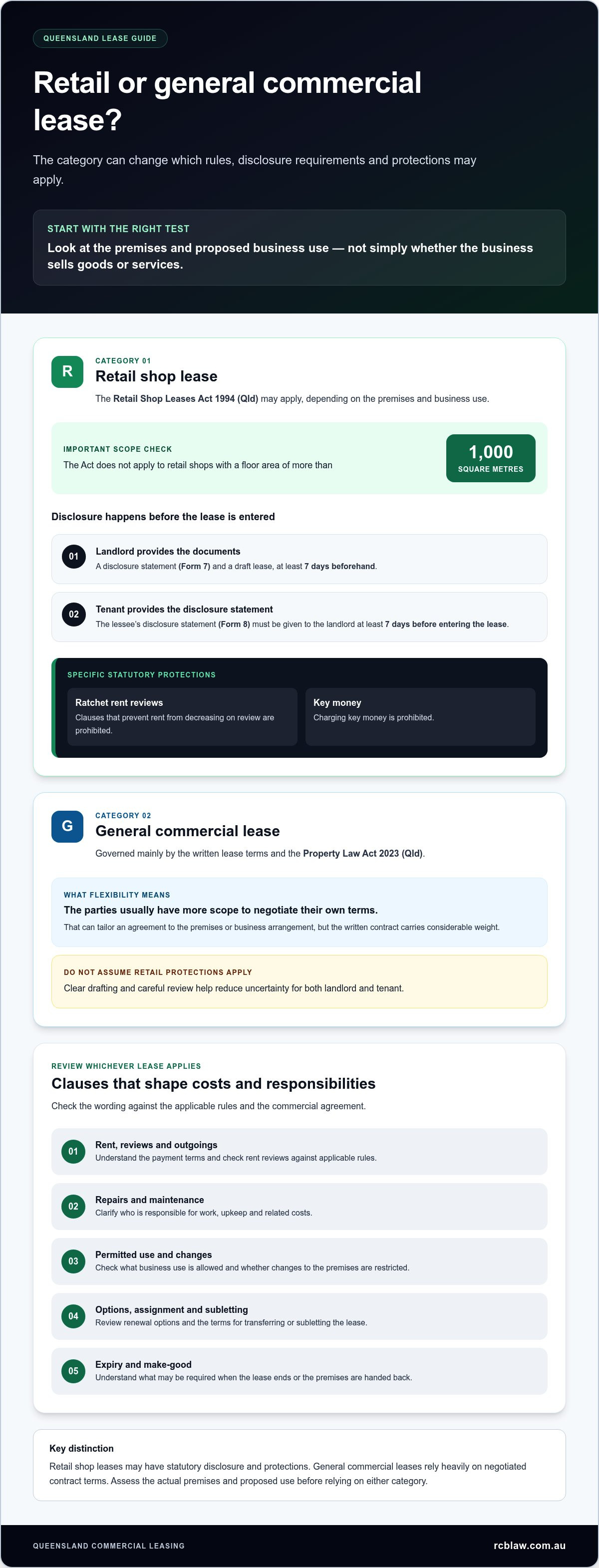
Not every business premises is covered by the same rules. In Queensland, a lease may be a retail shop lease under the Retail Shop Leases Act 1994 (Qld), or a general commercial lease governed mainly by the lease terms and the Property Law Act 2023 (Qld). The distinction matters because it can affect disclosure, rent reviews, outgoings and the protections available to each party.
Whether the Act applies depends on the premises and the business use, not simply on whether a business sells goods or services. The Act does not apply to retail shops with a floor area of more than 1,000 square metres. Assess the actual premises and proposed use before relying on retail lease protections. A commercial lease lawyer Brisbane businesses work with can help identify the relevant category and explain its consequences.
Key Protections Under the Retail Shop Leases Act
Disclosure is a central safeguard. Before a retail lease is entered into, the landlord must provide the tenant with a disclosure statement (Form 7) and a draft lease at least seven days beforehand. The tenant must also give the landlord a lessee’s disclosure statement (Form 8) at least seven days before entering the lease. Reviewing these documents together can help reveal costs and obligations that might otherwise be easy to miss.
The Act also limits certain lease practices. For example, it prohibits “ratchet” rent review clauses that prevent rent from decreasing on review, and prohibits charging key money. Outgoings, rent reviews and option periods still need careful review against the applicable rules and lease wording. A dispute can add pressure to an already demanding business relationship. The Queensland Small Business Commissioner explains the available commercial leasing dispute resolution process.
General Commercial Leases: Greater Flexibility, Greater Risk
General commercial leases usually give the parties more scope to negotiate their own terms. That flexibility can help tailor an agreement to a particular premises or business arrangement, but it also means the written contract carries considerable weight. Don’t assume retail protections apply automatically. Clear terms for rent, outgoings, repairs, permitted use, assignment and lease options help reduce uncertainty for both landlord and tenant.
- Retail shop lease: statutory disclosure and specific protections may apply, depending on the premises and use.
- General commercial lease: negotiated contract terms play a central role, so careful review and drafting are essential.
Lease decisions can form part of a wider property transaction, so it can be useful to understand the steps in commercial conveyancing in Queensland. RCB Law provides commercial leasing advice for landlords and tenants, helping clarify the rules and practical effect of proposed terms. For commercial leasing legal guidance, the firm provides support through the process.
Critical Lease Clauses: Protecting Your Interests in 2026
The most important lease terms are often the ones that shape your costs and choices years after signing. In Queensland, the Property Law Act 2023 introduced changes affecting commercial leases from 1 August 2025, so consider both current law and the wording of the agreement. A commercial lease lawyer Brisbane landlords and tenants rely on can help clarify how each clause works in practice.
Term, Options and Rent Reviews
Compare the lease term with your business plans, including how long it may take to establish the premises and whether you need certainty beyond the initial period. An option to renew can offer continuity, but only if you understand its conditions and exercise deadline. Missing a notice window could affect your ability to stay at the site.
Rent review clauses may use CPI, fixed increases or a market review. Each method affects future rent differently. Read the formula, timing and process carefully, including how a market review is handled if the parties disagree. For retail shop leases, Queensland law prohibits ratchet clauses that prevent rent from decreasing on review.
Financial Obligations and Outgoings
A gross lease generally includes some property expenses in the rent, while a net lease may require the tenant to pay specified outgoings in addition. The lease wording determines what applies. Check how a tenant’s proportionate share is calculated, which expenses are included, and how changes in the premises or occupancy affect that share. Under standard terms incorporated by the Property Law Act 2023, a tenant may be responsible for a proportional share of the landlord’s taxes and rates unless the lease specifies otherwise.
Make sure the agreement explains what supporting information is available and how building management and insurance costs are treated. Precise categories and calculation methods make it easier to understand what you’re agreeing to pay.
Maintenance, Make Good and Disputes
Maintenance clauses should distinguish routine upkeep from repairs and identify who is responsible for each obligation. The make-good clause deserves particular attention: it sets out the condition the premises must be in when the lease ends and which alterations or fittings must be removed. Clear requirements at the start can reduce uncertainty at handover.
If a breach occurs, the consequences and available steps depend on the lease terms and applicable law. Don’t assume every breach has the same notice or remedy process. QCAT can deal with retail shop lease disputes, while the appropriate pathway depends on the dispute and the legislation that applies. A dispute-resolution clause can set out practical steps, such as discussion or mediation before court proceedings, where suitable.
Careful review brings connected obligations into focus before they become urgent. RCB Law provides commercial lease legal advice to help landlords and tenants understand their rights, responsibilities and options.
The Step-by-Step Negotiation Process for Brisbane Businesses
A clear process helps landlords and tenants move from early discussions to a lease that records the deal they intend to make. Work through the key terms before signing and keep a written record as negotiations develop. This makes it easier to spot gaps before they become obligations.
1. Start with the Letter of Offer or Heads of Agreement
Review the Letter of Offer or Heads of Agreement, not just the final lease. These documents may set out core terms such as rent, lease length, options, permitted use, incentives and responsibility for fit-out work. Don’t assume a document is harmless simply because it’s described as “non-binding”. Its wording and the parties’ conduct matter, so get advice on what has been agreed and what remains open to negotiation.
For tenants, this is the time to raise practical needs such as a rent-free period or fit-out contribution. Landlords can clarify the scope, timing and conditions attached to any incentive. Record every agreed concession and verbal promise in writing, then check that it appears accurately in the final lease. If the lease omits a promise, relying on an earlier conversation may create uncertainty later.
2. Conduct due diligence on the premises and parties
Before committing, confirm that the premises and proposed permitted use suit the business. Review the property description and boundaries, and consider whether access, shared areas or restrictions could affect how the space can be used. Check that the proposed landlord or tenant details match the parties named in the lease, and identify any approvals or information needed before signing.
Property records can also reveal interests that affect use or access. A caveat or easement, for example, may be relevant to how a property can be dealt with or used. RCB Law’s plain-English guide to Queensland caveats explains this type of property encumbrance.
3. Mark up, negotiate and finalise the lease
Once the draft arrives, compare it with the heads of agreement and due diligence findings. A commercial lease lawyer Brisbane businesses engage can identify missing terms, draft amendments and explain their practical effect. Resolve inconsistencies before signing rather than assuming they can be fixed later.
- Tenant focus: confirm incentives, permitted use, access and responsibilities match the business plan.
- Landlord focus: ensure agreed conditions, payment obligations and use restrictions are clearly recorded.
Before signing, check that the final version includes all agreed changes, the correct parties and property details, and all required signing steps. RCB Law guides landlords and tenants through lease negotiation and documentation. Get legal guidance on your commercial lease before finalising the agreement.
How RCB Law Supports Your Commercial Leasing Journey
A commercial lease can affect your business long after the paperwork is signed. RCB Law provides legal guidance for landlords and tenants, making complex terms easier to understand and decisions more manageable. The firm has more than 30 years of experience in Queensland property law, with a local presence in Brisbane and the Sunshine Coast.
A Steady Guide Through High-Pressure Transitions
Taking on premises or leasing commercial property can involve tight timelines, significant commitments and unfamiliar language. RCB Law explains what the lease says, how its terms may affect you and which points may need attention. That guidance can help you approach negotiations with a clearer understanding of your options.
Commercial leasing sits within Queensland’s property law framework, and retail leases can raise additional questions under the Retail Shop Leases Act 1994. RCB Law advises on commercial and retail shop leasing, drawing on its Queensland experience to support Brisbane businesses through the legal details. The firm’s work includes advising on Brisbane shop and office leases, where permitted use, outgoings, fit-out responsibilities and lease-end obligations can all affect the arrangement.
Property Experience Beyond the Lease
Leasing decisions may connect with wider property matters, such as acquiring or disposing of a business premises. RCB Law’s property experience also spans residential conveyancing and commercial property law. For a plain-English overview of the wider transaction process, read this guide to conveyancing in Queensland.
Get Advice Early and Move Forward with Clarity
Seeking advice while terms are still being discussed can help identify issues before they make their way into the final lease. An early review may also help avoid time-consuming amendments later. Gather the draft lease and any Letter of Offer or Heads of Agreement, then discuss your priorities and questions with RCB Law.
If you’re looking for a commercial lease lawyer Brisbane businesses can turn to for clear, supportive guidance, RCB Law can assist with your leasing matter. Contact RCB Law to discuss your commercial lease.
Move Forward with Greater Lease Confidence
A well-understood lease gives your business a clearer foundation for the years ahead. Before signing, confirm which Queensland leasing rules apply, understand your obligations for rent, outgoings and maintenance, and make sure the written agreement reflects what you negotiated. Review how renewal, assignment and make-good terms may affect your future options.
Working with a commercial lease lawyer brisbane businesses can rely on helps bring clarity to complex documents and high-stakes decisions. RCB Law has more than 30 years of Queensland property law experience, a local presence in Brisbane and the Sunshine Coast, and expertise in commercial and retail leasing.
Take the next step with a clear understanding of your lease and the interests you need to protect. Discuss your commercial lease with RCB Law.
Frequently Asked Questions
What is the difference between a commercial lease and a retail shop lease in QLD?
A retail shop lease may be covered by the Retail Shop Leases Act 1994 (Qld), which provides specific disclosure requirements and tenant protections. Whether it applies depends on the premises and business use; the Act does not apply to retail shops with a floor area greater than 1,000 square metres. Other commercial leases are generally governed by the lease terms and the Property Law Act 2023 (Qld). Get advice from RCB Law about your premises before relying on particular protections.
Who is responsible for the legal costs of preparing a commercial lease?
Responsibility depends on the lease type and applicable law, as well as what the parties agree. For a general commercial lease, review any clause dealing with preparation or legal expenses rather than assuming the landlord or tenant automatically pays. Retail shop leases have statutory rules that affect which costs can be passed to a tenant. Each party may also choose to obtain independent legal advice, so clarify your own costs before proceeding.
Can a landlord refuse to renew my lease if I have an option?
A landlord generally can’t refuse a properly exercised option just because they would prefer not to renew, but the option’s wording and conditions are crucial. Check the exercise deadline, required notice method, rent-setting process and any conditions that must be met. Give notice exactly as the lease requires and keep a record. If you’re unsure how to exercise the option, seek advice from RCB Law before the deadline rather than relying on informal discussions.
What is a “Make Good” clause and why is it important?
A make-good clause sets out what you must do to the premises when the lease ends. It may address removing fit-out, repairing damage or returning the space to a specified condition. The exact obligation depends on the lease wording and any agreed starting condition. Read it before signing and document the premises’ condition at the beginning of the tenancy. Clear terms can help you plan for lease-end work and reduce disagreement at handover.
How long does the commercial leasing process typically take in Brisbane?
There’s no single timeframe for a Brisbane commercial lease. Timing depends on factors such as how quickly the parties agree on terms, the complexity of the lease, due diligence and any required approvals. Retail shop leases also have prescribed disclosure periods: the landlord must provide the disclosure statement and draft lease at least seven days before entry, and the tenant must provide their disclosure statement at least seven days before entry. Allow time for review and negotiation.
What happens if I need to end my commercial lease early?
Ending a lease early depends on the contract and the circumstances. Check for a break right, assignment or subletting provisions, and any agreed termination process before taking action. Under Queensland’s Property Law Act 2023, a landlord consent process applies to proposals such as assignment or subletting; the landlord must respond within one month after receiving all necessary details and can’t unreasonably withhold consent. Get advice from RCB Law before giving notice or leaving the premises.
Is a Disclosure Statement mandatory for all commercial leases in Queensland?
No. The statutory disclosure requirements apply to retail shop leases covered by the Retail Shop Leases Act 1994 (Qld), not every commercial lease. For a covered retail lease, the landlord must give the tenant a disclosure statement (Form 7) and draft lease at least seven days before the lease is entered into. The tenant must also provide a lessee’s disclosure statement (Form 8) at least seven days beforehand. First establish whether the Act applies to your premises and use.
Do I need a lawyer for a “standard” REIQ commercial lease agreement?
A lawyer isn’t automatically required for every general commercial lease, but a “standard” REIQ form may still contain terms with important financial and operational effects. Review clauses on rent, outgoings, repairs, permitted use, options and make-good obligations before signing. Retail shop tenants generally have additional legal and financial advice report requirements before entering a lease, unless they qualify as a major lessee. A commercial lease lawyer Brisbane businesses engage can explain the terms and identify points to address.


