
A problem discovered after settlement doesn’t automatically mean the seller broke the law. If you’re asking, “what are my rights if a seller doesn't disclose problems qld,” the answer depends on the disclosure rules that applied to your contract, the contract terms and the evidence available.
It’s understandable to worry that an undisclosed defect could mean unexpected repairs, financial loss or a missed deadline. Queensland’s seller disclosure regime, introduced on 1 August 2025, requires certain information and documents to be provided before a buyer signs a contract. That is different from a general guarantee that the property is free of physical defects, so not every problem will amount to a disclosure breach.
This article explains what sellers may be required to disclose, how prescribed information differs from the property’s physical condition, and what practical steps to take if something appears to have been left out. It also covers which records to preserve and why acting promptly can matter, particularly if settlement is approaching. RCB Law’s more than 30 years of residential conveyancing experience can help clarify the contract, disclosure documents and options relevant to your circumstances.
Key Takeaways
- To understand what are my rights if a seller doesn't disclose problems qld, first identify whether the concern relates to required disclosure, a seller’s representation or the property’s physical condition.
- Your contract date, what you already knew and the seller’s statements can all affect whether an omission gives you a legal option.
- Discovering a problem doesn’t automatically let you cancel or claim compensation. Your options depend on the law, contract terms, timing and evidence.
- Record when you found the issue and preserve the contract, disclosure documents, inspection reports, photos and communications before taking action.
- A Queensland conveyancing lawyer can review the documents and timeline to help clarify potential risks and practical next steps.
What does Queensland law require a seller to disclose about a property?
Discovering a property problem after signing can be unsettling, especially if you’re unsure whether it should have been disclosed. In Queensland, the answer depends on the applicable rules, the transaction and the evidence. Seller disclosure requires specified information and documents for relevant property sales. It isn’t a general promise that the property is free from defects or that every risk has been identified.
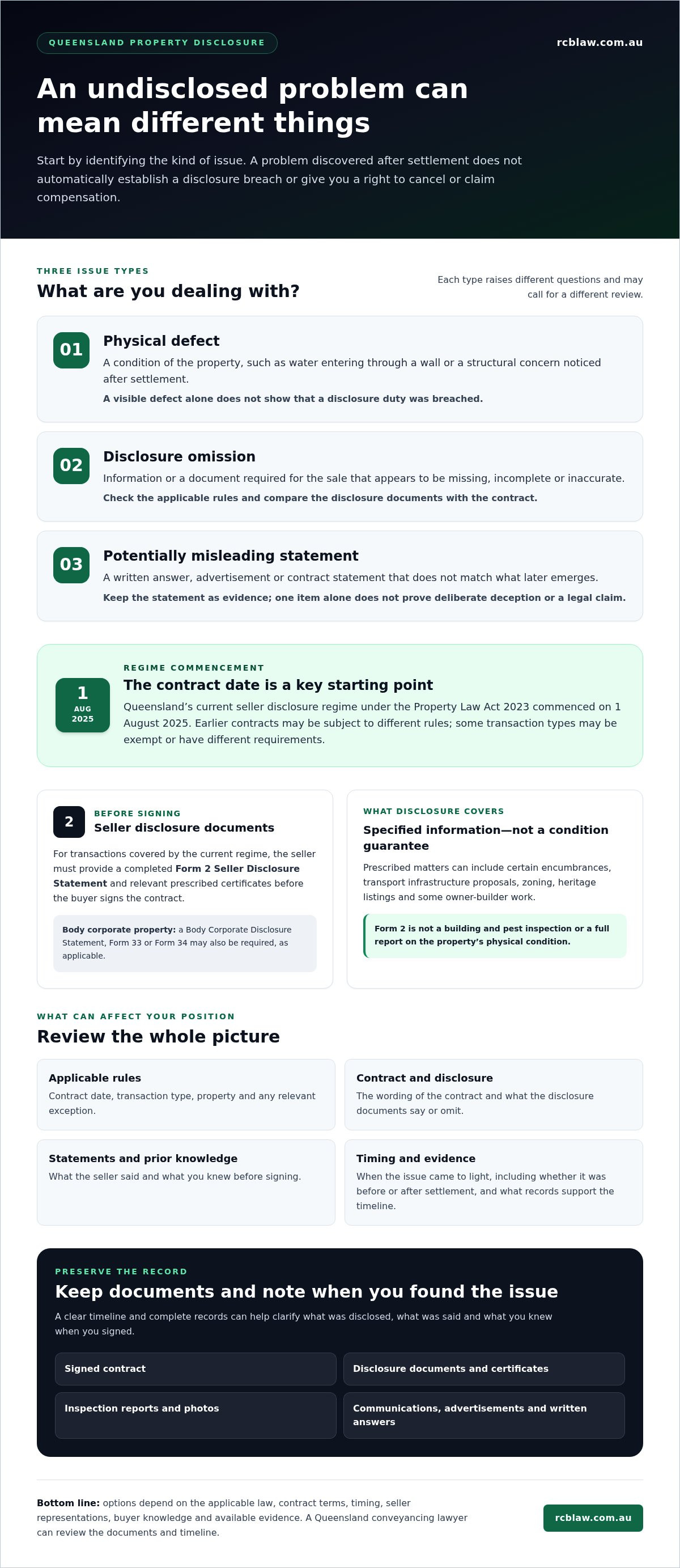
For buyers asking “what are my rights if a seller doesn't disclose problems qld,” the contract date is an important starting point. Queensland’s current seller disclosure regime under the Property Law Act 2023 commenced on 1 August 2025. The rules may differ for contracts made before that date, and some transaction types may be exempt or subject to different requirements. Don’t assume the same disclosure rules apply to every sale.
What is the Queensland seller disclosure statement?
For transactions covered by the current regime, the seller must provide a completed Form 2 Seller Disclosure Statement and relevant prescribed certificates before the buyer signs the contract. For a property in a body corporate, a Body Corporate Disclosure Statement, Form 33 or Form 34 as applicable, may also be required.
The statement covers prescribed matters, which can include certain encumbrances, transport infrastructure proposals, zoning, heritage listings and some owner-builder work. The documents required depend on the property and transaction. Form 2 is a legal disclosure document, not a building and pest inspection or a full report on the property’s condition.
Does the seller have to disclose every physical defect?
Not automatically. Prescribed disclosure focuses on specified information and documents. It doesn’t, by itself, require the seller to provide a complete inventory of every physical defect. A cracked wall or leaking roof, for example, may raise different questions from an omitted prescribed certificate or missing information in the disclosure documents.
That distinction doesn’t mean a known problem is always irrelevant. The seller’s statements, answers to direct questions, contract terms and the buyer’s knowledge may all matter. A false or misleading representation, or other conduct relating to the issue, may also affect the legal assessment. The circumstances need to be considered together.
If you find a problem, compare it with the disclosure statement, certificates and contract. Note when you signed and what you knew at the time. This helps identify whether the concern relates to prescribed disclosure, the property’s condition or something the seller said. A Queensland conveyancing lawyer can review the documents against the applicable rules and clarify which issues need prompt attention.
When can an undisclosed property problem affect your rights?
Finding a problem doesn’t, by itself, establish that the seller failed to meet a legal duty. First identify what kind of issue it is and how it relates to the sale. A missing prescribed disclosure item is different from a physical defect, and both differ from a statement that may have given you a misleading impression.
Could a problem be a defect, missing disclosure or misleading statement?
A physical defect is a condition of the property, such as water entering through a wall or a structural concern noticed after settlement. A disclosure omission is information or a document required for the sale that appears to be missing, incomplete or inaccurate. A potentially misleading statement could be a written answer, advertisement or contract statement that doesn’t match what later emerges.
These categories point to different questions and next steps. Evidence of water ingress, for example, doesn’t automatically show that the seller breached a disclosure duty. It may matter whether a prescribed item was omitted, whether the seller made a relevant statement, what the contract says and what you knew before signing. Preserve advertisements, emails, texts and written answers as evidence, but don’t treat any one item as proof of deliberate deception or a legal claim.
Why do the contract date and sale circumstances matter?
Queensland’s mandatory seller disclosure regime under the Property Law Act 2023 commenced on 1 August 2025. The contract date can help determine which rules apply. The transaction type, property and any relevant exception also matter, as does the wording of the contract. A sale that falls outside the standard requirements may need a different analysis, so the commencement date alone won’t resolve every case.
Timing can affect your practical position, too. A problem found before settlement may raise different questions from one discovered after ownership has transferred. The seller’s representations and your prior knowledge may also be relevant. Keep the signed contract and disclosure documents with a clear record of when and how the issue came to light.
Each situation turns on the applicable law, contract, transaction circumstances, timing, seller representations, buyer’s knowledge and available evidence. A visible defect is a reason to investigate, not a conclusion about wrongdoing. For broader context on the stages and documents involved in a Queensland property transaction, see this Queensland conveyancing guide.
If you’re unsure how those details fit together, advice from a Queensland conveyancing lawyer can help clarify the contract, disclosure documents and options specific to your circumstances. Explore conveyancing support.
Can you cancel the contract or claim compensation for an undisclosed problem?
Discovering a problem doesn’t automatically give you the right to cancel a property contract or receive compensation. If you’re asking “what are my rights if a seller doesn't disclose problems qld,” the answer depends on the disclosure rules that apply, the contract, when you discovered the issue and what the evidence shows.
For a covered contract under Queensland’s seller disclosure regime, a buyer may have a right to terminate before settlement if the seller failed to provide required disclosure documents or if disclosure was materially inaccurate or incomplete. Whether the issue meets the legal requirements, and whether an exception applies, must be assessed against the particular sale. If a valid termination right is exercised, the buyer may be entitled to a refund of the deposit. This isn’t an automatic result whenever a defect is found.
When might termination or another contract response be considered?
The legal basis for ending a contract may come from seller disclosure legislation, a contract term or another relevant legal principle. Each route has its own requirements. The contract may specify how notices must be given, while legislation can impose timing conditions. A right that may be available before settlement could be lost or no longer apply once settlement occurs.
If you’ve found a concern before settlement, get legal advice promptly and before withholding payment, refusing to settle or sending a termination notice. Acting on an incorrect assumption may expose you to a separate claim for failing to meet your own contractual obligations. Avoid making formal allegations about the seller until the documents and evidence have been reviewed.
Could compensation or another resolution be available?
After settlement, cancellation is generally no longer the practical contract response, but other options may be considered depending on the facts and legal basis. These could include seeking compensation or negotiating a resolution. Neither is guaranteed. The assessment may involve whether a legal duty or contractual promise was breached, whether the issue caused a loss, and whether that loss can be supported by evidence.
A repair estimate can help show the likely work involved, but it doesn’t prove by itself that the seller is legally responsible. Keep inspection findings, photographs, disclosure documents, communications and invoices, and record when the problem was discovered. The cause of the defect, its history and what was said or disclosed during the sale may all be relevant.
There may be strict deadlines or notice requirements. The applicable timeframe depends on the legal basis and circumstances. A Queensland conveyancing lawyer can review the contract, disclosure documents and evidence to help clarify your position before you take a step that may be difficult to reverse.
What should you do after discovering a seller may have withheld a problem?
Finding a possible defect can feel urgent, especially if settlement is approaching. Preserve information and understand your position before deciding how to respond. If you’re wondering “what are my rights if a seller doesn't disclose problems qld,” a clear timeline and the original sale documents can help a Queensland property lawyer assess the issue.
- Record when you discovered the problem. Note the date, what you observed and how it came to light. Avoid rushed decisions, such as withholding settlement or accusing the seller, until you understand the contract and your options.
- Preserve the sale documents. Keep the signed contract, Form 2 Seller Disclosure Statement, prescribed certificates, inspection reports and any documents provided before signing.
- Document the condition. Take dated photographs or videos, keep relevant repair assessments and record any changes. Don’t alter or discard evidence that may help show the issue’s nature or extent.
- Keep communications and make a timeline. Save emails, text messages, advertisements and written answers from the seller or their representatives. Note when each item was received or discussed, and separate what you directly observed from assumptions about what the seller knew.
- Get the right assessment and prompt legal advice. If the issue needs technical investigation, arrange an appropriately qualified building inspection. If settlement is pending or a notice or other deadline may apply, seek advice from a Queensland property lawyer promptly.
Who can help assess the property and the legal issue?
A building inspector can assess and report on physical conditions, such as water ingress or cracking. A Queensland property lawyer can review the contract, disclosure documents, communications and timeline to consider how the law and contract may apply. A technical report can support an assessment of the property, but it doesn’t by itself establish that the seller breached a legal duty.
Keep original files where possible, including message threads and report attachments, rather than relying only on screenshots or summaries. A dated record may help clarify what was known, by whom and when. An observation alone doesn’t prove what someone else knew.
A caveat isn’t a general remedy for a property defect or a substitute for addressing a dispute through the appropriate legal process. Read this Queensland caveat guide for context on what a caveat is used for. For help understanding your contract, disclosure documents and practical options, contact RCB Law about your property matter.
How can a Queensland conveyancing lawyer help you decide what happens next?
After finding a possible omission, it can be difficult to know whether to raise it with the seller, take another step under the contract or gather more information first. A Queensland conveyancing lawyer can bring the documents and timeline together, explain which issues may matter and help you understand practical options. Advice can clarify risks, but it can’t guarantee a particular outcome.
What can a conveyancing lawyer review?
A lawyer can examine the contract clauses, seller disclosure documents, relevant correspondence and the status of settlement. They can compare what was disclosed with what you’ve discovered, consider the sequence of events and explain how the contract and applicable law may affect your choices. The right next step can differ depending on whether settlement is pending or has already occurred.
RCB Law has more than 30 years of experience in residential conveyancing and assists clients across Brisbane and the Sunshine Coast. That Queensland property experience can help clarify questions about your contract, disclosure documents and circumstances. If you’re asking “what are my rights if a seller doesn't disclose problems qld,” a review of your own documents is more useful than relying on a general answer alone.
What information should you prepare before seeking advice?
You don’t need to resolve the issue before seeking guidance. Gathering the key records can make the discussion more focused. If available, prepare:
- the signed contract and Form 2 Seller Disclosure Statement, plus any prescribed certificates provided;
- building, pest or other inspection reports, photographs and repair assessments;
- emails, messages, advertisements and written answers relevant to the property or issue; and
- a dated summary noting when the problem appeared, when you first became aware of it, and whether settlement has taken place or is approaching.
Keep the summary factual. Note what you observed and when, and distinguish that from any assumption about what the seller knew. This helps a lawyer assess the chronology alongside the documentary record and identify whether a deadline or contract requirement needs prompt attention.
If you’re considering a consequential step, such as giving formal notice, withholding performance or making an allegation, seek advice before acting. Speak with RCB Law about your Queensland property matter to discuss the contract, available evidence and practical options for your circumstances.
Take the next step with a clearer view of your options
If you’re asking “what are my rights if a seller doesn't disclose problems qld,” first distinguish a possible breach of prescribed disclosure from a physical defect or a seller’s statement. The contract date, sale circumstances, timing and evidence all matter. Finding a problem doesn’t automatically mean you can cancel or claim compensation, so understand your position before taking a consequential step.
Keep the contract, disclosure documents, inspection reports, photographs and communications together, and record when you discovered the issue. These details can help a lawyer assess what may apply to your transaction and whether a deadline needs attention.
RCB Law brings more than 30 years of experience in residential conveyancing, supporting clients across Brisbane and the Sunshine Coast with guidance on contracts, disclosure documents and practical options. Speak with RCB Law about your Queensland property matter before making a decision that could affect your rights.
With the right information and timely advice, you can approach your next step with greater confidence.
Frequently Asked Questions
Does a seller have to disclose defects when selling a house in Queensland?
Not every physical defect must be listed in the seller disclosure statement. For relevant sales under Queensland’s regime, sellers must provide prescribed information and documents before the buyer signs, but this isn’t a complete building-condition report or a guarantee that the property is defect-free. The contract date and transaction type can affect which rules apply. Seller statements, contract terms and the circumstances of a particular defect may also be relevant.
Can I cancel a Queensland property contract if the seller did not disclose a problem?
Possibly, but finding a problem doesn’t automatically give you the right to cancel. Under the current seller disclosure regime, a buyer may have a termination right before settlement if required disclosure was not provided or information about a material matter was inaccurate or incomplete. Whether that right applies depends on the contract, the transaction and the evidence. Get legal advice before sending a termination notice or refusing to settle.
What happens if I discover a structural problem after settlement in Queensland?
After settlement, cancellation is generally no longer the practical response, but you may still have options depending on the facts and legal basis. Record when you found the issue, photograph it and arrange an appropriate technical assessment. Preserve the contract, disclosure documents and relevant communications. A structural report can describe the condition, but it won’t by itself establish that the seller breached a duty. Seek prompt legal advice about possible next steps.
Can I claim compensation for an undisclosed defect in Queensland?
Compensation may be an option, but it isn’t guaranteed just because repairs are needed. A possible claim depends on the applicable law or contract, what was disclosed or represented, and evidence connecting the issue to a legal breach and a loss. Keep repair assessments, reports, invoices and photographs. An estimate can help document likely work, but it doesn’t alone prove that the seller is legally responsible for the defect.
Does the Queensland seller disclosure statement list every problem with a property?
No. The Form 2 Seller Disclosure Statement covers prescribed information and isn’t a comprehensive inspection report or a full list of every physical defect. Consider it alongside the contract and any relevant certificates or seller communications. A buyer may still need independent information about the property’s condition. If something appears inaccurate or missing, compare the documents with the facts and get advice before assuming the omission creates a right to terminate or claim compensation.
How long do I have to act if a seller failed to disclose information?
There isn’t one deadline for every situation. Under the current disclosure regime, a relevant termination right must be considered before settlement, while a contract or another legal claim may have different notice requirements and time limits. The contract date and legal basis matter. If settlement is pending, or you’ve received a formal notice, seek advice promptly rather than relying on a general limitation period.
Should I get a building inspection if the seller has provided disclosure documents?
A building inspection may still be useful because disclosure documents and a condition assessment serve different purposes. Seller disclosure provides prescribed information; an inspection can report on observable building issues within its scope. For example, a report may identify areas needing further investigation without establishing the cause or history of a defect. Consider the property’s condition and your concerns, and keep any inspection report with the sale documents.
What evidence should I keep if I believe a Queensland seller withheld information?
Keep the signed contract, Form 2 Seller Disclosure Statement, prescribed certificates, inspection reports, photographs, repair assessments and communications such as emails or text messages. Preserve original files where possible and note when each item was received or created. Write a dated timeline of what you observed and when you became aware of it. Separate those facts from assumptions about what the seller knew, then have the documents reviewed.


