
What if your executor knows you have important online accounts but can’t tell what you want done with them? If you’re wondering how to include digital assets in a will QLD, the answer isn’t simply to list your passwords. Your digital life may include cryptocurrency, email, social media, online storage and treasured photos, and each account can have different access rules.
You may want family to find important records and preserve sentimental files while keeping private information secure. A will can set out directions for your estate, but it doesn’t automatically override a platform’s terms or provide the technical access needed to reach an account. Keep passwords, private keys and recovery codes out of your will.
This 2026 guide explains how to identify relevant digital assets and accounts, record practical instructions for your executor, and store access details securely elsewhere. It also covers how platform policies can affect accounts and when tailored Queensland will-drafting advice may help turn your wishes into clear, workable directions.
Key Takeaways
- Digital assets can include accounts, files, records and online holdings, not just cryptocurrency.
- Learn how to include digital assets in a will QLD by setting out your intentions and relevant directions, rather than using the will as a password list.
- Use a secure inventory to note providers, account identifiers, the purpose of each account and your preferred outcome.
- Consider how platform rules may affect social media, cloud files and access to digital holdings after death.
- Review your digital-asset plan as your accounts change, and seek tailored will-drafting advice if ownership or instructions are complex.
What Counts as a Digital Asset in a Queensland Will?
Important records, relationships and assets now sit behind screens, from family photographs stored in the cloud to banking statements delivered by email. Taking stock of these digital connections helps you identify what your executor may need to locate and what you’d like your family to know about.
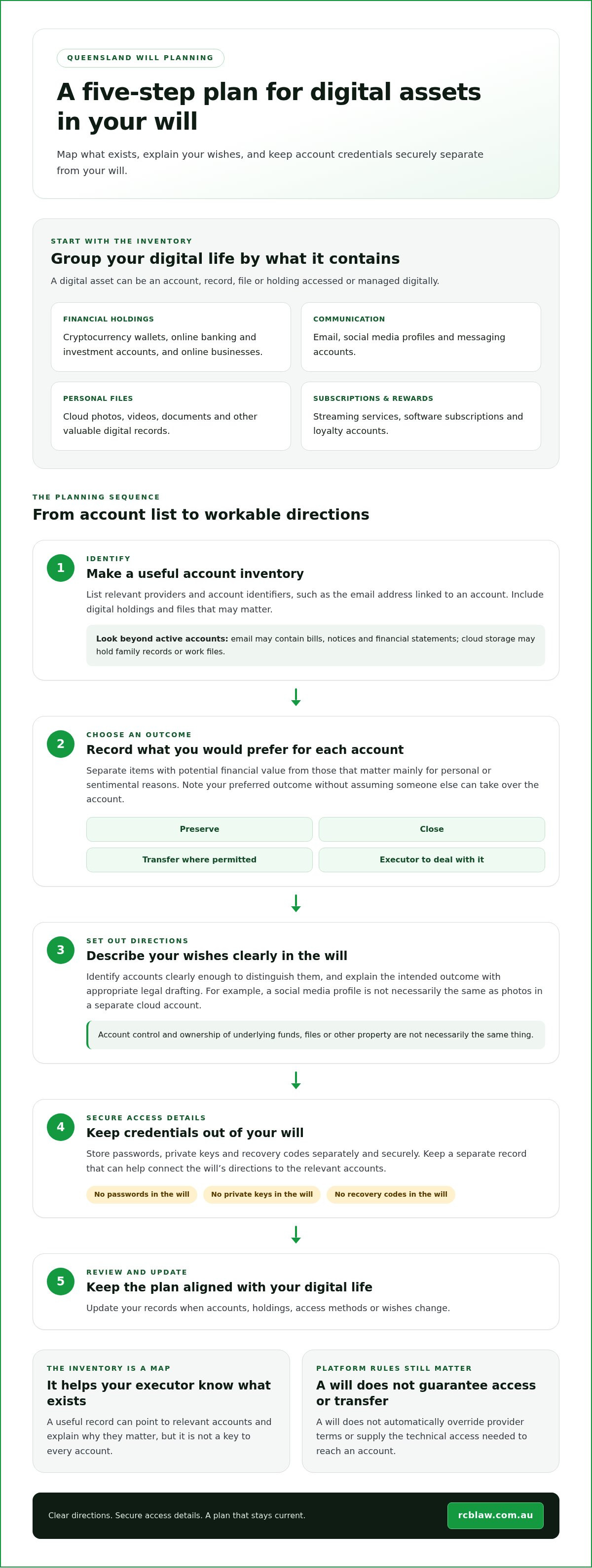
A digital asset is an account, record, file or holding that is accessed or managed digitally. The term covers more than cryptocurrency. It can include financial holdings, communication accounts, personal files and ongoing subscriptions. For a general overview, see What is a Digital Asset?
Start your inventory by grouping items according to how you use them:
- Financial holdings: Cryptocurrency wallets, online banking and investment accounts, and online businesses.
- Communication: Email, social media profiles and messaging accounts.
- Personal files: Cloud photos, videos, documents and other valuable digital records.
- Subscriptions and rewards: Streaming services, software subscriptions and loyalty accounts.
Which online accounts and files should you identify?
Start with accounts you use regularly, then look for services you may have forgotten. Email can contain bills, account notices and financial statements. Social media may hold messages and photos, while cloud storage can contain family records or work files. For each relevant service, note the provider and an account identifier, such as the email address linked to it. Don’t put passwords, private keys or recovery codes in your will.
Separate items with potential financial value from those that matter mainly for personal or sentimental reasons. A cryptocurrency wallet, business website or investment account may relate to assets or income. A photo library or message archive may have no obvious financial value but still be deeply meaningful to loved ones. A loyalty account or subscription may have terms affecting whether it can be transferred, continued or closed. Record the service and your preferred outcome without assuming someone else can take it over.
Why digital assets matter to an executor and family
If financial statements arrive online, an executor may not know which bank, investment platform or business service to look for unless you’ve left a useful record. An inventory can point them towards relevant accounts and records, giving them a clearer picture of your digital life. It’s a starting point, not a substitute for appropriate directions or secure access arrangements.
Personal files matter, too. Family members may be distressed if they know photos, messages or important documents exist but can’t locate them. However, listing an account doesn’t itself transfer ownership, grant access or override a provider’s terms and access restrictions. Think of the inventory as a map of what exists and why it matters, not a key to every account. That distinction is a useful foundation for deciding how to include digital assets in a will QLD and which instructions may need to sit elsewhere.
How to Include Digital Assets in a Queensland Will
A useful plan separates the directions in your will from the private information someone may need to locate accounts. Your will can express your intentions and relevant authority for your executor, but it shouldn’t become a password list. A separate, securely maintained record can help connect those directions to the accounts involved.
Use these steps to get started:
- Identify your assets. List providers, account identifiers, and any digital holdings or files that may matter.
- Decide the outcome. For each account or holding, note whether you’d prefer it to be preserved, closed, transferred where permitted, or dealt with by your executor.
- Record your directions. Describe relevant accounts clearly enough to distinguish them, and explain your wishes in the will with appropriate legal drafting.
- Secure access information. Keep passwords, private keys and recovery codes out of the will. Store access instructions separately and securely.
- Review the plan. Update your records when accounts, holdings, access methods or wishes change.
This sequence makes how to include digital assets in a will qld a manageable planning task, rather than a search for every password. For a broader view of estate planning, see this Queensland will planning guide.
What directions can you consider putting in your will?
Think about the outcome you want for each account or holding. You might want a family photo archive preserved, a subscription closed, or an executor to deal with a financial holding as part of administering your estate. The appropriate direction depends on who owns the account or underlying asset, the provider’s terms and applicable law. Avoid relying on a generic clause. The wording should reflect your circumstances and be considered as part of your will.
Be specific about what you mean. For example, distinguish a social media profile from photographs stored in a separate cloud account, or an online business account from the business assets it relates to. Control of an account and ownership of the underlying funds, files or other property aren’t necessarily the same thing. Clear descriptions can reduce guesswork, but a will can’t guarantee that a platform will permit access or a transfer.
Why passwords and recovery keys belong somewhere secure
Keep credentials out of your will. A will may be shared or become accessible during estate administration, so including passwords, private keys or recovery codes can expose sensitive information. Instead, maintain a separate secure record and note where it’s held so your executor can find it. Don’t put the secret itself in that pointer.
Access methods can change. Set a safe process for updating the separate record when you change a password, move a wallet or replace a device, and keep the location instructions current. Tailored Queensland will-drafting advice can help you turn your intentions into clear, coordinated directions without putting private credentials in the will.
What Happens to Social Media, Crypto, and Cloud Accounts?
Different digital assets call for different decisions. A social media profile isn’t the same as the photos stored in it, and access to an online account doesn’t necessarily mean ownership of the funds, files or digital property associated with it. Providers set their own processes and terms, which may change. Record your wishes without assuming a particular outcome.
| Account type | Planning question | Access consideration |
|---|---|---|
| Social media | Should the profile be preserved, memorialised, downloaded where permitted, or closed? | Provider processes may limit what an executor or family member can do, including access to messages. |
| Are there important records to locate, or should the account eventually be closed? | Account access may be restricted, even if messages contain useful estate or financial information. | |
| Cloud photos and files | Which files should be preserved, and who should know they matter? | Stored files and account access are separate issues. A provider may have specific access procedures. |
| Cryptocurrency and payment accounts | Is there a holding or balance to identify, and how should it be dealt with? | Access to cryptocurrency may depend on secure keys or recovery arrangements. An online account balance is not the same as ownership of an account login. |
| Subscriptions and digital purchases | Should a subscription be cancelled, or is purchased content important to identify? | A subscription, licence or digital purchase may be subject to different terms and may not be transferable. |
An executor may need to follow a provider’s processes to make a request or manage an account. A will doesn’t automatically override platform terms or guarantee access. When planning how to include digital assets in a will QLD, record both your preferred outcome and the possibility that provider rules may affect it.
Social media, email, and cloud-stored photos
For each service, consider whether you’d prefer the account or its contents to be preserved, memorialised, downloaded where the provider allows it, or closed. Record the platform name and your preference, but don’t assume that naming a person in your instructions will give them access. Private messages, stored files and control of the account can raise separate questions. A family member may be able to manage a memorialised profile, for example, without receiving access to private messages or every stored file.
Cryptocurrency, online payments, subscriptions, and digital purchases
For cryptocurrency, a will can describe your wishes, but technical access may depend on securely preserved keys or recovery arrangements. Don’t put those credentials in the will. An online payment account may contain a balance, while a subscription provides ongoing access and a digital purchase may be governed by a licence rather than ownership of a transferable file.
Questions about ownership, valuation, tax and estate administration can depend on the asset and your circumstances. Cryptocurrency is treated as property by the Australian Taxation Office, and its administration may have tax implications. Tailored professional advice can help clarify how these issues fit with your will and the directions you want to leave.
A Practical Digital-Asset Checklist for Your Will
A useful digital-asset plan is something you can maintain, not a one-off list that quickly becomes outdated. Keep your will focused on your intentions and relevant directions, and maintain a separate inventory to help your executor understand which accounts exist and where further information is held.
A separate, updated inventory gives your executor a clearer starting point for identifying digital accounts during estate administration.
Use this checklist to build and review your records:
- Discover: Review your devices, email statements, password-manager entries and recurring payments for accounts you may have overlooked.
- Identify: For each relevant account, note the provider, account identifier, purpose and any asset or records connected to it.
- Decide: Write down your preferred outcome, such as preserving files, closing an account or having an executor deal with an asset where permitted.
- Separate: Keep the inventory and access instructions apart from your will. Never put passwords, private keys or recovery codes in the will.
- Secure and locate: Store the record securely, and make sure the appropriate person knows how to find it without sharing sensitive details unnecessarily.
- Review: Update the inventory and your will directions as accounts and circumstances change.
Build and maintain a private digital-asset inventory
Look beyond the accounts you use every day. An email statement may reveal an investment account; a recurring payment may point to an old subscription; a password manager may show a business platform or cloud service you rarely open. Record only the information needed to identify each account and understand its purpose. Keep credentials in a separate secure system or record, with clear instructions about where that information is held.
Choose an update routine you can follow. For example, review the inventory when you open or close an important account, change how a digital holding is stored, or make a substantial change to your access arrangements. Check that the location instructions still work, but don’t include secret access details in your will. A secure record is useful only if it’s current and the appropriate person can find it.
Check whether your will still reflects your online life
Revisit your directions after major financial or family changes, or when an important account’s ownership or terms change. Make sure your executor can locate the inventory without exposing it more widely than necessary. Your will and inventory have different roles: one records your estate-planning directions, while the other helps identify relevant accounts and points to separately stored information.
Digital directions should also fit with your broader estate plan. A Queensland will planning guide can help you consider how these instructions sit alongside your other wishes. If your online assets or directions have changed, professional will-drafting advice can help bring your documents into line. Arrange a review of your Queensland will to consider whether it still reflects your digital assets and wishes.
Get Queensland Will Advice for Your Digital Assets
Digital-asset planning can become difficult when your wishes need to work alongside account ownership, provider terms and the rest of your estate plan. A lawyer can help translate personal intentions into clear, coordinated will directions while keeping access credentials in a separate secure record. This can help your executor understand what you want without suggesting that a will can guarantee account access or override a provider’s rules.
Tailored advice may be useful if your plans involve cryptocurrency, an online business, shared accounts, privacy concerns, uncertain ownership or complex family wishes. For example, you may want a family member to retain particular files while another person deals with a business-related account. Those intentions may need careful wording and consideration alongside your other estate-planning arrangements.
When should you seek tailored advice about digital assets?
Consider advice if it’s unclear who owns an account or the assets connected to it, or if more than one person has access or an interest. Cryptocurrency can raise questions about access arrangements, valuation and tax. Online businesses may involve both accounts and underlying business assets. Tailored advice can consider these details in the context of your estate plan and intended outcomes.
Advice may also help if your privacy wishes conflict with a family member’s desire to access messages or files, or if you’re unsure whether a digital holding is yours to give away. Legal requirements and provider policies can change, so Queensland-specific guidance should reflect the current position and your circumstances. No will direction can promise a particular access, transfer, tax treatment or legal result.
- Complex holdings: Cryptocurrency or digital investments may require coordinated directions and separate access planning.
- Shared accounts: Consider whether another person has ownership rights or access that affects your wishes.
- Business assets: Distinguish business accounts from the business interests or records connected to them.
- Privacy concerns: Decide what you want preserved or managed, while recognising that provider processes may limit access.
- Unclear ownership: Get help clarifying whether an account, file or holding can be dealt with as part of your estate.
How RCB Law can help with will planning
RCB Law provides Queensland will-drafting assistance to help turn personal intentions into clear estate-planning directions. The firm brings over 30 years of experience across its legal practice and can consider how your digital-asset wishes fit with your broader will. This can be particularly helpful if an existing document was prepared before your online accounts or priorities changed.
RCB Law offers a complimentary review of an existing will, giving you an opportunity to revisit whether it still reflects your wishes, including what you’d like done with important online accounts and records. This section provides general information, not advice tailored to your circumstances. Discuss your will with RCB Law as a next step in reviewing your digital-asset plans.
Make Your Digital Wishes Part of Your Estate Plan
Your online life will keep changing as accounts open, close and evolve. Revisit your digital-asset directions when your circumstances change so your estate plan continues to reflect what matters to you. A considered plan can give your executor clearer guidance while keeping private access details separate.
If you’re deciding how to include digital assets in a will QLD, tailored advice can help align your wishes with your wider estate plan. RCB Law assists Queenslanders with will drafting and estate planning, drawing on over 30 years of experience across its legal practice. If you already have a will, a complimentary review can help you consider whether it still reflects your current wishes and digital life.
Take the next step by discussing your will planning with RCB Law and reviewing how your estate plan addresses your digital assets.
Frequently Asked Questions
Can I put my passwords in my will in Queensland?
No. Keep passwords, private keys and recovery codes out of your will because they’re sensitive credentials and a will may be seen by people involved in estate administration. Instead, use a secure, separate record and make sure your executor knows how to locate it. If you’re considering how to include digital assets in a will QLD, focus the will on your wishes and directions, not the login details needed to carry them out.
Does a Queensland will automatically give my executor access to my social media accounts?
No. Naming an account or expressing a wish in your will doesn’t automatically give your executor technical access or require a platform to provide it. Each provider’s terms and processes matter, and they can change. Your executor may need to follow the platform’s process and provide requested documents. Consider using available account-planning settings during your lifetime, then record your preferences and review them if the provider changes its options.
Can my family inherit my cryptocurrency when I die?
Cryptocurrency may form part of your estate and pass according to your will, but inheritance and access are separate issues. The Australian Taxation Office treats cryptocurrency as property. If the relevant wallet keys or recovery arrangements can’t be found, a beneficiary may be unable to access the holding even if your intentions are clear. Record the asset’s existence and location securely, and get tailored advice about ownership, valuation and tax consequences.
What happens to my Facebook or Instagram account after I die?
The outcome depends on the platform’s policies and any settings you chose while alive. Meta provides a Facebook Legacy Contact option for certain account management after death, or a user may request account deletion. Don’t assume the same process or result applies to Instagram, or that a contact can view private messages. Review each service’s current settings and policies, and leave clear preferences about whether you’d like an account preserved or removed.
Should I appoint a digital executor in my Queensland will?
“Digital executor” isn’t a distinct legally recognised office in Queensland. You can still consider whether your chosen executor is comfortable handling online accounts or whether your will should allow for appropriate technical assistance. The right approach depends on your assets and circumstances. Discuss the proposed wording with a Queensland wills lawyer, particularly if access to cryptocurrency, online business records or valuable files may require specialist knowledge.
How often should I update my digital-asset inventory?
Review it whenever you open or close an important account, change how a digital asset is held, or make a significant change to your wishes. A scheduled review can also help identify inactive accounts or inaccurate records. After each update, check that your executor can still find the inventory and that its location instructions work, without putting confidential details in the will.
Can an executor access my private emails and cloud photos after death?
Not automatically. An executor’s role in administering an estate doesn’t guarantee that an email or cloud provider will grant access to private content. The provider’s terms, its request process and the circumstances all matter. Identify records that may be relevant, such as receipts or documents relating to estate property, and record your preferences for personal files. Your executor may need to follow the provider’s process rather than sign in using your credentials.


