
What if you miss the date to exercise an option, or the seller later uses their right to require a purchase? Before signing, a put and call option agreement QLD lawyer can help you understand who can act, when they can act and what the agreement requires from you.
It’s understandable to want certainty before committing to a property transaction. A put option and a call option work together, but their conditions, deadlines and consequences can be easy to misread. Option fees, finance arrangements, nomination clauses and Queensland duty implications may also affect your position.
This guide explains how the options operate and what to review before signing. It covers the steps from signing to completion, practical questions to ask about the agreement, and when Queensland conveyancing or commercial property law advice can help you understand the risks.
Key Takeaways
- Understand how the put and call rights work together, and how each party’s ability to require a sale may affect your position.
- Trace the agreement from signing through completion, paying close attention to its conditions, notices and deadlines.
- Compare the put right, call right and completion obligations to identify terms that need closer review for your circumstances.
- Prepare for a put and call option agreement QLD lawyer review by clarifying your commercial objective, preferred timing and main concerns.
- Queensland property and commercial-law guidance can help clarify the agreement’s rights, obligations and potential issues.
What is a put and call option agreement in Queensland?
A put and call option agreement sets out linked contractual rights that may allow one party or the other to require a property sale later, on agreed terms. The agreement should identify who holds each right, what must happen before it can be exercised, and what follows from valid exercise. Don’t infer those details from the labels alone. Read the operative clauses and definitions together.
This differs from an ordinary sale contract, where the parties generally agree to proceed with the sale under the contract’s terms. An option arrangement can give a party a period in which to decide whether to trigger a sale, while the paired rights may give the other party a way to require the transaction. The effect depends on the document, its conditions, the parties and the transaction. For a high-level explanation of the underlying concept, see this overview of a financial option. A property option agreement has its own legal wording and consequences, so that general explanation isn’t a substitute for reviewing the document.
What does the call option allow a party to do?
A call option generally gives its holder the right to require the other party to sell the identified property on agreed terms. Check who holds the call right, who must respond, which property is covered and how the holder must exercise the option. For example, the agreement may require written notice delivered in a particular way by a stated deadline. Follow the method and timing in the document. Don’t assume an email, verbal notice or late notice will be effective unless the agreement supports that interpretation.
What does the put option add to the arrangement?
A put option generally gives its holder the right to require the other party to buy the property on the agreed terms. In a common structure, the buyer holds the call option and the seller holds the put option, but the definitions and operative clauses must confirm who has each right. The call may let the buyer initiate the sale; the put may let the seller require it if the call hasn’t been exercised.
Neither right should be treated as automatic. Each may depend on valid exercise within the specified period and compliance with stated conditions. Together, the options can create different routes to a later sale, but the executed agreement determines the result. A put and call option agreement QLD lawyer can explain how the rights fit together and what the wording means for each party before signing.
How do put and call options work from signing to completion?
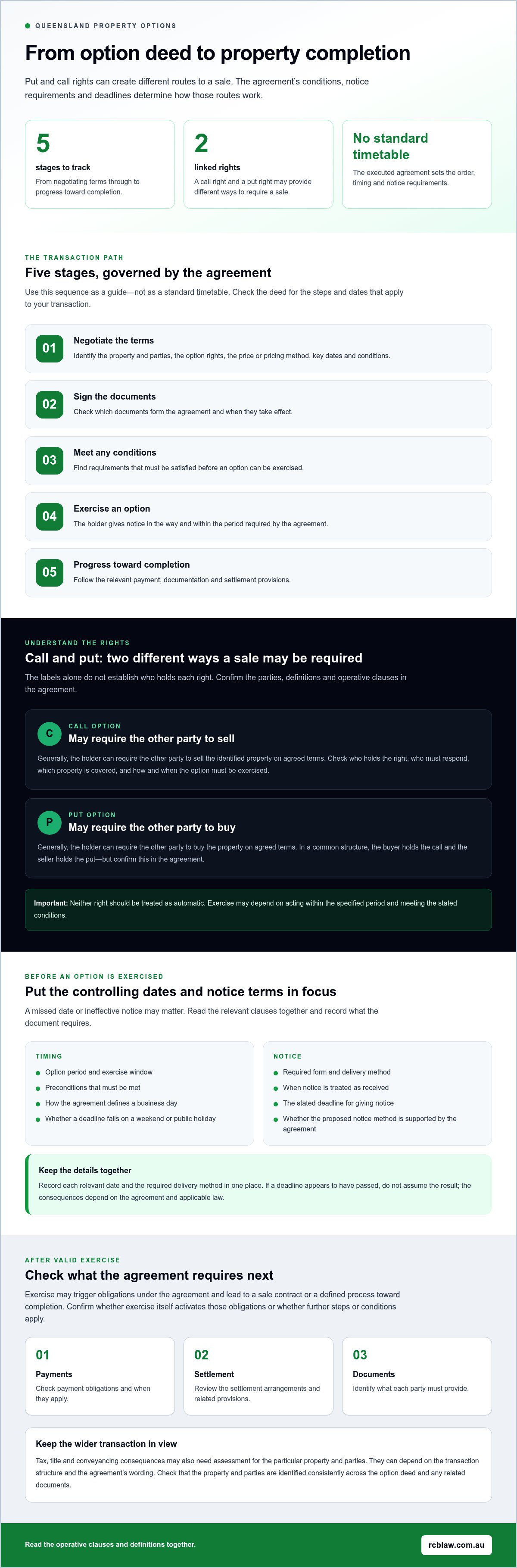
The path from signing an option deed to completing a property sale depends on the agreement. To follow the process, identify each step, the document that governs it and any deadline attached:
- Negotiate the terms: Identify the property, parties, option rights, price or pricing method, key dates and conditions.
- Sign the documents: Check which documents form the agreement and when they take effect.
- Meet any conditions: Identify requirements that must be satisfied before an option can be exercised.
- Exercise an option: The holder gives notice in the way and within the period the agreement requires.
- Progress toward completion: The parties follow the relevant payment, documentation and settlement provisions.
This sequence is a guide, not a standard timetable. The executed agreement determines the order, timing and notice requirements. A guide to property option agreements can provide general consumer context, but it can’t explain how a particular deed applies to your transaction.
Which dates and conditions control the option?
Find the option period, the exercise window, any preconditions and the clause explaining how notice must be given. Check how the agreement defines a business day, whether a deadline falls on a weekend or public holiday, and when notice is treated as received. Record each relevant date and the required delivery method in one place so they’re easy to track. Differences in wording or delivery method may matter. If a deadline appears to have passed, don’t assume the result. The consequences depend on the agreement and applicable law, so get advice promptly.
What can happen after an option is exercised?
A valid exercise may trigger obligations under the agreement and lead to a sale contract or a defined process toward completion. Check what happens next, including required payments, settlement arrangements and documents each party must provide. The effect can vary, so confirm whether exercise itself creates or activates those obligations, and whether further steps or conditions apply.
There may also be tax, title and conveyancing consequences to assess for the particular property and parties. These issues can depend on the transaction structure and the agreement’s wording. Understanding the Queensland conveyancing process can put the transfer stage in context, while legal review can connect that process to your option documents. A put and call option agreement QLD lawyer can help identify the dates, notices and completion obligations that need attention before you act. For tailored guidance, explore Queensland property law advice.
What should you compare and check before signing a Queensland option agreement?
A transaction’s commercial purpose doesn’t show by itself whether the drafted terms fit your circumstances. A familiar or standard-looking document may still fail to reflect the property, parties, timing or intended outcome. Compare the rights and obligations in the agreement, then trace how they work together. In particular, check that the property and parties are identified consistently across the option deed and any related documents.
| Agreement feature | What to check |
|---|---|
| Put right | Who holds the right to require a purchase, and what must they do to exercise it? |
| Call right | Who may require a sale, for which property, and on what agreed terms? |
| Exercise conditions | Are there preconditions, required notices or other steps before either right can be used? |
| Time limits | What are the relevant dates, exercise windows and rules for calculating or serving notice? |
| Completion obligations | What payments, documents and settlement steps follow a valid exercise? |
Which clauses deserve close legal review?
Review the names and roles of each party, the property description, and any option fee or other payment. Check the exercise process in detail, including how notice must be given and when it counts as received. Look at conditions, default provisions, termination rights and the consequences of unmet requirements. Then compare the option agreement with any related sale contract or transaction documents. If the documents use different property descriptions, dates or payment terms, clarify how they fit together before signing.
How can structure affect legal and duty considerations?
Duty and tax outcomes can depend on the documents, the parties, timing and transaction facts. For example, a proposed purchaser entity or nomination arrangement may affect the legal and duty analysis, so don’t assume the intended structure will produce a particular result. The option grant and any later transfer may also require separate consideration. A put and call option agreement QLD lawyer can review these issues against the proposed arrangement and identify questions that need specific advice.
Where a property transaction also involves business interests, consider the documents together. RCB Law’s Queensland commercial conveyancing guide provides broader context for transactions where those issues overlap. Review before signing can help clarify whether the agreement’s rights, conditions and obligations align with the transaction you intend to enter.
How can you prepare for a Queensland lawyer’s review?
Preparation can make a review more focused. Write down your commercial objective, preferred timing and main concerns about the proposed terms. Note whether you’re the put option holder, the call option holder or another party, since each role can carry different rights, deadlines and obligations. If a particular date is approaching, highlight it when you share the documents.
Early legal review gives you time to raise questions before signing, exercising a right or approaching a deadline. It can also help identify wording that needs closer consideration. A checklist can organise the discussion, but it doesn’t replace advice on how the documents apply to your circumstances.
What documents and details should you organise?
Gather the draft option agreement, any related sale contract or transaction documents, available title information, relevant correspondence and a list of important dates. Prepare a short summary of the parties’ roles, the intended transaction, key negotiation points and any conditions that remain outstanding. This gives the reviewer a practical starting point for comparing the agreement’s terms with the transaction you intend to make. The precise documents needed depend on the property, structure and stage of the deal.
What should each party ask their lawyer?
Shape your questions around your role. A put holder may want to understand when and how they can require the other party to buy; a call holder may need clarity on how to require a sale. Ask what notices and deadlines apply, what obligations follow exercise, and what risks may arise if a requirement isn’t met. Also ask which Queensland legal, conveyancing and duty issues need separate consideration.
Before the discussion, mark any clause you don’t understand and explain the outcome you’re trying to achieve. A put and call option agreement QLD lawyer can connect the wording to your objectives and identify issues that need further advice, rather than treating the agreement as a standard form with a one-size-fits-all effect.
If you’re preparing to sign or exercise an option, arrange a review of your Queensland option agreement with RCB Law.
How can RCB Law help with a put and call option agreement in QLD?
Put and call option agreements can combine property, commercial and timing considerations in one set of documents. RCB Law provides residential and commercial conveyancing, as well as business and commercial law services. With more than 30 years of experience, the firm assists clients in Brisbane, the Sunshine Coast and Redland Bay with property and commercial matters.
Review focuses on the agreement and the transaction, rather than assumptions about how a particular option arrangement should work. It can help you understand what the wording means for your role and which questions need to be resolved before you act.
What can a tailored agreement review help clarify?
A review can explain the rights and obligations created by the specific clauses, including how an option may be exercised and what time limits apply. It can also draw attention to unclear procedures, important conditions, inconsistencies with related documents or requirements that may be time-sensitive. The aim is to make the document easier to understand, not to promise a particular outcome.
Legal interpretation is one part of the picture. Depending on the arrangement, commercial decisions, tax treatment or other specialist issues may call for separate consideration. A put and call option agreement QLD lawyer can help identify where the agreement raises those questions and clarify which issues fall within the legal review.
What is a practical next step for Queensland parties?
Where practicable, seek advice before signing or exercising an option. This gives you an opportunity to understand the proposed terms and raise questions before a deadline or decision point becomes urgent. If you’ve already signed, share the executed documents and highlight any upcoming dates or notices that concern you.
To make the discussion more focused, prepare the draft or signed agreement and a concise summary of your transaction goals, your role and the points you want clarified. Include any related documents and relevant dates you have available. This helps your lawyer understand the context and tailor the review to your circumstances.
A clear explanation of the agreement can make the next step feel more manageable. Discuss your Queensland property-law matter with RCB Law.
Move forward with a clearer understanding of your option agreement
A put and call option agreement can create important rights for both parties, so the details matter. Before signing or exercising an option, make sure you understand who can act, how notice must be given, which deadlines apply and what obligations may follow. The agreement’s conditions, related documents and possible Queensland duty implications also deserve careful, transaction-specific review.
Working with a put and call option agreement QLD lawyer can help turn complex clauses into a clearer picture of your position and the issues that need attention. RCB Law brings Queensland property conveyancing expertise and more than 30 years of experience to property matters across Brisbane, the Sunshine Coast and Redland Bay.
If you’re considering an option agreement, discuss the document and your transaction goals before key dates approach. Arrange a Queensland property-law review with RCB Law.
Frequently Asked Questions
What is the difference between a put option and a call option?
A call option generally lets its holder require the other party to sell, while a put option generally lets its holder require the other party to buy. Those labels are only a starting point. Read the operative clauses to confirm who holds each right, the conditions and notice process for exercising it, and what happens next. The agreement’s actual wording determines how the options work in that transaction.
Is a put and call option agreement the same as a sale contract?
Not necessarily. An option agreement may create rights to require a property sale later, while an ordinary sale contract records an agreement to proceed with a purchase and sale under its terms. The option document may also connect with a separate sale contract, depending on its drafting and the transaction. Review the related documents together to understand how their terms fit and what obligations may arise.
When can a party exercise a put or call option?
A party can exercise an option only as permitted by the agreement, including its option period, conditions, notice requirements and delivery procedure. Check the executed document for the relevant dates and how notice must be served; informal communication may not meet the stated requirements. Because exercise may trigger contractual obligations, get legal advice before acting, particularly if a deadline is close or you’re unsure whether a condition has been satisfied.
Can a put and call option agreement affect Queensland transfer duty?
It may have Queensland transfer duty implications, but the treatment depends on the transaction structure, documents, parties, timing and current law. Don’t assume an option automatically reduces, avoids or defers duty. Before signing, seek advice based on the actual arrangement and check current Queensland Revenue Office guidance and applicable legislation. A tailored assessment is important where the agreement includes a proposed nominee, related transaction documents or a later property transfer.
Should a lawyer review a put and call option agreement before signing?
Yes. A lawyer’s review can help you understand the rights, obligations, conditions, deadlines and possible consequences set out in the actual document. It can also consider how connected contracts and your transaction circumstances affect the analysis. Advice from a put and call option agreement QLD lawyer may help identify questions while there’s still time to address them. Seek guidance early, especially before signing or exercising an option.


