
What if a property’s flood map looks clear, but its history tells a different story? If you’re searching for “undisclosed flooding history qld property,” look beyond a single map. Flood records can be difficult to interpret, and not every past event appears in the sources buyers commonly check.
Queensland’s seller disclosure scheme, which began on 1 August 2025, requires a Form 2 Seller Disclosure Statement before a contract is signed. However, sellers aren’t required to disclose a property’s flood history. That makes your own enquiries especially important. To assess what the documents establish, compare them with other property-specific evidence and note any gaps or inconsistencies.
This guide explains how to investigate a property’s flood history using sources such as Brisbane City Council’s FloodWise Property Report and FloodCheck Queensland. It also covers how to read disclosure information in context, what to consider before signing, and how to respond if you discover a possible omission later. RCB Law’s residential conveyancing service can help you review the contract and disclosure material before deciding how to proceed.
Key Takeaways
- A clear result on a flood map doesn’t prove a property has never flooded. Compare property-specific records with local council mapping and planning information.
- Use several sources to build a clearer picture, noting what each record can show and what it cannot establish.
- If you suspect an undisclosed flooding history qld property, keep dated copies of maps, photographs, messages and property details.
- What to do next depends on whether you find possible flooding before or after signing. Check your contract position promptly.
- A conveyancing review can help interpret contract and disclosure documents and identify questions that may need further evidence.
Undisclosed flooding history in a QLD property: what buyers need to know
Learning that a home you’re considering may have flooded can be unsettling, especially if you’ve already reviewed maps and property documents. An undisclosed flooding history qld property concern arises when a property may have experienced flood impacts that aren’t apparent in the information you’ve reviewed. Investigate the possibility carefully, but remember that a flood indication alone doesn’t prove water entered the home.
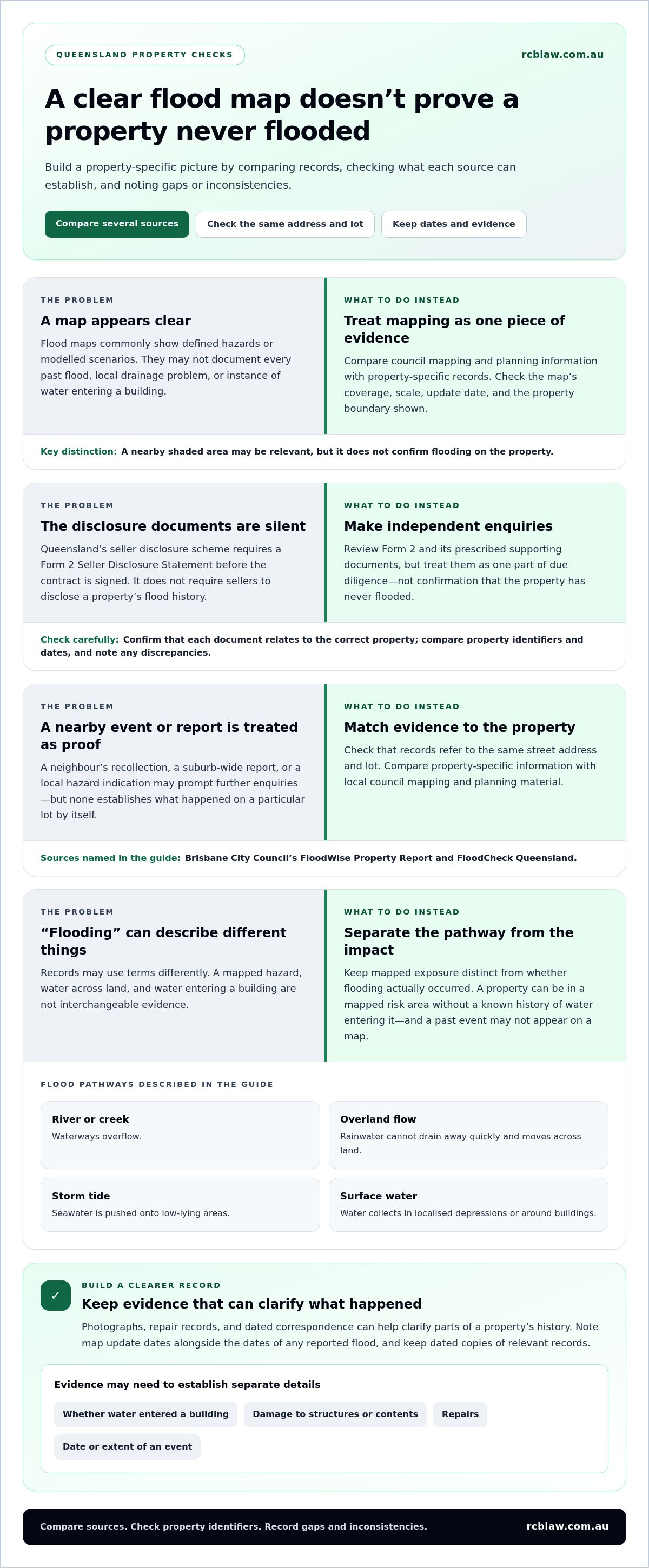
Keep two questions separate: is the property exposed to a mapped flood hazard, and has it actually flooded in the past? A property can be in a mapped risk area without a known history of water entering it. Conversely, a past event may not be apparent from a map.
What counts as a property’s flooding history?
Flooding can occur in different ways. River or creek flooding happens when waterways overflow; overland flow moves across land when rainwater can’t drain away quickly; storm tide can push seawater onto low-lying areas; and surface-water flooding can collect in localised depressions or around buildings. These terms describe different sources or pathways, and records may use them differently.
Distinguish confirmed evidence from a reason to investigate further. A local hazard indication, a neighbour’s recollection or reports of flooding across a suburb may prompt further enquiries, but none establishes what happened on a particular lot on its own. Water entering a building, damage to structures or contents, repairs, and the date or extent of an event are separate details that may each need supporting evidence. Photographs, repair records and dated correspondence can help clarify parts of the history.
Queensland’s history includes major events such as the 2010-2011 Queensland floods, but broad historical accounts cannot establish whether a specific property was affected.
Why a flood map may not tell the whole story
Flood maps commonly show defined hazards or modelled scenarios. They help explain potential exposure, but may not document every past flood, local drainage problem or instance of water entering a building. Coverage, scale, update date and the property boundary shown can all affect what a map reveals. For example, a nearby shaded area doesn’t confirm flooding on the property.
A single flood map cannot establish a complete property flood history. An address with no mapped flood indication isn’t proof that flooding never occurred. Treat mapping as one piece of evidence and compare it with property-specific records and other reliable information.
What Queensland seller disclosure rules may reveal about past flooding
Queensland’s seller disclosure scheme, introduced under the Property Law Act 2023 from 1 August 2025, requires a seller to give the buyer a Form 2 Seller Disclosure Statement before the contract is signed. The statement and its prescribed supporting documents provide important information about the sale, but they aren’t a complete record of everything that has happened at the property.
Queensland’s seller disclosure scheme does not require sellers to disclose a property’s flood history. The Queensland Government’s Guide to the seller disclosure scheme explains the scheme’s scope. Treat disclosure documents as one part of your due diligence, not as confirmation that a property has never flooded. If you’re concerned about an undisclosed flooding history qld property, make independent enquiries as well.
Which seller documents should a Queensland buyer examine?
Start with the Form 2 statement and the prescribed certificates or other documents provided with it. Check that each document relates to the correct property, then compare property identifiers and dates across the material. If details differ, or a document appears to cover a different lot or period, note the discrepancy and seek clarification before relying on it.
The documents have defined purposes and may not address whether water entered a home, when it happened, or what damage and repairs followed. A seller’s disclosure material can help you understand the transaction, but silence about flooding doesn’t establish that flooding never occurred.
Does an omission automatically mean the seller broke the law?
No single conclusion follows from an omission alone. The relevant question depends on what the law requires, what the seller knew, what was stated or asked, and the surrounding facts. A past flood may not be information the statutory statement requires. That is different from a seller or agent giving a false or misleading answer when directly asked about the property’s flood history.
Before alleging a breach or taking action, get prompt legal advice. A conveyancing lawyer can review the contract, Form 2 statement, supporting documents and related correspondence to clarify the issue and identify what evidence may still be needed. If you’re weighing up the documents before proceeding, residential conveyancing guidance can help you assess the transaction in context.
How to check a QLD property’s flood history: compare the evidence
Build a property-specific picture by comparing sources instead of relying on a single search. Several independent sources provide stronger context than one result. Check that each record refers to the same street address and lot. Note the map’s publication or update date alongside the date of any reported flood. A nearby event or hazard overlay may be relevant, but it doesn’t automatically establish what happened on the property.
| Source | What it may show | What it cannot establish alone |
|---|---|---|
| Relevant local council flood maps and planning information | Mapped hazard areas, flood types, planning overlays or property-level information, depending on the council. | Whether water entered a particular building or when damage occurred. |
| Brisbane City Council FloodWise Property Report | Flood information for a Brisbane address through the council’s Flood Awareness Map. | A complete record of every past event or the condition of the home during one. |
| FloodCheck Queensland | Statewide historical flood information and data. | Proof that a specific home flooded, or that it did not. |
| Property documents, photographs and repair records | Possible evidence of water entry, damage, works or dates. | A full account unless the records are complete and clearly relate to the property. |
| Neighbours’ recollections | Leads about events or local water behaviour to investigate further. | Standalone proof of the property’s flood history. |
Council maps, planning information and Queensland records
Start with the council responsible for the property. Council flood overlays can indicate exposure to a mapped hazard, not necessarily past inundation. Check which flood types are represented, the map’s date, scale and stated limitations, and whether planning information identifies the specific lot. FloodCheck Queensland offers statewide historical flood data. The Queensland Reconstruction Authority has also been developing Property Level Flood Information Portals with councils. Check the relevant council’s current information and the portal’s scope rather than assuming every location shows the same detail.
Physical signs, previous repairs and local accounts
If you inspect the property, record visible water marks, damaged materials, drainage changes and signs of repair. Keep dated photographs and copies of relevant insurance, repair or building documents, noting which property and event each relates to. Treat local accounts as leads, then look for independent corroboration. These checks can help assess an undisclosed flooding history qld property concern without treating any single clue as conclusive.
What to do if flooding is found before or after signing
Finding possible flood evidence doesn’t automatically determine whether you should proceed or what legal options you have. The next steps depend on when you discover it, what the evidence shows, the contract terms and any applicable disclosure obligations. Start a clear record: save dated maps and documents, photographs, messages and notes, along with the property address and lot details. Preserve original files where possible.
If you have not signed the contract
- Pause and identify the concern. Gather the specific map, photograph, repair record or other information that prompted your question. Separate evidence about the property itself from a broader area hazard or an unverified account.
- Ask focused questions in writing. Raise the issue through the appropriate conveyancing channel before committing. Keep the wording factual, identify the property and event where known, and retain the response.
- Arrange a legal review before deciding. Have the contract, Form 2 Seller Disclosure Statement, supporting material and timing-sensitive choices considered together. This can help clarify what the documents establish and what further information may be needed.
Don’t assume that a seller’s silence proves either that flooding occurred or that the seller breached a duty. Reviewing the information before signing can help you make an informed decision without treating incomplete evidence as conclusive.
If you have already signed or settled
- Record how the information emerged. Note when and from whom you received it, and keep the original messages, documents, maps and photographs. Include relevant property identifiers and dates so the material can be checked against the correct lot and event.
- Get advice promptly. Before making allegations to the seller or agent, or deciding on repairs, have the contract and available evidence reviewed. Your obligations and options may depend on the contract, the stage of the transaction, the facts and the law that applies.
- Don’t assume past flooding alone gives you a right to end the contract. Under section 64 of the Property Law Act 1974, a statutory right to terminate may arise if, before settlement, the property is damaged to the extent that it is “unfit for human habitation.” This is a high threshold and is distinct from simply discovering a prior flood history. Any possible remedy requires advice based on the circumstances.
If you’ve uncovered a possible undisclosed flooding history qld property concern, speak with RCB Law about your Queensland conveyancing concern. A careful review can clarify the documents and the next questions to address.
How Queensland conveyancing advice can clarify a flooding disclosure concern
Discovering a possible flood history can leave you unsure how much weight to give a map, a seller’s statement or an account from someone familiar with the area. A conveyancing lawyer can review those materials alongside the contract and related correspondence, helping you separate what the documents say from what remains uncertain. This can bring clarity to an undisclosed flooding history qld property concern without assuming a particular legal outcome.
Legal review focuses on the transaction and its documents. It may identify inconsistencies, relevant contract terms, questions that need further evidence and steps that could be affected by timing. It cannot, by itself, establish whether floodwater entered a building or prove the extent of physical damage. Those questions depend on the available records and evidence.
What a conveyancer can assess in a flood-history concern
A conveyancer can consider the contract, disclosure material and communications in context, explain which legal issues may matter to your circumstances, and identify points that may need clarification. For example, an address mismatch, a dated message about prior water entry or wording in a contract may raise questions. Advice can help you understand practical next steps and timing-sensitive choices, without guaranteeing that a concern amounts to a breach or provides a remedy.
Prepare for a focused legal conversation
Gather information that helps establish what happened and when. Bring the contract, disclosure documents, property address and lot details, along with relevant dates and correspondence. Include the maps, photographs, reports or repair records that prompted your concern. Organised records make it easier to identify what the documents establish, where accounts differ and what further evidence may be useful.
- Ask which contract terms and disclosure documents are relevant to the concern.
- Clarify whether any next step is time-sensitive and what information may be needed first.
- Discuss the practical risks and options based on your transaction’s current stage.
If you’d like background on the conveyancing process, read our Queensland conveyancing guide. For a property-specific review of your purchase documents and flooding concern, discuss your Queensland property purchase with RCB Law.
Make your next property decision with greater clarity
A flood map is a useful starting point, not a complete account of a property’s past. Compare property-specific records and physical evidence, and check that dates, addresses and lot details match before drawing conclusions. Queensland’s seller disclosure documents also have a defined scope, so silence about flooding doesn’t establish that a property has never been affected.
If you uncover a possible undisclosed flooding history qld property concern, keep the relevant records and seek advice promptly. Your options may depend on the evidence, contract terms and timing, particularly if you’ve already signed. A conveyancing review can help clarify what the documents say and which questions may need further investigation.
RCB Law brings more than 30 years of experience to Queensland residential conveyancing, with a local focus across Brisbane and the Sunshine Coast. For a considered review of your purchase, discuss your Queensland property purchase with RCB Law.
Frequently Asked Questions
Can a seller in Queensland leave a property’s flood history undisclosed?
Under Queensland’s current seller disclosure scheme, a seller isn’t required to disclose a property’s flood history in the Form 2 Seller Disclosure Statement. However, if a buyer asks directly about flooding, a seller or agent must not give a false or misleading answer. The absence of flood information in the statement doesn’t by itself prove a breach. If you’re concerned about an undisclosed flooding history qld property, consider both the documents and any answers given to your enquiries.
How can I check whether a QLD property has flooded before?
Compare several sources. Check the relevant council’s flood mapping and property-level planning information, and use tools such as Brisbane City Council’s FloodWise Property Report for Brisbane properties or FloodCheck Queensland for statewide historical flood data. Look for property-specific photographs, repair records, insurance documents or dated correspondence where available. Match the address and lot details across sources, and compare map dates with reported event dates. No single source is likely to establish the complete history.
Does a Queensland flood map prove that a house has flooded?
No. A flood map may show a modelled or mapped hazard, which indicates potential exposure rather than proof that water entered a particular house. Mapping may also have limits in coverage, scale or currency. A property outside a mapped area could still have experienced localised flooding or water entry. Use the map as one part of your investigation and compare it with property-specific records and other evidence before drawing conclusions.
What happens if I discover a possible undisclosed flood after signing?
Keep the original documents, maps, photographs and messages, and note when and how you learned about the concern. Then seek prompt legal advice before making allegations or taking action, because your position can depend on the contract, evidence and timing. If the property is damaged before settlement to the extent that it’s “unfit for human habitation,” section 64 of the Property Law Act 1974 may provide a termination right. A past flood history alone doesn’t establish that threshold.
Should I rely only on the seller disclosure statement when checking flood history?
No. The Form 2 Seller Disclosure Statement and its prescribed supporting documents provide important information about the sale, but they aren’t a complete history of a property. Flood history isn’t a required disclosure under the current scheme. Make independent enquiries using relevant council information, Queensland flood records and any property-specific documents you can obtain. Check that records refer to the correct lot and consider whether their dates and scope address your specific concern.
Can I withdraw from a Queensland property purchase if flooding was not disclosed?
Not automatically. A flood-history omission alone doesn’t necessarily give you a right to withdraw. Your options depend on the contract, the circumstances of the sale, what was represented or asked, and when the issue arose. Before settlement, section 64 of the Property Law Act 1974 may allow termination if damage makes the property unfit for human habitation, a high legal threshold. Get prompt legal advice before taking steps that could affect your contractual position.
Is a property outside a council flood overlay safe from flooding?
No. Being outside a council flood overlay doesn’t guarantee that a property is safe from flooding or that it has never flooded. An overlay shows the risks represented by that particular mapping and may not capture every flood type or local drainage issue. Check the map’s date, scope and limitations, and consider other property-specific evidence. If the result is unclear, a conveyancing lawyer can help identify questions about the transaction documents and possible next steps.


