
What if the property is not clean at final inspection, but settlement is just around the corner? Start by checking your signed contract. A dirty property does not automatically give you the right to delay settlement, and the seller may not have agreed to arrange a professional clean. The contract’s wording and the condition you find will help determine what to do next.
In Queensland, a standard REIQ contract generally requires the seller to leave the property in substantially the same condition as when the contract was signed, fair wear and tear excepted, and to remove their belongings and rubbish. A professional clean may be required if the contract includes a specific condition.
This article explains how to assess a final-inspection concern, what evidence to gather and when to notify your conveyancer. A conveyancing lawyer can review the contract and help you consider a practical response before settlement, without assuming that a cleaning concern alone gives you grounds to stop it.
Key Takeaways
- Distinguish ordinary untidiness from damage or missing inclusions, as each may raise a different issue under your contract.
- If you’re asking what if the property is not clean at final inspection, check the signed contract rather than relying on assumptions about customary cleaning.
- Record concerns with dated photographs and notes identifying the affected rooms or items, then notify your conveyancer promptly.
- Consider a cleaning request, a written agreement or legal review based on the evidence, contract wording and time remaining before settlement.
- A conveyancing lawyer can assess the concern and help you communicate a proportionate next step. Dirt alone is not an automatic reason to stop settlement.
What Does It Mean If a Queensland Property Is Not Clean at Final Inspection?
A final inspection gives the buyer an opportunity to view the property before settlement and compare its condition with the contract and any earlier records. Use it to identify concerns while there is still time to raise them. The inspection does not, by itself, mean the seller must arrange a professional clean or that settlement can be delayed.
If you’re wondering what if the property is not clean at final inspection, describe exactly what you found. Dust on a shelf, rubbish left behind, damage to a wall and a missing item listed as an inclusion are different issues. The contract and circumstances determine whether a concern may have contractual significance.
What should buyers look for during a final inspection?
Compare the property with its earlier condition and the relevant terms of your signed contract. Check each room, outdoor areas and items included in the sale. If the contract provides for vacant possession, look for belongings or other items that could affect the agreed handover.
Be specific about your observations. Light dust or cleaning residue may be different from bags of rubbish, furniture left behind, new damage or an included appliance that is missing. Separating these issues helps your conveyancer assess them against the contract.
Does a dirty property automatically breach the contract?
No single cleaning standard applies automatically to every sale. The contract wording, the property’s earlier condition and the facts at inspection all matter. A buyer’s preference for a spotless or professionally cleaned home does not, on its own, establish that the seller was required to provide one.
Standard REIQ residential contracts commonly address the property’s condition and the removal of the seller’s belongings and rubbish, but contract forms and editions can differ. Check the version you signed and any special conditions rather than relying on a general summary. If professional cleaning was specifically agreed in writing, that may affect the assessment.
Property law is state-based in Australia. For broad background, see Australian property legislation, which includes Queensland’s Property Law Act 2023. That overview is not a substitute for reviewing your sale contract or assessing how its terms apply to the inspection findings.
A cleanliness concern does not automatically give you the right to delay settlement or demand further work. Record what you observed and raise it promptly with your conveyancer. They can review the contract and help you decide whether to make a practical request, discuss a resolution or seek closer legal consideration.
How the Queensland Contract of Sale Affects a Dirty Property
Before deciding what to do, read the Contract of Sale you signed. General expectations about how a home is usually handed over cannot replace the terms of your agreement. REIQ residential contract forms are a common reference point in Queensland, but the form, edition and any changes made for your transaction can affect the assessment.
Look at the provisions dealing with the property’s condition, possession, included items and any special conditions. These address different aspects of the handover. For example, rubbish left in the yard may raise a different question from a listed appliance that is missing. An express written promise that the property will be professionally cleaned may also be relevant, while an expectation of a spotless home is not necessarily a contract term.
Which contract terms may matter before settlement?
Review the signed document alongside your inspection findings. A conveyancer can help identify the relevant wording and consider how the provisions work together. Common REIQ residential contracts may require the seller to leave the property in substantially the same condition as at the contract date, allowing for fair wear and tear, and to remove belongings and rubbish. The precise wording and its application depend on the contract edition and any special conditions.
- Condition: Does the observed state appear different from the condition addressed in the contract?
- Possession: Does anything left behind affect an agreed vacant-possession arrangement?
- Inclusions: Are the items listed in the contract present?
- Special conditions: Is there a specific written promise about cleaning or presentation?
Do not rely on a clause number or quotation from a different contract edition. Review the exact document signed for your purchase before drawing conclusions.
Why contract wording matters more than general expectations
There is a difference between an express obligation and a preferred cleaning standard. A written condition requiring a professional clean may provide a clearer basis for raising the issue than a general expectation that the home will be spotless. A concern involving damage, rubbish or a missing inclusion may also need to be assessed differently from light dust or residue.
The Real Estate Institute of Queensland discusses reasonableness in the context of building and pest inspection findings. That guidance relates to those contract provisions. It is not a standalone rule that a property must be professionally cleaned, but it reinforces the need to assess inspection concerns against the relevant terms.
If you’re asking what if the property is not clean at final inspection, avoid treating a general explanation as a definite answer about your rights. A conveyancing lawyer can review your contract and evidence, then help you consider a proportionate response. For support with a Queensland property transaction, read RCB Law’s residential conveyancing guidance.
What Are Your Options If the Property Is Still Dirty Before Settlement?
Your response should match the problem, the contract and the time remaining before settlement. A few crumbs in a kitchen drawer may call for a different approach from a garage full of belongings, fresh damage or an item that was meant to remain with the property. If you’re asking what if the property is not clean at final inspection, do not jump straight to a demand or assume settlement can be stopped.
Send your conveyancer a clear description of what you found, with photographs where possible. They can review the evidence alongside the signed contract and help you choose a proportionate next step. General industry guidance, including REIQ advice on property cleanliness, distinguishes a property sale from a tenancy and notes that a standard sale contract may not require a clean home unless the parties agree otherwise.
When might a direct cleaning request be proportionate?
If the concern is minor and easy to address, such as a small amount of rubbish left in a room, a polite request may be a practical starting point. Keep the message factual: identify the affected area, say what you are asking to be done and allow time for a response. Your conveyancer can communicate the request through the appropriate representative, keeping the discussion focused.
If the seller agrees to arrange cleaning or remove items, ask for the agreement to be recorded in writing. It should specify what work will be done and by when. A verbal understanding can lead to different expectations, especially as settlement approaches.
When should a buyer seek legal advice promptly?
Contact your conveyancer promptly if the inspection reveals substantial rubbish, damage, missing inclusions or an unmet written promise about cleaning. The seriousness of the issue, supporting evidence, relevant contract wording and time remaining may all affect the available options. Early review gives your conveyancer more opportunity to raise the concern and discuss a workable resolution with the seller’s representative.
Do not assume you can withhold settlement funds, cancel the contract or change settlement arrangements on your own. Those steps may have serious consequences and require advice based on your contract and circumstances. If the parties agree to a remedy or a change to arrangements, have the terms clearly documented rather than relying on an informal understanding. RCB Law provides Queensland residential conveyancing support to help assess the contract and communicate your concern before settlement.
Pre-Settlement Checklist for Queensland Buyers
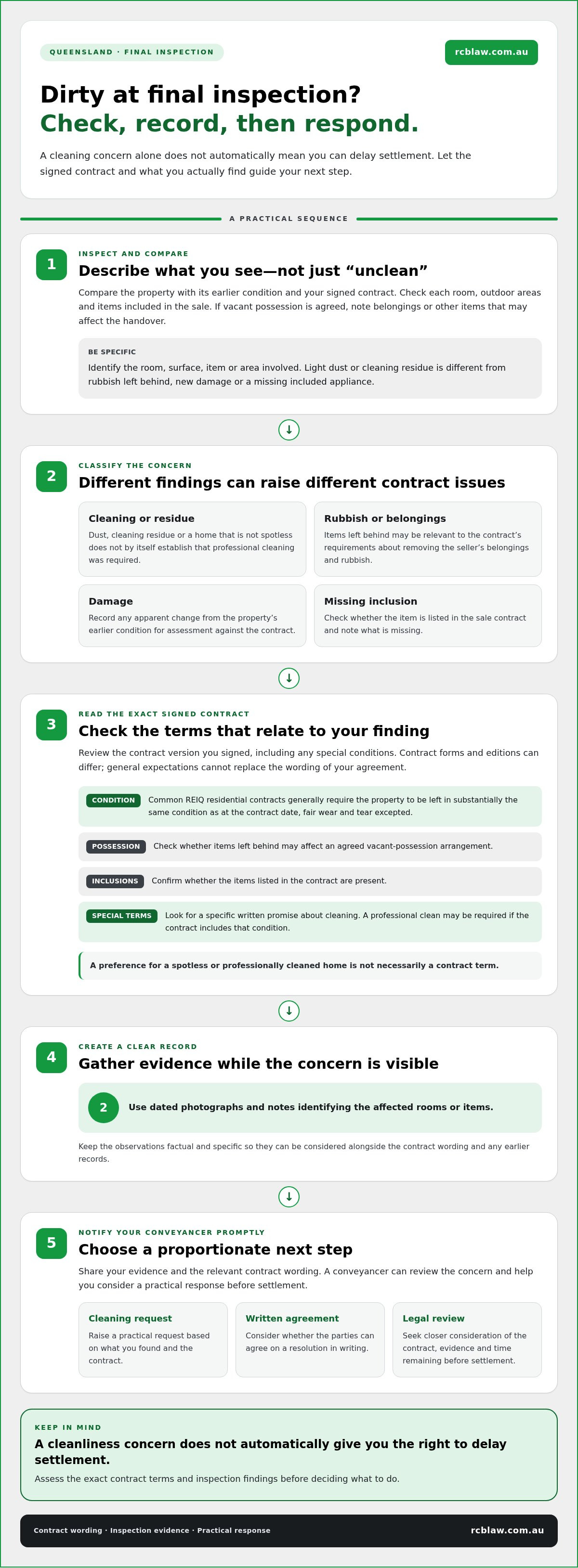
A clear record helps your conveyancer assess the concern against your contract. If you’re unsure what if the property is not clean at final inspection, follow a simple sequence: inspect, document, compare, notify and get advice. Focus on what you observed rather than assumptions about responsibility.
- Inspect: Check the rooms, outdoor areas and included items. Note where you found each concern.
- Document: Take clear, dated photographs or video and write down what each image shows.
- Compare: Review the relevant contract terms and any earlier inspection records or written promises.
- Notify: Send the information to your conveyancer or solicitor promptly, especially as settlement approaches.
- Get advice: Ask your legal representative to assess the issue and communicate it through the appropriate transaction channel.
How should you document the cleanliness problem?
Take photographs that show both the specific issue and enough of the surrounding area to identify its location. For example, photograph rubbish in the garage and note that it is in the rear-left corner, rather than simply recording “the property is dirty.” Keep earlier inspection records so the condition can be compared where relevant.
Describe observable facts, not conclusions about cause or legal responsibility. Save your inspection notes, emails, messages and any written response together. A clear record helps your conveyancer review the concern without having to piece together details from memory.
Who should you notify and how quickly?
Contact your conveyancer or solicitor as soon as you can after identifying an issue. Send the relevant contract details along with your notes and evidence. Your legal representative can consider the wording and communicate the concern through the appropriate channel, helping avoid rushed or unclear messages between the parties.
Timing matters because there may be limited opportunity to clarify a proposed remedy before settlement. If the parties agree on a practical step, ask for the scope and timing to be confirmed in writing. For more context on the transaction process, read this Queensland conveyancing guide.
For help reviewing a final-inspection concern and your contract, speak with RCB Law about your conveyancing matter.
How RCB Law Can Help With a Queensland Final-Inspection Concern
A final-inspection concern can be difficult to assess when settlement is close. A conveyancing lawyer can review your signed contract alongside the evidence you have gathered, helping distinguish a cleaning preference from a concern that may relate to the property’s condition, vacant possession, an inclusion or a written promise.
The right response depends on the contract, what you found and how much time remains. RCB Law has more than 30 years of experience in residential conveyancing across Brisbane and the Sunshine Coast. Its conveyancing guidance can help you understand the relevant terms, communicate the issue through the appropriate channel and consider practical next steps before making a settlement decision.
What information helps your conveyancer assess the issue?
Share the signed contract, any special conditions and the settlement date. Add clear inspection photographs or video, earlier condition records if available, and a concise description of what you observed and where. If the concern involves a missing item, identify the relevant inclusion in the contract.
Include any written discussion or agreement about cleaning, vacant possession or items to remain at the property. A complete record gives your conveyancer useful context and helps them focus on the contract terms that may matter. If you’re unsure what if the property is not clean at final inspection, providing the facts early can help move the discussion from uncertainty to an informed assessment.
Get clear advice before deciding what to do
General information can help you understand the issue, but it cannot determine your rights under an individual contract. Do not assume that an untidy property automatically gives you the right to postpone settlement, withhold funds or require professional cleaning. A legal review can consider the wording, evidence and time available, then help you weigh a proportionate response.
That support may include explaining which contract terms are relevant and communicating your concern to the seller’s representative. If the parties reach an agreement, your conveyancer can help ensure its terms are recorded clearly. This reduces confusion about what action is expected and when, while keeping the focus on completing the transaction appropriately.
If a final-inspection issue is causing concern, get tailored Queensland conveyancing guidance before changing settlement plans. Speak with RCB Law about your Queensland conveyancing.
Take Your Next Step With Confidence
If you’re asking what if the property is not clean at final inspection, start with the contract, not assumptions about what a seller should do. The property’s condition, any agreed cleaning terms and the evidence from your inspection all matter. Record what you found and tell your conveyancer promptly, especially as settlement approaches.
A cleanliness concern does not automatically give you the right to delay settlement or require a professional clean. The sensible next step depends on the contract and circumstances. Reviewing the terms and communicating clearly can help you understand your options before making a decision that may affect settlement.
RCB Law brings more than 30 years of legal experience to residential conveyancing matters across Brisbane and the Sunshine Coast. For practical guidance on your Queensland property transaction, speak with RCB Law about your Queensland conveyancing.
With clear advice and a measured approach, you can address the concern and move forward with greater confidence.
Frequently Asked Questions
Can I refuse to settle if the property is not clean at final inspection?
Not automatically. A cleanliness concern alone does not necessarily give you the right to refuse or delay settlement. Your rights depend on the signed contract, the condition you find and any relevant written agreements. Before changing settlement arrangements or withholding funds, contact your conveyancer or solicitor. They can review the contract and evidence, explain the risks and help you communicate with the seller’s representative.
Does the seller have to professionally clean the property before settlement in Queensland?
Generally, a seller is not automatically required to arrange a professional clean unless the contract says so. A standard REIQ contract may address the property’s condition and removal of the seller’s belongings and rubbish, but contract forms, editions and special conditions can differ. Check your signed agreement for an express cleaning promise. Your conveyancer can help interpret the relevant terms and how they apply to your inspection findings.
Can I ask the seller to arrange cleaning before settlement?
Yes, you can ask, but the seller may not be contractually obliged to agree. A polite, specific request can be a practical approach for a minor, fixable issue, such as rubbish left in a room. Raise it promptly through your conveyancer or solicitor. If the seller agrees to clean or remove items, record in writing what will be done and by when to avoid different expectations.
When can I carry out the final inspection in Queensland?
The timing depends on your contract and the arrangements made for access. Check the relevant terms and confirm the inspection time through the appropriate transaction channel rather than assuming there is one fixed inspection day for every purchase. Plan to inspect close enough to settlement to identify concerns, while leaving time to notify your conveyancer and discuss next steps. Your conveyancer can clarify the process for your transaction.
What should I do if I find rubbish or damage at the final inspection?
If you’re asking what if the property is not clean at final inspection, document exactly what you find and contact your conveyancer promptly. Take clear, dated photos, note the affected areas and distinguish rubbish from damage or missing inclusions. Compare the issue with your contract and any written agreements. Do not assume you can delay settlement or require a particular remedy without advice on your circumstances.
Can I ask for money off the purchase price because the property is dirty?
You can propose a price adjustment, but the seller must agree to any change. A dirty property does not automatically entitle you to deduct an amount from settlement funds or reduce the purchase price. Raise the proposal through your conveyancer, who can consider the contract and help communicate with the seller’s representative. Put any agreed change in writing, and get legal advice before altering settlement payments.
What if the seller refuses to clean the property before settlement?
If the seller refuses, send your conveyancer the inspection evidence, relevant contract terms and any written cleaning promise. They can assess whether the facts may raise a contractual issue and discuss proportionate options with the seller’s representative. The available response depends on the agreement and timing. Do not cancel, withhold funds or delay settlement on your own. Get advice before taking any step that could affect completion.


