
Selling a property is one of the most significant financial milestones you'll experience. But alongside the excitement, there's often a wave of uncertainty, especially when it comes to understanding your obligations around capital gains tax. The official rules can feel overwhelmingly complex, leaving you with pressing questions: Does this apply to my family home? What happens if I calculate it incorrectly? Am I paying more than I need to?
We understand this process can be stressful. That’s why we’ve created this simple guide to replace confusion with confidence. Here, we will break down exactly how CGT works in Australia, providing clear answers and practical steps. You will learn how to determine if CGT applies to your sale, a straightforward method for calculating what you might owe, and actionable strategies to legally minimise your tax bill, ensuring you can navigate your property transaction with complete peace of mind.
What is Capital Gains Tax (CGT)? A Plain English Explanation
Navigating the world of property and tax can feel overwhelming. We understand that terms like 'capital gains tax' can sound complex, but the concept is quite straightforward. Simply put, Capital Gains Tax (CGT) is the tax you pay on the profit-or 'capital gain'-you make when you sell a valuable asset.
It’s important to know that it isn't a separate tax with its own rate. Instead, the gain is added to your income for the year and taxed at your marginal rate. While it most commonly applies to property, it also affects assets like shares and managed funds. The system of Capital gains tax in Australia is triggered by a 'CGT event,' with the sale of an investment property being the most frequent example for homeowners and investors.
How CGT Works for Property in Australia
When you sell an investment property in Australia, the process is integrated into your annual tax obligations. You must calculate your net capital gain and report it in your income tax return for that financial year. The Australian Taxation Office (ATO) then adds this amount to your assessable income. This means the tax you pay on the gain is determined by your personal marginal tax rate-the higher your income, the higher the rate applied to your capital gain.
Key Terms You Need to Know
To confidently calculate your position and ensure there are no surprises, it helps to understand three essential terms. Getting these right is the foundation of correctly managing your CGT obligations.
- Capital Proceeds: This is the total amount of money you receive from the sale of your property, less any agent or legal fees directly related to the sale.
- Cost Base: This includes the original purchase price of the property plus certain other costs associated with buying, holding, and selling it, such as stamp duty, legal fees, and the cost of major improvements.
- Capital Gain or Loss: This is the difference between your capital proceeds and your cost base. If your proceeds are higher, you have a capital gain. If your cost base is higher, you have a capital loss, which can be used to offset future capital gains.
The Main Residence Exemption: Is Your Family Home CGT-Free?
For most Australian homeowners, the most significant relief from capital gains tax is the main residence exemption. We understand that the rules can seem complex, but this exemption is designed to ensure you don't pay tax on the profits from selling your family home. Getting clear guidance on these rules is crucial for a stress-free property sale. The Australian Taxation Office provides a comprehensive ATO guide to Capital Gains Tax, which outlines the conditions for this important exemption.
When is Your Home Fully Exempt from CGT?
To receive a full exemption from CGT when you sell your property, it must have been your main residence and meet several key conditions. Your home is generally considered exempt if:
- It has been the home for you, your partner, and your family for the entire period you have owned it.
- It has not been used to produce assessable income, which means you haven't run a business from it or rented out any part of it.
- It is situated on land of two hectares or less.
If you meet these conditions, the profit from your sale is entirely tax-free.
Partial Exemptions: When You May Still Owe CGT
Life changes can affect your exemption status. You may only be entitled to a partial exemption if you used your home to produce income. A common scenario is moving out and renting the property. Under the '6-year rule', you can continue to treat the home as your main residence for up to six years after you move out, provided you don't nominate another home as your main residence. If you rent it out for longer than six years or use a portion of your home exclusively for business, CGT will likely apply to that period or portion.
CGT on Investment Properties
It is important to be clear: the main residence exemption does not apply to investment properties. Any property you have purchased solely for rental income or as a long-term investment is fully subject to capital gains tax upon sale. However, if you have owned the investment property for more than 12 months, you may be eligible for the CGT discount, which can reduce your taxable capital gain by 50%.
How to Calculate CGT on Property: A Step-by-Step Guide
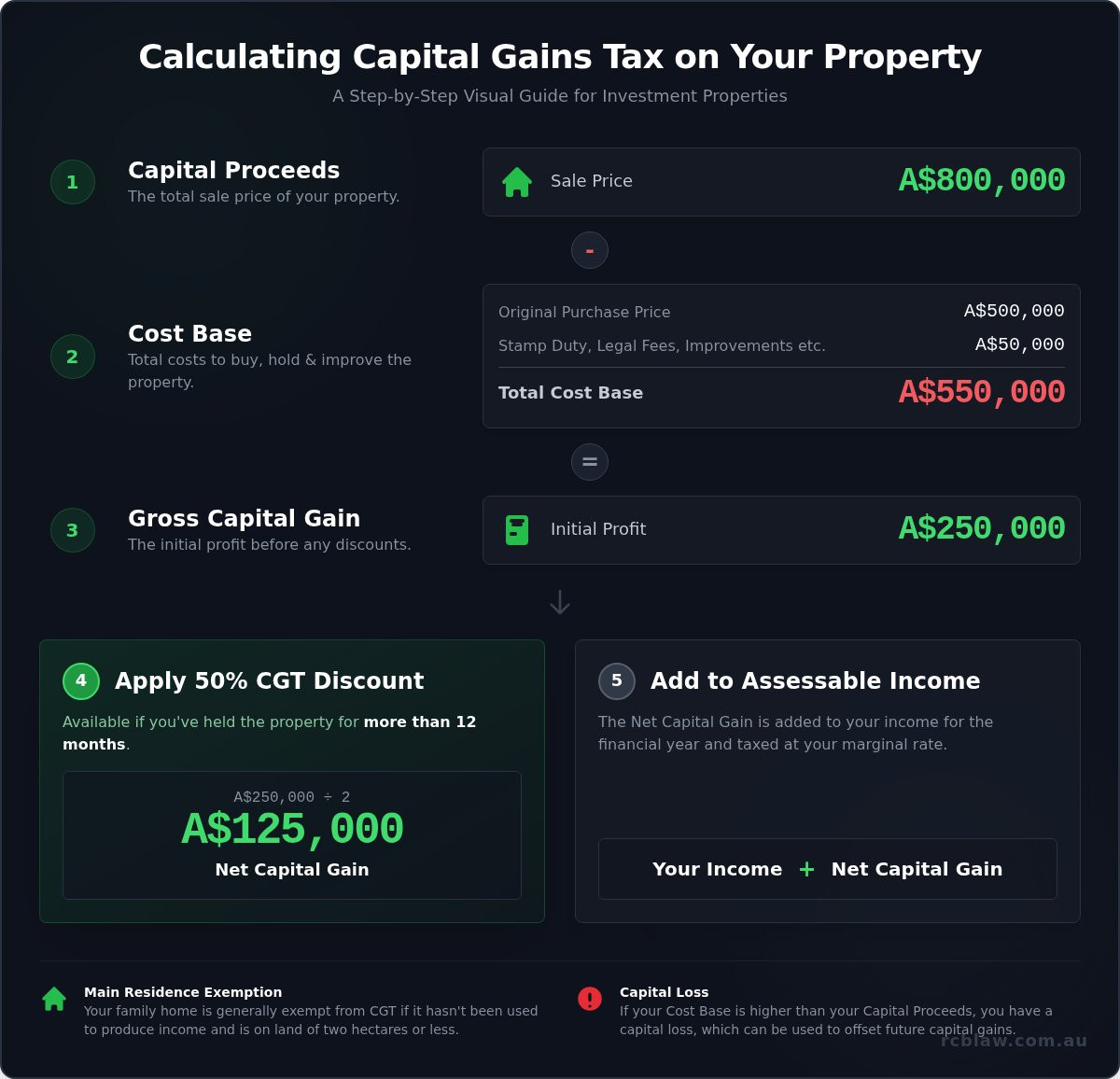
We understand that tax calculations can feel complex, but determining your capital gains liability follows a logical, four-step process. The most critical element is keeping meticulous records of every cost associated with your property from the day you acquire it. It's also vital to remember that for capital gains tax purposes, the 'CGT event' occurs on the date you sign the sale contract, not the final settlement date.
While this guide provides a clear framework, we always recommend referring to the official ATO guidelines on property and CGT for comprehensive details specific to your situation. Let's walk through a simple example.
Step 1: Calculate Your Capital Proceeds
Your capital proceeds are the total amount you receive from the sale. This is typically the property's sale price, which is the gross amount before any agent commissions or other selling costs are deducted. In rare cases, it could also include an insurance payout if the asset was destroyed.
- Example: You sign a contract to sell your investment property for A$800,000. This is your capital proceeds.
Step 2: Determine the 'Cost Base' of Your Property
The 'cost base' is what the property cost you to acquire, hold, and improve. It starts with the original purchase price and includes other essential expenses that add to its value. These costs typically include:
- Stamp duty paid on the purchase
- Legal and conveyancing fees
- Agent commissions on purchase or sale
- Major capital improvements, like a significant renovation (e.g., a new kitchen or extension).
Example: You paid A$500,000 for the property, plus A$20,000 in stamp duty and A$30,000 in other eligible costs (like legal fees and a new kitchen). Your total cost base is A$550,000.
Step 3: Calculate the Gross Capital Gain
Your gross capital gain is calculated with a simple formula: Capital Proceeds minus the Cost Base. If the result is a negative number, you have made a capital loss, which can be used to offset other capital gains you might have now or in the future.
- Example Calculation: A$800,000 (Capital Proceeds) - A$550,000 (Cost Base) = A$250,000 (Gross Capital Gain)
Step 4: Apply Discounts and Concessions
If you are an individual and have owned the property for more than 12 months, you can generally apply the 50% CGT discount. This significantly reduces the taxable amount. The discount halves your gross capital gain, and the remaining amount is added to your taxable income for that financial year.
- Example Calculation: A$250,000 (Gross Gain) x 50% = A$125,000 (Net Capital Gain)
In this scenario, A$125,000 is added to your income and taxed at your marginal rate. Please note that companies and trusts are subject to different rules.
Strategies to Legally Minimise Your CGT Liability
Navigating your tax obligations can feel overwhelming, but with careful planning, you can legally reduce your capital gains tax liability. This isn't about tax evasion; it's about making smart, informed decisions using the provisions available to every property owner. Proactive strategies and clear guidance can make a significant difference to your final tax bill.
Time Your Sale Strategically
Timing is a powerful tool. In Australia, if you own an investment property for at least 12 months before selling, you may be eligible for a 50% discount on your capital gain. Furthermore, consider which financial year the sale contract is signed in. A sale in late June places the gain in the current financial year, while a sale in early July defers it to the next. This can be advantageous if you anticipate having a lower personal income in the following year.
Keep Meticulous Records to Maximise Your Cost Base
Your property's 'cost base' is more than just its purchase price. Every eligible expense you add to this base directly reduces your taxable capital gain. We understand that keeping track of paperwork over many years can be a challenge, but it is crucial for an accurate capital gains tax calculation. Be sure to keep detailed records of:
- The original purchase contract and associated costs like stamp duty.
- Legal and conveyancing fees for both buying and selling.
- Costs of major capital improvements (e.g., a new kitchen or extension), not general repairs.
- Real estate agent's commission and advertising costs upon sale.
Use Capital Losses to Offset Capital Gains
If you've made a capital loss on another asset, such as shares, you can use that loss to reduce your capital gain from the property sale. You must apply any capital losses against capital gains in the same financial year first. If your losses exceed your gains, the remaining net capital loss isn't wasted-it can be carried forward indefinitely to offset against future capital gains.
When to Seek Professional Advice
While these strategies provide a strong foundation, property tax law can be complex. Situations involving inherited properties, a change in property use (from main residence to rental), or calculating a partial exemption require expert guidance to ensure compliance and accuracy. Getting it wrong can be a costly mistake. Our property law experts can provide clarity and peace of mind.
Special CGT Situations: Inheritance, Divorce, and Foreign Residents
Life is rarely straightforward, and major events like the death of a loved one, a relationship breakdown, or moving overseas can add significant complexity to your financial obligations. We understand these can be stressful times, and navigating the nuances of capital gains tax is often the last thing on your mind. This section provides a clear, high-level overview of these special situations to help you understand the key principles involved.
However, the information below is a guide only. These scenarios almost always require specialised legal and tax advice to ensure you meet your obligations and protect your financial position.
CGT on Inherited Property
When you inherit a property, the standard cost base rules do not apply. Instead, the property's value at the date of the original owner's death is often used to calculate your future capital gain or loss. Key considerations include:
- Pre-CGT Assets: If the deceased acquired the property before 20 September 1985, you may be exempt from CGT when you sell it.
- Main Residence Exemption: If the property was the deceased's main residence, you may be entitled to a full exemption if you sell it within two years of their death.
Relationship Breakdowns and Property Transfers
The Australian tax system provides relief to prevent a divorce or separation from triggering an immediate CGT liability. The 'marriage or relationship breakdown rollover' allows property to be transferred from one partner to another without incurring capital gains tax at that time. Instead, the tax obligation is deferred until the receiving partner eventually sells the asset. This rollover is not automatic; it must be part of a formal arrangement, such as a court order or a binding financial agreement.
Rules for Foreign Residents Selling Australian Property
The rules for foreign residents are significantly different and stricter. Generally, a foreign resident is not entitled to claim the main residence exemption on the sale of their Australian property, even if they lived in it previously. Furthermore, when a foreign resident sells Australian real estate valued at A$750,000 or more, the purchaser is required by law to withhold a percentage of the sale price and pay it directly to the Australian Taxation Office (ATO). This is known as the Foreign Resident Capital Gains Withholding (FRCGW).
Navigating these complex life changes requires more than just an understanding of the law; it requires compassionate and practical guidance. For expert advice tailored to your unique circumstances, the team at RCB Law is here to help you move forward with confidence.
Navigate Your CGT Obligations with Confidence
Mastering the details of property tax is a crucial step in protecting your investment. This guide has shown that understanding key concepts-like the main residence exemption and how to calculate your liability-is essential. By applying smart, legal strategies, you can significantly reduce what you owe, ensuring you keep more of your hard-earned profit. While the rules surrounding capital gains tax can seem daunting, especially in unique situations like divorce or inheritance, you are now better equipped to handle them.
We understand that even with a guide, applying these rules to your personal circumstances can be stressful. At RCB Law, our specialty is making complex legal matters simple and clear. With over 30 years of dedicated experience in Queensland property law, our team provides the support you need. We offer peace of mind with services like fixed-fee conveyancing for complete cost certainty. Navigating property tax can be stressful. Let our expert team provide clear, practical guidance. Take the next step with confidence, knowing you have an expert on your side.
Frequently Asked Questions
When do I have to pay Capital Gains Tax?
Capital Gains Tax (CGT) is payable in the financial year a CGT event occurs, most commonly when you sign the contract to sell your property. The tax isn't a separate bill; instead, the calculated gain is added to your assessable income for that year and included in your annual income tax return. We understand this can be a source of stress, but planning for this event when you sell ensures you can manage the process smoothly and without surprises.
Is my family home always exempt from CGT?
Generally, your main residence is exempt from CGT. However, this full exemption can be lost if certain conditions apply. For example, if you have used part of your home to run a business, or if you have rented it out for a period, you may have a partial CGT liability. Navigating these rules can be complex, and obtaining clear guidance is essential to ensure you meet your obligations correctly and avoid any unexpected tax issues down the track.
What happens if I make a capital loss on my property?
If you sell a property for less than its cost base, this results in a capital loss. You cannot deduct this loss from your regular income, like your salary. Instead, the loss can be used to offset capital gains from other assets in the same year. If you have no other gains, the loss can be carried forward indefinitely to reduce capital gains in future years. Meticulous record-keeping is crucial for claiming these losses correctly.
Can I avoid CGT by gifting my property to my children?
Gifting a property to a family member, including your children, is still considered a CGT event by the Australian Taxation Office (ATO). The transfer is treated as if you sold the asset at its current market value. This means you will still need to calculate and potentially pay capital gains tax based on that valuation, even if no money changes hands. We can provide the clear support you need to navigate this process for your family.
How long do I need to keep records for CGT purposes?
You must keep records related to your property for at least five years after the financial year in which you sell it and report the CGT event in your tax return. This includes contracts of sale, receipts for improvements, and legal fees. Given that property is a long-term asset, we recommend keeping these documents securely for the entire period of ownership, plus the legally required five years, to ensure you can accurately calculate your cost base when the time comes.
Does CGT apply to a deceased estate?
The tax implications for a deceased estate can be complicated. Generally, if a beneficiary inherits a property that was the deceased's main residence and sells it within two years, it may be exempt from CGT. However, if the asset was an investment property, CGT will likely apply when the beneficiary eventually sells it. We understand this is a difficult time and can offer compassionate, practical guidance to help you manage these responsibilities.
What's the difference between Land Tax and Capital Gains Tax?
Land Tax and capital gains tax are two entirely different taxes. Land Tax is an annual state government tax based on the value of land you own that is not your main residence. In contrast, Capital Gains Tax is a federal tax managed by the ATO. It is only triggered when you sell or dispose of an asset and is calculated on the profit (the capital gain) you make. Understanding this distinction is a key part of successful property investment.


