
What if the person you trust to carry out your wishes is difficult to reach when your family needs answers? Knowing how to choose an executor for your will qld involves more than selecting someone close to you. Their communication style, availability and ability to manage a demanding responsibility matter too.
If an executor stops responding, it’s understandable to worry that the estate is being mishandled or that asking for an update could deepen family tensions. Silence alone doesn’t reveal what’s happening, so a calm, clear request is often a sensible first step. The right approach depends on the circumstances and stage of estate administration.
This article explains what an executor may need to do, which qualities to consider when choosing one, and how to request an update in a measured, documented way. It also outlines when Queensland-specific legal advice may help address concerns. Careful will planning includes considering a suitable executor and backup arrangements, while a review of an existing will can help you check whether your choices still reflect your wishes.
Key Takeaways
- An executor’s communication habits are part of their suitability, and a delay in responding doesn’t by itself prove that anything is wrong.
- When considering how to choose an executor for your will qld, weigh trustworthiness alongside availability, organisation, judgement and clear communication.
- Compare potential executors against the same practical criteria, including their willingness to take on the responsibility.
- If an executor stops responding, take measured steps: review previous updates, make a clear written request, allow reasonable time and keep records.
- Planning ahead means naming a preferred executor and alternate, and considering the communication expectations that matter to you.
What an Executor Does in Queensland, and Why Communication Matters
Waiting for information while important practical matters are being handled can be unsettling. But a delay or period of silence doesn’t, on its own, show that an executor is acting improperly. They may be locating records, confirming what the estate owns and owes, or managing steps that take time. Understanding the role can help you distinguish a slow process from a concern that needs a measured response.
An executor is the person named in a will to administer the deceased person’s estate and carry out the will’s directions. The role differs from that of a beneficiary: an executor manages the estate, while a beneficiary is entitled to receive a gift or share under the will. As a general overview, the Role of an Executor involves administering a deceased person’s affairs under the authority given by the will and applicable law.
What does an executor do after someone dies?
The executor needs to locate the will, identify the estate’s assets and liabilities, and take steps to administer the estate in line with the will. Depending on the circumstances, this may involve securing property, contacting financial institutions, paying valid debts and expenses, and arranging distribution to beneficiaries. The work can involve information from different organisations and careful record-keeping.
Probate is a grant from the Supreme Court of Queensland that may be needed to confirm an executor’s authority. It isn’t automatically required for every estate. Whether it’s needed can depend on the assets involved and the requirements of organisations holding them. An estate with property, multiple accounts, business interests or complex records may take longer to administer than a straightforward one. Waiting for information or a necessary step to be completed can explain a delay without proving wrongdoing.
What can beneficiaries reasonably expect to hear?
Beneficiaries can reasonably seek clear, appropriate information about progress. For example, they may ask whether the executor has located the will, whether key assets are being identified, or whether an outstanding issue is affecting timing. There isn’t one communication timetable that fits every estate. The estate’s complexity, what has already been completed and what remains to be resolved all matter.
An executor’s role is to administer the estate under the will, not to meet every beneficiary’s preferred timetable for updates or payment. Asking for a brief status update is different from demanding immediate distribution. The estate may not be ready to distribute, and the executor may need to complete administration steps first.
Some information may be private or sensitive, or not yet available while matters are being resolved. An executor may need to balance a beneficiary’s request for clarity with the estate’s administration and relevant legal obligations. If you’re considering how to choose an executor for your will qld, include communication in your assessment alongside trustworthiness and practical availability. A considerate request for an update can often clarify what is happening without escalating family tension.
How to Choose an Executor for Your Will in Queensland
Choosing an executor is both a practical and a personal decision. Someone may know you well and care deeply about your family, yet have limited time or feel uncomfortable managing paperwork and difficult conversations. A useful way to approach how to choose an executor for your will qld is to assess how someone is likely to manage the responsibility, not just how close you are.
Which qualities matter most in an executor?
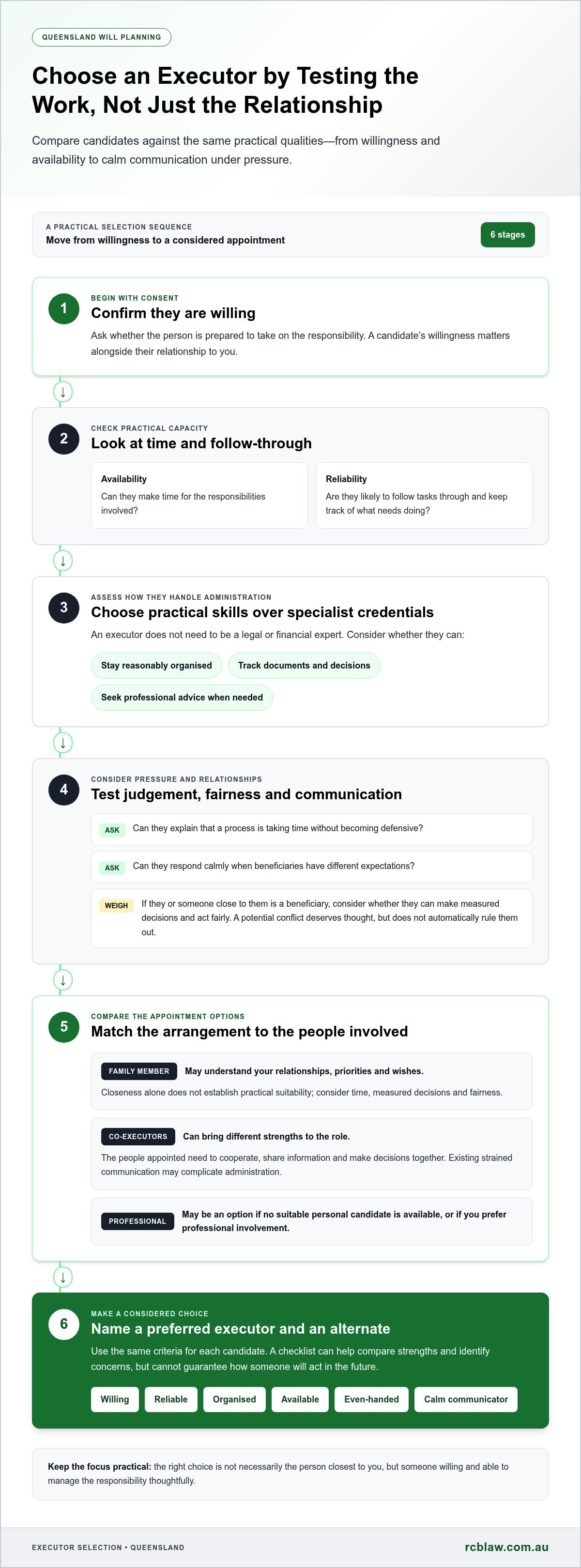
Consider whether your preferred person is willing to take on the role and able to follow tasks through. They don’t need to be a legal or financial expert. They should be reasonably organised, able to keep track of documents and decisions, and comfortable seeking professional advice when a question is beyond their knowledge.
Think about how they communicate under pressure. Could they explain that a process is taking time without becoming defensive? Could they respond calmly if beneficiaries have different expectations? These questions matter because an executor may need to handle sensitive conversations as well as administrative work.
A suitable executor is willing, reliable, organised, available, even-handed and able to communicate calmly. No checklist can guarantee how someone will act in the future, but it can help you compare practical strengths and identify concerns before making an appointment.
Should you appoint a family member, co-executor or professional?
A family member may understand your relationships, priorities and wishes, which can be helpful. But closeness alone doesn’t establish practical suitability. Consider whether the person has time, can make measured decisions, and can act fairly if they or someone close to them is also a beneficiary. A potential conflict doesn’t automatically rule someone out, but it deserves careful thought.
Appointing co-executors can bring different strengths to the role, such as one person’s knowledge of family circumstances and another’s organisational skills. The arrangement also depends on both people being able to cooperate, share information and make decisions together. If communication between them is strained now, consider whether that could complicate administration later.
A professional executor may be an option if you don’t have a suitable personal candidate or would prefer professional involvement. The scope of their role, how decisions are made and any fees depend on the arrangement. Clarifying those details as part of your planning can help you decide whether this option fits your circumstances.
Before naming anyone, discuss the responsibility with them. A direct conversation can reveal whether they’re willing and give you the chance to explain your expectations about updates, record-keeping and seeking advice. If you’re preparing a will or reconsidering an existing appointment, will drafting and review can help you consider executor suitability and backup arrangements as part of your planning.
How to Compare Executor Candidates Before Naming One
When two or more people seem capable, comparing them against the same criteria can make the choice clearer. It also helps you look beyond instinct or family expectations. The aim isn’t to find a flawless candidate, but to identify who is best placed to carry out your wishes in your circumstances.
Use the table as a discussion guide, not a scorecard. The example assessments are hypothetical: a person’s circumstances and behaviour matter more than their relationship to you.
| Criterion | Candidate A | Candidate B |
|---|---|---|
| Availability | Has time to respond and follow up | Work or caring commitments may limit capacity |
| Organisation | Keeps records and handles paperwork reliably | May need support to manage documents |
| Communication | Comfortable giving calm, considered updates | Hasn’t yet discussed communication expectations |
| Impartiality | Can consider beneficiaries’ interests fairly | A perceived conflict may need careful thought |
| Willingness | Understands the role and is willing to accept it | Needs time and information before deciding |
How do you assess availability and communication?
Consider practical realities, not just good intentions. Distance may affect how easily someone can deal with in-person tasks, while work, health or caring commitments may limit the time they can give. Circumstances can change, so consider whether the person is likely to remain reachable and keep you informed over time.
Discuss the role before naming a candidate. You might explain that you value a brief update when there’s progress or a delay, then ask how they’d feel about handling paperwork and sharing difficult news with beneficiaries. Their response can show whether they understand the communication involved and feel comfortable with it.
How should you weigh family dynamics and conflicts?
Consider how beneficiaries might view the appointment, particularly if the proposed executor is also a beneficiary or has a close connection with one. That relationship alone doesn’t make someone unsuitable. Focus instead on whether they can make decisions fairly, explain their reasoning respectfully and keep conversations from becoming personal disputes.
For example, one candidate may be highly organised but involved in a sensitive disagreement; another may be less familiar with the family but have more time and a calm communication style. Neither profile is automatically the better choice. Weigh the practical strengths and possible tensions together.
A short private note about why you chose a candidate, and what mattered in your comparison, can help you revisit the decision later. It’s a planning aid, not a legal requirement. How to choose an executor for your will qld ultimately depends on your wishes, the people involved and the circumstances you’re planning for. Reconsider your choice if those circumstances change.
What to Do If an Executor Is Not Communicating
Receiving no reply can be stressful, especially when you’re unsure what is happening with an estate. Start with a measured approach. A missed message or slow response doesn’t establish misconduct, and a clear, documented request may resolve a misunderstanding without escalating family tension.
Consider these steps in order:
- Review previous updates. Check letters, emails and messages for information about the estate’s progress, any outstanding issue or an expected next step. You may find that a delay has already been explained or that a specific question hasn’t yet been answered.
- Send a clear written request. Ask about one or two specific matters, such as whether an asset has been identified or whether there’s an issue affecting progress. Keep the tone courteous and include relevant dates so the executor can understand what you’re following up on.
- Allow reasonable time for a response. Set a practical timeframe that reflects the question and circumstances. There’s no single period that suits every situation. Avoid sending repeated messages in quick succession if the executor needs time to gather accurate information.
- Keep a record. Save your request and any reply, and note when and how you tried to make contact. This creates a clear account of what you asked and when, should you need to explain the communication history later.
How can you make a clear, documented request?
A concise message is often more useful than a long, emotional account. For example: “I’m following up on my message of [date]. Could you please let me know whether the estate’s property has been identified and whether anything is currently affecting progress? An update by [date] would help me understand the next steps.” Choose a response date that’s reasonable for the information requested.
Stick to what you know. Avoid threats, accusations or public allegations based only on unanswered messages. Those steps can intensify family conflict and distract from the information you need. If there’s a misunderstanding, a neutral written request gives the executor an opportunity to clarify.
When should you seek Queensland legal advice?
Consider getting Queensland-specific legal advice if silence continues after a clear follow-up, if you become aware of a possible conflict, or if you have a concrete concern about estate assets. Keep relevant documents and a timeline of contact attempts together. Advice can help you understand what options may be appropriate in light of the will, available evidence and the estate’s circumstances.
Legal remedies, court applications and any question of removing an executor depend on the facts and current Queensland law. Court action isn’t automatic, and no particular result can be assumed from silence alone. Don’t treat a general guide as a decision about what to do in a specific estate.
If this experience has prompted you to reconsider the person named in your own will, arrange a review of your existing will so executor suitability and backup arrangements can be considered as part of your planning.
Plan Your Queensland Will With Executor Communication in Mind
Executor choice is easier to revisit before circumstances become urgent. A move, a change in health, new caring responsibilities or shifts in family relationships can affect whether your current appointment still makes sense. Reviewing your will gives you a chance to consider not only who could manage the role, but also how you’d like them to communicate with the people affected.
What should you prepare before reviewing your will?
A short preparation list can keep the discussion focused. Note your preferred executor and an alternate, then consider what you know about their current circumstances. Someone who was available when you made your will may now have significant work or caring commitments, or live further away.
- Your preferred executor and an alternate candidate.
- Any changes in their availability, health, location or relationship with you.
- Questions about beneficiaries, competing interests or potential family sensitivities.
- Your expectations for updates, including how you’d like delays or difficult decisions communicated.
- Any questions about how the will reflects your wishes and the people you want to provide for.
These notes don’t need to resolve every issue. They can help you explain why you’re considering a change and identify matters that need careful thought. For broader context on will planning, the guide Why You Need a Will: A Comprehensive Guide for Queenslanders can help you think through the decisions a will is intended to record.
Be realistic about communication expectations. You might want an executor who provides considered updates, but the timing and detail may depend on what is happening with the estate. Discussing your preferences in advance can help a prospective executor understand what the role may involve.
How can legal guidance make the decision clearer?
Preparing a will is an opportunity to record your choices clearly and consider whether an alternate appointment would provide a practical backup. If you already have a will, a review can help you reconsider whether the named executor still suits your circumstances and wishes. It can also give you a chance to raise questions about the wording of your will and the arrangements you want it to put in place.
RCB Law assists with will drafting and provides a complimentary review of existing wills. With more than 30 years of legal experience, the firm works with clients across Brisbane, the Sunshine Coast and Redland Bay. A conversation about your circumstances can help bring your executor choice, backup arrangements and communication expectations into clearer focus.
If you’re ready to review your arrangements or prepare a will, Discuss your will with RCB Law.
Make Your Executor Choice With Confidence
Your will can do more than record who receives your estate. It can reflect the care you’ve taken to choose someone prepared to act responsibly and communicate respectfully. As you consider how to choose an executor for your will qld, think about whether your appointment still fits the people and circumstances in your life now.
If you’re uncertain, you don’t need to resolve every detail alone. A considered discussion can help you explore your options, check whether your current arrangements reflect your wishes and decide what to review next. Taking this step now may make your intentions clearer for the people who’ll rely on them later.
RCB Law brings more than 30 years of legal experience to will drafting and complimentary reviews of existing wills, serving clients across Brisbane, the Sunshine Coast and Redland Bay. Start a conversation about your will and take a steady next step towards arrangements that feel right for you.
Frequently Asked Questions
Can an executor ignore beneficiaries in Queensland?
An executor shouldn’t treat reasonable questions about estate administration as irrelevant, but beneficiaries aren’t necessarily entitled to every document or detail they request. For example, an executor may need to protect confidential information or wait until figures are confirmed before giving a reliable answer. If you’re concerned, ask a focused question about how the will’s administration affects you, and consider the response in context rather than assuming silence proves improper conduct.
What should I do if an executor is not responding?
If an executor isn’t responding, start by checking earlier correspondence for an update or explanation. Then send one courteous written message identifying the issue and asking for a practical update by a reasonable date. Keep the message and any reply. If your question concerns a particular asset, explain why you’re asking. Persistent silence or specific concerns about estate property may call for advice about the next appropriate step.
How long can an executor take to reply in Queensland?
There isn’t a universal reply period that applies to every beneficiary enquiry in Queensland. A simple question may be answered quickly, while a request involving unconfirmed valuations, records or input from others may take longer. If you need a response for a particular reason, explain that in your message and suggest a reasonable date. If that date passes without an answer, follow up calmly and retain a record of the exchange.
Can a beneficiary ask an executor for an update?
Yes, a beneficiary can ask for an update about matters relevant to their interest in the estate. Make the request specific: for instance, ask whether a particular asset has been identified or whether an unresolved issue affects the next step. A request for information isn’t the same as insisting on immediate payment. The executor may need to consider privacy and the estate’s circumstances before deciding what information can appropriately be shared.
Can an executor be removed for not communicating?
Not necessarily. Lack of communication alone doesn’t mean an executor will be removed, and a court application isn’t an automatic remedy. The appropriate response may depend on the seriousness and duration of the silence, evidence of other problems, the will and the estate’s circumstances. If you’re considering removal or court action, get Queensland legal advice before acting. A lawyer can assess the facts and explain what options may be available.
Can I appoint two executors in Queensland?
You can name more than one executor in a will, but consider how the people will work together before choosing this arrangement. For example, two candidates with complementary skills may offer useful perspectives, but disagreement or difficulty coordinating decisions can create extra complexity. Discuss the appointment with both people and consider whether they can communicate and cooperate. The will’s wording and your circumstances matter, so obtain advice if you’re unsure how to structure the appointment.
Should I choose a family member as my executor?
A family member may be a good choice if they’re willing, capable and able to act fairly, but being related to you doesn’t automatically make them suitable. Consider whether they might feel caught between beneficiaries, especially if family members disagree about a decision. A trusted friend or another candidate may also suit your circumstances. The practical question is who can carry out your wishes with sound judgement, not who holds a particular family title.
Can I change my executor after making a will?
Yes, you can usually change your choice by updating your will through a properly prepared new will or an appropriate amendment. Don’t rely on an informal note or conversation to alter the appointment. Before making a change, consider whether your alternate is still suitable and whether other parts of the will need review too. If you’re unsure how to choose an executor for your will qld, legal guidance can help you consider your options and document your wishes clearly.


