
What if the rural property you plan to farm, build on or use as a retreat cannot legally support that use? A view and a promising block are only part of the picture. A thorough legal checklist for buying rural property sunshine coast buyers can use should connect each enquiry to their plans for the land.
If you’re unsure about zoning, legal access, water rights or easements, look beyond standard residential conveyancing checks. Rural properties can have arrangements or restrictions that aren’t obvious during an inspection. Water rights, for example, are separate from land ownership, so it’s important to establish what rights apply to the property.
This Queensland-focused guide explains what to investigate before contract conditions and deadlines expire, including planning controls, title interests, access, water and existing arrangements. It also explains how routine conveyancing checks differ from rural due diligence, and how a conveyancing lawyer can help clarify contract terms, raise property-specific enquiries and guide you through review and settlement.
Key Takeaways
- Use a legal checklist for buying rural property sunshine coast that reflects your plans for the land, rather than relying on standard residential checks alone.
- Choose title, planning, environmental and operational enquiries to suit the property and your intended use.
- Assess each finding by its practical effect on your lifestyle, hobby-farm or business plans before deciding how to proceed.
- Review the contract, track key dates and raise important enquiries promptly so you can address issues before deadlines pass.
- A conveyancing lawyer can help clarify contract terms, property-specific enquiries and the steps towards settlement.
Why buying rural property on the Sunshine Coast needs a tailored legal checklist
An acreage purchase can be less predictable than buying a suburban home. The land may look suitable for a home, orchard or small-scale business, yet the contract, title or planning controls can affect what you’re able to do. A legal checklist for buying rural property sunshine coast buyers can rely on starts with the specific parcel and the purpose behind the purchase, not assumptions based on its appearance or marketing.
Rural due diligence brings together checks of the title, contract, planning controls and property-specific matters. It helps you understand the recorded rights and restrictions, what the contract requires, and whether further investigation is needed for your plans. The Sunshine Coast includes a mix of coastal, hinterland and rural areas; the Sunshine Coast, Queensland Wikipedia page provides general regional context, but it can’t establish the rules for an individual property.
The right enquiries depend on the parcel, its location, your intended use and the contract terms. A concern isn’t automatically a deal-breaker. The important thing is to understand its effect on your plans before relevant contract dates pass.
Start with the property’s intended use
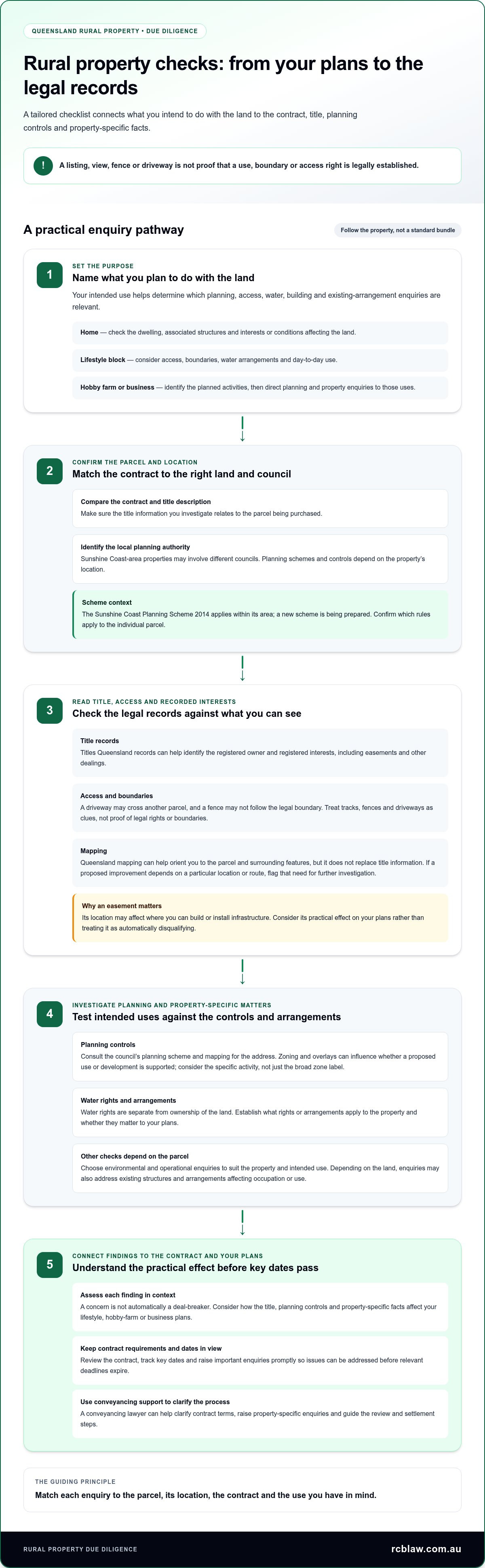
Be specific about your plans. Are you looking for a home, a lifestyle block, a hobby farm or a property for business use? Each goal can raise different questions about planning, access, water, buildings and existing arrangements. A listing description may help you picture the property, but it doesn’t establish that a particular use is legally permitted. Use your plans to decide which enquiries are relevant.
- Home: focus on the existing dwelling, associated structures and any conditions or interests affecting the land.
- Lifestyle block: consider access, boundaries, water arrangements and how you expect to use the land day to day.
- Hobby farm or business: identify the activities you intend to carry out, then direct planning and property enquiries to those uses.
Why rural land differs from a standard residential purchase
On larger blocks, access and boundaries can be harder to assess from a visit or listing. A driveway may cross another parcel, or a fence may not follow the legal boundary. Title and other relevant records can help clarify registered interests and access rights. Water also needs particular attention: legal water rights are separate from ownership of the land.
Rural due diligence means checking the legal records, contract and property-specific facts against what you plan to do with the land. Depending on the property, enquiries may also need to address easements, existing structures and arrangements that affect how the land is occupied or used. Assess each issue in context. For example, consider an easement’s location and practical effect on your plans rather than treating it as automatically disqualifying.
Identify which local planning authority applies to the property. Sunshine Coast-area searches may involve different councils depending on the address, and planning schemes and controls are location-specific. The Sunshine Coast Planning Scheme 2014 is the primary scheme for properties within its area, while a new scheme is being prepared. Confirming the property’s council area early helps focus planning enquiries on the rules relevant to that parcel.
Which Queensland rural property searches and records should buyers investigate?
A useful search program has two layers. First, establish what the contract and title say about the transaction and the legal interests affecting the land. Then consider planning, environmental and operational questions that depend on the property and your intended use. The legal checklist for buying rural property sunshine coast should be tailored, not treated as a standard bundle. A buyer planning a home may need different enquiries from someone intending to run livestock or establish a business.
Check title, access and recorded interests
Start with the title details for the parcel and the contract documents. Titles Queensland records can help identify the registered owner and registered interests, such as easements or other dealings. Compare the title description with the contract to make sure you’re examining the correct land. An easement may affect where you can build or install infrastructure; an access right may determine whether a route across another parcel is legally available. Review relevant current records and mapping, and treat visible fences, tracks and driveways as clues, not proof of legal boundaries or rights.
Queensland mapping resources can help you orient yourself to the parcel and surrounding features. Use them alongside title information, not as a substitute. If your plans depend on a particular boundary, access route or location for a proposed improvement, identify that when deciding what further investigation is needed.
Investigate planning, water and land-history questions
Identify the local council for the property and consult the planning scheme and mapping that apply to its address. Zoning and overlays can influence whether a proposed use or development is supported. Look beyond a broad zone label and consider the specific activity you have in mind. Check current council information and search procedures, as planning controls and processes may change.
Let the land’s features and history guide other enquiries. Consider whether water rights or arrangements are relevant to your intended use, whether vegetation controls could affect planned clearing, and whether biosecurity matters are relevant to proposed agricultural activity. Previous uses may prompt further investigation into possible contamination, while location and historical records may raise questions about mining activity. These are reasons to make targeted enquiries, not proof by themselves that a property has a problem.
- Title and contract: confirm the parcel, ownership details, registered interests and contract terms.
- Planning: check the correct council scheme and mapping against each intended use.
- Property-specific matters: investigate water, vegetation, biosecurity and land history where relevant.
Search results are evidence to interpret, not a substitute for reviewing how the records and contract affect this particular property. A conveyancing lawyer can help connect those findings to contract terms and your proposed use. For Queensland conveyancing assistance, RCB Law can help clarify which enquiries deserve attention before you proceed.
How to assess rural property findings against your plans
A search result is a starting point, not a verdict on whether a property will work for you. The same easement, planning overlay or existing arrangement can have different consequences depending on your plans. For each finding, ask: what does the document say, where does it apply, and how could it affect my intended use?
Read planning information alongside title and contract documents. Planning controls may shape what activities or structures are supported, while a registered interest or contract term may affect where or how you can use the land. Don’t assume one document answers every question, or that a use is permitted or prohibited without checking the parcel’s current controls and circumstances.
Compare the property with lifestyle, farming or business plans
Use your plans to prioritise enquiries. The table below is a guide, not a determination of what is legally allowed. A finding calls for closer review if it could prevent an essential activity, add a condition or require further investigation.
| Intended use | Enquiries to consider | What to assess |
|---|---|---|
| Lifestyle use | Access, services, existing structures and applicable planning controls | Whether the property’s recorded access and improvements align with how you expect to live there. |
| Hobby farming | Water arrangements, land history, biosecurity and operational matters | Whether relevant rights, restrictions or existing arrangements may affect your planned activities. |
| Business use | Planning controls, potential approvals, contract terms and commercial implications | Whether the intended activity raises questions that need tailored legal review before you commit. |
Keep the question specific. “Can I use this property for farming?” may be too broad to guide an enquiry. Identify the activity, the area of land involved and any infrastructure it depends on. Then relate the answers to current planning information, title and contract documents.
Review structures, boundaries and existing arrangements
Compare visible buildings and improvements with the property records and documents available to you. A shed, access track or other structure may be important to your plans, but its presence alone doesn’t establish its status or whether it can be used as you intend. If a boundary or access route matters, make that clear when deciding what further enquiries are needed.
Read the contract for details of inclusions and arrangements that may continue after the sale. Check whether it refers to equipment, leases, occupation by another person or other arrangements affecting use of the land. If records appear inconsistent with what you observed, or a listed inclusion is essential to your plans, raise the question for review rather than relying on an assumption.
Some findings may be resolved through clarification; others may call for further enquiries or carefully drafted contract terms. The right response depends on the documents, the property and your priorities. A legal checklist for buying rural property sunshine coast buyers can use should turn each finding into a practical question: does it affect a core plan, and what needs to be understood before the relevant contract deadline?
What to do before signing or reaching a contract deadline
Rural purchase checks often happen on different timelines. A clear sequence helps you understand the contract, organise the right enquiries and raise concerns while there’s still time to consider your options. Keep a written record of key dates and share it with your conveyancing lawyer early.
A practical pre-signing sequence for rural buyers
- Arrange contract review before signing. Have the proposed contract examined so you understand its terms, dates, conditions and included items before committing. If you’ve already received a draft, provide it with a concise description of how you intend to use the property.
- Identify the enquiries and inspections that fit your plans. Your lawyer can help identify legal searches and contract questions. Separately organise relevant building and pest inspections, insurance enquiries and finance checks. These serve different purposes: an inspection assesses physical condition, while legal searches and contract review address records, rights and obligations.
- Map each task to the contract dates. Note the dates that apply to conditions and other important steps, and discuss their effect with your conveyancing lawyer promptly. Don’t assume an enquiry, inspection or finance discussion changes a deadline or extends a condition.
- Review findings before deciding how to proceed. Raise unexpected results early. Depending on the contract and circumstances, you may need further enquiries, advice about available contractual options or a considered decision about whether to continue.
- Prepare for settlement. Once the key questions have been addressed, keep track of the remaining contract requirements and settlement arrangements with your lawyer. Resolve outstanding issues early enough to avoid discovering them at the last moment.
For a broader explanation of the transaction stages, RCB Law’s Queensland conveyancing guide outlines the general process of buying and selling property in Queensland.
Respond to issues before they become settlement surprises
If a search or inspection identifies a concern, share the relevant documents with your lawyer as soon as possible. Ask what the finding means under the contract, whether more information is needed, and what options the contract may provide. A result doesn’t automatically determine your next move, but waiting can leave less time to investigate or consider a response before a deadline.
Keep the type of issue clear. A legal search may identify a registered interest; an inspection may raise a building or pest concern; a finance check addresses borrowing; and insurance enquiries concern cover. These checks inform one another, but they aren’t interchangeable. Your lawyer can help assess how legal findings relate to the contract and flag when revised terms or further advice may be appropriate.
Also consider ownership-related costs as part of your broader decision-making. Queensland land tax depends on individual circumstances and applicable rules, so the Queensland land tax guide offers helpful background to factor into your planning.
A well-timed contract review can make the next steps clearer. RCB Law provides rural property contract review and conveyancing and guides Queensland buyers through contract review and settlement.
How RCB Law can guide a Sunshine Coast rural property purchase
Once you’ve identified the checks that matter to your plans, the next step is making sense of the contract and findings as a whole. RCB Law is a Queensland firm serving clients throughout the Sunshine Coast and Brisbane, with conveyancing as a primary focus. The firm has over 30 years of experience and assists with contract review, property transfers and settlement.
A well-prepared legal checklist for buying rural property sunshine coast buyers can use is most helpful when each enquiry connects to a decision: what does the contract require, what does the property information reveal, and what questions still need to be resolved? Conveyancing support can help bring those pieces together without assuming that one search result tells the whole story.
What conveyancing support can clarify
Contract review can help explain the terms, conditions and key dates that shape your purchase. That gives you a clearer basis for organising enquiries and understanding when decisions need to be made. Property-specific findings can then be considered alongside your intended use, rather than treated as a generic list of potential concerns.
For example, an access-related record may need to be considered in light of how you expect to reach or use different parts of the land. RCB Law assists with contract review and conveyancing, including property transfers and settlement, so the legal process is clearer from review through to completion.
Take the next step with a clear plan
Before a discussion, gather the proposed contract, property address or description, any searches or reports you’ve received, and a short outline of your plans for the land. Note any dates shown in the contract and highlight the questions you most need answered. This helps focus the review on what matters to you and where further enquiries may be needed.
Rural purchases can raise questions that are easier to manage when addressed one at a time. A contract term, title record or existing arrangement can be reviewed in context, with attention to how it relates to your plans and the next contract step. If an issue needs further investigation, understanding it early can help you consider your options before relevant deadlines.
Buying rural land is a substantial decision, and uncertainty about the legal details can feel heavy. You don’t have to work through the contract and its implications alone. Discuss your Sunshine Coast rural property purchase with RCB Law for support with contract review and conveyancing, from initial enquiries through to settlement.
Make your next move with greater clarity
A rural property decision often comes down to whether the land, its legal position and your plans fit together. Before moving forward, write down the questions that could change your decision, along with any approaching contract dates. This gives your next discussion a clear focus and helps keep important details from getting lost in the excitement of a purchase.
Use your legal checklist for buying rural property sunshine coast as a working document, not just a list to tick off. Add questions as you receive information, and seek legal guidance promptly if a finding could affect your plans or a contract condition. A considered next step can help you proceed with a clearer understanding of what you’re agreeing to.
RCB Law assists buyers with Queensland conveyancing, from contract review through to settlement. Talk with RCB Law about your Sunshine Coast property purchase and take the next step with support tailored to your purchase.
Frequently Asked Questions
Can a rural property on the Sunshine Coast be used for any purpose described in its listing?
No. A listing describes the property for marketing, but it doesn’t establish that every advertised or suggested use is allowed. Plans to host visitors, keep animals or add accommodation, for example, may raise different planning questions. Check the controls applying to the specific parcel and consider the contract and property records before relying on a proposed use. The relevant local council depends on the property’s location.
Do I need a solicitor to buy rural property in Queensland?
No, you’re not required to use a solicitor simply because a property is rural. However, legal review can help you understand contract conditions, key dates and issues specific to the land. A rural purchase might involve an access arrangement or an existing occupation agreement that isn’t obvious during an inspection. A Queensland conveyancing lawyer can explain how those details relate to your contract and plans.
What happens if a rural property search reveals a problem after I sign?
Your next steps depend on the contract wording, the nature of the finding and any relevant conditions or deadlines. Don’t assume a search result gives you an automatic right to end the contract or renegotiate. Send the documents to your conveyancing lawyer promptly, and include the date you received them and any deadline shown in the contract. Your lawyer can explain your position and possible options within the applicable timeframes.
Does buying acreage automatically allow me to build another dwelling?
No. A second dwelling isn’t automatically permitted just because the property is large or already has a home. The answer depends on the site’s current planning controls and other property-specific requirements. Before paying for designs or making building plans, identify the exact parcel and the type of dwelling you’re considering, then seek advice based on current council information. An existing building or listing description doesn’t confirm development potential.
Are water rights automatically included when buying rural land in Queensland?
Don’t assume they are. Water-related rights and arrangements may depend on the property records and contract terms, so establish what applies to the particular land. If a bore, irrigation arrangement or other water access is essential to your plans, make that clear during contract discussions and have the relevant documents reviewed before proceeding. The presence of water infrastructure on the property doesn’t, by itself, establish the legal rights attached to it.
Should I investigate the previous use of a rural property before buying?
Yes. A property’s history may prompt questions that aren’t answered by checking title alone. Former agricultural activity, old structures or waste disposal, for instance, could be relevant to your intended use. Consider available records alongside what you observe during an inspection, and seek suitable advice if something raises concern. The right investigation depends on the site, so don’t assume that a property’s appearance tells the whole story.
Is a standard residential conveyancing checklist enough for rural property?
It’s a useful starting point, but it may not cover every issue that matters for acreage. If you plan to keep livestock, for example, you may need to consider different operational questions than someone buying a rural home for lifestyle use. Tailor your enquiries to the land and your plans, including relevant access, water or existing arrangements. The legal checklist for buying rural property sunshine coast buyers use should guide, not replace, legal review.


