
Planning to buy or sell property in Queensland in 2026? The excitement of this major life step can often be overshadowed by one big worry: unexpected costs. Trying to pin down the true cost of conveyancing qld 2026 can feel like navigating a maze, with vague quotes and the constant fear of hidden fees leaving you anxious about the final bill. You deserve clarity and peace of mind, not confusion over what you’re actually paying for.
We understand that a smooth transaction starts with a transparent budget. That’s why we’ve created this complete guide to demystify every expense involved. Inside, you’ll get a practical breakdown of professional fees and disbursements, empowering you to compare quotes intelligently and plan your finances with confidence. Let us provide the clear, concise guidance you need to ensure your property journey is successful and stress-free, without any nasty surprises on settlement day.
Key Takeaways
- Understand that a conveyancing quote has two parts: the solicitor’s professional fee for their expertise and the separate, fixed costs for essential property searches.
- To budget for the cost of conveyancing qld 2026, use current rates as a strong guide, as professional fees may adjust slightly while government-set search fees remain more stable.
- Learn to spot the difference between a genuine 'fixed-fee' service and deceptively cheap quotes that often exclude standard costs, leading to unexpected bills later on.
- Factor in the largest expenses separately: government stamp duty and title registration fees are mandatory charges for buyers and are not included in your conveyancer's quote.
What's Included? Breaking Down a Standard Conveyancing Quote
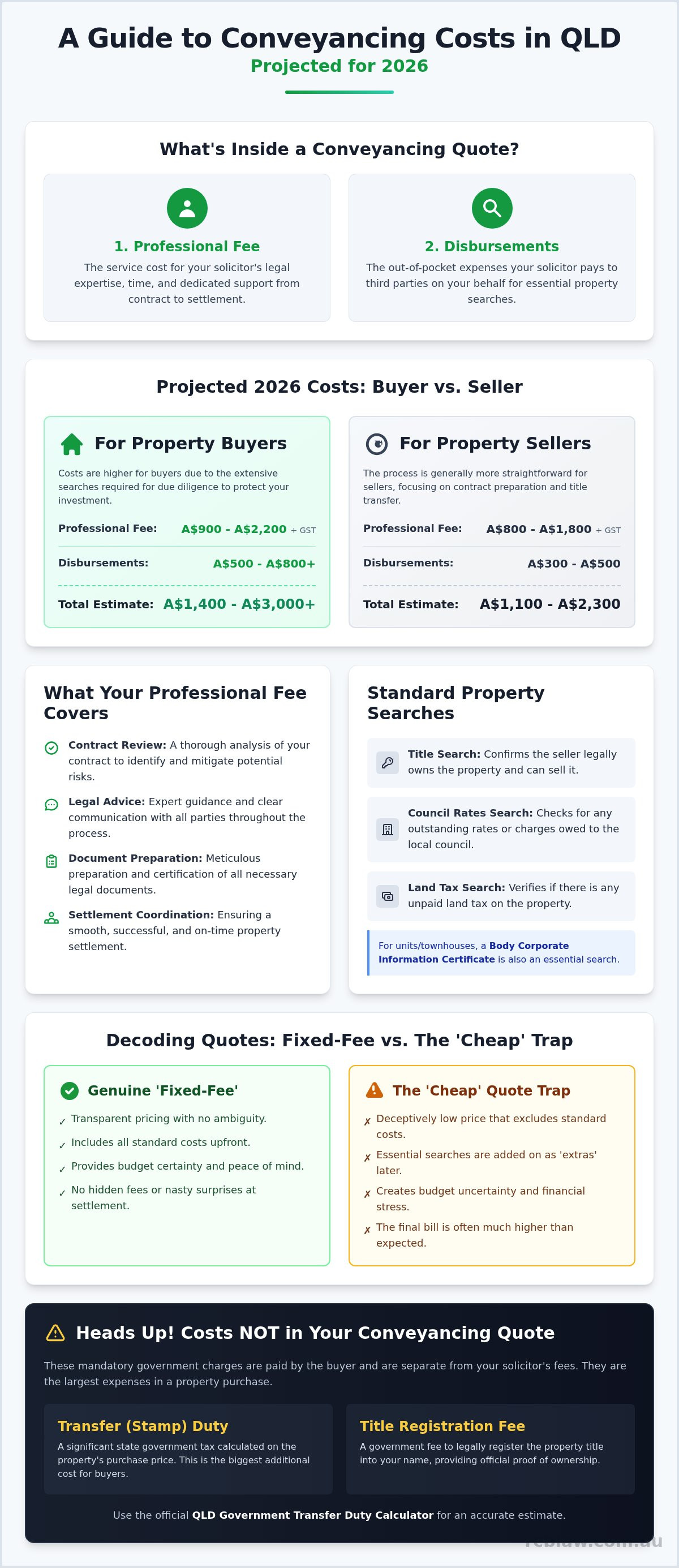
Understanding the cost of conveyancing qld 2026 can feel overwhelming, especially when quotes from different firms look so different. We understand that clarity is key during this significant life event. The first step to a stress-free transaction is knowing that every standard conveyancing quote is comprised of two distinct parts: the professional fee and disbursements. Recognising this split is essential for accurately comparing services and ensuring there are no hidden surprises.
The Professional Fee: What You're Paying For
This is the 'service' component of your bill, covering the solicitor's legal expertise, time, and dedicated support from the moment you sign the contract until settlement day. It's the fee for peace of mind. This payment secures professional guidance through the entire legal process of transferring property ownership. If you need a basic overview, this resource explains what is conveyancing? in more detail. This fee includes:
- A thorough review of your contract to identify risks.
- Expert legal advice and communication with all parties.
- Preparation and certification of all necessary legal documents.
- Coordination of a successful and on-time settlement.
Disbursements: Standard Third-Party Search Costs
Disbursements are the out-of-pocket expenses your conveyancer pays to third parties on your behalf to conduct essential due diligence. These are not the law firm's fees but rather mandatory costs required to protect your interests. Because these are direct pass-through costs, they should be very similar no matter which conveyancer you choose. Standard searches in Queensland typically include a Title Search, a Council Rates Search, and a Land Tax Search.
Optional vs. Standard Searches
While some searches are non-negotiable, others depend on the specific property you are buying. A Title Search, for instance, is always standard as it confirms the seller's legal right to sell the property. However, if you are purchasing a unit or townhouse, a Body Corporate Information Certificate becomes an essential search. This is considered an 'optional' search for a standard house but is critical for a strata property. These necessary additions can influence the final disbursements, making it a key factor in the overall cost of conveyancing qld 2026.
Average Conveyancing Costs in QLD for 2026 (Projected)
We understand that budgeting for a property transaction is crucial, and you need clarity on the expected cost of conveyancing QLD 2026. While predicting exact figures years in advance is challenging, we can provide reliable estimates based on current 2024-2025 rates and anticipated market adjustments. Your total cost is comprised of two key parts: the solicitor's professional fee for their time and expertise, and disbursements, which are the out-of-pocket costs paid to third parties for essential property searches.
It's important to note that while professional fees may see minor increases in line with inflation, disbursements are set by government bodies and search providers, making them less predictable. The following estimates provide a strong baseline for what you can expect.
Estimated Costs for Property Buyers
As a buyer, your conveyancing costs are typically higher because your legal representative must conduct extensive due diligence to protect your investment. This involves numerous property searches to ensure the title is clear and there are no hidden issues with the property.
- Professional Fee Estimate: A$900 - A$2,200 + GST
- Disbursements Estimate: A$500 - A$800+
These fees cover the legal work and standard searches. They do not include major government charges like transfer duty (stamp duty), which is a significant additional expense. To understand this tax, it's best to consult the official Queensland Government transfer duty rates and use their online calculators for an accurate figure.
Estimated Costs for Property Sellers
For sellers, the process is generally more straightforward, resulting in slightly lower costs. The primary focus is on preparing the contract of sale and ensuring a smooth transfer of title to the buyer, which requires fewer third-party searches.
- Professional Fee Estimate: A$800 - A$1,800 + GST
- Disbursements Estimate: A$300 - A$500
Factors That Can Influence the Final Price
The estimates above are for standard residential property transactions. However, certain complexities can increase the legal workload and, consequently, the final cost. Always disclose the full details of your transaction to get an accurate quote.
- Property Type: Units and townhouses require body corporate searches to investigate the financial health and compliance of the strata scheme, adding to disbursement costs.
- Complexity: Transactions involving off-the-plan properties, rural land with water rights, or purchases through a Self-Managed Super Fund (SMSF) are more complex and often incur higher professional fees.
- Urgency: A request for an unusually fast settlement may require additional resources, which can sometimes affect the cost.
Ultimately, these figures are a guide. The only way to know your exact costs is to request a detailed, fixed-fee quote from your conveyancing solicitor. This provides you with certainty and ensures there are no hidden surprises on settlement day.
Decoding Quotes: 'Fixed-Fee' vs. The Trap of Cheap Conveyancing
When you're budgeting for the cost of conveyancing qld 2026, it’s tempting to jump at the lowest quote you find. We understand that buying or selling a home is one of life's biggest financial commitments, and every dollar counts. However, an unusually low price is often a red flag for hidden fees and unexpected charges that can cause significant stress down the line.
The most common trap is the 'unbundled' quote. Some firms advertise a very low professional fee but deliberately exclude the cost of essential third-party searches and reports, known as disbursements. These are non-negotiable costs required to complete your transaction properly. When the final invoice arrives, it can be hundreds of dollars more than you anticipated, turning a seemingly 'cheap' service into an expensive and frustrating lesson.
What a True Fixed-Fee Service Should Include
A genuine fixed-fee service from a reputable firm provides complete cost certainty from the outset. It is designed to give you peace of mind, knowing the price you are quoted is the price you will pay. This transparency is a crucial part of the official home buying process, allowing you to budget effectively. A truly all-inclusive quote will cover:
- All professional legal work from contract review to settlement.
- The costs of all standard property searches and government enquiries.
- One final, clear invoice that matches your initial agreement, with no surprises.
Questions to Ask Before Engaging a Conveyancer
To protect yourself and ensure you have an accurate picture of your final costs, it’s vital to ask the right questions before you sign anything. A transparent conveyancer will be happy to provide clear, direct answers. We recommend asking:
- Is your quote fully inclusive of GST and all standard searches required for my property?
- Are there any additional administrative fees for sundries like postage, printing, or phone calls?
- What are the potential costs if the contract terminates for any reason before settlement?
Asking these questions ensures clarity from the start. For a quote you can trust, our team is here to provide the support and guidance you need. Get a transparent, all-inclusive fixed-fee quote from RCB Law.
Major Government Fees: Budgeting for Stamp Duty & Registration
We understand that budgeting for a property purchase can be a stressful experience. Beyond your deposit and professional legal fees, the most significant expenses for a buyer are mandatory government charges. These fees are separate from your conveyancer's costs, are non-negotiable, and must be paid at settlement.
Failing to account for these substantial amounts can unfortunately derail an entire property transaction. Accurately forecasting these government fees is essential when planning for the total cost of conveyancing qld 2026. Let's break down the two main charges you need to prepare for.
Transfer Duty (Formerly Stamp Duty)
Transfer duty, commonly known as stamp duty, is a state government tax levied on property transactions in Queensland. The amount payable is calculated on a sliding scale based on the property's dutiable value-typically the purchase price or market value, whichever is higher. This fee can amount to tens of thousands of dollars, making it a critical part of your budget.
Fortunately, the Queensland Government offers several concessions that can significantly reduce this cost, most notably:
- First Home Concession: For eligible first-time buyers purchasing a home as their principal place of residence.
- Home Concession: A reduced rate for buyers who will live in the property.
To get a precise estimate for your situation, we strongly recommend using the official government tool. Calculate your transfer duty using the QLD Government's online calculator.
Title Registration Fees
Once settlement is complete, the property title must be transferred into your name. This is how your legal ownership is officially and publicly recorded. A fee is payable to Titles Queensland to process this registration.
While much smaller than transfer duty, this is a mandatory step to secure your legal rights to the property. The fee is determined by the purchase price and is updated periodically. You can find the most current schedule on the official Titles Queensland website.
At RCB Law, we provide our clients with a clear and comprehensive breakdown of all anticipated costs, ensuring there are no stressful surprises on settlement day. If you need support navigating the cost of conveyancing qld 2026, our experienced team is here to provide practical guidance. Contact us for a personalised consultation.
Is DIY Conveyancing a Smart Way to Save Money?
When purchasing a property, which is often the largest financial commitment of your life, the desire to cut costs is completely understandable. The idea of handling your own conveyancing to save a few thousand dollars can seem tempting. However, while it is legally possible to do your own conveyancing in Queensland, it is an extremely risky path for anyone who is not a legal professional.
The reality is that conveyancing is far more than just filling out forms. It is a complex legal process designed to protect your rights and your investment. The small amount you might save is insignificant compared to the potential for catastrophic and costly errors that could jeopardise your entire purchase.
The Risks of Going It Alone
Attempting to navigate the legal intricacies of a property transfer without professional guidance exposes you to significant dangers. When you manage your own conveyancing, you take on all the liability, and a simple oversight can have devastating consequences. Key risks include:
- Missing Critical Dates: A property contract is filled with strict deadlines. Missing a finance or settlement date can put you in breach of contract, potentially causing you to lose your entire deposit or even the property itself.
- Misinterpreting Search Results: Do you know how to interpret a title search for easements, covenants, or caveats that could restrict your use of the property? Overlooking a critical detail could mean buying a home with a serious, undisclosed problem.
- No Professional Indemnity Insurance: Solicitors are required to have professional indemnity insurance. If they make a mistake, you are covered. If you make a mistake, you have no financial safety net and are personally liable for any losses.
The Value of a Professional: Peace of Mind as an Investment
Engaging a conveyancing solicitor is not just another expense; it's an investment in security and peace of mind. When you factor in the professional fee to the total cost of conveyancing QLD 2026, you are paying for an expert to safeguard your most valuable asset. A qualified solicitor manages all legal risks, ensures every document is compliant, and handles any complex negotiations that may arise from issues found during building inspections or searches.
Ultimately, the professional fee is a small price to pay for the assurance that your property transaction is handled correctly and your interests are protected from start to finish. Don't risk your financial future to save a fraction of the cost. Let our experts handle the stress. Contact RCB Law today.
Navigate Your QLD Property Purchase with Confidence
Budgeting for your property transaction means looking beyond the headline price. As we've explored, understanding the true cost of conveyancing qld 2026 involves decoding quotes, avoiding the pitfalls of cheap offers, and accounting for significant government fees. We understand this can be a stressful process, and your investment deserves absolute clarity and expert guidance, not guesswork.
With over 30 years of dedicated QLD property law experience, RCB Law offers the certainty you need. Our specialist conveyancing lawyers for Brisbane and the Sunshine Coast provide a fixed-fee guarantee, ensuring there are no hidden surprises-just complete peace of mind. Let us handle the legal complexities so you can focus on the excitement of your new property.
Ready for a seamless, stress-free transaction? Get a Clear, Fixed-Fee Conveyancing Quote for Your QLD Property and take the first step with a team you can trust.
Frequently Asked Questions
When do I have to pay my conveyancing fees?
We understand that managing finances during a property transaction is a key concern. Generally, our professional legal fees for conveyancing are payable upon successful settlement. This means you won't need to pay our service fee until the property is officially yours. However, costs for property searches, known as disbursements, are often paid by us on your behalf during the process. These are then included in your final invoice at settlement, ensuring a simple, consolidated payment at the end.
What's the difference between a conveyancer and a solicitor in QLD?
In Queensland, both solicitors and conveyancers can manage property transfers. A conveyancer is a licensed professional who specialises solely in property transactions. A solicitor, on the other hand, is a qualified lawyer who can provide the same service but also has the expertise to handle more complex legal issues if they arise. Engaging a solicitor provides an extra layer of legal protection, offering peace of mind should any unexpected legal complications occur during your property journey.
Are search costs different for a house versus a unit or apartment?
Yes, the search costs for a house are different from those for a unit or apartment. When purchasing a unit, we must conduct a body corporate search to investigate the scheme's finances, by-laws, and insurance. This is a crucial step that is not required for a standard freehold house. Consequently, the total cost for disbursements is typically higher for a unit, which is a key factor in the overall cost of conveyancing qld 2026.
What happens if the sale falls through? Do I still have to pay the full fee?
We understand how stressful it is when a property sale doesn't proceed. Most reputable firms operate on a 'no settlement, no fee' basis for their professional services. This means if your contract is terminated, you will not be charged our full professional fee for the work. You would, however, still be responsible for the out-of-pocket expenses for any property searches and reports that have already been ordered and paid for on your behalf.
Can I add the cost of conveyancing to my home loan?
This is a common question and often depends on your lender and the specifics of your home loan. Some lenders may allow you to add conveyancing costs to your total loan amount, provided it doesn't exceed their loan-to-value ratio (LVR) limits. We strongly recommend discussing this possibility with your mortgage broker or bank early in the process. They can provide clear guidance based on your financial situation and their lending policies, helping you plan your finances effectively.
How much is stamp duty for a first home buyer in QLD?
In Queensland, first home buyers may be eligible for significant stamp duty concessions. As of current regulations, you may pay no stamp duty on a first home valued under A$500,000. Concessional rates then apply for properties valued between A$500,000 and A$550,000. It is important to note that these government thresholds can change. We always provide our clients with a precise calculation based on the latest regulations to help them understand their complete financial obligations.


