A family contribution is a gifted house deposit only when the buyer is not expected to repay it. To understand how to gift a house deposit legally in Australia, start with that distinction: lenders usually require a signed letter confirming the money is an unconditional gift, not a loan. Australia generally has no gift tax, although a large gift can affect the giver’s Centrelink means testing.
It’s understandable to want the support to help with a purchase without creating uncertainty for either side. A clear record of what the money is, who is providing it, and whether repayment or a property interest is expected can help explain the arrangement to the lender.
This article explains what a deposit gift letter should cover, how a genuine gift differs from a family loan, and how Australian gift tax and Centrelink rules may apply. It also outlines when a family contribution may need more formal legal documentation, helping you approach the purchase with greater clarity.
Key Takeaways
- Understand why a signed gift letter can explain the arrangement to a lender, but may not establish where the money came from.
- Learn which details a lawyer can help set out so the letter reflects the family’s actual intentions.
- Recognise when repayment, an ownership share or other conditions mean a simple gift letter may not be suitable.
- See how tax and Centrelink considerations can differ for the person giving the money, and what to consider before proceeding.
What is a property deposit gift letter?
A property deposit gift letter records that a family member’s contribution is a gift, not money the buyer must repay. Lenders use it to understand the deposit and assess the buyer’s loan application.
Lender Checks on Gifted Funds
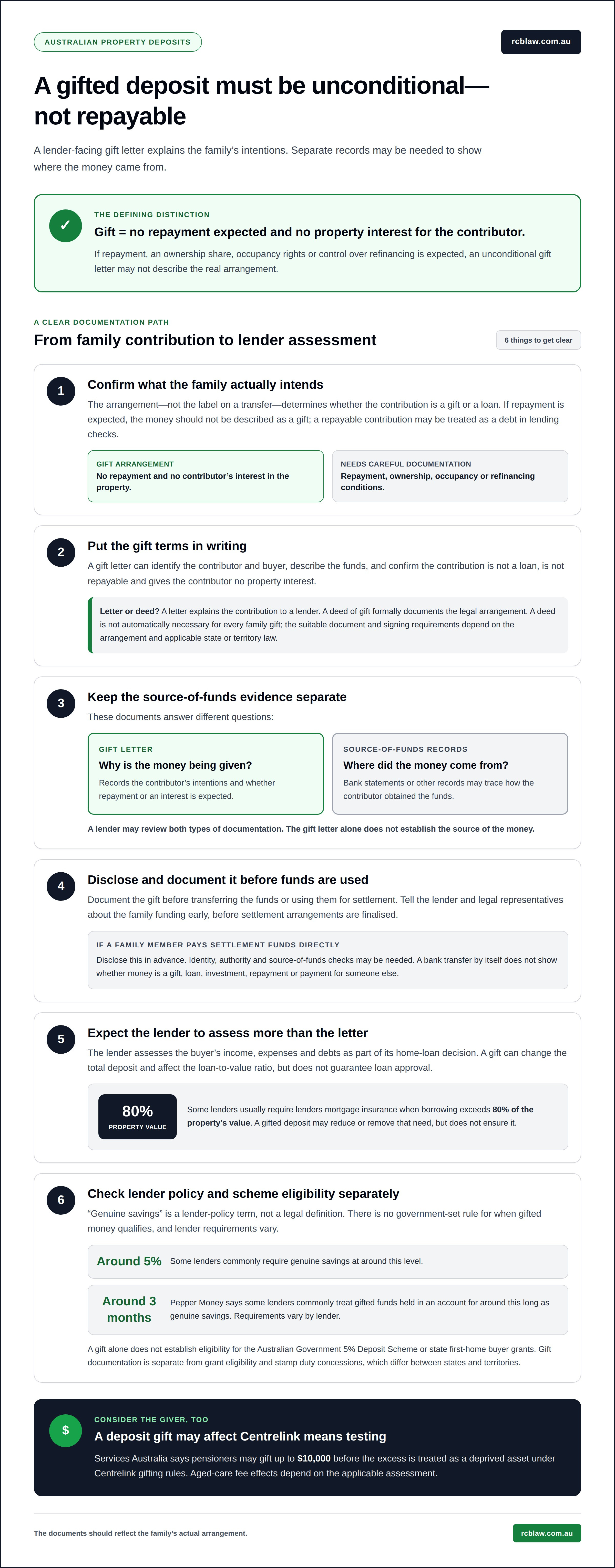
A lender may review a gift letter alongside bank statements or other evidence showing where the gifted deposit came from. The letter explains the family member’s intentions, but does not establish the source of the money. As part of its home loan decision, the lender also assesses the buyer’s income, expenses and debts.
A gift can affect loan-to-value ratio through the total deposit, not its source. Some lenders usually require lenders mortgage insurance when borrowing exceeds 80% of the property’s value. A gift may reduce or remove that need, but it doesn’t guarantee loan approval.
A gift alone doesn’t establish eligibility for the Australian Government 5% Deposit Scheme or state first-home buyer grants. The buyer must meet the relevant scheme or grant criteria.
Gift Letters and Source-of-Funds Evidence
A gift letter describes the arrangement; source-of-funds evidence traces how the contributor obtained the money. A lender may request bank statements or other records to support the transfer. Keeping both types of documentation helps explain the deposit, especially when the funds come from an account that is not the buyer’s.
A gifted deposit does not by itself determine stamp duty or first-home buyer eligibility. Stamp duty concessions and grant rules differ between Australian states and territories, so the buyer’s eligibility and the gift documentation are separate considerations.
Gifted Funds and Genuine Savings
“Genuine savings” is a lender-policy term, not a legal definition, and there is no government-set rule for when gifted money qualifies. Some lenders accept a fully gifted home deposit; others require the buyer to show their own savings.
Some lenders commonly require around 5% genuine savings. Pepper Money says that, as at July 2026, some lenders commonly treat gifted funds held in an account for around three months as genuine savings. Requirements vary by lender, so the timing and evidence may affect how the deposit is assessed.
Timing and Documentation for Gifts
Document the gift before transferring the funds or using them for settlement. If a family member plans to pay settlement funds directly, disclose this in advance because identity, authority and source-of-funds checks may be needed.
For pensioners, Services Australia says up to $10,000 may be gifted before the excess is treated as a deprived asset under Centrelink gifting rules. A deposit gift may therefore affect the giver’s Centrelink assessment. Any aged-care fee effect depends on the applicable assessment.
How a lawyer can help with what to include in a property deposit gift letter
A lawyer can help draft or review a gift letter so it reflects the family’s actual arrangement. Legal help is especially useful when the contribution has conditions or the family is considering a deed.
Confirming the Gift Is Non-Repayable
A gift letter can record that parents or another family member will not receive repayment. It can identify the contributor and buyer, describe the funds, and confirm that the contribution is not a loan. A lender may consider this statement when assessing the buyer’s borrowing and mortgage application.
A lawyer can help express the arrangement plainly and avoid wording that conflicts with the family’s intentions. If repayment is expected, the letter should not call the money a gift. The distinction matters because a repayable contribution may be treated as a debt during lending checks.
Gift Letters and Deeds of Gift
A gift letter explains the contribution to a lender, while a deed of gift formally documents the parties’ legal arrangement. A lawyer can help assess which document suits the circumstances and whether the family’s intentions call for more than a lender-facing letter.
For example, a simple contribution with no repayment or property interest may be documented differently from an arrangement involving conditions. A deed is not automatically necessary for every family gift. Its terms and signing requirements depend on the document and applicable state or territory law.
Unconditional Gift Statements
An unconditional gift statement confirms that the money is not repayable and that the contributor will not obtain an interest in the property. A lender may require these confirmations before accepting the gifted deposit as a gift.
A lawyer can help ensure the statement matches the family’s real intentions. If the contributor expects repayment when the property is sold, an ownership share, occupancy rights or control over refinancing, those terms should not be hidden behind an unconditional gift letter. They may need separate legal documentation.
Document preparation costs depend on the arrangement’s complexity and the documents required; the cost is provided after a quote request. For guidance on property documentation, consider property law advice before the family finalises its wording.
Distinguishing a gift from a family loan
The difference depends on the actual agreement, not the label used for the transfer. Buyers should disclose the arrangement consistently in their mortgage application and written documents.
Disclosing Family Funding Early
Early disclosure means informing the lender and legal representatives before settlement arrangements are finalised. In Queensland, disclose family funding to the buyer’s lawyer or conveyancer and lender as early as possible in the property transaction.
This gives the lender time to assess the payment’s purpose and request relevant records. A bank transfer alone does not show whether the money is a gift, loan, investment, repayment or payment made for someone else. Explain the arrangement accurately before it affects the application.
Lender Treatment of Family Loans
A genuine gift has no expected repayment; a family loan creates a debt. Australian lenders treat repayable amounts as liabilities that affect serviceability, so buyers must disclose them.
For example, an undisclosed family loan with repayments can leave the lender with an incomplete view of the buyer’s financial commitments. A signed gift statement should never describe money as an unconditional gift if repayment is expected. The lender assesses the actual arrangement, including any repayment terms.
Put the family’s understanding in writing, including whether repayment is expected and when. Clear terms help buyers and contributors avoid different assumptions about future payments, especially if the buyer’s circumstances change.
Overseas contributions need the same clear distinction. A transfer from a parent’s overseas account does not, by itself, prove whether the money is a gift or a loan. Lenders may request records showing its source, and foreign-language bank, company or estate documents may need certified English translations.
Written terms can also help protect family relationships. If a parent expects repayment when the home is sold, or an ownership share, record that expectation rather than relying on a conversation. Otherwise, buyers and contributors may remember the arrangement differently when a sale, refinance or repayment is discussed.
Gift tax in Australia
Australia generally has no gift tax, so a genuine cash gift from a relative is not automatically taxed as income. The ATO categorises genuine cash gifts from relatives as other non-taxable amounts that generally do not need to be declared as income. Individual circumstances and the nature of the arrangement still matter, particularly if the money is provided in exchange for an interest, repayment or another benefit.
For families considering how to gift a house deposit legally in Australia, the buyer’s tax position is only part of the picture. Receiving a genuine gift toward a home deposit generally does not make the amount taxable income. The key distinction is whether the payment is genuinely a gift or part of another financial arrangement. Documents should describe the agreement accurately.
The giver’s position can differ. A large gift may affect Centrelink means-testing, including the giver’s assets assessment and deemed income. Services Australia says pensioners may gift up to $10,000 before the excess is treated as a deprived asset. Centrelink also treats gifts exceeding $30,000 across five financial years as a deprived asset.
As at July 2026, Age Pension gifts above the gifting free area are counted in the giver’s assets test and deemed to earn income for five years from the gift date. A pensioner considering a deposit contribution should weigh it against their savings, income and future expenses. This is separate from whether the buyer’s lender accepts the contribution as genuine savings.
Australia has no inheritance tax, but Centrelink considerations may still apply. A gift involving an ownership interest, repayment or another benefit may be treated differently from an unconditional cash gift. Understanding how to gift a house deposit legally in Australia means considering both the buyer’s tax position and the giver’s means-tested position. Accurate documentation helps clarify the arrangement before funds are transferred.
RCB Law
RCB Law can help buyers understand how a family contribution fits into the legal aspects of a property purchase. If a gift involves repayment expectations, an ownership interest or other conditions, clear legal advice can help the parties understand the arrangement before funds are transferred.
Through residential conveyancing, RCB Law assists with the legal complexities of buying property. This can be a useful next step when a family contribution raises questions alongside the purchase or settlement process. The right documentation depends on what the giver and buyer have actually agreed.
For legal guidance about a family contribution and your property purchase, contact RCB Law.
Make the family arrangement clear before moving forward
A house purchase can bring family expectations into sharper focus. Before money changes hands, consider what the contribution means for everyone involved and whether it fits the buyer’s wider plans. A clear understanding now can help prevent uncertainty later, especially if circumstances change or the property is sold.
If you’re considering how to gift a house deposit legally in Australia, RCB Law can help you consider the legal aspects of the arrangement alongside your property purchase. Its work includes residential conveyancing, commercial property law and business law, supporting clients with related property and business matters.
For guidance tailored to your situation, contact RCB Law about a gifted deposit. A considered next step can help you approach the purchase with greater confidence.
Frequently Asked Questions
What is a gifted deposit and how does it work?
A gifted deposit is money given to help a buyer purchase a home, with no repayment expected. For example, a relative may transfer funds to the buyer, who then uses them toward the purchase. The lender assesses the buyer’s loan application and may ask for records explaining the contribution. The transfer itself does not tell the lender whether the funds are a gift or part of another arrangement.
Can I use a cash gift from my parents as a house deposit in Australia?
Yes, a cash gift from your parents can contribute to a home deposit, subject to the lender’s assessment and any genuine-savings policy. Keep a clear record of the transfer, including who sent the funds and when. If the money comes from an overseas account, the lender may request documents showing its source. A gift does not replace the usual assessment of income, expenses and existing debts.
What happens if the money is actually a loan?
If you’re expected to repay the money, it’s a family loan rather than a gift. Disclose it in your loan application, including any agreed repayment obligations, so the lender can accurately assess your financial commitments. For example, regular repayments may affect how much you can borrow. Calling a loan a gift could leave the lender with an incomplete picture of your liabilities.
Can both parents give the gift in one deed?
A deed can name both parents as contributors and describe how their contributions form part of the same arrangement. It should identify each parent, the intended recipient, and whether either parent expects repayment or another benefit. The document’s wording and execution matter, so a lawyer can help prepare terms that reflect both parents’ intentions. The lender may also have its own documentation requirements.
Can my parents get their money back later if it was a gift?
If the arrangement was genuinely a gift, your parents were not meant to receive repayment under its terms. They should not assume they can recover the funds later simply because circumstances change. If repayment, a share in the property or another benefit was intended from the beginning, document the arrangement truthfully as something other than an unconditional gift. Clear written terms can reduce family misunderstandings.
Can my parents transfer the money directly to settlement?
Parents may propose paying funds directly toward settlement, but disclose the plan in advance to the lender and the buyer’s legal representative. A third-party payment can prompt additional checks about identity, authority and the source of funds. For example, the parties may need to explain who is paying, why the payment is being made and whether the buyer must repay it. Keep the arrangement consistent with the loan application.