
An executor’s most important job is not simply handing out inheritances. In Queensland, an executor must act honestly and in good faith for all beneficiaries, protect and manage the deceased’s assets, pay valid debts and tax obligations, then distribute what remains under the will. If you’re asking what the duties of an executor in QLD are, that is the central responsibility.
Being named in a will can feel like a lot to take on, especially while grieving. The role follows a process: probate is typically needed before an executor can legally deal with most estate assets, and the estate must be administered before beneficiaries receive their inheritance.
This article explains what an executor does, when probate may be required and how to apply. It also covers the duties involved in administering an estate, including keeping records and distributing assets according to the will.
Key Takeaways
- Understand why probate may be needed before an executor can deal with estate assets, and how to begin the application process.
- See how an executor’s responsibilities extend beyond locating assets to protecting the estate and keeping clear records.
- Learn why debts, tax obligations and potential claims matter before beneficiaries receive their inheritance.
- Discover how Queensland law shapes an executor’s decisions, including when several executors are appointed.
Does Queensland law require executors to obtain probate before administering an estate?
Usually, yes, before legally dealing with most Queensland estate assets. A grant of probate from the Supreme Court of Queensland confirms the executor’s authority under the will. Whether a grant is needed depends on the assets and the institutions holding them.
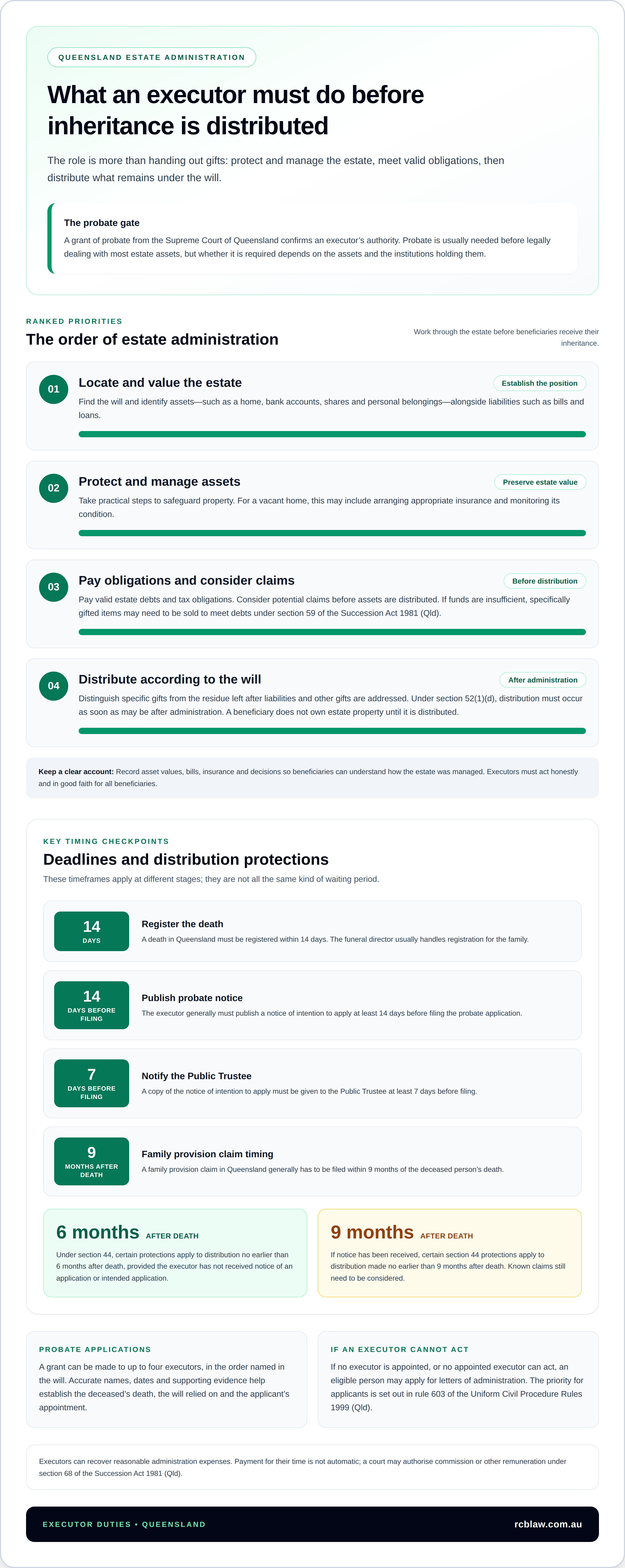
The executor’s responsibility begins with locating and valuing assets, such as a home, bank accounts, shares and personal belongings. They should also identify liabilities, including outstanding bills and loans, so the estate’s position is clear before distribution. The Succession Act 1981 requires the estate to be administered according to the relevant legal framework.
Protecting assets means taking practical steps to preserve them during administration. For a vacant property, this may include arranging appropriate insurance and monitoring its condition. The executor should keep records of asset values, bills, insurance and decisions, creating an account that beneficiaries can understand.
Executors must act honestly and in good faith for all beneficiaries, not just themselves. Valid estate debts and tax obligations should be paid before beneficiaries receive inheritances. If funds are insufficient, specifically gifted items may need to be sold to meet debts under section 59 of the Succession Act 1981 (Qld).
A family provision claim in Queensland generally has to be filed within nine months of the deceased person’s death, according to Queensland Government, Queensland Legislation. This timing makes it important to consider potential claims before distributing assets.
Immediately after someone dies, the executor should locate the will, identify urgent estate assets and arrange their protection. A death in Queensland must be registered within 14 days; the funeral director usually handles registration for the family.
An executor can recover reasonable expenses incurred administering the estate. Payment for their time isn’t automatic, but a court may authorise commission or other remuneration under section 68 of the Succession Act 1981 (Qld).
The Supreme Court of Queensland receives probate applications. The Public Trustee must receive a copy of the notice of intention to apply within the required timeframe and may act if a nominated executor declines the role.
Applying for probate in Queensland
An executor applies to the Supreme Court of Queensland for a grant of probate, which recognises the executor’s authority to administer the estate under the will. A grant can be made to up to four executors, in the order named in the will. If several executors are appointed, the application should reflect who is seeking the grant.
Before filing, the executor generally must publish a notice of intention to apply at least 14 days beforehand. A copy of that notice must also be given to the Public Trustee at least 7 days before filing. These steps alert relevant parties and provide time for issues to emerge before the court considers the application.
The application papers must establish the deceased’s death, the will relied on and the applicant’s appointment as executor. The original will is central because it records the deceased’s wishes and names the person responsible for administration. Supporting documents and evidence explain the application and any matters affecting the will or the executor’s authority.
People asking “what are the duties of an executor in qld?” should know that probate is only one part of the role. An executor must also administer the estate under the will and meet legal responsibilities. Accurate names, dates and details help the Supreme Court assess the application. If a will is damaged or an appointment is uncertain, further explanation may be needed.
Probate is not the only form of court authority. If no executor is appointed, or no appointed executor can act, an eligible person may apply for letters of administration instead. The priority for applicants is set out in rule 603 of the Uniform Civil Procedure Rules 1999 (Qld). This is relevant to “what are the duties of an executor in qld?” because an administrator generally carries out estate administration under the grant’s conditions.
Once probate is granted, the executor can collect assets from institutions that require the court’s authority. A solicitor can help prepare the papers and address procedural requirements before filing.
Distributing the estate
Distribution follows estate administration, once the executor has dealt with liabilities and claims. Under section 52(1)(d) of the Succession Act 1981 (Qld), the executor must distribute as soon as may be after administration.
Distributing Property Under the Will
Distributing property means transferring or paying estate assets to beneficiaries according to the will. The executor must distinguish specific gifts, such as a named item, from the residue left after liabilities and other gifts are addressed. A beneficiary does not own estate property until the personal representative distributes it. Following the will carefully helps prevent mistakes, disputes and unequal treatment between beneficiaries.
Waiting Periods Before Distribution
Statutory waiting periods allow time for certain claims before assets are distributed. Under section 44 of the Succession Act 1981 (Qld), certain protections apply when distribution occurs no earlier than six months after death, provided the executor hasn’t received notice of an application or intended application. If notice has been received, certain protections apply to distribution made no earlier than nine months after death. These timeframes inform decisions about when to distribute.
These periods provide statutory protection, but they are not a reason to ignore known claims. Before deciding whether assets are ready for distribution, an executor should consider notices received, outstanding liabilities and the progress of the estate’s administration. If a claim or uncertainty could affect beneficiaries’ entitlements, legal advice can help clarify the risks before property is transferred. The executor should also keep clear accounts of payments and distributions to support transparent reporting to beneficiaries.
Interest can also affect what beneficiaries receive. In Queensland, general legacies in a will carry interest at 8 per cent per annum. General cash gifts generally accrue interest from the first anniversary of the deceased’s death, unless the will says otherwise. The executor should identify which gifts are general legacies and account for any interest when calculating payments. This helps ensure the final distribution reflects both the will’s terms and applicable obligations.
Statutory executor duties
The Succession Act 1981 (Qld) sets the framework for administering an estate, but an executor’s responsibilities also depend on the will and circumstances. An executor must act honestly and in good faith, protect estate assets, and account for decisions. These duties apply whether the estate includes a bank account, a home or a business. The core principle is careful administration for the beneficiaries, rather than personal advantage.
Where several executors are appointed, they generally exercise their powers jointly under section 49 of the Succession Act 1981 (Qld). That means co-executors should communicate and agree on significant decisions, including selling or leasing real property. Someone named as executor who acts without the other appointed executors may create disputes or delay. A lawyer can help clarify authority when co-executors disagree or a major decision requires action.
The will can also create specific responsibilities. Under section 7 of the Cremations Act 2003 (Qld), an executor who knows of the deceased’s signed cremation instructions must follow them. If someone receives letters of administration instead, section 50 of the Succession Act 1981 (Qld) generally gives that person the executor’s rights and liabilities, subject to conditions in the grant.
Running a deceased person’s business carries a separate limit. An executor generally can’t continue operating it for more than 2 years after death without court approval, unless the will provides otherwise. If the estate earns rent or dividends before distribution, it may also need a separate tax return. These duties make it important to distinguish routine asset protection from ongoing business decisions.
Neglect can have legal consequences. Under section 52(2) of the Succession Act 1981 (Qld), a person aggrieved by an executor’s neglect may apply to the court for orders. The court can remove an executor who breaches their duties and appoint a suitable replacement. In practice, timely records, joint decisions and attention to the will help demonstrate responsible administration and reduce avoidable conflict.
RCB Law
RCB Law can assist with legal issues connected with a will, property or a business interest in an estate. If you’re preparing for the future, Will Drafting can help put your wishes into a formal document. Where estate assets include property or business interests, Residential Conveyancing, Commercial Property Law or Business Law can address related legal matters.
Consider seeking legal guidance when the will’s wording is unclear, property ownership raises questions or a business interest forms part of the estate. Identifying the issue that needs attention can help you choose a practical next step while keeping the executor’s responsibilities in view.
For help with a will or related property or business matter, contact RCB Law.
Take the next step with clarity
Being named executor can mean balancing personal responsibilities with legal decisions. Understanding what the duties of an executor in QLD are is a useful starting point. Next, identify which aspects of the estate’s circumstances need attention. A property transfer or an interest in a business, for example, may raise legal questions alongside estate administration.
RCB Law provides Residential Conveyancing, Commercial Property Law and Business Law for related property and business matters. This support may be relevant when an estate includes a home, commercial property or business interests. Discuss the legal issue affecting your next decision with RCB Law to understand what assistance may fit.
Contact RCB Law for estate guidance to discuss your circumstances and move forward with greater clarity.
Frequently Asked Questions
What is an executor of a will?
An executor is the person named in a will to carry out its instructions and administer the deceased person’s estate. The role begins when the will-maker dies, when their property passes to the executor under section 45(1) of the Succession Act 1981 (Qld). The executor’s authority is for estate administration, not personal ownership, and their role ends when distribution to beneficiaries is complete.
What real and personal estate must an executor collect in Queensland?
An executor should identify property forming part of the estate, including real estate such as a house or land, and personal assets such as bank funds, shares, vehicles and belongings. The will and ownership records help establish what the deceased owned and whether an asset passes under the will. The executor should also record liabilities, since debts affect what can ultimately be transferred to beneficiaries.
Can you refuse to be an executor, or step down later?
Yes. A nominated executor can decline the appointment, sign a legal renunciation or arrange for the State Trustee to act instead. Taking steps in the role can make withdrawal harder, but section 54(2) of the Succession Act 1981 (Qld) allows an executor to renounce even after doing some estate work. Because actions may affect the position, get legal advice before dealing with estate assets.
Executor, administrator or personal representative?
An executor is appointed by a will, while an administrator receives authority through a court grant when an executor cannot act or none is appointed. “Personal representative” is a broader term that can refer to either role. In Queensland, section 50 of the Succession Act 1981 (Qld) generally gives an administrator similar rights and liabilities to an executor, subject to conditions attached to the grant.
What are an executor’s main duties in Queensland?
An executor must administer the estate honestly, follow the will, protect assets and deal with liabilities before beneficiaries receive their entitlements. They must also keep estate accounts and records for at least three years after administration ends. Under section 65 of the Succession Act 1981 (Qld), a beneficiary may reasonably request to inspect those accounts and receive copies at their own cost within a reasonable time.
How does an executor apply for probate in Queensland, and when is it required?
An executor applies to the Supreme Court of Queensland for a grant of probate, which is typically needed to legally deal with most Queensland estate assets. The process involves filing the required application papers and giving notice beforehand. A separate notice inviting claims against an estate must set a closing day at least two months after publication, giving potential claimants time to come forward.