
What if the most critical moment of a Queensland property auction happens two weeks before the auctioneer even calls for opening bids? In the fast-paced local market, an auction is truly won or lost during the legal due diligence phase. Understanding the legal requirements for property auction qld is your best defense against the fear of being locked into an unconditional contract for a property that isn't what it seems. It's natural to feel anxious about the total lack of a cooling-off period or the specific ID requirements needed just to register as a bidder.
We recognize that these high-pressure transitions can be overwhelming, but you don't have to face them alone. This guide will help you master the mandatory legal steps and uncover hidden risks so you can bid with absolute confidence. We'll walk you through the 2026 bidder registration rules, the truth about vendor bids, and a structured framework for protecting your deposit. By following these clear steps, you'll move from a state of uncertainty to a feeling of total security when the hammer finally falls.
Key Takeaways
- Understand why Queensland auction contracts are unconditional and why the statutory five-day cooling-off period does not apply to these high-stakes transactions.
- Learn the mandatory legal requirements for property auction qld, including the bidder registration process and ID verification required under the Property Occupations Act 2014.
- Discover the rules governing auctioneer conduct, specifically how vendor bids must be announced and how the reserve price remains confidential.
- Identify the essential pre-auction due diligence steps, such as professional contract reviews and title searches, that safeguard your deposit from hidden risks.
- See how local legal expertise and digital settlement tools like PEXA can remove the friction from your property purchase, ensuring a secure transition to ownership.
Understanding the QLD Auction Framework: High Stakes and No Safety Nets
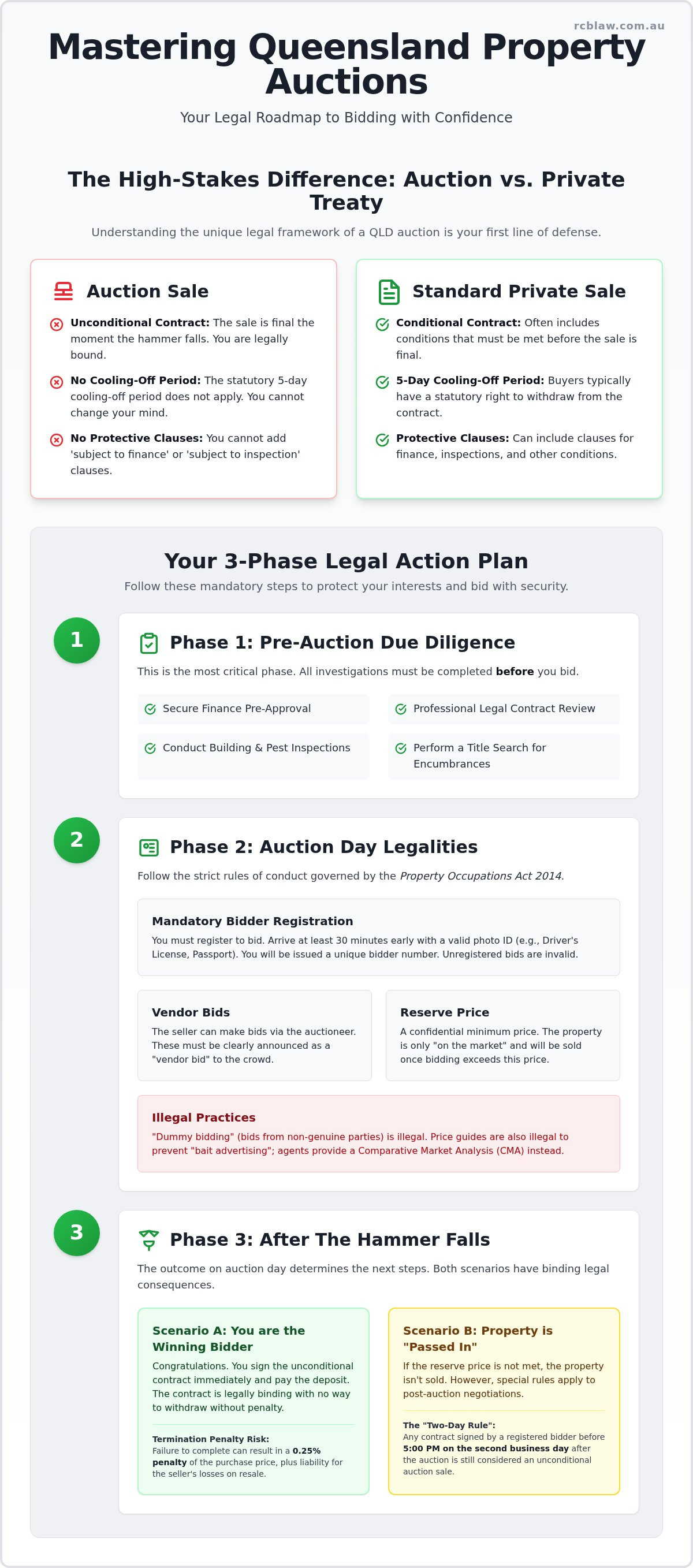
Purchasing a home through a public sale is a unique experience that requires a specialized approach to legal preparation. Within the Queensland auction framework, a property is sold to the highest bidder once the price exceeds the seller's confidential reserve. This process is designed for transparency and speed, but it also carries significant legal weight. Unlike a standard private treaty sale, an auction contract is unconditional from the moment it's signed. This means you're legally bound to complete the purchase without the ability to withdraw if you change your mind or discover an issue later.
One of the most critical legal requirements for property auction qld involves the 'two-day rule.' If a property is passed in because it didn't reach the reserve price, the auction conditions can still apply to subsequent negotiations. Any contract entered into by a registered bidder by 5:00 pm on the second business day after the auction day is treated as an auction sale. This extension ensures that the finality of the auction environment remains intact even if the hammer didn't fall on the day itself.
The Absence of a Cooling-Off Period
In a typical residential sale in Queensland, buyers usually enjoy a statutory five-business-day cooling-off period. However, this safety net is entirely removed for auction purchases. You can't include common protective clauses like 'subject to finance' or 'subject to building and pest inspections' in an auction contract. Because the sale is finalized on the spot, any due diligence must be completed before you ever raise your paddle. If you win the bid but later decide you can't proceed, you'll face a termination penalty of 0.25% of the purchase price and may be liable for the seller's losses if the property resells for a lower amount.
Price Guides and Comparative Market Analysis (CMA)
Queensland law takes a strict stance on price transparency to prevent misleading conduct. It's actually illegal for real estate agents to provide a specific price guide for any property being sold at auction. This regulation aims to stop 'bait advertising' where properties are listed below their expected value to attract more bidders. Instead, agents provide a Comparative Market Analysis (CMA). This document lists recent sales of similar properties in areas like Brisbane or the Sunshine Coast. By reviewing these facts, you can establish a realistic bidding limit without relying on a potentially biased estimate. Understanding these legal requirements for property auction qld helps you enter the fray with a clear strategy based on data rather than emotion.
Mandatory Bidder Registration: The Legal Requirements for Participation
You can't just raise your hand on a whim during a Queensland property auction. The Mandatory Bidder Registration process is a cornerstone of the Property Occupations Act 2014. It's designed to ensure transparency and prevent "dummy bidding" from non-genuine parties. The law requires the auctioneer to keep a formal register of every person who intends to bid. This register isn't public. Only the auctioneer and government officials from the Office of Fair Trading can access it. Your privacy is protected, but your identity must be verified to keep the process fair for everyone involved.
An auctioneer has the legal right to refuse a bid from anyone who isn't registered. If you haven't been issued a unique bidder number, your bid effectively doesn't exist. This is why following the legal requirements for property auction qld is so important for a successful purchase. You must clearly display your bidder number or paddle when making an offer. This physical identifier connects your bid to your registration entry, making the contract enforceable the moment the hammer falls.
Step-by-Step Registration Process
We recommend arriving at least 30 minutes before the auction starts. This gives you time to complete the paperwork without feeling rushed or anxious. You'll need to provide a formal photo ID, such as a current Driver's License or a Passport, to the sales agent. Once they verify your identity and record your address, they'll hand you a paddle or a card with your unique number. Keeping this process orderly helps lower the stress of the day and ensures you're ready when the bidding opens.
Bidding on Behalf of Others
If you can't attend in person, the law allows for proxy bidding, but it requires strict documentation. You must provide a written 'Letter of Authority' to the auctioneer before the event begins. For those buying under a company name, you'll need to show evidence that you're authorized to bind that corporate entity. Telephone bidding is also possible, but it involves specific forms from the Office of Fair Trading that must be signed in advance. If you're feeling uncertain about these technicalities, having a professional team handle your residential conveyancing can provide the clarity you need to proceed safely. Ensuring these legal requirements for property auction qld are met ahead of time prevents any last-minute heartaches at the auction site.
Auction Day Conduct: Reserve Prices, Vendor Bids, and Dummy Bidding
The atmosphere of a property auction is intentionally high-energy. However, strict legal guardrails exist to ensure every bid is legitimate. One of the most misunderstood legal requirements for property auction qld is the reserve price. This is the minimum amount the seller is willing to accept. By law, the seller must provide this price in writing to the auctioneer before the event. Crucially, this figure remains confidential. The auctioneer cannot disclose it to bidders. When the bidding reaches or exceeds this hidden threshold, the auctioneer will often announce that the property is "on the market." This is a significant legal turning point. It means the property must be sold to the highest bidder, and the seller can no longer withdraw the home from sale.
To maintain market integrity, Queensland law strictly prohibits dummy bidding. This involves non-genuine bids made to artificially inflate the price. The penalties for this conduct are severe. As of July 1, 2026, the value of a penalty unit in Queensland is $172.70. Fines for illegal bidding practices can reach tens of thousands of dollars. We believe that knowing these rules helps you stay calm. You can focus on your strategy, knowing that the Office of Fair Trading actively monitors for fairness and transparency throughout the process.
The Role of the Auctioneer
The auctioneer isn't just a performer; they're a licensed professional with specific legal duties. In Queensland, they must hold a valid auctioneer’s license or a real estate agent’s license. Before the first bid is even invited, the auctioneer must make a mandatory opening statement. This covers the terms of the sale and confirms that the property is being sold under auction conditions. If two bidders claim to have made the same bid simultaneously, the auctioneer has the legal authority to resolve the dispute. They may choose to restart the bidding or nominate the person they believe bid first.
Vendor Bids vs. Dummy Bidding
It's important to distinguish between illegal dummy bidding and legal vendor bids. An auctioneer can legally make a bid on behalf of the seller to help move the price toward the reserve. However, they must clearly announce it using specific phrasing like "the bid is with the vendor" or "bid on behalf of the seller." Under the legal requirements for property auction qld, vendor bids are only permitted up to the reserve price. Once the reserve is met, vendor bidding must stop. If you suspect any illegal conduct, you can report it to the Office of Fair Trading, which investigates breaches of the Property Occupations Act 2014.
Pre-Auction Legal Due Diligence: Your Essential Checklist
Winning at a property auction is a rewarding experience, but the true victory is secured weeks before the auctioneer calls for opening bids. Because the contract becomes unconditional the moment the hammer falls, you must complete every stage of your due diligence in advance. This preparation is the only way to satisfy the legal requirements for property auction qld while protecting your financial future. We believe that a structured approach to your pre-auction checks can transform a high-pressure situation into a controlled, confident transaction.
Your first priority is a comprehensive contract review. The standard REIQ Contract of Sale is a complex document that requires a professional eye to spot potential pitfalls. Our team at RCB Law provides expert residential conveyancing services to ensure you aren't agreeing to unfavorable terms hidden in the fine print. We also conduct thorough title searches to identify easements, encumbrances, or caveats. Discovering a shared driveway or a hidden debt on the title after you've signed is a risk you simply don't need to take.
Building and pest inspections are equally non-negotiable. Since there is no "subject to building and pest" clause at auction, you must have these reports cleared before the big day. Similarly, your finance pre-approval must be rock-solid. Most auctions require an immediate deposit, often 10% of the purchase price, payable on the spot. Ensure your bank is ready to facilitate this unconditional transfer so you don't find yourself in breach of contract minutes after winning.
Contract and Disclosure Statement Review
We often find "Special Conditions" added to contracts that can shift significant risks onto the buyer. We check for these specifically, alongside compliance items like Pool Safety Certificates and Smoke Alarm requirements. In Queensland, the Disclosure Statement serves as your primary legal protection by mandating that the seller reveals specific details about the property's history and any known defects. If this document is missing or inaccurate, it may provide the only legal avenue to contest the sale later.
Negotiating Terms Before the Auction
Many buyers don't realize that the "standard" auction terms can sometimes be varied if you act early. You can legally request a lower deposit amount, such as 5% instead of 10%, or ask for a longer settlement period of 60 days. These requests must be made to the seller's agent well before the auction begins. If the seller agrees, these variations are captured in a "Side Letter" or an amended contract. Having these legal requirements for property auction qld handled in writing ensures that your specific needs are met before you ever raise your bidder paddle.
How RCB Law Secures Your Queensland Property Purchase
The hammer falls. You've won. While the excitement of a successful bid is undeniable, the immediate shift into the settlement phase can feel like another high-pressure hurdle. Complying with the legal requirements for property auction qld doesn't end when you sign the contract; it's simply the beginning of a complex transition toward ownership. We position ourselves as your steady guide through this process, using over 30 years of experience in the Brisbane and Sunshine Coast markets to ensure your journey is as calm and predictable as possible.
We believe that transparency is the best way to soothe auction-related anxieties. That's why we offer fixed-price residential conveyancing. You'll know exactly what your legal costs are from the start, with no hidden fees or unexpected surprises. In 2026, the speed of property transactions continues to increase. We stay ahead of this pace by utilizing PEXA and other advanced digital tools. These platforms allow us to manage your title transfer with minimal friction, ensuring that your settlement is completed securely and on time without the need for manual, paper-based delays.
From Hammer Fall to Settlement
Once you've signed the unconditional contract on auction day, our team moves quickly to verify the exchange and confirm your deposit is correctly held in trust. We don't just wait for the settlement date to arrive. We proactively liaise with your financier to ensure your funds are ready and that all bank requirements are met well in advance. Our process includes managing every final search and adjustment, from rates to land tax, so you can step into your new home knowing your investment is fully protected. This structured approach removes the emotional burden from your shoulders, allowing you to focus on the joy of your new property.
The RCB Law Advantage
Navigating the legal requirements for property auction qld requires a partner who looks beyond the paperwork to see the person behind the transaction. Since the early 1990s, we've helped thousands of Queenslanders transition through major life events with confidence. We understand that buying a home is an emotional journey, not just a legal one. Our role is to provide the professional mastery needed to navigate complex property laws while offering the warmth and accessibility of a trusted local advisor. Whether you're buying in the heart of Brisbane or along the Sunshine Coast, we're here to provide the brief, direct, and empathetic assistance you deserve.
Don't leave your unconditional purchase to chance. Reach out to our team today to ensure your interests are protected before you ever step onto the auction floor. Contact RCB Law for a Pre-Auction Contract Review and bid with the certainty that comes from 30 years of local expertise.
Bid with Absolute Certainty in the 2026 Market
Entering a property auction is a significant milestone, and it's natural to feel the weight of an unconditional contract. Success depends on mastering the legal requirements for property auction qld before the first bid is even placed. By completing your building inspections early and registering your details correctly, you remove the friction that often leads to auction day anxiety. You've learned that the lack of a cooling off period makes pre-auction preparation your most valuable asset during the purchase process.
With over 30 years of property law experience, our specialist Sunshine Coast and Brisbane conveyancers act as your steady guide through these high pressure transitions. We provide the clarity you need with reassuring, fixed price legal support so there are no surprises at settlement. Our goal is to ensure your deposit is protected and your transition to a new home is as seamless as possible. You don't have to navigate these complex legal waters alone.
Secure your auction purchase with an expert contract review from RCB Law. Take the first step toward your new property today; we look forward to helping you bid with total confidence.
Frequently Asked Questions
Is there a cooling-off period for property auctions in QLD?
No, there is no cooling-off period when you purchase a property at auction in Queensland. The sale is unconditional the moment the hammer falls. This lack of a safety net is why completing your due diligence before the auction day is vital. If you sign the contract and later change your mind, you'll be in breach of contract and risk losing your entire deposit.
What happens if I win an auction but my finance is declined?
You'll be in default of the contract because auction purchases are not subject to finance. The seller can legally keep your deposit and may sue you for damages if they resell the property for a lower price. It's essential to have a formal pre-approval from your lender and a clear understanding of your borrowing capacity before you raise your paddle to bid.
Do I need to register to bid at a house auction in Queensland?
Yes, you must be formally registered on the bidder's register before you can make a bid. This is one of the mandatory legal requirements for property auction qld designed to prevent fraudulent bidding practices. The auctioneer is legally required to verify your identity and provide you with a unique bidder number or paddle, which you must display clearly whenever you make an offer.
Can a seller bid on their own property at a QLD auction?
The seller cannot bid personally, but the auctioneer can make "vendor bids" on their behalf. These bids must be clearly announced to the crowd as being made for the vendor. In Queensland, these bids are only permitted before the property reaches its reserve price. Once the reserve is met and the property is "on the market," the auctioneer can no longer make vendor bids.
What is the standard deposit for a QLD property auction?
The standard deposit is typically 10% of the purchase price, payable immediately after the hammer falls. You should ensure you have these funds available in a way that allows for an instant transfer, such as a bank cheque or an electronic funds transfer. If you wish to pay a lower deposit, you must negotiate this with the seller and get their written consent before the auction starts.
What documents do I need to provide to register as a bidder?
You must provide formal photo identification that shows your name and current address. A valid Australian Driver's License or a Passport combined with a utility bill are the most common forms of ID used. If you're bidding on behalf of a company or another person, you'll also need to provide a written letter of authority or corporate documentation to meet the legal requirements for property auction qld.
Can I change the settlement date of an auction contract?
You can only change the settlement date if the seller agrees to the variation in writing before the auction begins. Standard auction contracts usually specify a 30-day settlement period. If you need 60 or 90 days to arrange your move or finance, your solicitor must request this change from the seller's legal team. If they agree, the auctioneer will be notified of the specific terms for your bid.
What is a 'passed in' auction and what are the legal next steps?
An auction is "passed in" when the highest bid fails to reach the seller's confidential reserve price. Legally, the highest bidder is usually given the first opportunity to negotiate with the seller immediately after the event. Remember that if you reach an agreement and sign a contract before 5:00 pm on the second business day after the auction, the sale is still treated as an unconditional auction contract.


