
Imagine you and your closest friend finally secure a home in a thriving Brisbane suburb, only to find yourselves at a standstill three years later because one of you needs to sell and the other doesn't. Without a formal plan, a shared dream can quickly become a source of friction and financial risk. You've worked hard to enter the market, and it's completely normal to feel anxious about mortgage defaults or the confusing legal jargon surrounding ownership structures.
Establishing a formal co-ownership agreement for property brisbane isn't about a lack of trust; it's about providing a professional framework that protects everyone involved. In this guide, you'll learn how to safeguard your equity and maintain your peace of mind under the latest Queensland property laws. We will explain the vital differences between Joint Tenants and Tenants in Common, how to share costs fairly, and how to create a legally binding exit strategy that keeps your investment secure and your relationships intact.
Key Takeaways
- Understand why informal "handshake deals" are a high-risk strategy and how a formal document provides a stable foundation for shared property investments.
- Learn the legal distinctions between Joint Tenants and Tenants in Common to ensure your ownership structure correctly reflects your Will and future estate planning.
- Discover how a co-ownership agreement for property brisbane defines clear rules for sharing mortgage payments, maintenance costs, and daily decision-making.
- Prepare for the future with a legally binding exit strategy that protects your equity and outlines fair buyout options if one owner needs to move on.
- Find out how to integrate your agreement into a seamless residential conveyancing process for total peace of mind under current Queensland law.
Why You Need a Co-Ownership Agreement for Brisbane Property
The Brisbane property market has reached a point where collective buying is no longer just an option; it's a necessity for many. By the first quarter of 2026, average property prices in our city climbed to $1,123,700. This financial reality has led to a significant rise in friends, siblings, and extended family members pooling their resources to enter the market together. While this strategy makes homeownership accessible, it introduces a layer of complexity that a standard bank mortgage simply doesn't cover.
Many buyers mistakenly believe that having their names on the title and a mortgage contract is enough to protect them. It's vital to realize that a mortgage is a contract with your lender to ensure they get paid. It doesn't dictate how you and your co-owners will handle a broken hot water system or what happens if one person loses their job. A co-ownership agreement for property brisbane serves as the essential rulebook for your partnership. It provides a clear, low-friction framework that reduces stress and preserves the very relationships that made the purchase possible in the first place.
The Risks of Informal Shared Ownership
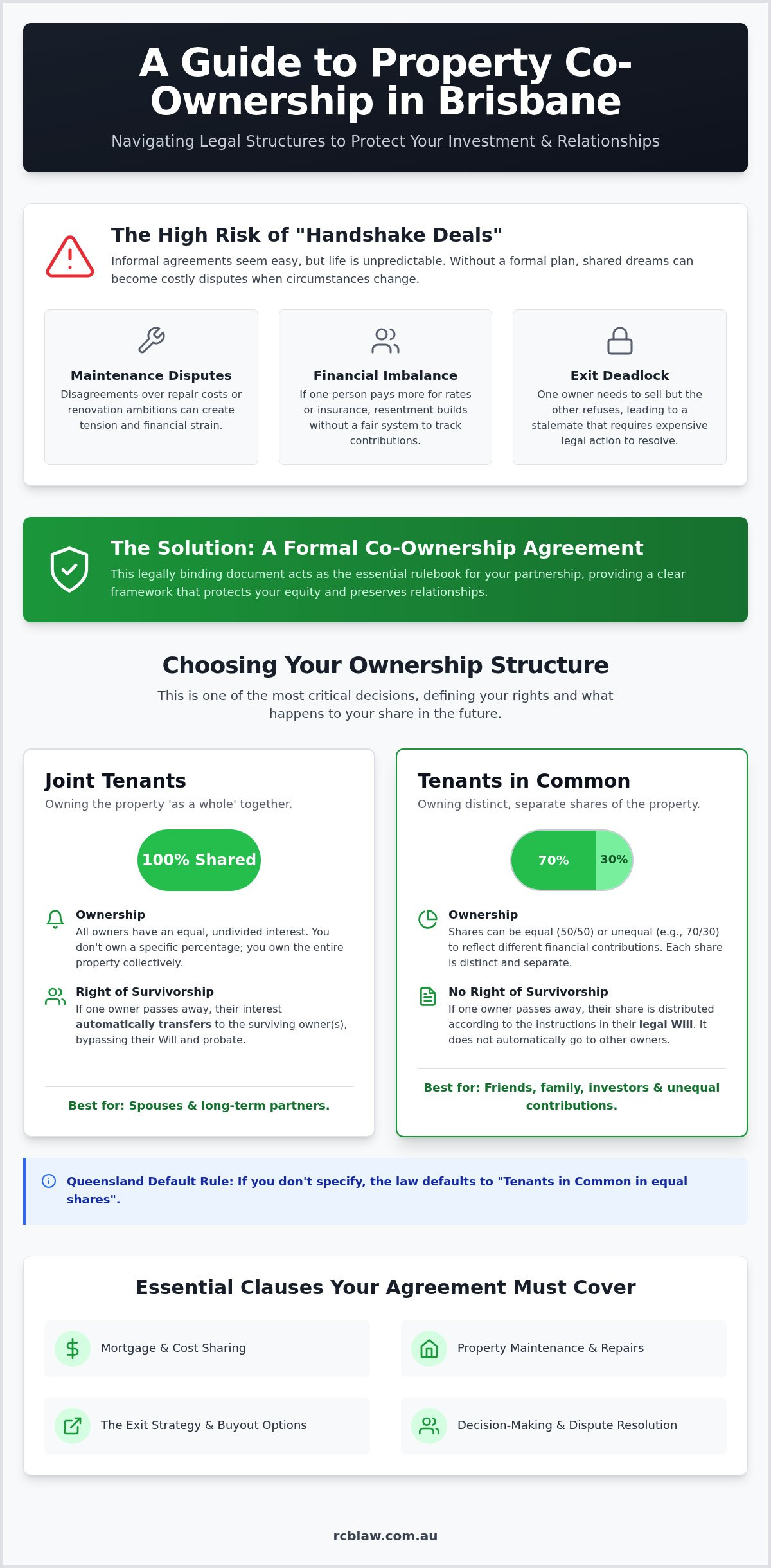
Entering into a "handshake deal" with someone you trust feels natural, but it's a high-risk strategy in a high-stakes market. Life is unpredictable. We've seen how unforeseen events like a sudden job loss, a relationship breakdown, or even the death of a co-owner can turn a smooth investment into a legal nightmare. Without a formal document, these transitions often become high-pressure conflicts that are difficult to resolve.
- Maintenance and Renovations: Disputes often arise over how much to spend on repairs. If one owner wants a premium kitchen upgrade and the other is struggling with the 6.92% average mortgage rates, tension is inevitable.
- Financial Imbalance: If one person consistently pays more for rates or insurance, resentment builds quickly without a pre-agreed ledger system to track contributions.
- The Deadlock: This is the most difficult scenario. If one owner needs to sell their share to access equity but the other refuses to sell the property, you face a stalemate that only expensive legal intervention can resolve.
The Legal Landscape in Queensland
The legal foundation of shared property is known as a Concurrent estate. In Queensland, the Property Law Act 2023 now provides the modernized framework for how these estates are managed, replacing the legacy 1974 legislation. However, relying solely on default legislation is risky because the law provides generic solutions that may not fit your specific financial goals or personal circumstances. Relying on the courts to settle a dispute under default rules is often a slow and costly process that drains your hard-earned equity.
A co-ownership agreement is a private contract that overrides default legal assumptions to provide a tailored resolution for your specific partnership. By choosing to define your own terms now, you ensure that your investment remains secure and your path forward is always clear.
Joint Tenants vs Tenants in Common: Choosing the Right Structure
Deciding how your names appear on the title is one of the most significant legal choices you'll make during the purchase process. This decision dictates your rights while you own the property and determines what happens to your share when you pass away. In Queensland, if you don't specify a preference on the transfer documents, the law defaults to "tenants in common in equal shares." While this might seem straightforward, it often fails to account for the unique financial contributions or long-term intentions of a modern partnership.
Selecting the right structure is a foundational step in your co-ownership agreement for property brisbane. It ensures that your legal standing matches your personal goals, providing a sense of security from the moment you settle on your new home. Whether you are buying with a partner or an investment group, understanding these two distinct paths will help you avoid future complications and emotional stress down the track.
Joint Tenancy: Pros and Cons
Joint tenancy is the most common choice for spouses and long-term partners. Under this structure, you don't own a specific percentage; instead, you both own the whole property together. The defining feature here is the "Right of Survivorship." If one owner passes away, their interest automatically transfers to the surviving owner, completely bypassing the probate process. This provides a seamless transition during a difficult time, ensuring the surviving partner remains secure in their home without unnecessary administrative friction.
However, this lack of defined shares can be a disadvantage if you've contributed unequal amounts to the deposit or ongoing costs. Because the law views you as a single entity, you cannot leave your "share" to anyone else in your Will. For those needing more control over their individual equity, a different approach is often required to reflect the reality of their investment.
Tenants in Common: The Flexible Alternative
If you're buying with friends, siblings, or business associates, the "Tenants in Common" structure is usually the preferred option. It allows you to own specific, defined shares of the property. For example, if you provided 70% of the deposit and your co-owner provided 30%, your ownership can be recorded exactly that way on the title. This flexibility is essential for ensuring fairness and protecting your individual financial interests from the outset.
Unlike joint tenancy, there is no right of survivorship. Your share becomes part of your estate, meaning you can choose exactly who inherits it. This makes it vital to ensure your Will drafting is up to date and aligned with your property interests. This structure offers the clarity needed for complex investment groups, ensuring that every owner’s equity is clearly documented and legally protected under current Queensland law.
Essential Clauses for a Robust Co-Ownership Agreement
Once you've decided on your ownership structure, the focus shifts to the day-to-day reality of owning a home together. A co-ownership agreement for property brisbane should act as a comprehensive manual for your partnership, addressing the "what ifs" before they become points of contention. With the average Brisbane property price exceeding $1.1 million, the financial stakes are too high to leave daily operations to chance. Clear clauses ensure that every owner understands their role, reducing friction and providing a predictable path for the years ahead.
Your agreement needs to address several key areas to be truly effective. These include:
- Financial Contributions: Beyond the mortgage repayments, which currently average around 6.92% for variable loans, you must decide how to split council rates, insurance, and utilities.
- Occupancy Rights: It's helpful to define whether an owner can move a partner in or rent out a room to a third party without the other's consent.
- Default Mechanisms: If a co-owner fails to meet their financial obligations, the consequences must be clear. In Queensland, unpaid tax interest rates can reach 12.43%, so a default by one owner can quickly create a significant debt burden for the others.
Managing Ongoing Costs and Bills
Establishing a dedicated "house account" is a practical way to manage shared expenses. Every owner contributes a set amount via direct debit to cover predictable costs like the $50.20 land tax clearance certificate fees or annual insurance premiums. This system creates transparency and ensures funds are always available for routine maintenance. For larger capital improvements, such as a $20,000 deck or kitchen renovation, your agreement should specify that these require unanimous consent and a clear plan for how the added value is credited to the contributing owners.
We also suggest including provisions for "sweat equity." If one owner is a tradesperson who performs the renovation work themselves, the agreement can recognize this labor as a financial contribution. This prevents future arguments about who did more work and ensures everyone feels the arrangement is fair and balanced.
Dispute Resolution and Decision Making
Even the best relationships can face moments of disagreement. Your agreement should outline a clear, stepped process for resolving conflicts, starting with informal discussion and moving to professional mediation if a resolution isn't reached. This prevents a minor disagreement from escalating into a costly legal battle in the Queensland courts. A well-drafted "buy-out" clause serves as the ultimate tie-breaker by allowing one party to purchase the other's interest at a fair market value if a permanent deadlock occurs. This keeps the investment moving forward while providing a dignified exit for those who wish to move on.
The Exit Strategy: Selling Your Share or the Property
While the initial excitement of buying into the Brisbane market is focused on the "now," the most vital part of your partnership is actually the end. We understand that discussing the end of a partnership can feel uncomfortable when you are just starting out. However, a clearly defined exit strategy is the ultimate insurance policy for your investment. It ensures that if life circumstances change, every owner has a dignified and predictable way to access their equity without destroying the relationship.
A robust co-ownership agreement for property brisbane should outline specific "trigger events" that allow an owner to initiate a sale. These might include a job transfer, a relationship breakdown, or simply reaching the end of a pre-agreed investment term, such as five years. By defining these triggers early, you remove the emotional pressure from the decision-making process when the time eventually comes to move on.
The Buy-Out Process
The "Right of First Refusal" is a central clause that protects the stability of the home. It ensures that if one owner wants to leave, they must first offer their share to the remaining co-owners before listing it on the open market. This keeps the property within the original group if others wish to stay. We recommend a structured three-step process to keep this transition low-friction:
- Step 1: Formal Notice. The departing owner provides a written notice of their intent to sell their share.
- Step 2: Independent Valuation. To ensure fairness, a registered Brisbane valuer should determine the current market value. With average property prices reaching $1,123,700 in early 2026, an accurate valuation is essential for protecting everyone's equity.
- Step 3: Finance Timeframes. The remaining owner is given a specific window, typically 60 to 90 days, to secure the necessary finance to complete the buyout.
Selling to the Open Market
If a buyout isn't possible, the property will need to be sold to the open market. Your agreement should specify how you will choose a real estate agent and how you'll set the reserve price. This prevents a deadlock where one owner wants to hold out for an unrealistic figure while the other needs a quick sale. Once the property is sold, the proceeds are distributed according to your ownership percentages after the mortgage is discharged and selling costs are covered.
It's important to account for the financial implications of a sale, including Capital Gains Tax and the transfer duty rates that took effect on July 1, 2026. For a standard transaction at the current average price, the stamp duty can be approximately $45,138. Understanding these costs beforehand ensures there are no surprises during the settlement process. To ensure your exit strategy is legally sound and protects your financial future, you can contact our residential conveyancing team to discuss your specific needs.
How RCB Law Supports Your Brisbane Property Journey
With over 30 years of experience in Queensland property law, we understand that entering into a shared purchase is a significant life event. It's a move that brings both opportunity and a unique set of pressures. Our role is to act as your steady guide, ensuring that the technical legalities of your co-ownership agreement for property brisbane are handled with precision and care. We focus on creating a sense of calm by removing the friction often found in complex property transitions.
Integrating your agreement into our residential conveyancing services is a core part of our methodical approach. We don't view these as separate tasks. Instead, we see them as a single, seamless journey toward securing your future. By having our local specialists in Brisbane and Redland Bay manage both the transfer of title and the private contract between owners, you ensure that every detail is consistent and legally sound from the very beginning.
Our commitment to your security extends beyond the initial purchase. Because a property share is a major asset, we also emphasize the importance of having your Will drafting updated to reflect your new interests. This holistic approach ensures that your equity is protected for your loved ones, providing total peace of mind that your investment is secure under the latest 2026 Queensland regulations.
Tailored Legal Advice, Not Generic Templates
DIY templates often fail to provide the protection Brisbane buyers need. These generic forms frequently overlook the specific requirements of the Property Law Act 2023 or fail to account for the nuances of your particular partnership. We believe in tailored advice. We take the time to listen to your concerns about mortgage liability, maintenance budgets, and exit strategies. Our team translates these personal goals into clear, binding terms that reflect your reality, not a standard boilerplate.
We pride ourselves on empathetic and proactive communication. We know that buying with others involves emotional and financial complexities. Our goal is to alleviate that burden by providing brief, direct assistance that clarifies the process. We offer fixed-fee property services, so you can move forward with confidence, knowing exactly what to expect without the worry of hidden costs.
Next Steps: Securing Your Investment
Taking the first step toward a secure partnership is simple. We invite you to book a consultation with our property lawyers to discuss your vision. To make our first meeting as productive as possible, it's helpful if you bring along:
- Details of your financial contributions and deposit splits.
- A clear idea of your goals for the property (e.g., how long you plan to hold the investment).
- Any specific concerns you have regarding shared occupancy or future sale triggers.
Contact RCB Law today to discuss your co-ownership agreement and let us help you build a foundation for your property journey that is as stable as it is rewarding.
Building a Secure Foundation for Your Shared Investment
Entering the Brisbane property market with others is an exciting milestone, but it's one that deserves a professional safety net. By choosing the correct ownership structure and defining clear rules for daily costs and future exits, you remove the friction that often clouds shared investments. You've seen how a well-drafted co-ownership agreement for property brisbane protects your equity and, more importantly, your personal relationships. This document isn't just about legalities; it's about providing the clarity needed for your partnership to thrive.
At RCB Law, we bring over 30 years of Queensland property law experience to your side. Our specialist conveyancing team provides the empathetic, client-focused support you need to move from a state of uncertainty to total confidence. We're here to ensure that every detail of your partnership is documented with care, mastery, and a deep understanding of our local market. Whether you're buying with a sibling, friend, or partner, we'll help you navigate the process with ease.
Secure your property future with a professional co-ownership agreement from RCB Law. Taking this proactive step now ensures that your journey into homeownership is as smooth and rewarding as you imagined it would be. We look forward to helping you protect what matters most.
Frequently Asked Questions
Is a co-ownership agreement legally binding in Queensland?
Yes, a co-ownership agreement is a legally binding private contract under Queensland law. It provides a structured framework that overrides the default provisions of the Property Law Act 2023. This allows you to tailor the rules of your partnership to fit your specific financial situation rather than relying on generic legislation that may not suit your goals.
How much does it cost to draft a co-ownership agreement in Brisbane?
The cost of a co-ownership agreement for property brisbane varies depending on the complexity of your specific arrangement and the number of owners involved. We focus on a fixed-fee approach for our property services to ensure you have total cost certainty from the start of the process. Viewing this as an investment in your long-term security helps prevent the far greater expense of future court disputes.
Can we change from Joint Tenants to Tenants in Common later?
You can change your ownership structure from Joint Tenants to Tenants in Common through a legal process called "severance." This involves lodging specific documents with Titles Queensland to record the change on the property title. It's a common step for owners whose personal circumstances or estate planning needs have evolved since they first entered the Brisbane market.
What happens if a co-owner dies without a Will?
If a co-owner dies without a Will while owning as Tenants in Common, their share is distributed according to Queensland’s intestacy laws. This can lead to unexpected family members inheriting a portion of the property, which often complicates the remaining owner's living situation. If you are Joint Tenants, the share automatically passes to the survivor regardless of whether a Will exists.
Does a co-ownership agreement affect my mortgage with the bank?
A co-ownership agreement for property brisbane does not change your contract with the bank or your "joint and several" liability for the debt. The lender still expects the full mortgage payment regardless of which owner is at fault for a missed installment. However, the agreement gives you a clear legal path to recover those costs from a co-owner who fails to meet their obligations.
Can I include a clause about who gets the larger bedroom?
You can absolutely include specific clauses regarding occupancy rights and the exclusive use of certain areas of the home. While many agreements focus on financial triggers and exit strategies, they can also define "house rules" for co-owners who live together. This level of detail helps prevent daily friction and ensures everyone feels the arrangement is fair and transparent.
What happens if my co-owner goes bankrupt?
If a co-owner goes bankrupt, their interest in the property may be seized by a trustee in bankruptcy to satisfy creditors. A robust agreement usually includes a clause that triggers an automatic right for the solvent owners to buy out the bankrupt party’s share at market value. This proactive measure protects the property from being sold unexpectedly to satisfy external debts.
Do I need a lawyer for a co-ownership agreement, or can I do it myself?
While DIY templates are available, they often miss critical local protections required by the latest Queensland property regulations. Professional legal support ensures the document is enforceable and correctly integrated with your residential conveyancing. Relying on an expert provides the peace of mind that your equity is fully protected and that the agreement will hold up if it is ever challenged.


