
In 2026, signing a contract for a home that doesn't exist yet feels less like a traditional real estate purchase and more like a high-stakes act of faith. You might find yourself lying awake wondering if your deposit is truly safe or if a valuation shortfall at settlement will suddenly derail your financial future. It's completely natural to feel this anxiety, especially as you weigh the risks of buying property off the plan 2026 presents against the allure of the $30,000 First Home Owner Grant and recent stamp duty exemptions.
We understand that these major life transitions are high-pressure moments that require a steady, professional guide to remove the friction. This guide promises to help you move through the complexities of the current Queensland market with total confidence. You'll gain a clear legal framework for protecting your deposit and learn how to use QLD-specific sunset clause protections to your advantage. We will provide a structured breakdown of how to stress-test your contract, ensuring your path to homeownership is secure, logical, and free from the confusion of recent budget changes.
Key Takeaways
- Navigate the 2026 Queensland landscape where high demand meets limited supply in key regions like Brisbane and the Sunshine Coast.
- Identify the specific risks of buying property off the plan 2026, from managing developer insolvency to addressing the 53% apartment defect rate.
- Prepare for financial hurdles like valuation shortfalls while leveraging new budget rules that favor new builds for tax deductions.
- Stress-test your contract with essential clauses that limit developer variations and secure a long-term defects liability period.
- Protect your deposit with a fixed-price contract review, ensuring your investment is backed by 30 years of local Queensland expertise.
Understanding Off-the-Plan Property in Queensland (2026 Market Context)
At its core, Understanding Off-the-Plan Property involves entering a legal agreement to purchase a residence that is still in the design or construction phase. In the current Queensland market, this usually means you're buying a promise of a finished home two or even three years into the future. For many, the appeal lies in securing a property at today's market value, with the hope that capital growth will increase your equity before the first mortgage payment is even due. It's a strategic move. However, understanding the risks of buying property off the plan 2026 requires a defense-first mindset to ensure that promise becomes a reality.
Why 2026 is a Unique Year for QLD Property
Queensland's property landscape is currently defined by a significant supply-demand gap. In Brisbane, the "Olympic Effect" has moved from a distant concept to a tangible driver of value. Major infrastructure projects are creating a ripple effect of demand across the inner-city and middle-ring suburbs. On the Sunshine Coast, the development boom shows no signs of slowing down, as the region transitions from a holiday destination to a primary residential hub. While the housing crisis of 2025 has begun to stabilize into a more predictable market in 2026, construction costs remain a factor. This makes the choice of developer more critical than ever before.
The Legal Mechanics: Contracts, Deposits, and Disclosure
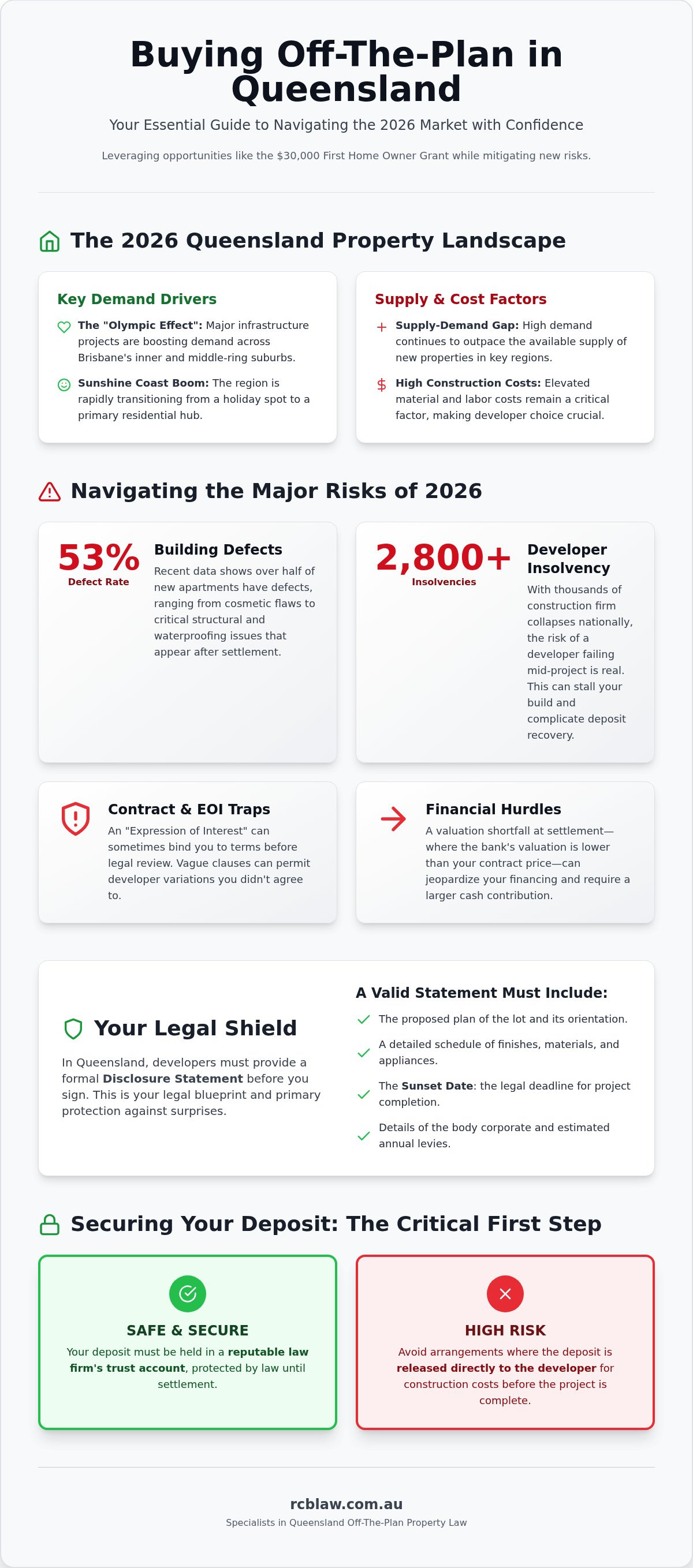
Queensland has rigorous disclosure requirements designed to protect you from surprises. Under the Property Law Act, a developer cannot simply sell you a "concept." They must provide a formal Disclosure Statement before you sign anything. This document isn't just paperwork; it's a blueprint of your legal rights. A valid statement must include:
- The proposed plan of the lot and its exact orientation.
- A detailed schedule of finishes, specifying the quality of materials and appliances.
- The Sunset Date, which acts as the legal deadline for the project's completion.
- Details of the body corporate and estimated annual levies.
One common trap we see involves the "Expression of Interest" (EOI) phase. Many buyers view an EOI as a low-risk way to "hold" a property while they think it over. In reality, these documents can sometimes contain clauses that make deposits difficult to recover or bind you to terms before you've had a chance to seek legal advice. It's vital to remember that in Queensland, the cooling-off period only begins once you've received a signed copy of the full contract from the developer. Treating the EOI with the same gravity as the final contract is a key step in managing your risk and keeping your journey stress-free.
The 2026 Risk Landscape: Developer Insolvency and Building Defects
The construction industry has faced significant headwinds over the last few years. As we move through 2026, the fallout from the 2024-25 period remains a primary concern for many buyers. Understanding the risks of buying property off the plan 2026 involves more than just looking at floor plans; it requires a deep dive into the stability of the people building your home. With over 2,800 construction insolvencies reported nationally in recent years, the risk of a developer failing mid-build is a reality we must account for in your strategy.
A major fear for many of our clients is developer insolvency. If a builder or developer faces financial collapse, your project could stall indefinitely. While your deposit is generally protected in a solicitor's trust account, the process of rescinding a contract and recovering those funds can be slow and emotionally draining. You should always confirm that your deposit is held by a reputable law firm's trust account, rather than being released directly to the developer for construction costs. This simple verification acts as your first line of defense against financial loss.
Building defects represent another hurdle. Recent data indicates a 53% apartment defect rate in newer developments, making quality control a critical concern for 2026 purchasers. These aren't just cosmetic flaws; they can include structural or waterproofing problems that only appear after you move in. This is why many buyers consider the risks of buying off-the-plan carefully before committing to a binding agreement.
Vetting Your Developer: Legal Due Diligence
You don't have to go into this blindly. We recommend checking a developer's track record through the Queensland Building and Construction Commission (QBCC). Reviewing past projects and their financial standing helps build a picture of reliability. It's also essential to scrutinize the 'Schedule of Finishes.' This document prevents quality downgrades by locking in specific materials, ensuring the granite benchtop you were promised isn't replaced with a cheaper laminate during the build phase.
Sunset Clauses: Your Rights Under QLD Law
In the past, some developers used sunset clauses to terminate contracts simply because property prices rose, allowing them to resell at a higher price. Queensland legislation was strengthened in November 2023 to prevent these 'bad faith' terminations. Now, a developer can only use a sunset clause to terminate a contract with your written consent or an order from the Supreme Court. If construction isn't finished by the sunset date, you generally have the right to terminate and get your deposit back, but you cannot be forced out of your contract just so the developer can make a larger profit. Engaging a specialist for a residential conveyancing review ensures your sunset clause is drafted to protect your interests, not just the developer's bottom line.
Financial Risks: Valuation Gaps and the 2026 Budget Impact
The financial side of an off-the-plan purchase often feels like aiming at a moving target. You're committing to a price today for a property that won't settle until 2028. While the $30,000 Queensland First Home Owner Grant provides a significant leg-up for properties under $750,000, navigating the risks of buying property off the plan 2026 requires looking far beyond the initial deposit. You must account for interest rate shifts and the possibility that the market might cool before your keys are handed over. Planning for 2028 interest rates while signing in 2026 is the only way to ensure your mortgage remains affordable long-term.
The Valuation Gap: A Practical Example
A valuation gap occurs when a lender determines the completed property is worth less than the price you agreed to pay years earlier in a volatile 2026 market. Imagine you sign a contract for $700,000. By settlement in 2028, the bank’s valuer assesses the unit at $650,000. Since the bank only lends against the lower figure, you're suddenly responsible for finding that $50,000 difference out of your own pocket. If you don't have the cash reserves, you might be forced into paying Lenders Mortgage Insurance (LMI) or, in the worst-case scenario, defaulting on the contract. We help clients stress-test their financial position early so these shortfalls don't become settlement disasters.
Negative Gearing and New Builds: The 2026 Tax Advantage
The 2026 Federal Budget introduced a major shift that makes new builds the 'gold standard' for property investors. While established homes have seen a reduction in tax benefits, off-the-plan purchases remain fully eligible for traditional negative gearing and depreciation schedules. There's a specific 'conveyancing trap' to watch for: the May 12, 2026 cutoff. If your contract isn't signed and exchanged before this date, you might fall under a stricter tax regime. This makes the timing of your legal review vital.
Investors are flocking to new construction to preserve their tax deductions, but speed shouldn't replace due diligence. The 2026 landscape rewards those who move quickly but penalizes those who skip a professional contract review. We suggest consulting with your accountant alongside our team to ensure your future tax liability is clearly understood. This collaborative approach removes the friction from the process and gives you a clear, low-risk path to settlement. By aligning your legal strategy with the latest budget rules, you can turn these market shifts into a long-term financial advantage.
Stress-Testing Your Contract: Essential Clauses for 2026
Entering a contract for a property that hasn't been built yet requires more than just a leap of faith; it requires a robust legal shield. The 2026 market involves complex construction timelines and shifting economic conditions. Your contract is the only document that defines your rights when things don't go as planned. To manage the risks of buying property off the plan 2026, you must ensure your agreement is stress-tested against potential variations, financial hurdles, and quality concerns long before the first brick is laid.
One of the most overlooked areas is the finance clause. In a standard residential sale, a finance clause usually lasts 14 to 21 days. For an off-the-plan purchase, this is practically useless. Since a lender won't provide final, unconditional approval until the building is complete and a valuation is conducted, a standard short-term clause leaves you exposed for years. We advocate for specific language that protects you if your financial circumstances or bank lending criteria change during the construction period. Similarly, you should understand the body corporate disclosure. This document outlines your future levies and management rules, which can significantly impact your ongoing cost of living or investment yield.
The 'Material Change' Test in QLD
Queensland law provides a specific safety net regarding "material changes." If a developer makes a change to the project that is materially prejudicial to you, such as significantly reducing the floor area or altering the unit entitlements, you may have the right to rescind the contract. However, what counts as "material" is often a point of contention. Legal precedents in Queensland developments show that even a 5% change in size or a shift in the view can sometimes trigger these rights. We review these variation clauses to ensure the developer cannot make major changes to your future home without your explicit consent.
Pre-Settlement Inspections and the 'Punch List'
As settlement approaches, your right to a professional building inspection becomes your final opportunity to ensure quality. This is where you create a "punch list" of minor defects like paint scuffs or misaligned cabinetry. More importantly, it's the time to identify major defects before final payment is made. You should ensure your contract includes a Defects Liability Period, ideally lasting 6 to 12 months post-settlement. This clause requires the developer to return and fix any issues that arise once you've moved in, providing you with long-term peace of mind. Buying a House? Key Legal Steps You Can't Skip is a helpful resource for understanding how these inspections fit into the broader legal process.
Protecting your investment starts with a deep understanding of the fine print. To ensure your interests are fully represented, we recommend a fixed-price residential conveyancing review before you sign any binding documents. This proactive step helps remove the friction from the buying process and establishes a clear, secure path to your new home.
How RCB Law Protects Your Off-the-Plan Investment
The decision to buy off-the-plan is a significant milestone, but it often carries a heavy emotional burden. You're balancing the excitement of a future home with the practical anxieties of market shifts and construction delays. At RCB Law, we see our role as more than just legal technicians; we act as a supportive partner to ensure your transition is as low-friction as possible. By focusing on residential conveyancing as our core expertise for over 30 years, we've developed a deep understanding of the local developer landscape across Brisbane and the Sunshine Coast. We know which builders have a history of quality and which ones might present red flags in their contractual terms.
One of our primary tools for your protection is our fixed-price contract review. Before you commit to a deposit or sign an expression of interest, we provide a structured breakdown of the legal and financial obligations you're assuming. This ensures you're fully aware of the risks of buying property off the plan 2026 before you've paid a cent toward the purchase price. We also utilize the latest digital tools, including PEXA, to ensure your settlement is seamless and transparent. This methodical approach allows us to guide you from a state of uncertainty to a feeling of total security.
The RCB Law Difference: Local Expertise
Choosing a specialist with local roots makes a tangible difference in your experience. Unlike a national firm that might treat your file as a transaction, we understand the specific nuances of Queensland property law and regional development trends. We pride ourselves on a proactive communication style that keeps you updated during the long build wait, which can often stretch to two years or more. We act as a steady guide for first-home buyers, providing the calm assurance and professional mastery needed to navigate a high-pressure property market with total clarity.
Next Steps: Secure Your 2026 Purchase
If you've found a development that feels right, the next step is to ensure your contract is 'stress-tested' by an expert. You can send your contract or expression of interest form to our team for an urgent review. This process identifies hidden clauses that might favor the developer and ensures your deposit is held in a secure trust account. Taking this step provides the peace of mind that your financial future is protected by a firm that understands the local context.
Don't leave your investment to chance in a volatile market. Let RCB Law review your off-the-plan contract today to ensure your journey to homeownership is safe, secure, and professionally managed from start to finish.
Moving Forward with Confidence in Your QLD Purchase
Buying a home is one of the most significant life events you'll experience, and the 2026 market requires a particularly steady hand. By understanding the risks of buying property off the plan 2026, you've already taken the first step toward a secure investment. You now know how to identify valuation gaps before they become settlement crises and how to use Queensland's strengthened sunset clause protections to keep your contract safe. Aligning your purchase with the latest tax advantages ensures your financial strategy is just as robust as your legal one.
You don't have to navigate these complex transitions alone. As fixed-fee residential conveyancing specialists with over 30 years of Queensland property law experience, we're here to act as your steady guide. We provide the expert guidance Sunshine Coast and Brisbane buyers need to remove the friction from long-term builds. Secure your property future with an RCB Law contract review to ensure your new home is protected by professional stress-testing. With the right support, you can look forward to your 2028 move-in date with total confidence.
Frequently Asked Questions
Is my deposit safe if the developer goes bust in 2026?
Your deposit is protected as long as it's held in a solicitor’s or real estate agent’s trust account rather than being released directly to the developer. Under Queensland law, these funds cannot be used for construction costs. If the developer becomes insolvent, the trust account structure ensures your deposit is returned, though the process can take time. We verify these trust arrangements during our contract review to soothe your anxieties about potential financial loss.
Can a developer increase the price of my off-the-plan property after I sign?
Developers generally cannot increase the purchase price once a contract is signed unless specific escalation clauses are included. While fixed-price contracts are the standard, some agreements allow for price adjustments if construction costs rise significantly or if you request changes to the finishes. We carefully scrutinize these clauses to ensure you aren't hit with unexpected costs at settlement. It's vital to have these terms stress-tested before you commit to a binding agreement.
What happens if the bank valuation comes in lower than the purchase price?
If the bank valuation is lower than the contract price, you're responsible for paying the difference to the lender at settlement. This is a primary risk when navigating the risks of buying property off the plan 2026. Banks only lend against the lower valuation figure, not the price you signed for years earlier. You may need to use cash reserves or pay Lenders Mortgage Insurance to bridge this gap and secure your home.
How do the 2026 Budget negative gearing changes affect off-the-plan buyers?
The 2026 Budget changes favor off-the-plan buyers by maintaining full negative gearing and depreciation benefits for new construction. While established homes face stricter rules, new builds remain the gold standard for tax deductions. To qualify for these benefits, your contract must typically be signed before specific cutoff dates, such as May 12. Consulting with an expert ensures your purchase aligns with these new regulations, providing a clear financial advantage for investors and first-time buyers alike.
Can I sell my off-the-plan contract (nominate) before settlement?
You can only sell or nominate your contract to another buyer if your agreement specifically includes an "and/or nominee" clause or allows for assignments. Many developers restrict this to prevent buyers from flipping contracts for profit before the building is finished. If allowed, this process involves complex legal steps and potential stamp duty implications. We can review your contract to see if this flexibility exists to meet your changing professional or personal needs.
What is a sunset clause and can I be forced out of my contract?
A sunset clause is a date by which the developer must complete the project, or the contract can be terminated. Recent Queensland reforms mean a developer can no longer force you out of a contract simply to resell the property for a higher price. They now need your written consent or a Supreme Court order to terminate. This provides a significant safety net, ensuring you aren't unfairly pushed out of the market as prices rise.
Do I still get the First Home Owner Grant for an off-the-plan purchase in QLD?
Yes, eligible first home buyers can access a $30,000 grant for new homes valued under $750,000 in Queensland. For contracts signed from 1 July 2026, this grant serves as a vital incentive for those building or buying off-the-plan. Additionally, eligible buyers may benefit from full stamp duty exemptions on new homes with no price cap. We help you confirm your eligibility so you can maximize these government incentives with total confidence and clarity.
What is the cooling-off period for an off-the-plan contract in Queensland?
The cooling-off period is five business days, starting from the day you or your solicitor receives a copy of the contract signed by both parties. During this window, you can withdraw from the sale for any reason, though a penalty of 0.25% of the purchase price may apply. It's the perfect time to have your legal representative conduct a final review to ensure the agreement aligns with your long-term expectations and financial goals.


