
What if the most dangerous thing about your new Queensland home isn't a hidden termite colony, but a simple misunderstanding of your contract dates? While the building and pest inspection clause qld is your primary shield against structural "lemons," it requires precise timing and legal accuracy to remain effective. It's completely normal to feel anxious about the 5:00pm deadline or the technicalities of the REIQ contract. You want a home that provides security for your family, not a mounting list of expensive repairs and legal headaches.
We're here to help you navigate these high-pressure transitions with ease. In this 2026 guide, you'll learn how to master the legal nuances of the building and pest clause to protect your deposit and your future. We will demystify the "acting reasonably" requirement and explain how the latest seller disclosure laws impact your rights. From understanding inspection costs to managing the notice process, this breakdown provides a clear, supportive path to a successful settlement. You can move forward with the confidence that your investment is sound and your interests are fully protected.
Key Takeaways
- Understand how the building and pest inspection clause qld acts as your primary legal shield, protecting you from structural defects and termite issues under the REIQ contract.
- Learn why Queensland's "time is of the essence" rule makes the 5:00pm deadline non-negotiable and how to manage your 7 to 14-day inspection window effectively.
- Discover the "objective reasonableness" test to determine when you have the legal right to terminate a contract or request a price reduction.
- Master the art of using a professional inspection report as a powerful tool to negotiate repairs or offset your purchase price before settlement.
- Find out how expert legal review can alleviate the emotional burden of the notice process, ensuring your interests are protected during high-pressure transitions.
What is the Building and Pest Inspection Clause in QLD?
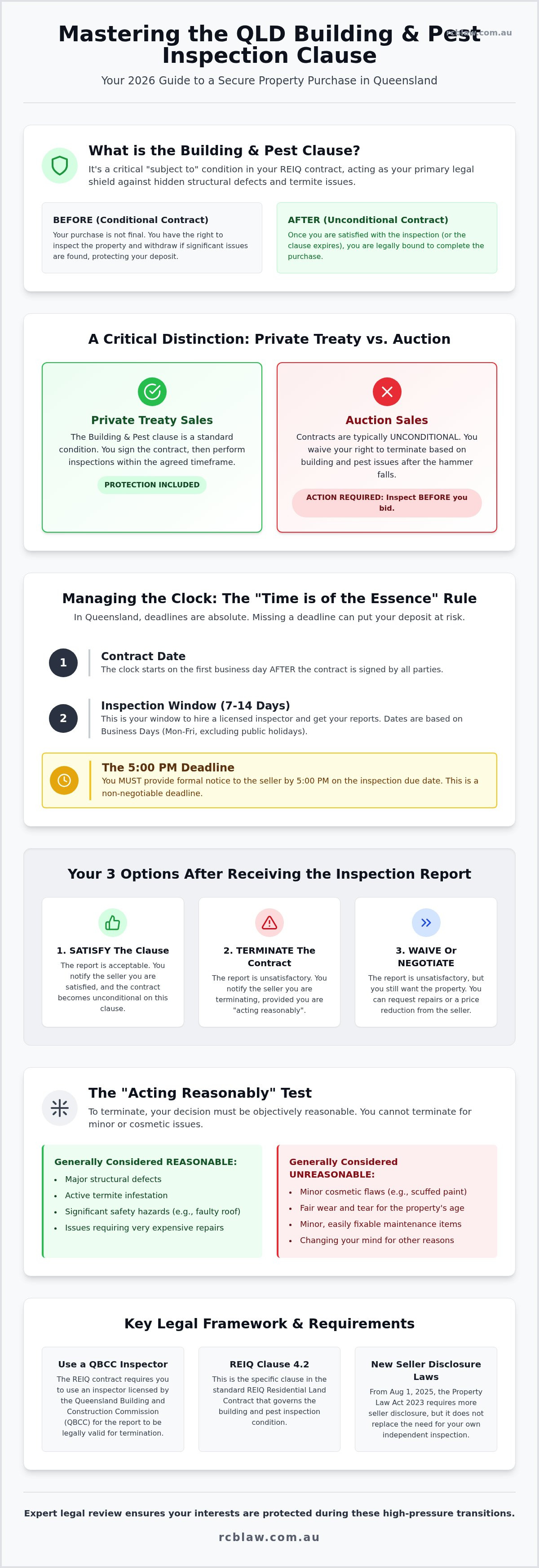
The building and pest inspection clause qld is a vital "subject to" condition within the standard REIQ contract. It transforms a potentially risky legal commitment into a conditional agreement, providing you with a necessary safety net during one of life's biggest transitions. Essentially, the building and pest clause is the buyer’s right to seek independent expert assessment of a property’s condition before being legally bound to complete the purchase. By including this condition, your contract remains "conditional" rather than "unconditional" from the moment of signing, which means you aren't locked into the sale until you are satisfied with the property's structural integrity.
Historically, Queensland property law operated strictly under the principle of "Caveat Emptor," or buyer beware. This meant the burden of discovery sat entirely on your shoulders. While the introduction of the Property Law Act 2023 on August 1, 2025, shifted some responsibility to sellers through mandatory disclosure, it hasn't removed the need for due diligence. A professional building inspection remains your primary protection against hidden defects, such as rising damp or structural movement, which a seller might not even be aware of themselves.
Private Treaty vs. Auction: A Critical Distinction
It's important to understand that the protection offered by a building and pest clause typically only applies to private treaty sales. When you buy a property at auction in Queensland, the contract is usually "unconditional" the moment the hammer falls. This creates a high-pressure environment where you waive your right to terminate based on the property's condition after the sale. To mitigate this risk, we strongly recommend arranging inspections before the auction date. Failing to do so could leave you legally bound to a property with significant termites or structural "lemon" traits, with no easy way to withdraw your deposit.
The Standard REIQ Contract Framework
In the standard REIQ Residential Land Contract, this protection is found in Clause 4.2. This clause works alongside other essential conditions, such as finance and the broader conveyancing process, to ensure you aren't forced into a bad investment. Under this framework, you have a specific obligation to appoint a licensed inspector who is approved by the Queensland Building and Construction Commission (QBCC). Using a qualified professional ensures the report is legally robust if you need to negotiate repairs or terminate the contract based on the findings.
Deadlines and Requirements: Managing the Clock
Managing the clock is often the most high-pressure part of a property transaction. In Queensland, property deadlines are strictly enforced under the "Time is of the Essence" rule. This means that if your contract specifies a 14-day period for the building and pest inspection clause qld, that date is absolute. Missing a deadline by even a few minutes can lead to a breach of contract, potentially putting your deposit at risk. We understand how stressful this countdown can feel, so we prioritize clear communication to ensure you never miss a critical milestone.
Your due date is calculated based on "Business Days," which exclude weekends and public holidays in Queensland. The count begins on the first business day after the contract date. The most vital moment in this timeline is 5:00pm on your nominated inspection date. By this time, you must provide formal notice to the seller regarding your satisfaction with the reports. As noted by the REIQ on the building and pest clause, the contract does not automatically end if you fail to give notice. Instead, it remains "on foot," but the seller may gain the right to terminate the contract if your notice is late.
Selecting a Licensed Inspector
The REIQ contract requires you to appoint an inspector who is licensed under the Queensland Building and Construction Commission (QBCC). While it might be tempting to ask a "handy mate" or a general builder to look over the property, their feedback usually won't satisfy the legal requirements of the clause. A licensed professional provides a standard visual inspection of accessible areas. If you suspect deeper issues, you may need to negotiate for invasive testing, which requires specific seller permission as it involves moving or removing parts of the structure.
Providing Proper Notice to the Seller
Once you receive your report, you have three primary paths for providing notice. You can notify the seller that you are satisfied and wish to proceed, notify them that you are not satisfied and intend to terminate, or choose to waive the benefit of the clause entirely. This notice must be in writing and delivered to the seller’s solicitor. Simply telling the real estate agent that you're happy with the report is not sufficient; the legal notice must reach the seller's legal representative by the 5:00pm cutoff. We act as your steady guide during this phase, ensuring all paperwork is accurately prepared and delivered to protect your interests and your path to settlement.
The "Acting Reasonably" Test: When Can You Terminate?
One of the most frequent sources of anxiety for our clients is the "acting reasonably" requirement. You might worry that if you discover a problem, the seller will challenge your decision to walk away or refuse to return your deposit. Under the building and pest inspection clause qld, your decision to terminate isn't a subjective choice. Instead, it relies on an objective test: would a reasonable person, having received that specific report, decide to terminate? It's a protective measure for both parties, ensuring the clause isn't used as a simple "change of heart" loophole while still protecting you from genuine property failures.
If you choose to end the contract based on the findings, the seller has a legal right to request a copy of your report. They do this to verify that your grounds for termination are objectively valid. QLD law requires buyers to act reasonably, meaning minor cosmetic issues rarely justify termination. We act as your steady guide during this assessment, helping you understand the legal weight of each finding so you can move forward with confidence.
Reasonable vs. Unreasonable Grounds for Termination
What constitutes a reasonable ground for termination often depends on the property's specific context. For a modern apartment on the Sunshine Coast, a major leak in the balcony waterproofing is a clear, reasonable ground for termination. Conversely, expecting a 100-year-old Queenslander in Brisbane to be free of minor timber decay or slightly uneven floors is often viewed as unreasonable. Common grounds that meet the "reasonable" threshold include active termite infestations, significant historical damage that compromises the structure, or severe drainage issues that lead to persistent rising damp. Unreasonable grounds typically involve "wear and tear" or cosmetic flaws, such as a single cracked bathroom tile or minor paint scuffs.
Major vs. Minor Defects
To provide further clarity, the industry follows the Australian Standard (AS 4349.1), which defines a major structural defect as a significant flaw in a primary element of the building. Safety hazards are also treated with high priority; for example, faulty electrical wiring or a lack of compliant pool fencing are serious issues that require immediate attention. However, maintenance items like a dripping tap or a slipped roof tile are generally considered minor. In older Brisbane homes, these are expected parts of property ownership and rarely provide a legal pathway to terminate the contract. We help you distinguish between a property that is merely "imperfect" and one that represents a genuine risk to your investment.
Negotiating Repairs or Price Reductions
Receiving an inspection report that highlights significant issues can feel like a major setback, but it often serves as a powerful tool for adjustment rather than a reason to walk away. While the building and pest inspection clause qld provides a path to termination, it also creates a window for renegotiation. We understand that you may still love the property despite its flaws, and our role is to help you find a path forward that doesn't compromise your financial security. Using the findings as leverage allows you to align the purchase price with the property's true condition, ensuring you don't overpay for hidden problems.
Deciding between a price reduction or a repair request is a critical strategic choice. A price reduction is generally the cleaner option for both parties. It allows you to control the quality of the repairs after settlement using your own trusted tradespeople. When a seller performs repairs, they may be motivated to choose the cheapest possible fix just to reach the settlement date. By taking a credit or a reduction in the purchase price, you eliminate the risk of poor workmanship and ensure the job is done to your satisfaction.
The Process of Seeking a Price Reduction
Your first step is drafting a clear, evidence-based proposal. This document should identify the specific defects found in the report and include professional quotes to justify the requested reduction. Once prepared, your solicitor communicates this proposal to the seller’s legal team. It is important to remember that the seller is not legally required to agree to a reduction. They can accept, reject, or provide a counter-offer. If they refuse, you must then decide whether the defects are serious enough to justify terminating the contract under the "acting reasonably" framework we discussed earlier.
Requesting Repairs Before Settlement
If you prefer the seller to handle the work before you take possession, your request must be highly specific. You should insist that all work is completed by a licensed tradesperson and that you receive copies of all invoices and warranties. Most importantly, you must ensure your contract includes a right to re-inspect the property before settlement to verify the repairs. Special conditions must be drafted with precision to avoid further disputes over what constitutes a "satisfactory" repair. If you're unsure how to phrase your request, our residential conveyancing specialists can review your report and draft the necessary legal notices to secure your investment.
How RCB Law Protects Your Interests in QLD
RCB Law serves as your steady guide through the high-pressure period surrounding the building and pest inspection clause qld. We understand that waiting for an inspection report can be an emotional journey, especially when your deposit and future home are on the line. Our team provides an expert review of your findings to help you determine if termination is legally "reasonable" or if a price negotiation is your best path forward. By managing the stressful "Notice" process, we ensure your rights are protected well before the critical 5:00pm deadline. We maintain proactive communication with the seller's solicitor to remove friction and provide peace of mind for buyers across Brisbane, the Sunshine Coast, and Redland Bay.
Our role is to provide clarity when technical reports feel overwhelming. We translate complex legal requirements into actionable steps, ensuring you understand your obligations and your rights at every stage. This supportive approach allows you to make informed decisions without the anxiety often associated with property law. Whether you are a first-time buyer or an experienced investor, we offer the professional mastery needed to navigate the nuances of the REIQ contract framework with complete confidence.
Local Expertise in Sunshine Coast and Brisbane
With 30+ years of experience, we have a deep understanding of the specific environmental factors that affect Queensland properties. Whether it is coastal corrosion on the Sunshine Coast or identifying risks in Brisbane flood zones, our local knowledge is a vital asset during your due diligence. We have navigated the complexities of REIQ standard contracts for decades, ensuring every special condition is drafted in your favor. This expertise is seamlessly integrated into your broader conveyancing checklist, allowing you to move from contract to settlement without unexpected legal hurdles.
Taking the Stress Out of the Settlement Process
Our primary goal is to alleviate the emotional burden of your property transition. We manage the entire flow of legal documents and deadlines so you can focus on the practicalities of your move. To provide financial certainty, we offer fixed-price options that help you maintain a clear property budget from the outset. We don't just process paperwork; we act as a supportive partner committed to your success. Contact RCB Law today for expert conveyancing assistance.
Move Forward with Confidence and Clarity
Mastering the building and pest inspection clause qld is your most effective strategy for ensuring your new home is a sanctuary rather than a source of financial stress. By respecting the strict 5:00pm deadlines and applying the "acting reasonably" framework, you maintain complete control over your property investment. Whether you're negotiating a price reduction for structural repairs or simply seeking the peace of mind that comes with a clear report, professional legal review ensures your interests are never compromised. You deserve a settlement process that feels smooth and predictable, free from the friction of last minute contract disputes.
We bring over 30 years of Queensland property law experience to your side. As specialist Sunshine Coast and Brisbane conveyancers, we pride ourselves on providing reassuring, client-focused support that simplifies high pressure transitions. We act as your steady guide, ensuring every legal notice is served correctly so you can focus on the excitement of your move. Secure your property purchase with RCB Law’s expert conveyancing services. We look forward to helping you step into your new home with total security and peace of mind.
Frequently Asked Questions
Can I terminate a contract for a minor issue like a leaking tap?
Generally, you cannot terminate for minor issues. Queensland property law requires you to act reasonably when invoking the building and pest inspection clause qld. Minor maintenance items, such as a leaking tap, a cracked tile, or a loose door handle, are expected in most established homes. Terminating for these reasons could be viewed as unreasonable, potentially leading to a legal dispute over your deposit. We help you distinguish between simple maintenance and genuine structural concerns.
What happens if I miss the 5:00pm building and pest deadline?
If you miss the 5:00pm deadline, the contract does not automatically end. Instead, it remains "on foot," but the seller gains the immediate right to terminate the contract until you provide your notice. This puts you in a vulnerable position where you could lose the property. We prioritize proactive communication with the seller's solicitor to ensure your notice is served well before this critical cutoff, keeping your path to settlement secure and low-friction.
Does the seller have to fix the issues found in the inspection report?
No, the seller has no legal obligation to rectify issues found in the report. The building and pest clause simply gives you the right to terminate or negotiate. You can propose that the seller completes repairs or offers a price reduction, but they can choose to refuse. If they say no, your choice is to either proceed with the purchase as is or terminate the contract if the defects are objectively major and reasonable.
Who pays for the building and pest inspection in Queensland?
The buyer is responsible for the cost of the building and pest inspection in Queensland. This is a standard part of your due diligence to ensure the property is a sound investment. In 2026, a combined inspection typically costs between $475 and $900, depending on the property's size and location. While it is an additional expense, it provides the essential evidence needed to protect your deposit and negotiate fairly with the seller during the process.
Can I use a building and pest report from a previous buyer?
While you might see a previous report, you should always commission your own. If you rely on another buyer's report and the inspector missed a major defect, you have no legal recourse against them because the contract is not in your name. To ensure the building and pest inspection clause qld protects you fully, you need a fresh, independent assessment from a QBCC-licensed professional who is legally accountable to you and your solicitor.
Is a building and pest clause the same as a cooling-off period?
No, these are two distinct protections. The cooling-off period is a statutory five-business-day window that begins when you receive the signed contract; terminating during this time usually incurs a 0.25% penalty. In contrast, the building and pest clause is a specific contract condition that allows you to terminate without penalty if the property has major defects. Both are important, but they serve different roles in protecting your interests during the high-pressure transition of buying a home.
Can a seller refuse to give the inspector access to the property?
Under the standard REIQ contract terms, the seller is required to provide the inspector with reasonable access to the property. If a seller refuses access, they may be in breach of their contractual obligations. We act as your steady guide in these situations, communicating directly with the seller's legal team to resolve access issues. Ensuring your inspector can view all accessible areas is vital for a thorough and legally robust report that protects your investment.
What is the "acting reasonably" requirement in QLD law?
The "acting reasonably" requirement is an objective test used by Queensland courts. It asks whether a reasonable person, in the buyer's exact position and with the same inspection report, would choose to terminate the contract. It prevents buyers from using the clause as a "get out of jail free" card for minor issues. We help you navigate this requirement by reviewing your report and providing clear advice on whether your grounds for termination are legally sound.


