
What if a handwritten note, text message or saved file appears to set out someone’s final wishes, but was never signed or witnessed? If you’re seeking informal will qld legal advice, the key question is whether the document was meant to operate as the person’s final will, not simply whether it looks like one.
It’s understandable to worry that an unfinished draft could lead to disagreement or that a court might not accept the document. Under section 18 of Queensland’s Succession Act 1981, the Supreme Court can dispense with the usual signing and witnessing requirements if it’s satisfied that the deceased intended the document to be their will. That possibility is not a guarantee, and the circumstances matter.
This guide explains the legal test, what records and surrounding evidence may help show the will-maker’s intentions, and how next steps differ depending on whether they’re still alive. If they are, advice can help clarify their wishes and prepare a properly executed will. If they’ve died, the document may need to be assessed in the context of the estate. RCB Law has more than 30 years of experience in wills and estate planning in Queensland.
Key Takeaways
- Start by identifying what the document is and whether the will-maker is alive, as these details shape the next steps.
- Queensland’s section 18 test focuses on whether the deceased intended the document to form their will, but recognition is never automatic.
- Messages, drafts and surrounding circumstances may help clarify intention, while signs that the document was unfinished can create uncertainty.
- If the will-maker is still alive, a properly prepared will can make their wishes clearer and reduce future uncertainty.
- Informal will qld legal advice can help you understand the evidence, available options and a suitable next step for the circumstances.
Informal wills in Queensland: what counts, and why the distinction matters
Finding instructions about someone’s estate that weren’t signed or witnessed in the usual way can be unsettling. You may be unsure whether you’ve found their final wishes, an unfinished draft or something they never intended to be a will. In Queensland, an informal will is a document that may not meet the formal requirements for making a will. Its status depends on more than its appearance or format.
Section 18 of the Succession Act 1981 (Qld) gives the Supreme Court of Queensland power to dispense with the usual execution requirements if it is satisfied that a document was intended to form the deceased person’s will. This is a court decision, not an automatic result. An informal document isn’t automatically valid, but it isn’t automatically invalid just because it lacks the usual signatures or witnesses.
What kinds of documents may raise an informal-will question?
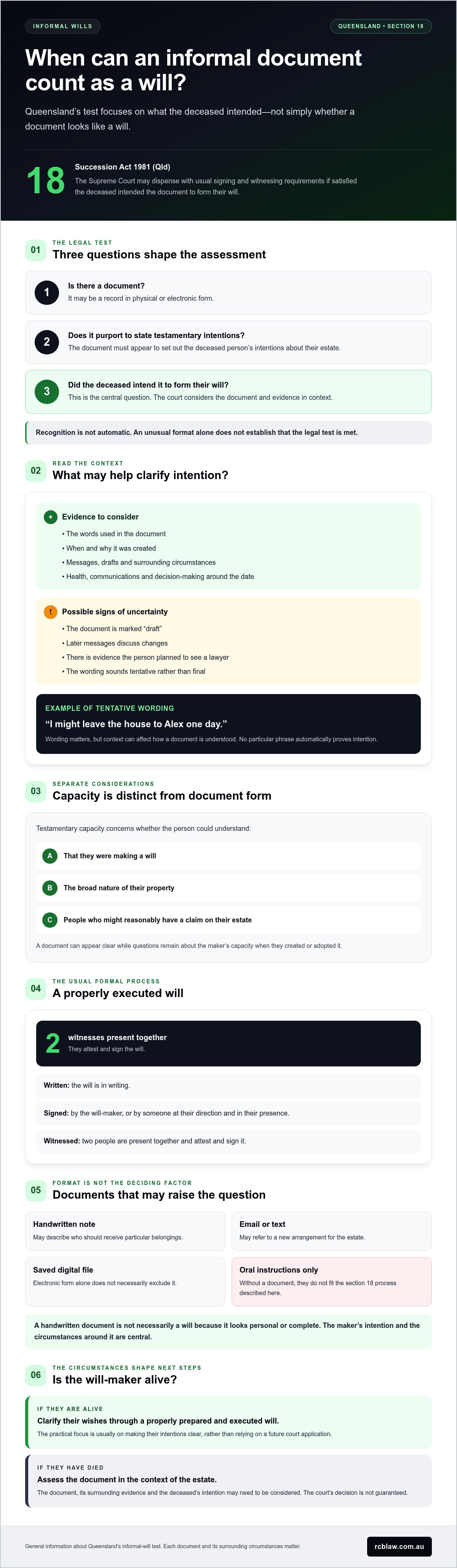
A handwritten note, email, text message or other recorded material may raise the question of whether a person intended to make or change a will. For example, a note might describe who should receive particular belongings, while a message might refer to a new arrangement for the estate. These are possibilities, not guarantees of recognition. The key distinction is between a document recording final testamentary intentions and one that merely discusses or considers them.
Format alone doesn’t answer that question. A digital file isn’t necessarily excluded because it’s electronic, and a handwritten document isn’t necessarily a will because it looks personal or complete. The circumstances surrounding its creation and what the maker intended it to do are central. Purely oral instructions, without a document, do not fit the section 18 process described here.
How an informal will differs from a properly executed will
A properly executed will generally follows statutory requirements for signing and witnessing. Under Queensland’s usual formal process, the will is in writing, signed by the will-maker (or by someone at their direction and in their presence), and witnessed by two people present together who attest and sign it. Meeting these formalities helps clarify whether the document was intended to operate as a will. A general overview of the concept is available in Will and testament.
With an informal document, the issue is different: the court may be asked to dispense with formal requirements under section 18. That can mean closer attention to the document’s wording, its context and any surrounding records. If the will-maker is alive, the practical focus is usually on making their wishes clear through a properly prepared and executed will, rather than relying on a future court application. RCB Law’s Queensland will guide explains how a will can help record those wishes.
If you’re uncertain about a document, informal will qld legal advice can help clarify what it may represent and which questions matter next. Identifying its status early can help you avoid treating a draft as a final decision or dismissing a document before its circumstances have been considered.
The Queensland legal test: intention, document, and testamentary capacity
Section 18 of Queensland’s Succession Act 1981 gives the Supreme Court power to dispense with the usual execution requirements in certain circumstances. In plain English, the court considers whether:
- There is a document, which may be a record in physical or electronic form.
- The document purports to state the deceased person’s testamentary intentions.
- The deceased intended that document to form their will.
This checklist is a guide to the section 18 questions, not a prediction of how a particular application will be decided. The court assesses the document and evidence in context. An unusual format alone does not establish that the legal test is met.
The central question is whether the deceased meant this document to operate as their will, rather than merely record an idea or possible future plan.
Did the will-maker mean this document to be their will?
Intention may be assessed by looking at the words used, when and why the document was created, and what was happening around that time. A document that clearly sets out who should receive property may be relevant, but wording alone doesn’t decide the issue. No particular phrase automatically proves that the maker intended to create a will.
Compare a signed note that appears to give final directions with a message saying, “I might leave the house to Alex one day.” The first could be consistent with final instructions; the second sounds tentative. But context can change how either is understood. A note marked “draft,” later messages discussing changes, or evidence that the person planned to see a lawyer may raise questions about whether the document was complete and intended to take effect.
Why capacity and timing may matter
Testamentary capacity is separate from the document’s form. In plain terms, it concerns whether the person had the mental ability to understand that they were making a will, the broad nature of their property, and the people who might reasonably have a claim on their estate. A document can appear clear while questions remain about the maker’s capacity when they created or adopted it.
Timing can help frame those questions. Evidence about the person’s health, communications and decision-making around the date of the document may be relevant. Capacity is not determined simply by a diagnosis or by age; the circumstances and applicable legal principles need careful assessment.
Section 18’s dispensing power does not turn every question about a document into a section 18 question. Capacity or other challenges to validity may need separate consideration. The statutory wording and relevant Queensland authorities should be considered in light of the circumstances, particularly where family members dispute the document. Informal will qld legal advice can help separate the issues and identify what evidence may matter, without promising that a court will accept the document.
If the will-maker is alive, preparing a properly executed will can reduce uncertainty about their intentions. Queensland will advice can help clarify the options, including whether an existing will should be reviewed or updated.
Can an informal will be accepted? Evidence, uncertainty, and the court’s role
Queensland’s Supreme Court assesses the document and its surrounding circumstances. A message or note isn’t recognised as a will simply because its format is unusual, nor is it necessarily ruled out for that reason. The question is whether the evidence satisfies the legal test in the particular case.
The comparison below can help you organise relevant information. These are possible indicators, not a checklist that guarantees a result.
Evidence that may support an intention to make a will: The document appears complete, sets out how property should pass, and is consistent with communications describing it as the person’s final instructions. Its date and circumstances of creation are clear, and people involved can explain what the maker said or did at the time.
Issues that may create uncertainty: The document is marked as a draft, leaves key details unresolved, or is followed by messages suggesting the maker planned to change it. There may be conflicting accounts, uncertainty about when it was created, or questions about the maker’s capacity at that time.
What evidence may help explain the document?
Preserve the original document and relevant electronic records in their existing form. Don’t edit, annotate or delete them. Keep the full message thread or email chain, rather than only a cropped extract, and note where and when the document was found. These steps help retain context for later assessment.
Other potentially relevant material may include communications about the person’s intentions, records that help establish the document’s date, and accounts from people who discussed or witnessed its creation. Information about the maker’s health and decision-making around that time may also matter if capacity is raised. Evidence needs to be considered as a whole; one supportive message or witness account doesn’t decide the issue by itself.
Evidence can help explain a document, but no single item proves that it is a valid will.
What happens when the court must consider an informal will?
If the person has died, an interested party may need to apply to the Supreme Court of Queensland for an order under section 18 concerning the document. The application asks the court to decide whether it should dispense with the usual execution requirements. The precise process and application materials depend on the circumstances, so current court requirements should be considered before taking procedural steps.
If relatives disagree about the document, the estate’s administration may become more uncertain while its status is resolved. Gathering records, obtaining evidence and pursuing a court application can take time and create expense. There’s no automatic outcome; the court’s decision depends on the evidence and applicable law.
Informal will qld legal advice can help identify what to preserve, which questions need attention, and whether a court application may be appropriate. Keeping the evidence intact is a useful early step, even before the legal pathway is clear.
Steps for Handling an Informal Will in Queensland
The right next step depends first on whether the person who made the document is still alive. That distinction matters: a living person can clarify and formally record their wishes, while after a death the document may need to be assessed in the context of the estate.
- Check whether the will-maker is alive. If they are, focus on helping them record their current wishes clearly. If they have died, avoid assuming the document is either valid or invalid.
- Preserve what you have found. Keep the document and related records in their original form, including complete message or email threads where relevant.
- Gather the surrounding context. Note when and where the document was found, and collect relevant drafts, communications and information about its creation.
- Seek advice suited to the circumstances. The options differ depending on the person’s status, the document and the estate. Avoid taking steps based on assumptions about the outcome.
If the will-maker is alive
A person who is alive can get advice about recording their current wishes in a properly prepared and executed will. This can reduce uncertainty about whether an earlier note or draft was meant to be final. Before a will-planning discussion, gather any existing wills, drafts, notes and other documents that may help explain what has changed and what the person wants now.
Reviewing those materials together can help identify outdated instructions or inconsistencies that need attention. RCB Law’s will and estate-planning guidance explains how a will can record a person’s wishes and help provide clarity for those who may later administer the estate.
If the will-maker has died
It can be difficult to know what to do when family members have different views about a document. Start by keeping the original safe and unaltered. For electronic material, retain the available original records and surrounding conversation rather than relying only on screenshots or selected extracts. Avoid adding notes to the document itself or deleting potentially relevant messages.
An executor or family member may need advice tailored to the estate, including whether the document could be considered under Queensland law and what evidence may help explain its purpose. It’s also useful to distinguish a question about whether the document is a will from other disagreements about the estate. Don’t assume an application will succeed or that the estate can be distributed on the document’s terms before its status is understood.
If you’re dealing with a document after a death, read about Queensland will advice from RCB Law. Informal will qld legal advice can help clarify a measured next step without promising that a court will recognise the document.
Get informal will legal advice in Queensland and reduce future uncertainty
When a document may express someone’s wishes, start by clarifying three things: what the document is, the circumstances in which it was created, and whether the person who made it is alive. These details help distinguish a will-planning discussion from questions that arise after a death. They also help avoid treating a draft as final or assuming an informal document will be accepted by a court.
Tailored legal advice can help assess the document alongside the available context and explain what options may apply. If the will-maker is alive, the focus can be on recording their current wishes in a properly prepared will. If they have died, an executor or family member may need to understand the document’s status in light of the estate’s circumstances. Neither pathway guarantees a particular court outcome.
When tailored will advice can bring clarity
A discussion about a new will is different from advice about an estate after someone has died. For a living person, a lawyer can help clarify current wishes and prepare a will intended to reduce uncertainty for those who may later administer the estate. After a death, the questions may instead involve the document, its context and the available evidence. The legal options depend on the circumstances, so it’s helpful to keep these situations distinct.
RCB Law has more than 30 years of experience and provides wills and estate-planning services across the Sunshine Coast, Brisbane and Redland Bay. The firm’s Queensland focus helps keep will-planning advice grounded in the law and circumstances relevant to the person and their estate.
Prepare for a will-planning or review discussion
A little preparation can make it easier to explain what you need help with. If the will-maker is alive, gather existing wills, drafts or notes that may show how their wishes have changed. Bring a clear outline of what they want now, including any questions about who should receive property or take on responsibilities. If the person has died, preserve relevant documents and records in their original form and be ready to explain when and how they were found.
For someone reviewing an existing will, RCB Law offers a complimentary review. This can be a practical way to consider whether an older document still reflects the will-maker’s wishes and whether it may need attention. A review is distinct from seeking a court decision about an informal document after a death.
Informal will qld legal advice can help you understand the relevant questions and choose a considered next step, without promising that an informal document will be recognised. For support with will planning or a review, speak with RCB Law about will advice.
Take the next step with greater clarity
When a document raises questions, you don’t have to resolve every issue at once. Begin by noting what you know, what remains uncertain, and which decision needs attention first. Keeping facts separate from assumptions can make conversations about someone’s wishes more considered and help you focus on the issue that matters now.
Whether you’re planning ahead or dealing with an estate, informal will qld legal advice can help you understand your options and decide what information to gather next. No one can promise that a court will recognise an informal document, but a clearer understanding of the circumstances can make the way forward more manageable.
If you’d like support with your will or estate concerns, speak with RCB Law about will planning or a review. A calm, informed next step can help you move forward with greater confidence.
Frequently Asked Questions
Is an informal will legally valid in Queensland?
An informal will may be recognised, but it isn’t automatically valid. Under section 18 of the Succession Act 1981 (Qld), the Supreme Court may dispense with formal requirements if satisfied that the document and circumstances meet the relevant test. For example, a note written after a major life change may need to be considered alongside other records. This general explanation can’t predict the result for a particular estate, so the specific facts matter.
Can a text message or email count as an informal will in Queensland?
A text message or email may raise the question of whether an informal will exists, but electronic format alone doesn’t make it valid. The court may consider whether the deceased intended the material to operate as their will and whether it sets out their wishes for the estate. Preserve the full conversation, including dates and replies, without editing or deleting messages. Informal will qld legal advice can help assess the records in context.
What happens if someone dies without a formally signed will in Queensland?
An informal document might still be considered, so the absence of a formally signed will doesn’t settle the issue by itself. If no valid will governs the estate, Queensland’s intestacy rules may apply, with distribution depending on the deceased’s family circumstances. For instance, the people entitled to share an estate can depend on which relatives survive them. Intestacy and recognition of an informal will are different legal pathways, and advice can help identify which may be relevant.
How can you prove that an informal document was intended to be a will?
No single phrase, signature or witness account guarantees that a document will be accepted. Relevant material may include its wording, when and why it was made, communications about the person’s plans, and accounts from people who discussed it with them. For example, a later message may clarify whether an earlier note was final or still under consideration. Preserve original records and have the full circumstances assessed; evidence informs the decision but isn’t the decision itself.
Does testamentary capacity matter for an informal will in Queensland?
Yes, capacity may matter if there’s a question about whether the person could understand the decision they were making when they created or adopted the document. This is distinct from whether the document was signed or witnessed correctly. A medical record may provide context, but it doesn’t by itself establish whether the person had testamentary capacity at the relevant time. The timing of the document and other available evidence should be considered together with tailored legal advice.
Should I use an informal will instead of making a formal will?
An informal document can leave uncertainty about whether it expresses final wishes, and its effect may need to be assessed after death. If you’re planning ahead, a properly prepared will provides a clearer way to record your instructions, though it can’t prevent every possible disagreement. For example, changes to family or financial circumstances may make an older will worth reviewing. Advice can help you prepare or update a will so it better reflects your current intentions.
Can an informal will be challenged by family members in Queensland?
Family members may dispute whether a document was meant to be final or raise other legal issues about its validity. A disagreement doesn’t automatically mean a court case will follow, or that a challenge will succeed. For example, relatives may interpret an unfinished note differently, while other records may provide useful context. The outcome depends on the facts and applicable law. Before relying on assumptions about the document, get advice that considers the estate and the concerns being raised.


