
In Queensland, the terms "strata" and "community title" are often used interchangeably, but misunderstanding the distinction could leave you responsible for unexpected maintenance costs or complex insurance gaps. It's completely natural to feel a sense of confusion when your property contract is filled with references to "Body Corporate" rules and "Community Titles Schemes." Most buyers believe these are simply different labels for the same concept, yet the legal differences between strata and community title determine exactly where your property boundaries begin and where your personal liability ends.
We've designed this guide to provide a clear, legal comparison that ensures your investment is protected and your future obligations are transparent. Our goal is to replace uncertainty with a sense of calm and confidence by breaking down the specific nuances of 2026 QLD property law. You'll learn how to identify your specific title type, gain certainty regarding insurance premiums, and discover how to read your contract with the eyes of a seasoned professional. Let's move through the complexities together so you can focus on the excitement of your new home.
Key Takeaways
- Identify your specific property boundaries by distinguishing between Building Format Plans and Standard Format Plans to know exactly what you own.
- Understand the legal differences between strata and community title to ensure you aren't surprised by hidden maintenance levies or complex insurance gaps.
- Gain clarity on the role of the Body Corporate and how your voting rights influence the management of shared amenities and common property.
- Learn why a comprehensive contract review and strata search are essential steps to protect your financial interests before you commit to a purchase.
Beyond the Label: Strata vs Community Title in Queensland
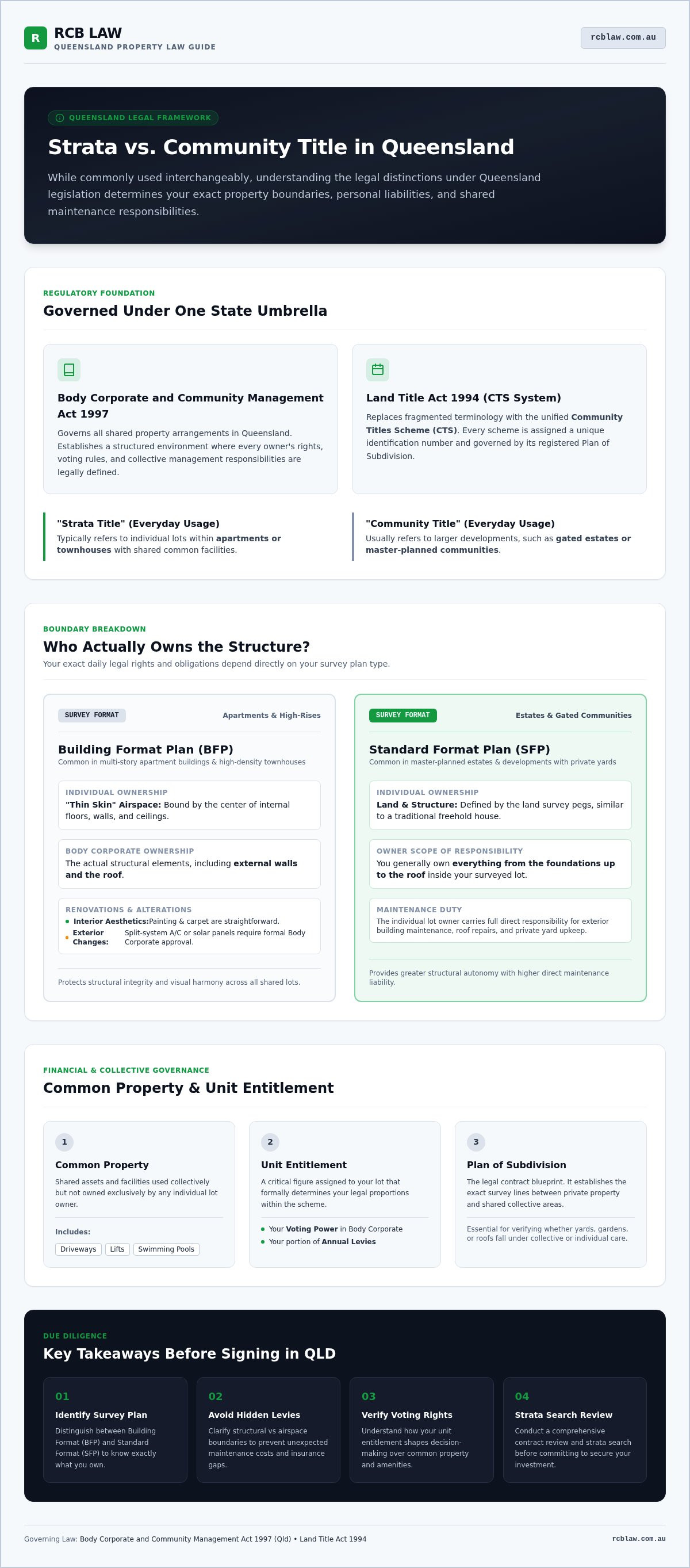
Buying a home is a major life milestone that should feel rewarding, yet the dense terminology of property law can often create unnecessary friction. In Queensland, you'll likely hear the term "strata title" used to describe apartments or townhouses where you own a specific "lot" while sharing ownership of common areas. Conversely, "community title" usually refers to broader developments like gated estates or master-planned communities. While these sound like two distinct paths, understanding the legal differences between strata and community title starts with recognizing that both fall under the same regulatory umbrella in our state.
All shared property arrangements in QLD are governed by the Body Corporate and Community Management Act 1997. This legislation creates a structured environment where every owner's rights and responsibilities are clearly defined. It ensures your investment remains protected through a collective management system known as the Body Corporate, which handles the practicalities of shared living so you don't have to manage them alone.
The Queensland Context: Why Terminology Matters
You might notice that while your real estate agent mentions "strata," your legal documents will strictly refer to a Community Titles Scheme (CTS). This is because Queensland transitioned to a unified strata title framework to simplify how multi-lot properties are registered and managed. Under the Land Title Act 1994, every CTS is assigned a unique identification number. Your specific rights aren't just determined by the name of the complex, but by the "Plan of Subdivision" attached to your contract. This document is the blueprint for your ownership; reviewing it carefully is a vital step in removing uncertainty before you sign.
Common Property vs Individual Ownership
One of the most significant legal differences between strata and community title involves how you interact with shared spaces. Common property includes assets like driveways, swimming pools, and lifts; these are facilities you use but don't own exclusively. Your share of the costs for these areas is determined by your "unit entitlement." This figure dictates both your voting power in the Body Corporate and your portion of the annual levies. During the conveyancing process, we identify these specific boundaries to ensure you aren't surprised by maintenance obligations for a garden or roof you thought belonged to the collective.
Defining Boundaries: Who Actually Owns the Structure?
One of the most common sources of stress for property buyers is the uncertainty over what they actually own. While we've explored the broad framework of a Community Titles Scheme, your daily responsibilities are governed by the specific format of your survey plan. In Queensland, the legal differences between strata and community title are most visible when comparing Building Format Plans (BFP) and Standard Format Plans (SFP). These designations, outlined under the Body Corporate and Community Management Act 1997 (Qld), dictate whether you're buying a slice of airspace or a piece of the earth itself.
Building Format Plans are typically found in high-rise apartments and multi-story townhouse developments. In this scenario, your ownership is often described as the "thin skin" of the unit. Your boundaries are generally the center of the floors, walls, and ceilings. This means you own the internal airspace, but the Body Corporate owns the actual structure, including the external walls and the roof. Understanding these legal differences between strata and community title is essential for budgeting, as maintenance responsibilities vary wildly between these two plan types.
Building Format Plans (BFP) Explained
This structure makes internal aesthetic renovations, like painting or changing carpets, relatively straightforward. However, because you don't own the exterior, making changes like installing a split-system air conditioner or solar panels requires formal Body Corporate approval. These rules exist to maintain the structural integrity and visual harmony of the entire building. It's a system designed to protect the long-term value of everyone's investment by ensuring no single owner makes changes that could affect the whole.
Standard Format Plans (SFP) Explained
Standard Format Plans are more common in gated communities or estates where each lot has its own yard. Here, your boundaries are defined by the land itself, similar to a traditional freehold house. You generally own everything within those survey pegs, from the foundations to the sky. This provides a greater sense of autonomy, but it also shifts the maintenance burden. You're typically responsible for repairing your own roof, painting the exterior, and maintaining the building's foundations.
Even with this added freedom, you must still adhere to "site coverage" rules and by-laws that may limit how much you can extend or modify the home. If you're feeling overwhelmed by these technicalities, a detailed contract review can help you understand exactly where your liabilities lie before you commit to a purchase. Knowing these boundaries early ensures you can plan for future maintenance without any unwelcome surprises.
Governance and Rules: Navigating the Body Corporate
Understanding how a complex is managed is just as important as knowing your physical boundaries. The Body Corporate acts as the legal entity responsible for maintaining common property and ensuring all residents live harmoniously. One of the unique legal differences between strata and community title in Queensland is the potential for "layered schemes." In large developments, you might belong to a subsidiary scheme with its own committee, which sits under a larger principal scheme. This structure means you could be subject to two sets of rules and two sets of levies, making it vital to have a professional review your contract before you commit.
Decisions within these schemes are made by a Body Corporate Committee, which is elected by the owners at an annual general meeting. Your voting rights are usually tied to your lot's unit entitlement, which also dictates your financial contribution. This committee manages everything from garden maintenance to the enforcement of by-laws. To understand your specific obligations, you should refer to the Queensland Government body corporate maintenance guidelines, which clarify how these rules apply to different plan types across the state.
The Power of By-Laws
Every scheme is governed by a Community Management Statement (CMS), which contains the specific by-laws for that property. These rules can be surprisingly detailed; they might prohibit hanging laundry on balconies, restrict the size of pets, or set specific hours for using shared pools. If a particular rule feels overly restrictive, owners can propose changes at a general meeting. However, it's far easier to understand these rules before you buy than to try and change them later. Reviewing the CMS helps you ensure the lifestyle offered matches your personal expectations.
Dispute Resolution in QLD Schemes
Living in close proximity to others occasionally leads to friction. If a dispute arises regarding by-law breaches or maintenance failures, Queensland provides a specific pathway for resolution through the Commissioner for Body Corporate and Community Management. This process typically begins with formal mediation to find a calm solution, but it can progress to adjudication if a consensus isn't reached. Our property lawyers act as your steady guide during the purchase phase, ensuring that any existing disputes or non-compliant by-laws are identified during the search process. This proactive approach helps you avoid inheriting someone else's legal headache.
The Financial Impact: Levies, Insurance, and Maintenance
Financial clarity is the foundation of a stress-free property investment, yet ongoing costs are often the biggest source of anxiety for buyers. Many people assume that choosing a gated estate over an apartment means they'll avoid Body Corporate fees. This is a common misconception. One of the key legal differences between strata and community title involves how these costs are structured and who is ultimately responsible for the bill. Whether you're buying into a high-rise or a suburban development, you'll likely contribute to a collective fund to keep the scheme running smoothly.
Body Corporate levies are generally split into two distinct buckets. The Administrative Fund covers the day-to-day running costs, such as common area electricity, gardening, and management fees. The Sinking Fund acts as a long-term savings account for major capital works. By law, a Body Corporate must remain solvent and usually relies on a 10-year Sinking Fund Forecast. This document predicts major expenses, like repainting the building or replacing a lift, to ensure there's enough money in the bank when those big-ticket items fall due.
Insurance Obligations: The Great Divide
The legal differences between strata and community title are most apparent when it comes to insurance. In a Building Format Plan (typically strata), the Body Corporate is legally required to insure the entire building structure under one policy. This cost is shared among all owners through their levies. In a Standard Format Plan (typically community title), you're often responsible for taking out your own building insurance, just as you would with a traditional house. In both cases, the Body Corporate must still maintain public liability insurance for any shared common property, such as private roads or parklands.
Maintenance Responsibilities
Your maintenance burden depends heavily on the assets within your scheme. A high-rise strata owner contributes to the upkeep of lifts, fire systems, and shared hallways. A community title owner in a gated estate might instead fund the repair of private sewerage lines or internal roads. You should also look for "exclusive use" areas in your contract. These are parts of the common property, like a specific car park or courtyard, that only you can use. While you don't own the land, the by-laws often state you're responsible for keeping that area clean and tidy.
It's also worth remembering that land tax considerations may still apply to the underlying value of your lot. If you're feeling uncertain about the potential for unexpected costs, our team is here to help. We provide the clarity you need through a comprehensive contract review so you can move forward with total financial confidence.
Ensuring a Smooth Settlement with RCB Law
Entering the final stages of a property purchase should be a time of celebration, not a period of high-pressure uncertainty. To secure your investment, we conduct a rigorous "Strata Search" and review the mandatory Body Corporate Disclosure Statement. These documents are the only way to uncover hidden financial liabilities, pending legal actions, or special levies that haven't been fully disclosed. By analyzing these records, we bridge the gap between the legal differences between strata and community title and your actual experience as a future owner.
Buying without a professional contract review is a significant risk that can have long-term financial consequences. You could inherit a pro-rata debt for a major structural repair or find yourself in a scheme with insufficient sinking fund reserves for the year ahead. At RCB Law, we verify every detail of the survey plan to confirm your boundaries and check the current levy balances. This process removes the friction often associated with complex property transitions, allowing you to move forward with a clear and calm understanding of your obligations.
Why Local Expertise Matters
The Sunshine Coast and Brisbane property markets have unique trends, from high-density coastal apartments to sprawling gated estates in the hinterland. With over 30 years of experience in Queensland property law, we've developed a deep understanding of the regional schemes that may present "red flags" to buyers. Our approach is built on empathy; we recognize that this isn't just a transaction, but a major life event. We act as your steady guide, ensuring that the legal differences between strata and community title don't become obstacles to your long-term happiness.
Next Steps: Getting Your Contract Reviewed
We believe in transparency and accessibility, which is why we offer a fixed-price conveyancing model for our clients. You'll know your legal costs from the very beginning, with no hidden fees or surprising invoices to worry about. If you've found a property you love, simply send the contract to our team before you sign. We'll provide a brief and direct assessment of the terms, protecting you from unfavorable conditions or complex boundary disputes. Contact RCB Law today for a stress-free property settlement and let us handle the legal complexities while you plan your move.
Move Forward with Confidence in Your Property Journey
Choosing your next home should be a rewarding experience, not a source of legal stress. By understanding the legal differences between strata and community title, you've taken the first step toward protecting your financial future. You now know that your ownership boundaries and maintenance obligations depend entirely on whether your scheme is registered as a Building or Standard Format Plan. This clarity ensures you won't be caught off guard by unexpected insurance requirements or sinking fund levies after you've already moved in.
As specialists in the Sunshine Coast and Brisbane markets, we're here to provide the steady guidance you need. With over 30 years of experience in Queensland property law, our team focuses on making the conveyancing process as smooth and transparent as possible. We offer fixed-price services to remove financial friction, allowing you to focus on the excitement of your new lifestyle. Secure your property investment with RCB Law’s expert conveyancing and enjoy the peace of mind that comes with professional support. Your path to a successful settlement is clear, and we're ready to help you every step of the way.
Frequently Asked Questions
Is strata title the same as a body corporate?
Strata title refers to the ownership model, whereas the Body Corporate is the administrative entity that governs the scheme. Every strata or community title property in Queensland belongs to a Community Titles Scheme (CTS). The Body Corporate is responsible for making decisions about shared assets and enforcing the by-laws. It's the group of owners working together, while the title defines what you actually own on paper.
Can I have pets in a community title scheme?
Your ability to keep a pet depends on the specific by-laws found in the Community Management Statement (CMS). Recent Queensland law changes make it harder for committees to ban pets entirely, but they can still impose reasonable conditions regarding size or noise. It's vital to review these rules before settlement to ensure your companion is welcome in your new gated estate or apartment complex.
Who pays for the roof repair in a strata building?
Your survey plan type determines who fixes the roof. In a Building Format Plan (BFP), the Body Corporate usually maintains the roof as part of the common property structure. However, in a Standard Format Plan (SFP), the owner is generally responsible for their own roof and foundations. This is one of the most significant legal differences between strata and community title regarding ongoing maintenance costs.
What happens if I don’t pay my body corporate levies?
Failing to pay levies can lead to serious financial consequences. The Body Corporate can charge penalty interest and recover any legal costs associated with collecting the debt. You'll also lose your right to vote on important committee decisions until your account is cleared. If the debt remains unpaid for a long period, the Body Corporate may even commence formal debt recovery action in court to secure the funds.
Is community title cheaper than strata title?
Community title isn't always the cheaper option. While your Body Corporate levies might be lower because you're responsible for your own building maintenance, your individual insurance premiums will likely be higher. Strata title levies often seem more expensive because they include the cost of building insurance and structural repairs. You should compare the total cost of ownership, including both levies and personal maintenance, before deciding.
Can a community title scheme be converted to strata?
Changing the format of a scheme from community to strata is a complex legal undertaking. It requires a resolution without dissent from all owners, meaning every single member must agree to the change. You'd also need to commission a new survey plan and update the Community Management Statement. Because of the high cost and difficulty of reaching a unanimous agreement, these conversions are relatively rare in Queensland.
What is a Disclosure Statement in a QLD property contract?
A Disclosure Statement is a mandatory legal document that a seller must provide before you sign a contract. It contains vital information about the Body Corporate, including the current levy amounts, the scheme's financial health, and any known structural defects. Reviewing this statement is a critical step in our conveyancing process, as it helps identify potential red flags that could impact the value of your investment.
Do I need separate building insurance for a strata unit?
In most strata arrangements (Building Format Plans), you don't need separate building insurance because the Body Corporate covers the entire structure. However, you're still responsible for insuring your internal contents, carpets, and personal belongings. If your property is a Standard Format Plan, you'll likely need to arrange your own building insurance, making it essential to confirm your plan type during the contract review stage.


