
What if a single overlooked document gave your buyer the legal right to walk away from your sale just hours before settlement? Since the mandatory disclosure reforms took effect in late 2025, the old "buyer beware" approach is gone, and the legal requirements for selling a house in QLD are now more rigorous than ever. It's completely natural to feel a sense of anxiety about these technical shifts, especially when you've worked hard to prepare your property for the market.
We're here to help you move through this complex process with absolute confidence and ease. This 2026 guide provides a clear, supportive breakdown of the new disclosure regime, including the essential Form 2 statement and the latest anti-money laundering verification rules that commenced on July 1, 2026. You'll learn exactly how to satisfy your statutory obligations, from pool safety certificates to smoke alarm compliance. Our goal is to ensure you achieve a bulletproof contract and a smooth, on-time settlement without the stress of unexpected legal hurdles.
Key Takeaways
- Understand the mandatory Form 2 Disclosure Statement required before any contract is signed to prevent buyer termination.
- Learn about the new identity verification standards for sellers and agents that came into effect on July 1, 2026.
- Navigate the essential legal requirements for selling a house qld, including current smoke alarm standards and pool safety certifications.
- Identify how the standard REIQ contract and digital settlement via PEXA provide a more secure path to a successful sale.
- Recognize why the timing of your disclosures is now the most critical factor in securing a legally bulletproof property transfer.
Understanding the Legal Landscape for Selling Property in QLD (2026)
Selling your home is a major life transition that often brings a mix of excitement and pressure. In 2026, the legal framework in Queensland has evolved to prioritize transparency, making it essential to understand the modern rules of engagement. The core objective of these legal requirements for selling a house qld is to create a transparent, friction-free environment where both parties can proceed with certainty. By adhering to the current standards, you ensure that your contract remains valid and enforceable; this protects your financial interests from the first signature through to the final settlement day.
The process involves several key stakeholders working in tandem to move the property transfer forward. As the seller, you're now the primary source of property information. The buyer relies on your disclosures to make an informed decision. Your agent manages the marketing and negotiations while navigating new 2026 identity verification rules. Finally, your solicitor acts as your legal safeguard, ensuring every document meets the strict standards of the law. Within the broader context of Australian property law, Queensland has established its own distinct path to simplify these interactions and reduce the likelihood of costly delays.
The Property Law Act 2023: What Changed?
The most significant shift in recent years arrived with the commencement of the Property Law Act 2023 on August 1, 2025. This legislation fundamentally changed the responsibility of sharing property information. Instead of leaving the buyer to discover issues on their own, the law now requires you to provide a comprehensive disclosure package upfront. This intent is clear: the government wants to eliminate the "surprises" that often lead to pre-contractual disputes or failed settlements. The statutory disclosure regime is the new standard for all 2026 sales.
Why "Buyer Beware" No Longer Applies
For decades, Queensland operated under the principle of caveat emptor, or "buyer beware." This meant the onus was on the buyer to investigate every detail of the property. Today, that system is obsolete. The 2026 legal requirements for selling a house qld demand that sellers are proactive. While this might seem like more work initially, it actually offers you a higher level of protection. By disclosing everything required by law before the contract is signed, you significantly reduce the risk of post-sale litigation or a buyer terminating the contract due to a technical error. Your solicitor plays a vital role here, certifying that your compliance is complete so you can sleep soundly during the settlement period.
The Mandatory Seller Disclosure Statement: Your Top Requirement
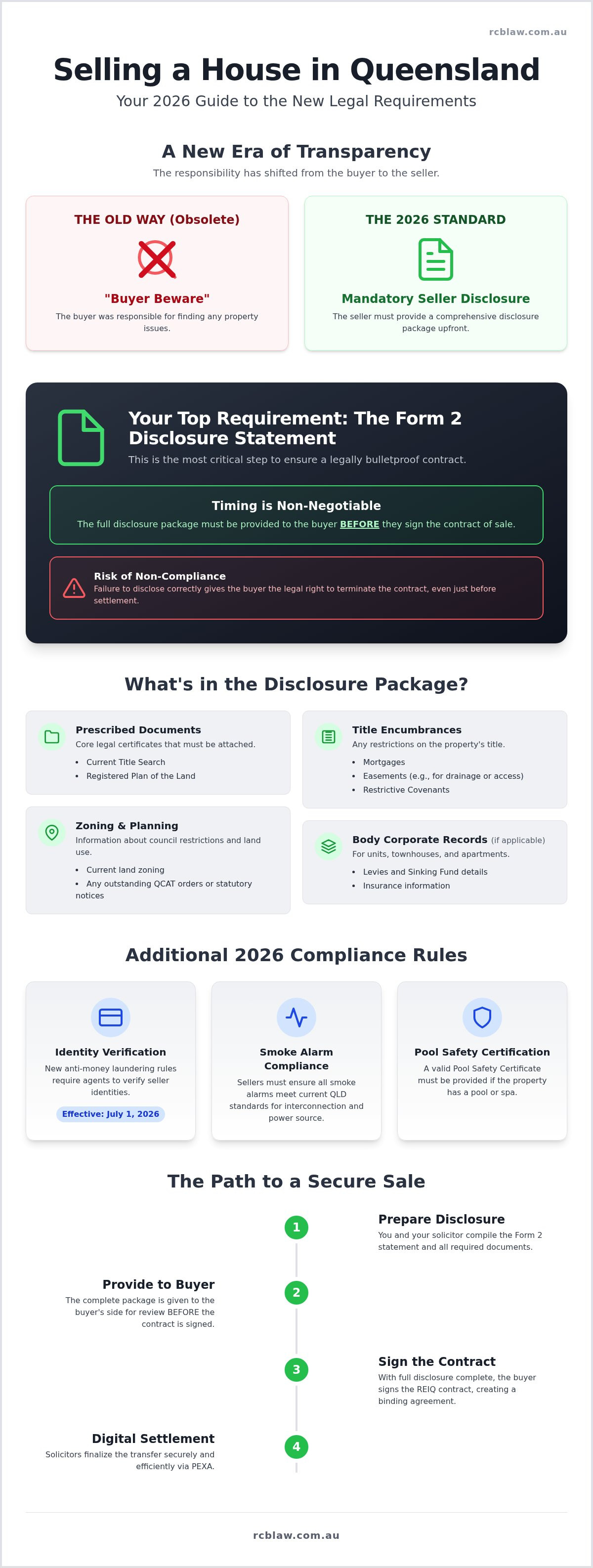
Providing a mandatory disclosure statement is perhaps the most critical step in meeting the modern legal requirements for selling a house qld. While it might feel like a heavy administrative burden, this requirement actually offers you a profound sense of emotional relief. By being fully transparent from day one, you remove the fear of "hidden" issues resurfacing later to derail your plans. The Property Law Act 2023, which became fully operational in late 2025, mandates that you provide a Form 2 Seller Disclosure Statement along with several prescribed documents before the buyer signs the contract.
The timing here is non-negotiable. If the disclosure is provided even a few minutes after the buyer signs, the contract may be voidable at the buyer's discretion. This shift ensures that every party has the same information at the same time, aligning with the broader Queensland Government guide to selling a home. To be compliant, you must attach specific certificates, such as a current Title Search and a Registered Plan, which verify the legal boundaries and ownership of your property.
What Must Be Disclosed? A 2026 Checklist
Your disclosure package needs to be comprehensive to withstand legal scrutiny. It's not just about the physical state of the house; it's about the legal "health" of the land. Accuracy is the key to a smooth transition. Ensure your statement covers:
- Title Encumbrances: You must list any mortgages, easements, or restrictive covenants that affect how the land is used or accessed.
- Zoning and Planning: Current council restrictions or statutory notices, including any outstanding QCAT orders, must be clearly stated.
- Body Corporate Records: If you're selling a unit or townhouse in Brisbane or the Sunshine Coast, you must include detailed records regarding levies, sinking funds, and insurance.
The Risks of Inaccurate Disclosure
The consequences of getting this wrong are significant. If a buyer discovers an inaccuracy or realizes they weren't given the full disclosure package before signing, they have the legal right to terminate the contract at any time before settlement. This could lead to the sale falling through at the last minute, causing immense stress and potential financial loss. To prevent these high-pressure situations, we recommend having a professional residential conveyancing specialist audit your documents to ensure they're bulletproof before they reach the buyer's hands.
Navigating the Contract of Sale and Methods of Sale
Choosing the right method of sale is more than just a marketing decision; it fundamentally changes the legal framework of your transaction. In Queensland, most residential properties are sold either through private treaty or public auction. Each path carries distinct legal requirements for selling a house qld that impact your rights and the buyer's obligations. While a private treaty sale allows for a negotiation period and conditional clauses, an auction creates an unconditional contract the moment the hammer falls. This immediacy can be a source of great comfort for sellers who want a clean, certain exit from their property.
The vast majority of residential sales in our state utilize the standard REIQ contract. This document is highly regarded because it balances the interests of both parties while adhering to current legislation. It is vital to remember that even with a standard form, the REIQ seller disclosure information must still be provided correctly to ensure the contract remains binding. Most buyers will request clauses such as "Subject to Finance" or "Building and Pest" inspections. These conditions give buyers a window to finalize their funding and verify the property's condition, which helps prevent disputes later in the settlement process.
REIQ Contracts vs. Bespoke Agreements
Standard REIQ contracts serve as a reliable benchmark for Brisbane residential sales because they are updated regularly to reflect the latest legal requirements for selling a house qld. However, some properties require more than a "one size fits all" approach. If you are dealing with complex Sunshine Coast easements or unique land use rights, your solicitor may need to draft custom special conditions. It's a wise practice to have your solicitor review the contract before it reaches your real estate agent. This proactive step ensures that any unique aspects of your property are protected legally from the start, removing friction before the first offer is even made.
The Cooling-Off Period: What Sellers Need to Know
Under Queensland law, most private treaty residential sales include a 5-business-day cooling-off period. This period begins the day the buyer receives a copy of the contract signed by both parties. It's designed to give buyers a short window to reconsider their decision. If a buyer chooses to pull out during this time, they must pay a financial penalty of 0.25% of the purchase price. In contrast, properties sold at auction do not have a cooling-off period. This is a significant advantage for sellers who prioritize certainty, as it creates a legally binding, unconditional sale the moment the auction concludes.
Physical Compliance: Smoke Alarms, Pools, and Safety
Preparing your home for sale involves more than just aesthetic touches like a fresh coat of paint or professional staging. It's about ensuring the property meets the specific safety standards mandated by Queensland law. These legal requirements for selling a house qld are designed to protect the incoming family and provide you with a clean break from liability. While the list of compliance items might feel overwhelming, addressing them early in your sale journey prevents last-minute settlement delays and maintains the buyer's confidence in the transaction.
Every contract for a residential sale in 2026 requires you to disclose whether compliant safety switches and smoke alarms are installed. If your property isn't currently compliant, you'll need to take corrective action before the buyer takes possession. Failing to meet these physical standards doesn't just create a safety risk; it gives the buyer's solicitor a technical opening to request financial adjustments or even delay the settlement until the work is certified. We've found that sellers who proactively manage these certificates often enjoy a much smoother, lower-friction path to a successful sale.
The Interconnected Smoke Alarm Deadline
By 2026, the requirements for interconnected, photoelectric smoke alarms are strictly enforced across all residential sales. To be compliant, your alarms must meet Australian Standard 3786-2014 and be installed in every bedroom, in hallways connecting bedrooms, and on every level of the home. These alarms must be interconnected, meaning if one triggers, they all sound. It's a high standard, but it's a non-negotiable part of the legal requirements for selling a house qld. We recommend keeping all installation receipts and compliance certificates ready for the buyer's solicitor to review, as this simple step removes a common point of friction during the due diligence period.
Pool Safety and Form 36
If your property includes a pool or spa, you must provide a valid Pool Safety Certificate (Form 23) before the contract is signed. For private pools, these certificates are valid for two years. The current Queensland Government (QBCC) fee for the certificate is $47.30, though inspection costs from local Sunshine Coast or Brisbane providers typically range between $150 and $250. If you don't have a valid certificate, you must provide the buyer with a "Form 36 - Notice of no pool safety certificate." This notice is a critical legal tool that shifts the responsibility of obtaining a certificate to the buyer within 90 days of settlement, though it often leads to a request for a price reduction. If you need help managing these disclosures to ensure your contract remains secure, contact RCB Law for expert residential conveyancing.
Finally, don't overlook the safety switch (RCD) requirement. You're legally obligated to disclose on the REIQ contract whether a compliant safety switch is installed for the general purpose socket outlets. If one isn't present, the buyer can technically request an adjustment at settlement to cover the cost of installation. Being transparent about these physical details from the start is the best way to ensure your sale stays on track and your emotional journey remains as stress-free as possible.
Finalizing the Sale: Settlement and the Role of Your Solicitor
Settlement is the moment your hard work finally pays off. It's the final stage where ownership officially transfers and you receive the proceeds of your sale. In 2026, the legal requirements for selling a house qld are increasingly digital, which helps remove the friction that once defined this high-pressure day. Your solicitor manages the heavy lifting during this phase, ensuring every technical detail aligns so you can focus on your next chapter. By the time settlement day arrives, most of the complex paperwork is already complete, leaving only the final verification and fund transfer to be managed.
PEXA and Digital Conveyancing
Queensland has fully embraced digital settlement through PEXA. This platform replaces the old method of physical meetings and paper checks with a secure, online environment. By using digital conveyancing, we significantly reduce the risk of human error or document delays that used to cause last-minute settlement failures. One of the greatest benefits for you is the near-instantaneous transfer of funds. Instead of waiting days for a bank check to clear, your money is typically available shortly after the digital "keys" are handed over. RCB Law utilizes PEXA to provide a seamless, transparent experience for all our clients.
Behind the scenes, your solicitor performs a series of complex calculations known as adjustments. These ensure that you only pay for property expenses, such as council rates, water charges, and land tax, up until the exact day of settlement. From that point on, these costs become the buyer's responsibility. We handle these communications with local councils in Brisbane and across the Sunshine Coast, ensuring the math is perfect so there are no financial surprises after the sale is complete. This precision is a core part of meeting the legal requirements for selling a house qld while protecting your bottom line.
The physical handover is the final piece of the puzzle. Unless your contract states otherwise, you're required to provide "vacant possession" by the settlement time. This means all your belongings are removed, and the property is ready for the new owners. You'll typically leave all keys, garage remotes, and security codes with your real estate agent once the solicitor confirms the sale is "on risk." It's a symbolic moment that marks the end of your time with the property and the beginning of the buyer's journey.
Managing the Emotional Transition
We understand that the final 48 hours of a sale can be an emotional rollercoaster. The stress of packing and moving is often compounded by the fear of a technical glitch or a sudden delay. Our role is to act as your steady partner, providing proactive communication during these final hours to keep you informed and at ease. We believe that legal clarity is the best antidote to anxiety. By managing the final requirements with precision, we turn a complex legal process into a successful fresh start. Expert legal support doesn't just protect your interests; it gives you the confidence to step into your new future without looking back.
Secure Your Property Transfer with Certainty
Navigating the 2026 property market requires a proactive approach to transparency and compliance. By mastering the mandatory Form 2 disclosure and ensuring your home meets the latest interconnected smoke alarm standards, you protect yourself from the risk of buyer termination. These legal requirements for selling a house qld are designed to create a smoother journey for everyone involved, but they don't have to be a source of stress. When you prioritize accuracy from the start, you pave the way for a faster, more reliable settlement.
With over 30 years of Queensland property law experience, our specialist conveyancing team in Brisbane and the Sunshine Coast is here to handle the technical details for you. As PEXA-certified digital settlement experts, we focus on removing friction so you can focus on your next move. Let RCB Law guide you through a stress-free sale; contact our QLD conveyancing experts today. We're ready to provide the steady guidance and professional support you need for a successful fresh start.
Frequently Asked Questions
Do I legally need a solicitor to sell my house in QLD?
You aren't legally required to engage a solicitor to sell your house, but it's a vital step for most sellers. Queensland's property laws are intricate, especially with the 2025 disclosure reforms. A solicitor ensures your contract is legally sound and manages the transfer of funds through PEXA. Without professional help, you risk technical errors that could allow a buyer to terminate. It's about buying yourself peace of mind during a high-pressure transition.
What happens if I forget to disclose an easement in the Disclosure Statement?
Forgetting to disclose an easement gives the buyer a legal right to terminate the contract before settlement. Under the current 2026 legal requirements for selling a house qld, accuracy in the Form 2 Disclosure Statement is paramount. If an encumbrance is missing or incorrect, it's considered a failure to disclose. This often leads to high-pressure negotiations or a total collapse of the sale. It's much safer to have your solicitor audit these documents early.
Is the cooling-off period the same for auctions and private sales?
No, the cooling-off period only applies to private treaty sales. In Queensland, buyers have a five-business-day window to change their mind during a private sale, though they'll pay a 0.25% penalty. Auctions are different; they're unconditional. Once the hammer falls, the buyer is legally bound with no cooling-off period. This provides sellers with immediate certainty on auction day, though it requires all disclosure documents to be perfectly prepared in advance.
Who pays the commission and legal fees during the settlement process?
As the seller, you're responsible for paying the real estate agent's commission and your own legal fees. These costs are typically deducted from the sale proceeds at settlement. Your solicitor will calculate these adjustments so you don't have to worry about manual payments. The buyer covers their own legal costs and any government transfer duties associated with the purchase. This structured approach ensures that all financial obligations are met clearly and transparently on the day.
How long does a standard property settlement take in Queensland?
A standard property settlement in Queensland usually takes between 30 and 60 days from the date the contract is signed. This timeframe allows both parties to satisfy conditions like finance approval and building inspections. While shorter settlements are possible, they can increase the pressure on everyone involved. We find that a 42-day period often provides the best balance for a smooth, low-friction transition. This allows enough time for all legal searches to be completed thoroughly.
What is an ATO Clearance Certificate and do I need one to sell?
An ATO Clearance Certificate proves you aren't a foreign resident for tax purposes. If your property sells for $750,000 or more, you must provide this certificate to the buyer before settlement. Without it, the buyer is legally required to withhold 12.5% of the purchase price and pay it to the ATO. Obtaining this early prevents significant financial delays on settlement day. Your solicitor can assist in applying for this to ensure your funds are protected and accessible.
Can a buyer terminate the contract if my smoke alarms aren’t compliant?
A buyer cannot usually terminate the contract solely because of non-compliant smoke alarms, but they can claim a financial adjustment. Under the REIQ contract, if you fail to install compliant alarms, the buyer is entitled to an adjustment of 0.5% of the purchase price at settlement. It's much simpler to ensure compliance before listing the property to avoid these last-minute deductions. This keeps the transaction moving forward without unnecessary friction or financial loss for either party.
What documents do I need to provide if my property is part of a Body Corporate?
If your property is part of a Body Corporate, you must provide a specific disclosure statement detailing levies and insurance. You'll also need to include the Community Management Statement, which outlines the by-laws and lot entitlements. Providing these documents upfront is a core part of the legal requirements for selling a house qld. It ensures the buyer understands their ongoing financial obligations before they commit. This transparency helps build trust and leads to a more secure contract.


