
What if your commercial lease was actually a tool for growth instead of a source of constant financial anxiety? It's common to feel overwhelmed by the weight of a fifty-page contract, especially when you're worried about hidden outgoings or being locked into unfair terms for years. You want a space where your business can thrive, but the fear of making a costly mistake often turns an exciting milestone into a high-pressure ordeal.
Securing a commercial lease agreement qld doesn't have to be a source of friction. With the commencement of the Property Law Act 2023 and updated 2026 regulations, there are now clearer protections for tenants, including stricter rules on rent increases and more formalised landlord consent processes. This guide provides a steady, expert-led breakdown of the clauses that matter most to your bottom line. You'll learn how to distinguish between retail and commercial requirements, ensuring your monthly costs remain predictable and your exit options stay flexible. We've simplified the legal complexities so you can move forward with the confidence of a seasoned professional.
Key Takeaways
- Understand how the 2026 legal landscape in Queensland impacts your lease drafting and long-term business security.
- Learn to navigate the REIQ framework, including the Reference and Item Schedules, to ensure every term aligns with your operational goals.
- Gain clarity on financial obligations by breaking down Gross and Net lease models within your commercial lease agreement qld.
- Identify the critical differences between retail and commercial lease protections to avoid unexpected compliance issues or hidden outgoings.
- Discover a structured, step-by-step approach from the initial Heads of Agreement to final registration, ensuring a low-friction transition into your new premises.
Understanding Commercial Lease Agreements in Queensland (2026)
A commercial lease is a legally binding contract that grants your business the right to occupy a non-residential property for a specific period. It's often the most significant financial commitment a business owner makes, involving years of rent, outgoings, and operational obligations. Because of this, it's completely natural to feel a sense of pressure or anxiety when faced with a complex legal document. Since the Property Law Act 2023 commenced on August 1, 2025, the legal framework for a commercial lease agreement qld has shifted significantly. The 2026 economic environment requires more robust drafting to ensure your interests are protected under these new regulations, which replaced the decades-old 1974 Act.
Before the final lease is prepared, you will typically start with a "Heads of Agreement" (HOA). This document acts as a preliminary roadmap, outlining essential terms like rent, duration, and fit-out periods. While the HOA serves as a foundation, it's the formal lease that carries the full legal weight of your commitment. For a foundational look at these concepts, Understanding Commercial Lease Agreements can help clarify the global legal principles that underpin your specific local contract.
Commercial vs. Retail Shop Leases: Why the Difference Matters
In Queensland, not all business leases are treated equally. Retail Shop Leases are governed by the Retail Shop Leases Act 1994, which provides additional layers of protection for tenants. These protections include mandatory disclosure statements and specific rules regarding outgoings. Generally, a lease falls under this category if the premises are located within a retail shopping centre or are used predominantly for a retail business. However, if your space is over 1,000m², it's typically excluded from these retail protections. Whether you're setting up a clinic in Brisbane or a warehouse on the Sunshine Coast, identifying which law applies is the first step in managing your risk.
The Legal Risks of "Standard" Templates
Relying on a "one-size-fits-all" template is a high-risk strategy that can lead to expensive litigation. Every industry has unique requirements; a medical suite needs different environmental and access clauses than a heavy industrial workshop or a high-rise office. Generic templates often fail to address specific maintenance responsibilities or the nuances of the new 2025 landlord consent processes. It's a common misconception that a "standard" REIQ or industry form is fixed; in reality, standard does not mean non-negotiable in Queensland law. Tailoring your lease ensures that the document reflects the actual needs of your business rather than a generic set of assumptions.
Decoding the REIQ Commercial Tenancy Agreement
In Queensland, the most common framework you'll encounter is the REIQ Commercial Tenancy Agreement. Landlords prefer these documents because they provide a tested, industry-recognised structure that reduces their own legal overheads. However, for a tenant, the "standard" nature of the document can be deceptive. It's typically divided into three main parts: the Reference Schedule, which contains the specific details of your deal; the Item Schedule, which outlines financial obligations; and the Standard Terms, which are the fine-print rules. While the Standard Terms are often left untouched, the real power lies in the "Special Conditions" added at the end. This is where a property lawyer becomes a vital partner, translating dense jargon into plain English and ensuring the final commercial lease agreement qld reflects your actual business needs rather than a generic template. Cross-referencing the Item Schedule against the Reference Schedule is essential to catch any clerical errors that could lead to financial disputes later.
Key Items in the Reference Schedule
The Reference Schedule is the heart of your lease. You need to pay close attention to the "Term" and "Options". An option to renew gives you the right to stay, but it doesn't force you to; it provides the security of a long-term home without the immediate risk of a ten-year commitment. "Permitted Use" is another critical field. If it's defined too narrowly, such as "General Practitioner" instead of "Medical Centre and Allied Health", you might find yourself unable to expand your service offerings later. Finally, consider the security deposit. Whether it's a cash bond or a bank guarantee, this directly impacts your upfront capital. We often help clients negotiate these amounts to keep more cash flowing within their business, especially when bank guarantees can take weeks to process through Australian lenders.
Negotiating Special Conditions
Special Conditions allow you to tailor the lease to your specific risks and growth plans. For example, an "Exclusivity" clause ensures the landlord won't lease a neighbouring shop to a direct competitor, protecting your market share in a busy Brisbane or Sunshine Coast hub. A well-drafted commercial lease agreement qld should always include protections that account for the "what ifs" of business life. In a post-2024 landscape, we also look closely at "Force Majeure" or pandemic-related clauses to protect you if external events disrupt your ability to trade. If you're unsure about the future, a "Break" clause can offer a clear exit path after a set period. Negotiating these terms requires a steady hand and local expertise to ensure you aren't signing away your flexibility for the sake of a quick deal. If you're feeling overwhelmed by the technicalities, seeking a fixed-price lease review can provide the clarity and cost certainty you need to move forward with confidence.
Essential Clauses: Rent, Outgoings, and Maintenance
Understanding the financial structure of your commercial lease agreement qld is the best way to eliminate the fear of hidden costs. Most agreements in Queensland operate on either a "Gross" or "Net" basis. In a Gross lease, you pay a single, all-inclusive amount. This provides excellent cost certainty but is less common in the current market. Most landlords prefer a Net lease, where you pay a base rent plus a proportion of the building's operating expenses, known as outgoings. These typically include council rates, water charges, building insurance, and land tax. To maintain a sense of calm and control over your budget, you should insist on clauses that require the landlord to provide an annual budget and an audited statement of actual expenses. This ensures you only pay your fair share of the property's running costs.
Repair and maintenance obligations are another frequent source of friction. While the landlord is generally responsible for structural repairs, the tenant usually looks after the day-to-day maintenance of the premises and its services, such as air conditioning. Clearly defining where the landlord's duty ends and yours begins can prevent high-pressure disputes when equipment fails. We often recommend specific maintenance schedules be agreed upon upfront to keep the relationship professional and the property in good standing.
Rent Review Mechanisms: Avoiding Bill Shock
Rent rarely stays the same for the life of a lease. Most Queensland agreements include annual reviews to keep pace with the economy. You might see fixed percentage increases, perhaps 3% or 4% per year, which offer the most predictability for your cash flow. Alternatively, reviews may be linked to the Consumer Price Index (CPI). Market rent reviews usually occur at the start of a new option period. If you and the landlord cannot agree on the new rate, an independent valuer is typically brought in to make a determination. It's vital to check for "ratchet clauses," which prevent the rent from ever decreasing. While these are prohibited under the Retail Shop Leases Act 1994, they are still a common feature in non-retail commercial contracts.
The "Make Good" Clause: Planning for the Exit
The "Make Good" clause is often the most overlooked expense, appearing only when you decide to move on. It requires you to return the premises to the exact state they were in before your fit-out began. This might involve removing partitions, floor coverings, and signage, then repainting the entire space. To protect your business from an unexpected A$20,000 bill at the end of your term, you should negotiate a "fair wear and tear" exception. In 2026, the most effective way to safeguard your position is to complete a comprehensive condition report, backed by high-quality photos, before you even move your first piece of furniture into the space.
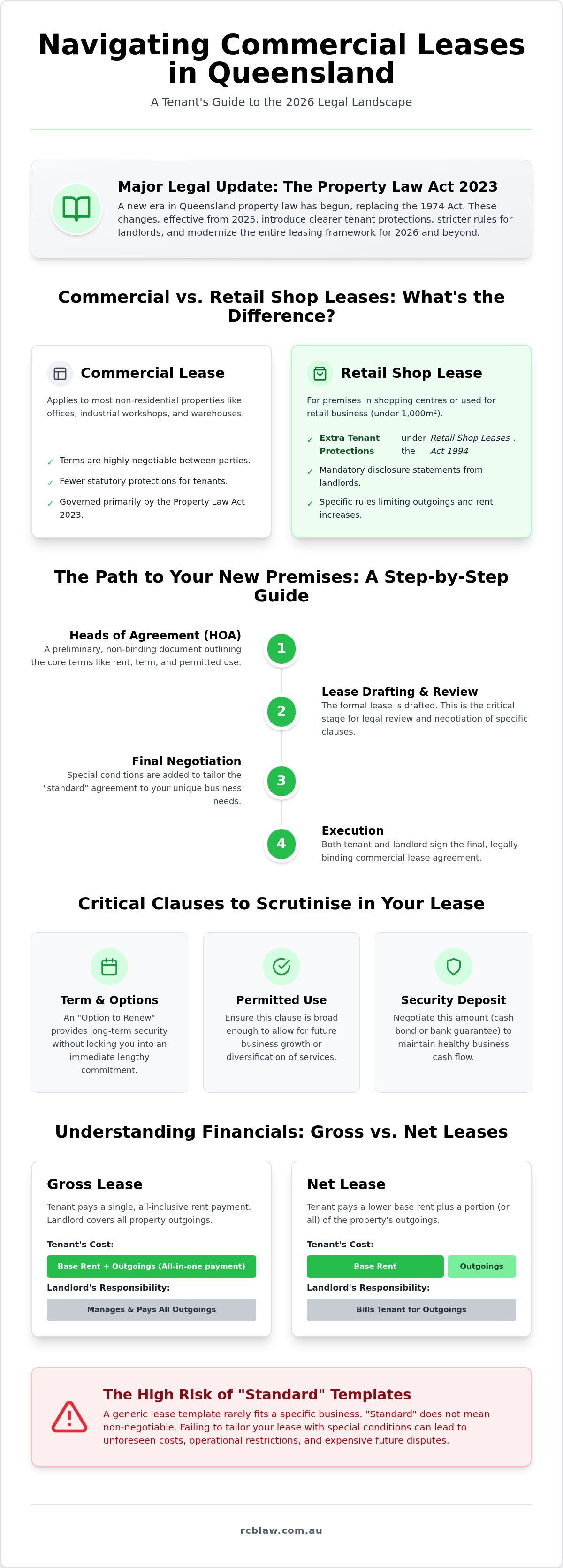
The Step-by-Step Process: From Negotiation to Registration
Moving from an initial site inspection to a fully executed commercial lease agreement qld is a journey that requires both patience and precision. It begins with the Heads of Agreement (HOA). This document captures the commercial "handshake," but it's vital that no money changes hands at this stage. Once the HOA is settled, the landlord's solicitor prepares the formal Lease Agreement. If your premises fall under retail law, the landlord must provide a Disclosure Statement at least seven days before the lease is entered into. This is your window to verify that the lease terms match your expectations and that there are no hidden surprises in the outgoings or maintenance clauses we discussed earlier.
Negotiation is where we work to mitigate your specific business risks. We look at everything from fit-out periods to personal guarantees. After the terms are finalised, the signing and execution phase makes the contract legally binding. It's a significant moment, marking the transition from a prospect to a tenant with a protected place to grow. Following the 2025 legislative updates, landlords must also follow a defined process for any future consent requests, providing a more structured relationship from day one.
Due Diligence: What to Check Before You Sign
Before you put pen to paper, a layer of due diligence is essential to remove any lingering friction. We check the property's title for caveats or mortgages. If a bank holds a mortgage over the building, they must consent to your lease; without this, your tenancy could be at risk if the landlord defaults. We also verify that the local council zoning allows for your specific business use. It's heartbreaking to sign a five-year lease only to discover you can't get the necessary permits for your industry. Reviewing survey plans ensures the square meterage you're paying for matches the physical space you're occupying.
The Importance of Lease Registration
Registration with Titles Queensland is a critical step for any commercial lease agreement qld with a total term exceeding three years, including option periods. This process provides you with "Indefeasibility of Title." This means your lease is protected even if the landlord sells the building to a new owner. Without registration, a new landlord might not be legally bound to honour your lease if they weren't aware of it. We handle the lodgement process with Titles Queensland to ensure your business home remains secure for the long haul. If you're ready to secure your next business premises, our team can provide a comprehensive commercial property law review to ensure your interests are fully protected.
Why Expert Local Guidance is Your Best Business Asset
Attempting to navigate a commercial lease agreement qld without professional oversight is a high-risk strategy that often leads to avoidable financial strain. While online templates might seem like a cost-saving measure, they lack the specific regional nuances and protective drafting required for the Brisbane and Sunshine Coast markets. A single overlooked clause regarding outgoings or maintenance can result in thousands of dollars in unexpected costs over a five-year term. Proactive legal advice acts as an insurance policy for your business, identifying these risks before they become binding obligations and preventing the need for costly litigation later.
At RCB Law, we act as a "calm port" for business owners during what can be a high-pressure transition. With over 30 years of Queensland property law experience, we've seen how the local landscape has evolved, particularly with the significant legislative changes that commenced in 2025. Our role is to provide a steady hand, ensuring your lease isn't just a document you've signed, but a solid foundation for your future success. By translating technical jargon into actionable advice, we remove the friction often associated with complex legal processes, allowing you to focus on your operations with a feeling of security.
The RCB Law Approach: Empathy Meets Mastery
Our commitment to you is built on clear, informative, and supportive communication. We understand that your business is more than just a balance sheet; it's your livelihood and your passion. That's why we encourage a comprehensive contract review before any signatures are placed on a commercial lease agreement qld. This process allows us to tailor every clause to your specific industry, whether you're in a retail hub in Maroochydore or an office tower in Brisbane CBD. By addressing potential disputes during the negotiation phase, we help you avoid the emotional and financial burden of future litigation. Our mastery of the law is always balanced with an empathetic understanding of your individual circumstances.
Next Steps: Securing Your Premises
If you're ready to take the next step in your business journey, we invite you to reach out for a reassuring, expert review of your lease. We offer fixed-price options for lease reviews to ensure you have complete cost certainty from the very beginning. As part of our holistic approach to client care, we also provide a complimentary will review for our commercial clients. This ensures that as your business assets grow, your personal legacy remains protected. Building a secure foundation for your business success starts with the right partner. You can contact our team for a professional lease consultation to ensure your next move is your best move.
Take Control of Your Business Premises
Transitioning into a new commercial space is a significant milestone for any Queensland business owner. By understanding the nuances of rent review mechanisms and the critical importance of lease registration, you've already taken the first step toward long-term stability. A well-negotiated commercial lease agreement qld ensures that your monthly costs remain predictable and your business has the room it needs to grow safely. It's about more than just a physical space; it's about building a foundation that allows you to operate without the constant fear of hidden costs or unfair terms.
You don't have to face these complex legal documents alone. With 30+ years of QLD property expertise, our team acts as a steady guide through the high-pressure leasing process. We offer fixed-price commercial lease reviews to give you complete cost certainty before you commit to a multi-year contract. As local Sunshine Coast and Brisbane specialists, we're here to help you navigate the 2026 regulations with confidence and clarity.
Secure Your Business Future with an RCB Law Lease Review and move forward with the peace of mind that your foundation is solid. Your business deserves a space that supports its success, and we're here to make that transition as smooth as possible.
Frequently Asked Questions
What is the difference between a commercial and retail lease in QLD?
Retail leases fall under the Retail Shop Leases Act 1994 and apply to businesses located in shopping centres or those predominantly used for retail trade. These agreements offer extra tenant protections, such as mandatory disclosure statements. Commercial leases generally cover industrial, warehouse, or office spaces and are governed primarily by the Property Law Act 2023, which offers more flexibility but fewer statutory protections.
Do I need a lawyer to review a 'standard' REIQ commercial lease?
Yes, seeking a legal review is a vital step in protecting your business interests. While the base terms are industry standard, the "Special Conditions" added at the end are often drafted heavily in the landlord's favour. A lawyer ensures your commercial lease agreement qld is tailored to your specific industry needs, helping you avoid hidden costs or restrictive clauses that a generic template might overlook.
How much are the outgoings on a typical commercial lease in Brisbane?
Outgoings vary significantly based on the building's age, location, and the services provided. These costs typically include council rates, water charges, building insurance, and land tax. In a "Net Lease," you'll pay these on top of your base rent. It's essential to request an audited statement of outgoings from the previous year to ensure your monthly budget remains predictable and manageable.
What happens if I need to end my commercial lease early?
Ending a lease early usually requires you to either "assign" the lease to a new tenant or "sublease" the space. Under the Property Law Act 2023, there is now a formal process for requesting landlord consent. Landlords must respond to your proposal notice within one month. If your lease includes a "break clause," you may have a clearer path to exit after a set period, provided you meet specific conditions.
Is a Heads of Agreement legally binding in Queensland?
A Heads of Agreement can be legally binding if it contains all essential terms and the parties intend to be bound immediately. While many are marked "subject to contract," Queensland courts have held that these preliminary documents can create a binding obligation. It's a high-pressure stage of the negotiation, so you should always have the document reviewed before signing to avoid being locked into terms prematurely.
Who pays for the legal costs of preparing a commercial lease in QLD?
Under the Retail Shop Leases Act 1994, landlords are prohibited from passing on their lease preparation costs to the tenant. However, for non-retail commercial leases, the legal costs are entirely negotiable. It's common practice in Queensland for the tenant to pay the landlord's reasonable legal fees for the preparation and execution of the lease, though this is something we often negotiate on behalf of our clients.
Why do I need to register my lease with Titles Queensland?
Registration is a legal requirement for any commercial lease agreement qld with a total term exceeding three years, including option periods. This process grants you "indefeasibility of title," which is a powerful legal protection. It ensures that your right to occupy the premises remains secure even if the landlord decides to sell the building to a new owner who was unaware of your tenancy.
What is a 'Disclosure Statement' and do I need one?
A Disclosure Statement is a mandatory document for retail leases that outlines all key financial information, including rent and outgoings. The landlord must provide this to you at least seven days before the lease is entered into. If they fail to do so, or if the statement is materially incomplete, you may have the right to terminate the lease within the first six months of your tenancy.


