
A testamentary trust for a child with disability in QLD can be established through a Will. A Special Disability Trust takes effect when the will-maker dies and can hold and manage an inheritance for an eligible beneficiary. Its assets may receive concessional treatment under social security means tests, but only if the eligibility and trust requirements are met.
It’s understandable to want an inheritance to support your child without creating avoidable complications for their benefits or housing. How assets are held and used matters, and a trust doesn’t automatically exclude them from every assessment.
This article explains what makes a trust a Special Disability Trust, how trust assets may affect support and accommodation, and how a Will can create a structure suited to your child’s needs. It also outlines the considerations involved in choosing between a Special Disability Trust and other testamentary trust arrangements, so you can understand how each may work for your family.
Key Takeaways
- Learn what makes a Special Disability Trust distinct and the eligibility and use requirements that shape its social security concessions.
- Understand why trust assets may affect Disability Support Pension and public housing assessments, and what conditions can change how they’re treated.
- Compare a Special Disability Trust with other testamentary trust options to see how trustee discretion can support a beneficiary’s needs.
- See how a Will can establish a trust, direct how an inheritance is managed and appoint a trustee to carry out those wishes.
What is a Special Disability Testamentary Trusts?
A Special Disability Trust is designed to provide for an eligible beneficiary’s care and accommodation needs. Established through a Will, it can hold an inheritance and may receive social security concessions if it meets strict requirements.
Special Disability Trust Concessions
Concessions can affect how trust assets and certain gifts are treated under social security rules. Lifetime gifts to a Special Disability Trust may receive concessional treatment, subject to applicable rules. A Special Disability Trust may also help cover certain expenses for its beneficiary. These limits matter when families consider how much to contribute and what the trust may pay for.
Trust Requirements and Setup Costs
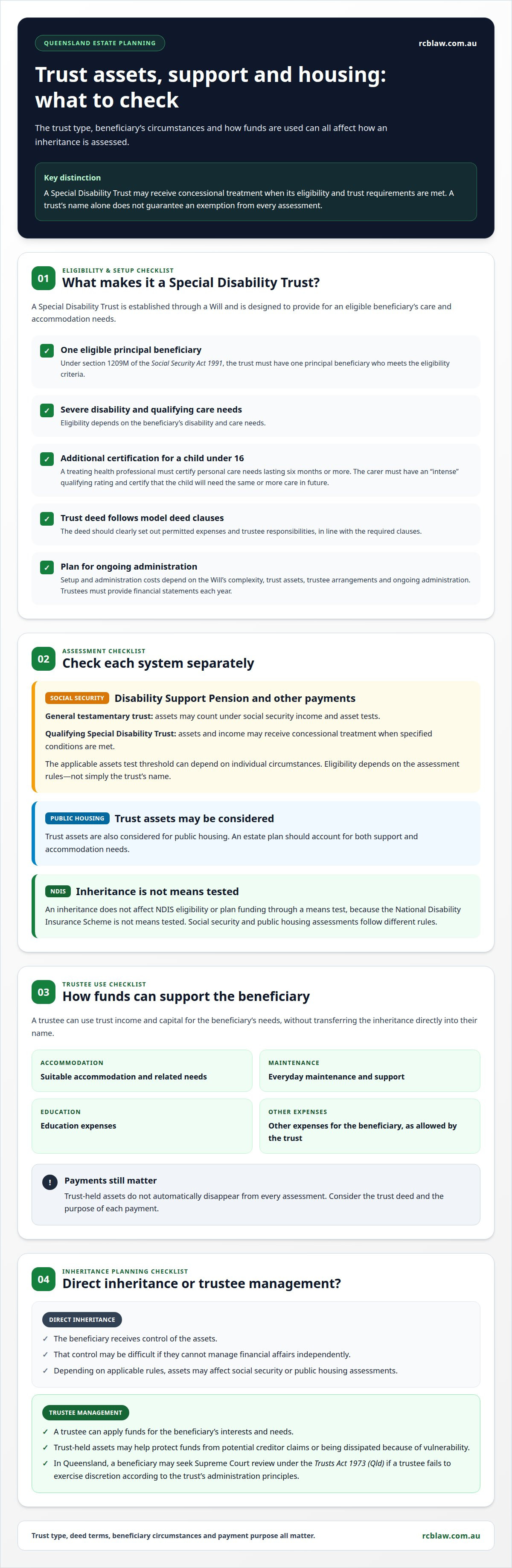
Eligibility depends on the beneficiary’s disability and care needs, and the trust deed must follow model deed clauses. Under section 1209M of the Social Security Act 1991, a Special Disability Trust must have one principal beneficiary who meets the eligibility criteria. The beneficiary must have a severe disability and qualifying care needs. For a child under 16, a treating health professional must certify personal care needs lasting six months or more. The carer must also have an ‘intense’ qualifying rating and certify that the child will need the same or more care in future.
Setup and administration costs depend on the Will’s complexity, the trust assets, trustee arrangements and ongoing administration. The cost is provided after a quote request. Trustees must provide financial statements each year, so administration continues after the trust is created.
Special Disability and Testamentary Trust Differences
A testamentary trust is created by a Will and takes effect after the will-maker dies. A Special Disability Trust is a particular type, with specific eligibility rules and social security concessions. A general testamentary trust doesn’t automatically qualify for those concessions.
A Special Disability Trust’s primary purpose is to provide for the beneficiary’s care and accommodation. It may operate alongside other supports: the National Disability Insurance Scheme is not means tested, while social security payments have separate assessment rules. The trust deed should clearly set out permitted expenses and trustee responsibilities.
Trust assets and disability support pension or public housing
Trust ownership can affect income support and housing assessments in different ways. The trust type, the beneficiary’s circumstances and how the assets are used all matter.
Social Security Income and Asset Tests
Social security income and asset tests assess financial resources when determining entitlement to payments such as the Disability Support Pension. Assets held in a testamentary trust may count towards these tests, while qualifying Special Disability Trust assets and income may receive concessional treatment when specified conditions are met.
The applicable assets test threshold can depend on individual circumstances. Trust assets are also considered for public housing, so an estate plan should account for both support and accommodation needs. Eligibility depends on the applicable assessment rules, not simply the trust’s name.
Trust Assets and Beneficiary Needs
A trustee can use trust income and capital for a beneficiary’s accommodation, maintenance, support, education and other expenses. This can provide practical access to resources without transferring the inheritance directly into the beneficiary’s name.
For example, a trustee may pay for suitable accommodation or support costs from trust funds. A Special Disability Trust may receive concessional treatment under social security means tests if it meets the required conditions. These arrangements don’t automatically remove every asset or income from assessment, so legal advice should consider the trust deed and the purpose of each payment.
Inheritance Effects on NDIS Supports
An inheritance does not affect NDIS eligibility or plan funding through a means test, because the National Disability Insurance Scheme is not means tested. Social security and public housing assessments are different, and trust assets may be relevant to them.
Understanding these systems separately helps families assess the likely effects of an inheritance. Trust funds may pay for needs beyond NDIS plan supports, while the NDIS provides supports under its own rules. The trust deed and distribution decisions should reflect the beneficiary’s circumstances and intended support arrangements.
Risks of Direct Inheritance
A direct inheritance gives the beneficiary control of the assets, which may be difficult if they cannot manage financial affairs independently. Depending on the applicable rules, those assets may also affect social security or public housing assessments.
A trust can instead give a trustee discretion to apply funds for the beneficiary’s interests. Trust-held assets may help protect funds from potential creditor claims or being dissipated because of vulnerability. In Queensland, a beneficiary may seek Supreme Court review under the Trusts Act 1973 (Qld) if a trustee fails to exercise discretion according to the trust’s administration principles.
Planning these choices within an estate plan for your family can help align inheritance arrangements with the beneficiary’s needs.
Testamentary trusts for beneficiaries with disability
A testamentary trust can hold estate assets for a beneficiary who needs support managing an inheritance. The type of trust determines how trustees can use its income and capital.
Protective Trusts for Vulnerable Beneficiaries
A Queensland protective testamentary trust can provide long-term care for a beneficiary with disability, mental illness or a psychological disorder. It may suit a child or adult who needs another person to manage inherited assets. Under this arrangement, the beneficiary can’t appoint trustees or change how funds are distributed. A will-maker can appoint the Public Trustee of Queensland as trustee, providing a defined management structure for the trust.
This structure can specify how funds support accommodation and other needs, rather than leaving the beneficiary to manage the estate alone. It differs from a direct gift, where the beneficiary receives the assets personally.
Trustee and Beneficiary Conflicts
A trustee holds property for the beneficiary and must act in the beneficiary’s interests, rather than profit from the role. This duty matters when a family member is both trustee and potential beneficiary, or has personal interests that may conflict with the trust’s purpose.
Parents should avoid leaving an intended inheritance to another family member on the informal understanding that they will provide for their child. This can create a conflict and gives the child no clear trust structure. A memorandum of wishes can explain the will-maker’s preferences, but it doesn’t bind the trustee. Clear terms in the Will provide firmer direction.
Long-Term Provision for Disability
A discretionary testamentary trust gives its trustee discretion to apply income and capital for the beneficiary’s interests. The trustee can respond to changing needs, including accommodation, support and education, instead of following a fixed payment pattern. Eligible testamentary trust income paid to minor beneficiaries may receive adult tax rates under section 102AG of the Income Tax Assessment Act 1936.
A written care plan can guide carers, guardians, executors and trustees when the parents are no longer available. It can describe the child’s routines, support needs and accommodation preferences, helping trustees make decisions that reflect the family’s intentions.
Testamentary trusts established through a Will
In Queensland, setting up a testamentary trust means deciding its purpose, beneficiaries, trustee and distribution terms in a Will. The trust is established under the Will and takes effect after the will-maker dies.
A Special Disability Trust can be created through a Will, but its concessions depend on meeting eligibility and trust requirements. The Department of Social Services sets severe disability criteria for the principal beneficiary. A general testamentary trust doesn’t automatically qualify for the same treatment.
Estate planning begins by matching the trust structure to the child’s circumstances. The Will can specify which estate assets go into the trust, who manages them and how income or capital may be used. For a Special Disability Trust, the deed must include the required model clauses and focus on care and accommodation.
Choosing a trustee matters. Look for someone with financial and property-management skills, or someone able to obtain appropriate professional advice. The Will should also explain how to appoint a replacement trustee, so the trust can continue if the original trustee can’t act.
Review the Will if the child’s support needs, family circumstances or intended beneficiaries change. Reconsider whether the trust’s purpose, trustee arrangements and distribution terms still reflect the estate plan. A care plan can give trustees and carers practical guidance about routines, accommodation and support needs.
For children under 18, property left to them must be held in trust until they turn 18. A protective testamentary trust can set a later age for access to capital, such as 21, when that better suits the child’s circumstances.
For help shaping these decisions into a Will, discuss Will-based estate planning that reflects your child’s needs.
RCB Law
RCB Law can help you put your wishes for your child into a clear Will. If you’re considering a testamentary trust, Will Drafting can address how estate assets are held, who acts as trustee and how funds may support your child. These decisions can be tailored to your child’s circumstances and your family’s intentions.
A carefully prepared Will can clarify how the trust should operate and provide practical direction for those responsible for administering the estate. This can be a useful step when reviewing an existing Will or planning how an inheritance should be managed. Trust eligibility and social security treatment involve separate requirements, so consider the Will’s terms alongside the intended trust structure.
Contact RCB Law to discuss Will Drafting for your family’s estate planning needs.
Put your family’s intentions into a clear plan
Planning a testamentary trust for a child with a disability in Queensland is an opportunity to put your intentions into practical terms. Consider what support you want the inheritance to provide, who could make decisions as trustee, and what guidance they may need as your child’s circumstances change. These choices can help shape an estate plan that reflects your family’s priorities rather than relying on informal assumptions.
A Will can give effect to that plan by setting out the trust structure and the responsibilities attached to it. RCB Law can assist with Will Drafting, helping you work through the choices involved and express your intentions clearly. The next step is a conversation about your family’s circumstances and the kind of provision you want to make.
Arrange a conversation with RCB Law and take a considered step towards planning for your child’s future.
Frequently Asked Questions
What is a trust?
A trust is a legal arrangement in which a trustee holds and manages property for beneficiaries under defined terms. For example, a Will may direct an executor to transfer part of an estate into a trust, then appoint a trustee to manage those assets. The trustee must follow the trust terms and act in the beneficiaries’ interests, rather than treating the property as their own.
Can Someone Contest A Testamentary Trust?
A person may challenge a Will or seek court intervention about trust property in certain circumstances. In Queensland, eligible people who believe a Will did not adequately provide for them can make a Family Provision Application under the Succession Act 1981. The Supreme Court can requisition assets allocated to a testamentary trust for a successful claimant. A dispute about a trustee’s decisions is a separate issue.
Estate planning when your child has a disability: What can I do?
Start by recording your child’s support needs, daily routines and important care preferences in a practical care plan. Consider who should manage inherited assets and who could provide guidance about long-term care. In Queensland, a parent may appoint a testamentary guardian in a Will, with powers over a child’s long-term care, welfare and development applying until the child turns 18.
What are the potential benefits?
A trust can provide structured management of an inheritance when a beneficiary needs help handling finances. For example, a trustee may use trust funds for a beneficiary’s accommodation or education while retaining capital for future needs. Depending on the trust type and applicable requirements, a Special Disability Trust may also receive social security concessions. These features can support planning, but don’t guarantee a particular payment or housing outcome.
What is a testamentary trust for a child with disability in Queensland?
A testamentary trust for a child with a disability in Queensland is a trust created through a Will to manage estate property for the child after the will-maker’s death. The Will sets out how the trust is formed and who will administer it. A parent can also appoint a testamentary guardian, helping identify who should have responsibility for the child’s care while they remain under 18.
What eligibility criteria apply to a special disability trust beneficiary?
A Special Disability Trust can have only one principal beneficiary, who must meet the relevant severe disability and care requirements under section 1209M of the Social Security Act 1991. For beneficiaries aged 16 or older, criteria include an ‘intense’ care-needs rating and limits on working capacity. A child under 16 has separate requirements, including professional care certification and an intense qualifying carer rating.


