
Your Will may not control your super. In Queensland, superannuation in estate planning can follow the fund’s rules and your nomination, rather than your Will. If there’s no valid binding nomination, the trustee decides how to distribute the death benefit.
That distinction can matter deeply in a blended family, where a current partner, children from an earlier relationship and other dependants may have different expectations. A nomination made before a relationship changed may no longer reflect your wishes.
It’s understandable to expect your Will to explain who receives your assets. But superannuation in estate planning in Queensland involves recognising that your Will and super arrangements may operate under different rules.
You’ll learn who may receive a super death benefit, how binding and non-binding nominations differ, and what blended families should consider when planning for the future. This guide to superannuation in estate planning in QLD explains where you need to express your wishes clearly.
Key Takeaways
- Identify which eligible beneficiaries may receive a super death benefit, and understand how the fund’s rules affect payment.
- Compare binding and non-binding nominations so you can see how much direction each gives the fund trustee.
- Consider how your Will, super arrangements and wider estate plan fit together, including whether a benefit may pass through your estate.
- In a blended family, review how your current partner, children and other dependants may be affected by your nominations and estate planning choices.
Who can receive a superannuation death benefit in Queensland?
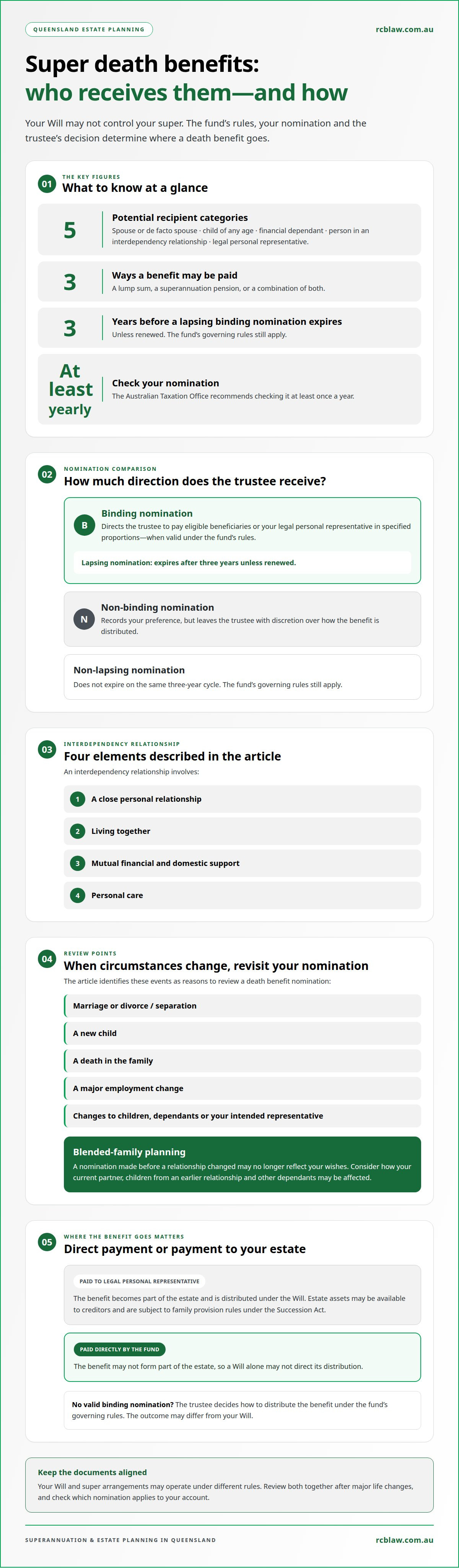
A superannuation death benefit doesn’t automatically follow a Will. The fund’s rules, your nomination and the trustee’s decision determine who receives it.
Eligible recipients may include a spouse or de facto spouse, a child of any age, a financial dependant, someone in an interdependency relationship, or the member’s legal personal representative. An interdependency relationship involves a close personal relationship, living together, mutual financial and domestic support, and personal care.
Payment may be a lump sum, a superannuation pension or a combination of both. A binding nomination directs the trustee to pay eligible beneficiaries or the legal personal representative in specified proportions. A non-binding nomination records a preference, while a reversionary beneficiary may continue a pension after the member’s death.
Review your death benefit nomination after marriage, divorce, a new child, a death in the family or a major employment change. The Australian Taxation Office recommends checking a nomination at least once a year. A lapsing binding nomination expires after three years unless renewed.
When No Valid Nomination Exists
Without a valid binding nomination, the trustee decides how to distribute the death benefit under the fund’s governing rules. The outcome may differ from your Will, so your estate plan should account for both. The trustee may pay eligible dependants, the legal personal representative or a combination, rather than automatically following a non-binding preference.
SMSF Succession and Executor Claims
For a self-managed super fund (SMSF), superannuation law and the trust deed govern distribution. A binding nomination generally applies only if the deed permits it. An SMSF may pay a death benefit pension to a death benefits dependant when its rules allow. An executor should identify the fund, review its deed and nomination, and establish whether the legal personal representative is entitled to receive the benefit. If it is paid to the estate, the benefit is distributed under the Will.
What is the difference between a binding and a non-binding superannuation nomination in Queensland?
A binding nomination directs the fund trustee to pay your benefit to eligible beneficiaries or your legal personal representative. A non-binding nomination records your preference but leaves the trustee with discretion.
Binding Nomination Duration
A binding death benefit nomination is an instruction the trustee must follow when it is valid under the fund’s rules. It can direct payment to eligible dependants or your legal personal representative, in specified proportions. For a lapsing nomination in Queensland, the nomination expires after three years unless renewed. That expiry matters because an old instruction may no longer guide payment.
Lapsing and Non-Lapsing Nominations
A lapsing nomination has an expiry point, while a non-lapsing nomination does not expire on the same three-year cycle. This affects how long your chosen beneficiaries remain nominated, but the fund’s governing rules still apply. Review your nomination after a relationship change or when your children, dependants or intended representative change.
A reversionary beneficiary applies to a super pension. If the nominated beneficiary is eligible, they become entitled to continue receiving the income stream automatically when the member dies. This differs from a nomination directing a lump-sum death benefit, so check which arrangement applies to your account.
Your Will and superannuation nomination should work together, but they don’t necessarily control the same assets. Super paid to your legal personal representative forms part of your estate and is distributed under your Will. A benefit paid directly by the fund may not form part of the estate, so a Will alone may not direct its distribution.
After a marriage, separation, new child or other major change, review both documents together. Queensland estate-planning advice can help clarify how your Will and intended distribution align. Consider Queensland Will planning when you need to put your estate wishes into a legal document.
What is estate planning (really)?
A Queensland estate plan coordinates your Will with your superannuation instructions. The trustee may pay a death benefit to eligible dependants or your legal personal representative.
Paying Benefits to Dependants or Representatives
A superannuation death benefit may go to eligible dependants, the estate’s legal personal representative or both. This matters because direct payment and payment to the estate follow different routes. A legal personal representative is the executor named in a Will or an administrator appointed for the estate.
If the trustee pays the benefit to the legal personal representative, it becomes part of the estate and is distributed under the deceased person’s Will. In Queensland, estate assets may be available to creditors and are subject to family provision rules under the Succession Act. These factors can affect how much beneficiaries ultimately receive.
The trustee’s decision depends on the fund’s rules and any valid nomination. For example, directing payment to the estate places the benefit under the Will’s instructions, while direct payment to an eligible dependant keeps it outside that estate distribution process.
Tax Treatment of Death Benefits
In Australia, superannuation death benefits are tax-free when paid to dependants, while benefits paid to non-dependants may be taxed. The tax outcome matters when comparing who receives a benefit and how it is paid.
Superannuation law and tax rules can classify a person differently. A deceased person’s child may qualify as a dependant under superannuation law but be a non-dependant for tax purposes. An adult child aged 18 or over who can’t show financial dependence may face tax on the benefit.
The payment form also matters: a lump sum and an income stream can have different tax treatment. A financial dependant may receive a benefit tax-free, while a financially independent adult child may need to pay tax. Consider the recipient’s dependency, the payment structure and the fund’s instructions together when planning distribution.
Superannuation in blended-family estate planning
A blended family can include a current spouse, children from earlier relationships and stepchildren. Superannuation directions need to account for these different relationships because a Will doesn’t automatically control a fund’s death benefit.
Consider a member who wants to support their current spouse while also providing for children from a previous relationship. A binding nomination can direct a benefit to eligible beneficiaries in specified proportions. The fund’s rules determine who may be nominated, so wishes should be expressed through arrangements those rules recognise.
Separation can create another mismatch. A nomination favouring a former partner doesn’t automatically change when the relationship ends. Review your nominated beneficiary after separation, remarriage, a new child or a death in the family. Then compare the updated directions with your Will so both reflect your current family situation.
Eligibility and tax treatment can also differ. A child may qualify as a dependant under superannuation law but be treated as a non-dependant for tax purposes. An adult child aged 18 or over who can’t establish financial dependence may face tax on a death benefit. A pension may also be available only to death benefits dependants, not every person eligible for a lump sum.
For each intended recipient, consider their relationship to the member, financial dependence and the form of benefit they can receive. These factors help explain why an equal split in a Will may not produce the same result for super. Review your nomination and Will together, especially when family responsibilities or intended distributions change. Clear, current directions can reduce uncertainty about distributing benefits among a spouse and children.
RCB Law: Residential Conveyancing
RCB Law’s Will Drafting service can help you set out your estate wishes in a Will. This matters when your superannuation death benefit may be paid to your estate, because the Will then sets out how estate assets are distributed.
A Will and a fund nomination serve different purposes. If you’re updating your estate documents after a relationship change, a new child or a property purchase, consider how your Will fits with your broader plans. Residential Conveyancing can also help when buying or selling a home forms part of that change.
For Queensland families, clear documents can help executors understand your intentions and manage the estate. Contact RCB Law to discuss Will Drafting or your property-related legal needs.
Give your estate plan a clear next step
Your intentions can change as family responsibilities, property and business interests evolve. Take time to consider whether your estate documents still reflect the people and priorities that matter to you. A sound approach to superannuation in estate planning in Queensland can help align those priorities with your wider plans.
Where commercial property or business interests form part of your plans, RCB Law’s Commercial Property Law and Business Law services can help with those legal matters. Considering superannuation in estate planning in Queensland alongside these interests can help keep your intentions clear.
If you’re ready to discuss the estate-planning documents within RCB Law’s services, contact RCB Law about estate planning. A thoughtful next step today can help bring greater clarity to the plans you leave behind.
Frequently Asked Questions
What actually happens to superannuation when someone dies in Queensland?
The super fund assesses the deceased member’s account and pays the death benefit under its governing rules. The benefit may include the remaining super balance and life insurance attached to the account. Payment can be a lump sum, an income stream or both. For example, an eligible dependant may receive a pension, while another recipient may receive a lump sum.
When should you update your estate plan?
Review your estate plan after a major change, such as marriage, divorce, a new child, a death in the family or a major employment change. The Australian Taxation Office recommends checking a superannuation death benefit nomination at least once a year. Regular reviews can help identify outdated choices, such as a nomination for a former partner that hasn’t changed after separation.
Does superannuation automatically form part of a deceased estate in Queensland?
No. Superannuation doesn’t automatically become part of a deceased estate in Queensland. It enters the estate if the trustee pays the benefit to the deceased member’s legal personal representative. Otherwise, the fund pays eligible recipients under its rules and any applicable nomination. This means an executor may need to consider super separately from assets already controlled by the Will.
What happens when superannuation does pass through the estate?
When the trustee pays super to the estate, the executor or administrator distributes it under the deceased person’s Will. In Queensland, estate funds may also be available to creditors and are subject to family provision rules under the Succession Act. The amount beneficiaries ultimately receive can therefore depend on estate obligations and applicable claims, not only on the Will’s gifts.
What types of nominations are available in Queensland?
Common arrangements include binding and non-binding nominations, a reversionary beneficiary for a pension, or trustee discretion. A binding nomination directs payment under the fund’s rules; a non-binding nomination records a preference. A reversionary beneficiary relates to continuing a pension. For a self-managed super fund, the trust deed matters because a binding nomination generally applies only if the deed permits it.
How is superannuation treated in an estate after death in Queensland?
Treatment depends on whether the benefit is paid to the estate or directly to a beneficiary, and on the recipient’s tax status. If it is paid to the estate, the Will governs distribution, while Queensland creditor and family provision rules may also affect estate assets. Tax can differ for dependants and non-dependants, so the recipient’s status and payment form are relevant.


