
A landlord can sell a tenanted property, but the sale doesn’t automatically end the tenancy. The landlord obligations when selling a tenanted property follow specific legal frameworks, and the existing agreement generally continues unless it is ended in line with the applicable rules. Here in Queensland, for example, the owner or property manager must give the tenant a Form 10 notice of the intention to sell.
It’s understandable to feel unsettled by sale signs, inspection requests or uncertainty about how long you can stay. The rules set clear boundaries around access and notice: Queensland open homes require the tenant’s written agreement, and specific timeframes apply to entry notices. This article explains what a sale means for your tenancy, what to expect from viewings, and how the rules apply under Queensland legislation. Drawing on local expertise, RCB Law explores how a periodic tenancy may end when a sale requires vacant possession, helping you better understand your rights and what may happen next.
Key Takeaways
- Understand how a sale can affect your rights as a renter, and why the state or territory matters.
- Learn what to expect from buyer inspections and how privacy and quiet enjoyment fit into the process.
- See what conditions may allow a periodic tenancy to end when a buyer needs vacant possession.
- Find out how an existing lease and landlord responsibilities are handled when ownership changes.
Can your landlord sell your rental property?
Yes, a landlord can sell while a tenant lives in the property. The landlord obligations when selling a tenanted property vary across Australian states and territories, particularly for sale notices, access and ending a tenancy.
Notice of Intention to Sell
A notice of intention to sell tells tenants that the owner plans to market the premises. It matters because disclosure can affect access and a tenant’s options if the proposed sale was not disclosed earlier. In Queensland, the owner or property manager must give Form 10, Notice of lessor’s intention to sell premises. In Victoria, written notice must be given at least 14 days before an owner or agent asks to enter to sell. South Australian landlords must notify tenants in writing within 14 days of signing a sales agency agreement. They cannot advertise or show the property to prospective buyers before that period passes. In NSW, a tenant may end a fixed-term agreement with 14 days’ notice if the landlord did not disclose a proposed sale before signing.
Termination Notices for a Sale
A termination notice is a formal notice requiring the tenancy to end, and its timing depends on the sale circumstances and agreement. In NSW, a proposed sale requires at least 90 days’ notice for a periodic tenancy or a fixed term longer than 6 months. For a fixed term of 6 months or less, the period is 60 days. Once the property is sold, the landlord must give at least 30 days’ notice to end the tenancy. In Queensland, if the buyer requires vacant possession from a periodic tenant, the notice to leave must allow at least 2 months after the contract of sale is signed. In South Australia, a contract requiring vacant possession means at least 60 days’ written notice to end a periodic lease.
State and Territory Differences
State and territory rules set different notice and entry requirements, so the property’s location determines what applies. Queensland’s Property Law Act 2023 introduced mandatory pre-contract seller disclosure through Form 2 from 1 August 2025, according to Queensland Legislation. Inspection rules also differ. In NSW, tenants must receive 48 hours’ notice before each showing unless they agree to a schedule. Queensland landlords must protect quiet enjoyment, and an open home requires the tenant’s written agreement. For valuations, South Australian tenants receive 7 to 14 days’ notice, while Western Australian tenants receive 72 hours’ notice before a private inspection or valuation. Victoria requires 7 days’ written notice for a valuation.
Before arranging entry, the landlord or agent must give the required notice and respect the tenant’s privacy. Rules for photographs, inspection times and access differ between states and territories.
Do I have to agree to viewings and open inspections?
Tenants must allow lawful access, but they do not have to agree to every request. The landlord or agent arranging sale inspections should coordinate access, repairs, cleaning and security. Tenants should not be expected to supervise buyers. Agree on practical arrangements for keys, doors and personal belongings before an inspection.
State rules set limits on timing and frequency. In Victoria, a renter must receive written notice at least 48 hours before entry to show the home to a buyer or hold an open inspection. Each sales inspection also requires compensation equal to half a day’s rent or A$30, whichever is more. In South Australia, prospective-buyer inspections can happen no more than twice every 7 days unless the tenant agrees to more. If inspection times aren’t agreed, normal hours are 8 am to 8 pm, Monday to Saturday.
Other examples differ. In the Northern Territory, sale inspections must take place between 7 am and 9 pm, and the tenant must be present unless an exception applies. Western Australian landlords must give 7 days’ notice before a home open or public viewing. Access is limited to 8 am to 6 pm on weekdays and 9 am to 5 pm on Saturdays. These rules help tenants plan around buyers while preserving privacy and quiet enjoyment.
Marketing access also has boundaries. In South Australia, a landlord must give 7 days’ notice before taking advertising photos or video footage. If the tenant’s possessions will appear, the tenant must receive 7 days’ notice and give written consent. A sale contract, once signed, doesn’t itself mean the tenant must vacate; whether vacant possession is required depends on the contract and tenancy arrangements. For clarity on how a property sale contract affects the transaction, residential conveyancing advice can help explain the legal steps.
Ending a periodic tenancy when vacant possession is required
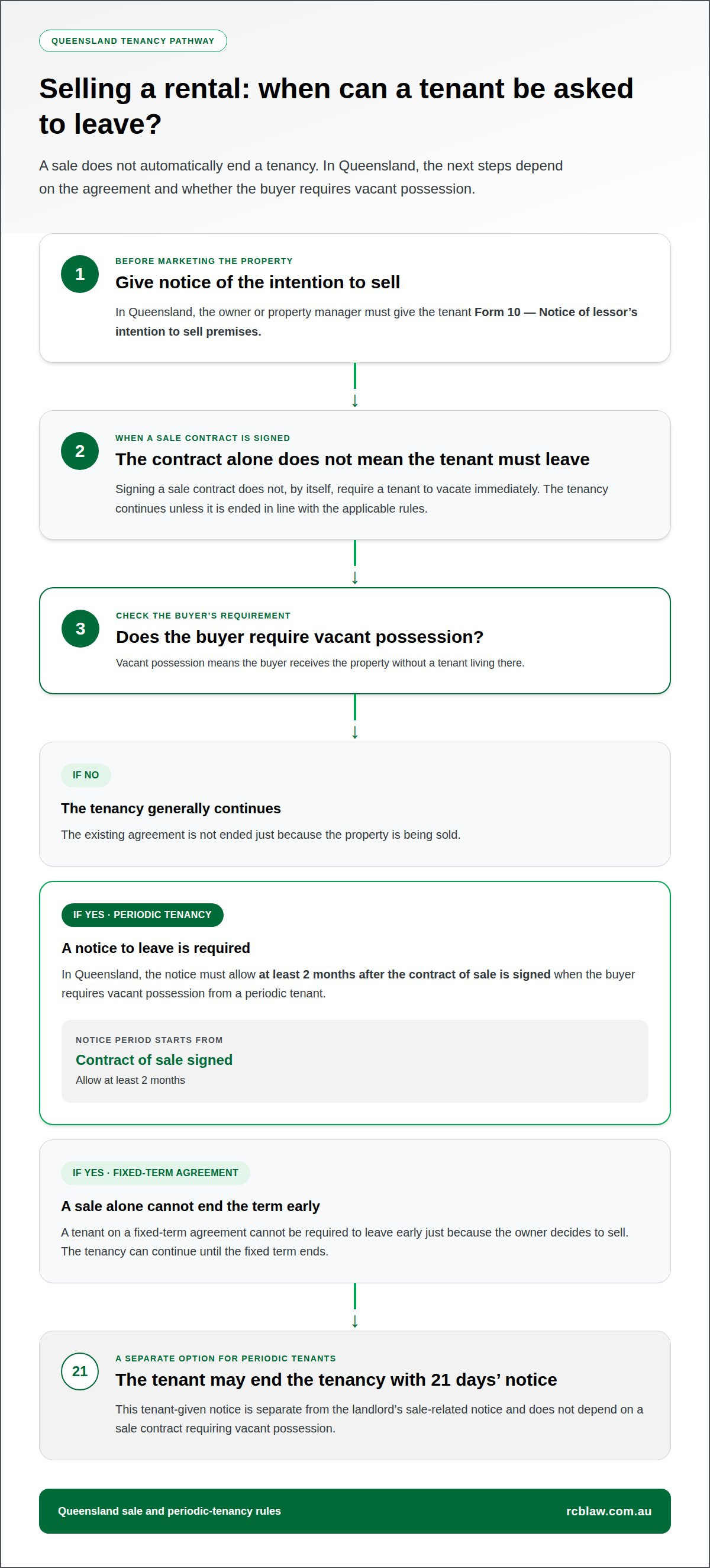
Vacant possession means the buyer receives the property without a tenant living there. A periodic agreement has no fixed end date, but the landlord must still follow the applicable termination rules. Signing a sale contract does not, by itself, require tenants to leave immediately. The required notice period and the event that starts it matter.
The rules for ending a periodic tenancy can depend on whether the sale contract requires vacant possession. A tenant on a periodic agreement can also end the tenancy by giving the landlord 21 days’ notice. These are different routes: the tenant’s notice is not dependent on a sale, while the landlord’s sale-related notice depends on the contract requiring vacant possession.
Queensland sets a separate rule for a buyer seeking vacant possession from a periodic tenant: the notice to leave must allow at least 2 months after the contract of sale is signed. A tenant on a fixed-term agreement cannot be required to leave early just because the owner decides to sell. The tenancy can continue until the fixed term ends.
In South Australia, a contract requiring vacant possession allows a landlord to end a periodic lease with at least 60 days’ written notice. Victoria requires at least 90 days’ notice to vacate when the property has been sold as vacant. If a Victorian landlord signs a contract of sale and wants the renter to move out, the notice must be given within 14 days of signing or when all contract conditions are met.
In the Northern Territory, a periodic tenant must receive 42 days’ written notice when the landlord wants the property vacant for sale. A fixed-term tenant generally cannot be forced out before the term ends unless they breach the lease. In Western Australia, the landlord must give 30 days’ written notice to end a periodic tenancy once a sale contract is in place and a settlement date is set. The termination process therefore depends on the state, agreement type and sale terms.
Selling a property with a tenant in place
A rental property can be sold while the tenant remains in place. The sale usually transfers the landlord’s rights and responsibilities to the buyer, while the existing tenancy terms continue. A change of ownership alone does not mean the tenant must leave. For example, a buyer who purchases a Queensland property with a valid lease takes over that lease on the same terms after settlement.
The agreement type still matters. In NSW, a new landlord usually cannot end a fixed-term agreement before its end date. If a fixed term exceeds 3 years and is registered with the Registrar General, the new landlord is subject to the whole agreement. In Western Australia, an existing fixed-term tenancy continues until its end date, and the buyer must honour its terms unless both parties agree otherwise.
After settlement, the tenant needs clear information about the new landlord and rent payments. In Queensland, the tenant must receive an attornment notice with the new owner’s details and where to pay rent. In South Australia, the outgoing landlord must give the buyer’s name and the date rent becomes payable to the buyer at least 14 days before settlement, or as soon as possible if settlement is sooner.
Marketing still requires care. In NSW, interior photos or videos for marketing may be taken only once, within the 28 days before marketing starts or the 28 days before the tenancy ends. Written consent is required for interior images showing a tenant’s belongings. A for-sale sign and an on-site auction also require consent, unless the sign or auction is on strata common property. These details can affect campaign planning and the buyer’s expectations. For tailored help with the sale’s legal arrangements, get advice on your property sale.
RCB Law: Residential Conveyancing
RCB Law assists with the residential conveyancing involved in selling a property with a tenant in place. If you’re preparing a sale, negotiating contract terms or planning settlement arrangements, conveyancing advice can clarify the legal steps and how the tenancy affects the transaction.
Turn to RCB Law for support understanding the property sale process alongside the existing rental agreement. Advice can help you consider the contract, required documents and change-of-ownership arrangements together, so you can make informed decisions about the transaction.
Contact RCB Law to discuss your property sale.
Plan your next move with clarity
Before committing to a sale or move, review the tenancy agreement alongside the sale documents. This can help identify what the contract requires, which decisions remain open and what needs to be communicated to the tenant or buyer. The landlord obligations when selling a tenanted property are easier to manage when the tenancy and sale arrangements are considered together.
RCB Law provides residential conveyancing for property transactions, as well as commercial property and business law services. If you’re selling or buying a tenanted property, legal guidance can help you understand the transaction documents and plan the next steps.
Contact RCB Law about your tenancy to discuss your property transaction and move forward with greater confidence.
Frequently Asked Questions
What happens if the landlord wants the tenant to leave?
The landlord must use a lawful reason and serve the notice required for that state or territory. A sale alone doesn’t automatically end a tenancy. For example, in the Northern Territory, a periodic tenant must receive 42 days’ written notice when the landlord wants the property vacant for sale. A tenant can compare the notice’s reason and end date with their agreement before deciding how to respond.
How can a lawyer help with selling a tenanted property in the Northern Territory?
A lawyer can review the sale contract alongside the tenancy agreement and identify how the documents affect each other. They can clarify whether the buyer expects the tenancy to continue, what information must be carried through settlement and how the change of ownership affects rent arrangements. For a Northern Territory sale, advice should account for Territory rules, including the tenant’s continuing right to live there after ownership changes.
Should you sell with tenants in place, or wait for vacant possession?
The right approach depends on the likely buyer and the sale terms you can lawfully offer. Selling with a tenant in place may suit a buyer seeking an investment and preserve the existing rental arrangement. Waiting for vacant possession may suit a buyer planning to occupy the home, but the tenancy must end through the applicable process. Consider the contract terms, the tenant’s agreement and timing together.
What Happens After the Sale?
After settlement, the new owner becomes responsible for the ongoing landlord relationship if the tenancy continues. A practical handover includes the agreement, rent records, inspection information and relevant tenant communications. In Western Australia, the seller should notify the tenant in writing of the change of ownership and transfer the bond to the new owner through the Bond Administrator. Clear records help prevent uncertainty about rent and tenancy arrangements.
What are a landlord’s obligations when selling a tenanted property in Australia?
Landlords must handle the sale without overlooking the tenant’s existing rights. Their obligations include giving required notices, arranging only lawful entry, protecting privacy and quiet enjoyment, and managing the agreement correctly if ownership changes. The exact steps vary by state or territory. For instance, Queensland requires a Form 10 notice of intention to sell, while Victoria has its own written notice requirements for sale-related entry.
Can a landlord sell a rental property while a fixed-term lease is in place?
Yes. A landlord can sell during a fixed term, but the sale itself does not automatically end the lease. The effect of a sale on a fixed-term tenancy can depend on the circumstances, so the parties should check the agreement and applicable rules. This distinction can affect the buyer’s expectations, so the sale documents should accurately state the tenancy’s status and terms.


