
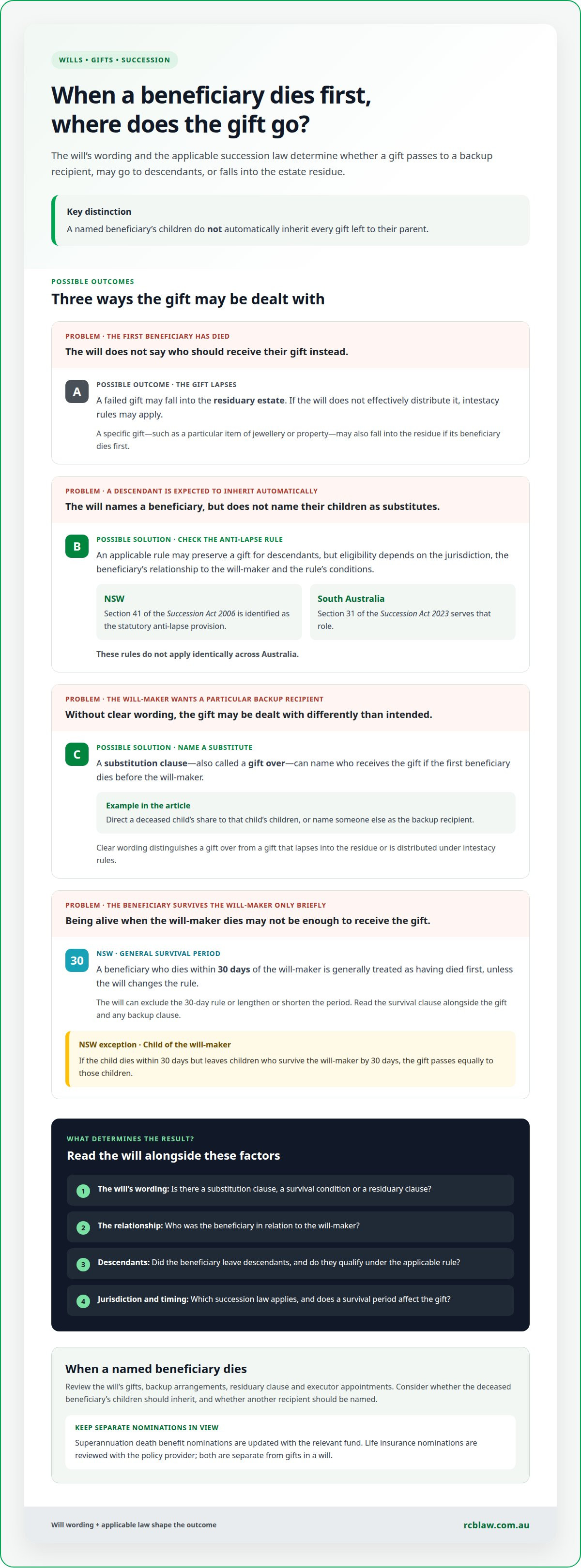
In Australia, what happens if a beneficiary dies before the will maker depends on the will’s wording and the succession law that applies. A gift may lapse into the residuary estate, while an anti-lapse rule can allow certain descendants to inherit instead. In NSW, a beneficiary who dies within 30 days of the will-maker is generally treated as having died before them.
It’s understandable to expect a named gift to pass automatically to that person’s children, but that isn’t always what happens. The outcome depends on who the beneficiary was, whether they left descendants and whether the will names someone else to receive the gift.
This article explains how lapsed gifts and anti-lapse rules work, what the NSW survival period means and why the wording of a will matters. It also explains how a will can name an alternative recipient if a beneficiary dies first, helping your intentions guide what happens to the gift.
Key Takeaways
- Start by reading the will’s wording: a substitution clause may name who receives a gift if the original beneficiary dies first.
- A deceased beneficiary’s children do not automatically inherit in every case. Whether an anti-lapse rule applies depends on the beneficiary’s relationship to the will-maker and the relevant state law.
- In NSW, a beneficiary who dies within 30 days of the will-maker is generally treated as having died first, subject to exceptions and the will’s terms.
- Review the will when a named beneficiary dies, so the intended recipients and any alternative arrangements remain clear.
What Happens When a Beneficiary Dies Before You?
What happens if a beneficiary dies before the will-maker depends on the will’s wording and the applicable state or territory law. The gift may lapse, pass to descendants under an anti-lapse rule or go to a named backup recipient.
Descendants Inheriting a Deceased Beneficiary’s Share
A deceased beneficiary’s children or other descendants may receive a gift if the will or an applicable anti-lapse rule directs it to them. Descendants don’t automatically inherit every gift left to their parent. If a will leaves property jointly to two beneficiaries and one dies first, the wording and applicable law determine whether the survivor receives the whole gift or the deceased beneficiary’s share is dealt with differently.
Anti-Lapse Rules for Descendants
An anti-lapse rule can preserve a gift for descendants when a beneficiary dies before the will-maker, subject to the relevant law’s conditions. In NSW, section 41 of the Succession Act 2006 (NSW) is identified as the statutory anti-lapse provision; in South Australia, section 31 of the Succession Act 2023 (SA) serves that role. These rules don’t apply identically across Australia.
Whether descendants can inherit a gift left to a child or other relative depends on the jurisdiction, the beneficiary’s relationship to the will-maker and the rule’s requirements. A child’s descendants may qualify in some circumstances, but a gift to any relative does not automatically pass to their children.
Redirecting a Share in the Will
A substitution clause, also called a gift over, names a backup recipient if the first beneficiary dies before the will-maker. For example, the will can direct a deceased child’s share to that child’s children, or name someone else. Clear wording distinguishes this outcome from a gift that lapses into the residue or is distributed under intestacy rules.
Updating a Will After a Beneficiary Dies
After a named beneficiary dies, review the gifts, backup arrangements, residuary clause and executor appointments. Decide whether the deceased beneficiary’s children should inherit, name another recipient if appropriate, and make changes through a properly prepared will. Separately, update superannuation death benefit nominations with the relevant fund. Review life insurance nominations with the policy provider too, because they are separate from gifts in a will.
Lapsed gifts when a beneficiary dies before the will-maker
In Australia, a gift to someone who dies before the will-maker generally lapses unless the will or an applicable anti-lapse rule provides otherwise. The failed gift may become part of the residuary estate, or intestacy rules may apply.
Specific Gifts That Fail
A specific gift identifies particular property, such as a piece of jewellery or a particular property, for a beneficiary. If that beneficiary dies first, the gift may fail and fall into the estate’s residue. For example, if a parent leaves a particular item to one child who dies first, the will’s other terms determine where it goes. This is why the gift’s description and any alternative recipient matter.
Conditional Gifts and Survival Periods
A conditional gift is one a beneficiary receives only after meeting a requirement in the will, such as surviving the will-maker for a stated period. If the beneficiary fails to meet that condition, the gift may lapse even if they were alive when the will-maker died. Read the condition alongside any backup clause: one may direct the gift elsewhere, while the other may leave it to the residue.
Lapsed Gifts and the Residuary Estate
The residuary estate is what remains after debts, expenses and specific gifts are dealt with. An ineffective gift may form part of the residuary estate. A residuary clause can then direct that property to the remaining beneficiaries. In Victoria, a lapsed gift may fall into the residue or be distributed under intestacy laws, depending on the will’s terms.
A Lapsed Residuary Gift
A residuary gift covers what remains of the estate, so its failure can leave property without an effective recipient under that clause. If a residuary beneficiary dies before the will-maker, check for a substitute beneficiary and any applicable anti-lapse rule. Where the will makes no provision for a failed residue share, intestacy rules may determine its distribution. For commercial land affected by a lapsed gift, commercial property guidance can help clarify property-related issues.
A beneficiary dying within the survival period
A survival period sets how long a beneficiary must outlive the will-maker to receive a gift. In NSW, the relevant period is generally 30 days, unless the will changes that rule.
Dying Before or After the Survival Period
In NSW, a beneficiary who dies within 30 days of the will-maker is generally treated as having died first. The gift is then dealt with under the will and applicable succession rules, rather than passing as an ordinary entitlement. A will-maker can exclude the 30-day rule or lengthen or shorten its period in the will.
There is an exception for a child of the will-maker who dies within 30 days: if that child leaves children who survive the will-maker by 30 days, the gift passes equally to those children. This distinction can change who receives the intended share, so the clause and family circumstances both matter.
The Default Survival Period
The applicable period depends on the jurisdiction and the will’s wording; NSW uses 30 days as its general rule. A survival clause can set a different period or exclude the statutory rule, so read it alongside the gift itself. For example, a clause may make a primary beneficiary’s entitlement conditional on surviving the will-maker for the stated period.
If two people die at the same time and the order of death cannot be determined in NSW, the older person is presumed to have died first. That presumption can affect whether a gift takes effect.
Death Before Estate Distribution
If a beneficiary survives the will-maker and the applicable survival period, but dies before distribution, the gift generally passes to the beneficiary’s estate rather than lapsing. If the beneficiary left no will, intestacy laws determine how their estate is distributed.
The executor’s position is separate: if no executor is able to act when the will-maker dies, someone may need to be appointed to administer the estate. Reviewing the executor appointment and survival clause as part of estate planning helps clarify both who administers the estate and who receives each gift.
Anti-lapse rules when a beneficiary dies before the will-maker
An anti-lapse rule may allow a deceased beneficiary’s descendants to inherit a gift in their place. It can change the usual result for a lapsed gift, but it doesn’t apply to every beneficiary or every gift. The applicable legislation, the beneficiary’s relationship to the will-maker and the will’s wording all matter.
Most Australian states have anti-lapse rules in succession legislation. In NSW, section 41 of the Succession Act 2006 (NSW) is identified as the statutory provision; in South Australia, section 31 of the Succession Act 2023 (SA) is the relevant provision. The South Australian Act’s changes took effect on 1 January 2025. These identifiers show why the state or territory governing the estate matters.
Consider a will-maker who leaves a gift to their child, who dies first and leaves children. An anti-lapse rule may allow those grandchildren to inherit their parent’s share if the statutory requirements are met. Descendants do not automatically receive every gift. A gift to a friend, for example, may be treated differently from a gift to a child or another relationship covered by the applicable rule.
The will-maker can also specify what should happen. A substitution clause might name the deceased beneficiary’s children, another relative or a different backup recipient. Unless the will provides otherwise, an applicable anti-lapse rule may operate. Clear alternative wording shows whether the will-maker intended descendants to inherit or wanted the gift redirected elsewhere.
For an executor preparing for probate, the key question is not simply whether the named beneficiary died first. The executor must read the gift and any substitution wording, identify the beneficiary’s relationship to the will-maker and apply the relevant state or territory rule. These details help determine who may inherit and whether the gift instead forms part of the residue.
To make your intended alternative clear, prepare a will with clear backup gifts that addresses what should happen if a beneficiary dies first.
RCB Law: Residential Conveyancing
RCB Law’s Will Drafting service can help you prepare or update a will, including wording that names an alternative beneficiary if someone dies first. Clear directions can reduce uncertainty about who should receive a gift and keep your intentions reflected in the document.
If the gift involves a home, Residential Conveyancing may also be relevant to the property transaction that follows. The will’s instructions and the property transfer are separate matters, so understanding each can help you plan the next step clearly.
For guidance on your will or a residential property matter, contact RCB Law or visit rcblaw.com.au.
Make your intentions clear for the future
Knowing what happens if a beneficiary dies before the will-maker can prompt a useful next step: write down who you would want to receive each gift if your first choice cannot. Consider whether descendants should inherit, whether a different backup is more appropriate and whether changes in your family or assets have made earlier instructions outdated.
Clear estate planning is not only about naming beneficiaries. It also means making your intentions understandable to the people who may need to carry them out. If you’re reviewing a will alongside property or business decisions, RCB Law offers Residential Conveyancing, Commercial Property Law and Business Law.
For help putting your wishes into clear legal documents, contact RCB Law about your next steps. A considered review can help you move forward with greater clarity and confidence.
Frequently Asked Questions
Note For Executors: What If a Beneficiary Has Already Died?
Pause distribution of the affected gift until you understand how the will directs it. Note the beneficiary’s date of death, identify the exact gift and look for a substitute recipient or wording that applies if they died first. Then consider whether a residuary clause or an applicable anti-lapse rule affects the outcome. These details help you explain the proposed distribution clearly to affected beneficiaries.
What Happens If Someone in Your Will Passes Away Before You?
The gift is dealt with under the will and the succession law that applies. For example, if a will leaves a particular item to a friend who dies first, check whether another person is named to receive it. If not, the gift’s treatment depends on the will’s other provisions and any relevant statutory rule. Review each affected gift separately rather than assuming the whole will fails.
What Is a Substitution Clause in a Will?
A substitution clause names someone else to receive a gift if the first beneficiary cannot take it. For example, the will might say that a named person receives a particular asset, but their child receives it if they die before the will-maker. The clause should identify the gift, the backup recipient and the event that activates the alternative. That wording gives the executor a clearer direction to follow.
What happens if part of your Will fails?
A failed gift does not necessarily invalidate the entire will. In NSW, section 31 of the Succession Act 2006 provides that an ineffective gift is treated as part of the residuary estate. The will’s residuary clause can then determine who receives it. If no effective will provision deals with the property, intestacy rules may govern its distribution. The result depends on which gift failed and what the remaining clauses say.
Can a will name a substitute or alternate beneficiary if the first beneficiary dies?
Yes. A will can name an alternate beneficiary and explain when that person receives the gift. For instance, it can leave a share to a primary beneficiary and name someone else to receive it if that beneficiary dies before the will-maker. The will-maker can also state whether descendants should receive the share instead. Clear alternatives distinguish the intended outcome from the default treatment of a failed gift.
How do Australian state and territory laws differ when a beneficiary predeceases the will-maker?
Succession legislation differs across Australia, including in how anti-lapse provisions apply and which beneficiary relationships they cover. NSW identifies section 41 of the Succession Act 2006 as its statutory anti-lapse provision; South Australia identifies section 31 of the Succession Act 2023. Most Australian states have anti-lapse rules. The relevant jurisdiction, relationship to the will-maker and will wording shape whether descendants can inherit.


