
In 2026, the old rule of "buyer beware" is officially dead in Queensland property law. While this shift brings more transparency, it also adds new layers of paperwork that can feel overwhelming when you're just trying to secure your future home. If you're feeling a sense of dread about understanding a contract of sale qld, you aren't alone. The introduction of the mandatory Seller Disclosure Scheme on August 1, 2025, changed the game, making the seller responsible for providing a Form 2 Disclosure Statement before you even sign.
We know that the pressure of "Subject to Finance" deadlines and the fear of missing a hidden property defect can keep you awake at night. You deserve to move through this transition with a sense of calm and confidence rather than confusion. This guide promises to simplify those complexities, giving you the tools to navigate the latest REIQ 19th Edition contracts without the stress of legal jargon. It's about turning a high-pressure moment into a structured, manageable process.
We'll walk you through the essential conditions that protect your deposit, explain how the 2026 disclosure laws work in your favor, and provide a clear roadmap of your rights during the five day cooling off period. By the end of this article, you'll have a clear understanding of your obligations and the peace of mind that your investment is legally sound.
Key Takeaways
- Learn how the standard REIQ contract functions as the foundation of your transaction and why the Reference Schedule is its most critical component.
- Gain clarity on why "Time is of the Essence" matters and how finance and building clauses act as a safety net for your deposit.
- Understand the 2026 Seller Disclosure Scheme to ensure you receive all mandatory documents before signing, a key step in understanding a contract of sale qld.
- Know your rights during the five-day cooling-off period, including the potential financial costs if you decide to withdraw from the sale.
- Prepare for a smooth settlement by knowing how rates and taxes are adjusted to ensure a fair transition of property ownership.
What is a Contract of Sale in QLD?
At its heart, a contract of sale is a legally binding agreement between a buyer and a seller for the transfer of real estate. While it might look like a stack of overwhelming paperwork, it's actually the roadmap for your entire property journey. Understanding a contract of sale qld starts with recognizing that this document is the primary legal engine governing the rights and obligations of both parties from the moment you sign until the day of settlement.
In Queensland, you can't rely on a handshake or a verbal promise to secure a home. Under the Statute of Frauds, all contracts for the sale of land must be in writing and signed by the parties involved to be enforceable. Without a written document, the agreement simply doesn't exist in the eyes of the law. This requirement exists to protect everyone involved, ensuring that the terms of the sale are clear, documented, and beyond dispute.
The Role of the REIQ and QLS
The Real Estate Institute of Queensland (REIQ) and the Queensland Law Society (QLS) collaborate to create the standard forms used for most residential transactions. The most common version is the 'Contract for Houses and Residential Land'. These documents are updated frequently to stay in line with new legislation, such as the significant changes introduced by the Property Law Act 2023. For instance, the 19th Edition released in June 2024 specifically addresses evolving tenancy laws.
When you look at these forms, you'll see "Standard Terms," which are the pre-printed rules that apply to every sale. However, your solicitor will often add "Special Conditions" to the end of the document. These are tailored clauses that address your specific needs, such as making the sale subject to the successful settlement of your current home or requiring specific repairs before the keys are handed over. These additions are vital for removing friction and ensuring the contract actually fits your life.
When Does the Contract Become Binding?
The journey toward ownership begins with an offer, which is often followed by a period of negotiation and counter-offers. A contract only becomes binding once both parties have signed and the final acceptance has been communicated back to the other side. This moment of communication is crucial because the date it occurs is officially the "Day of Sale." This date triggers all your critical deadlines, including the cooling-off period and finance approval dates.
Real estate agents might describe a contract as "standard" to help you feel more comfortable, but every property has unique risks that a generic form might not cover. Signing before a solicitor's review can lead to unexpected stress or litigation later on. Having a steady guide review the terms before you commit ensures that you're understanding a contract of sale qld fully and that your interests are protected from the very beginning.
The Anatomy of an REIQ Property Contract
If you're feeling overwhelmed by the twenty or more pages of a standard REIQ agreement, focus your attention on the first few pages. This section, known as the Reference Schedule, is the heart of the document. Most litigation and delays stem from simple clerical errors made in these early boxes. Understanding a contract of sale qld requires a meticulous eye for these details because they dictate every deadline and dollar amount involved in your purchase.
The "Particulars of Sale" identify the land not just by its street address, but by its legal Title Reference and Lot on Plan description. It's vital that these match the title search exactly. If there are encumbrances like easements or caveats, they must be disclosed here to prevent friction later in the process. Accuracy at this stage ensures that what you think you're buying is exactly what is being transferred to your name.
You'll also find the purchase price and deposit structure clearly outlined. In Queensland, it's common to see an "Initial Deposit" paid upon signing or within twenty four hours, followed by a "Balance Deposit" once the contract becomes unconditional. The settlement date is typically calculated using a formula, such as "30 days from the Contract Date," rather than a specific calendar day. This ensures the timeline shifts automatically if negotiations take longer than expected, providing a buffer for both parties.
Identifying the Property and Chattels
A frequent source of anxiety for buyers is what actually stays with the house. Generally, "Fixtures" are items that are bolted, screwed, or plumbed in, and they remain with the property. "Chattels" are moveable items that the seller takes. If you've fallen in love with a specific chandelier or a custom built-in mirror, ensure they are explicitly listed as included. Conversely, if a seller is taking a family heirloom light fixture, it must be noted as excluded to avoid a dispute on moving day. Having a professional review your contract before you sign can ensure these specific items are documented correctly.
The Reference Schedule Checklist
Before you put pen to paper, run through this quick checklist to ensure your interests are protected. Properly completing these sections is a foundational part of understanding a contract of sale qld and ensuring you aren't walking into a trap:
- Names: Check that all buyer names match your legal identification or company registration exactly.
- Ownership Structure: Decide if you are buying as "Joint Tenants," where the property passes to the survivor, or "Tenants in Common," where you own specific shares.
- Critical Conditions: Look closely at the Finance and Building and Pest boxes. If these are marked "N/A" or left blank by mistake, you may be waiving your right to terminate if the bank denies your loan or the inspection reveals a "lemon."
Essential Conditions: Finance, Building, and Pest
Most property transactions in Queensland include safety nets known as conditions. These protections only work if you understand the strict rules surrounding them. When you're understanding a contract of sale qld, the most critical phrase to remember is "Time is of the Essence." This isn't just a suggestion; it's a legal rule meaning that missing a deadline by even a few minutes can give the other party the right to terminate the contract or sue for damages. There's no grace period in Queensland property law, which is why having a steady guide to track these dates is vital.
The Finance Clause acts as your primary shield, protecting your deposit if your lender decides not to approve your loan. Similarly, the Building and Pest condition allows you to investigate the property's physical health before fully committing. These conditions must be satisfied to the buyer's satisfaction acting reasonably. This means you can't terminate for a trivial reason, but you're protected if a genuine issue arises that makes the purchase unviable for you.
Subject to Finance: More Than Just an Approval
A common mistake is assuming that a pre-approval from your bank is enough to satisfy the contract. In reality, you need a formal, unconditional offer of finance in writing. The Finance Date is usually set for 14 or 21 days after the contract date, giving your lender time to conduct a valuation and verify your details. If the bank's valuation comes in lower than the purchase price, or if the interest rate is higher than you expected, you may choose to terminate. However, you must notify the seller by 5:00 PM on the due date. If you miss this cutoff, the seller gains the right to terminate the contract themselves, which can create a high-pressure situation for any buyer.
Building and Pest: Navigating the "Reasonable" Test
This condition gives you the right to have the property inspected for major structural defects or active pest infestations. It's essential to hire a licensed inspector rather than relying on the opinion of a handy friend. A professional report carries the legal weight needed if you need to terminate or negotiate. While you might feel tempted to use the report to ask for a price reduction over minor maintenance issues, like a leaky tap or a cracked tile, this can be risky. Sellers are generally only required to address "major" issues. Pushing too hard on small details can cause friction and potentially derail the sale. Focusing on structural integrity and safety ensures you don't buy a "lemon" while keeping your path to ownership clear and predictable.
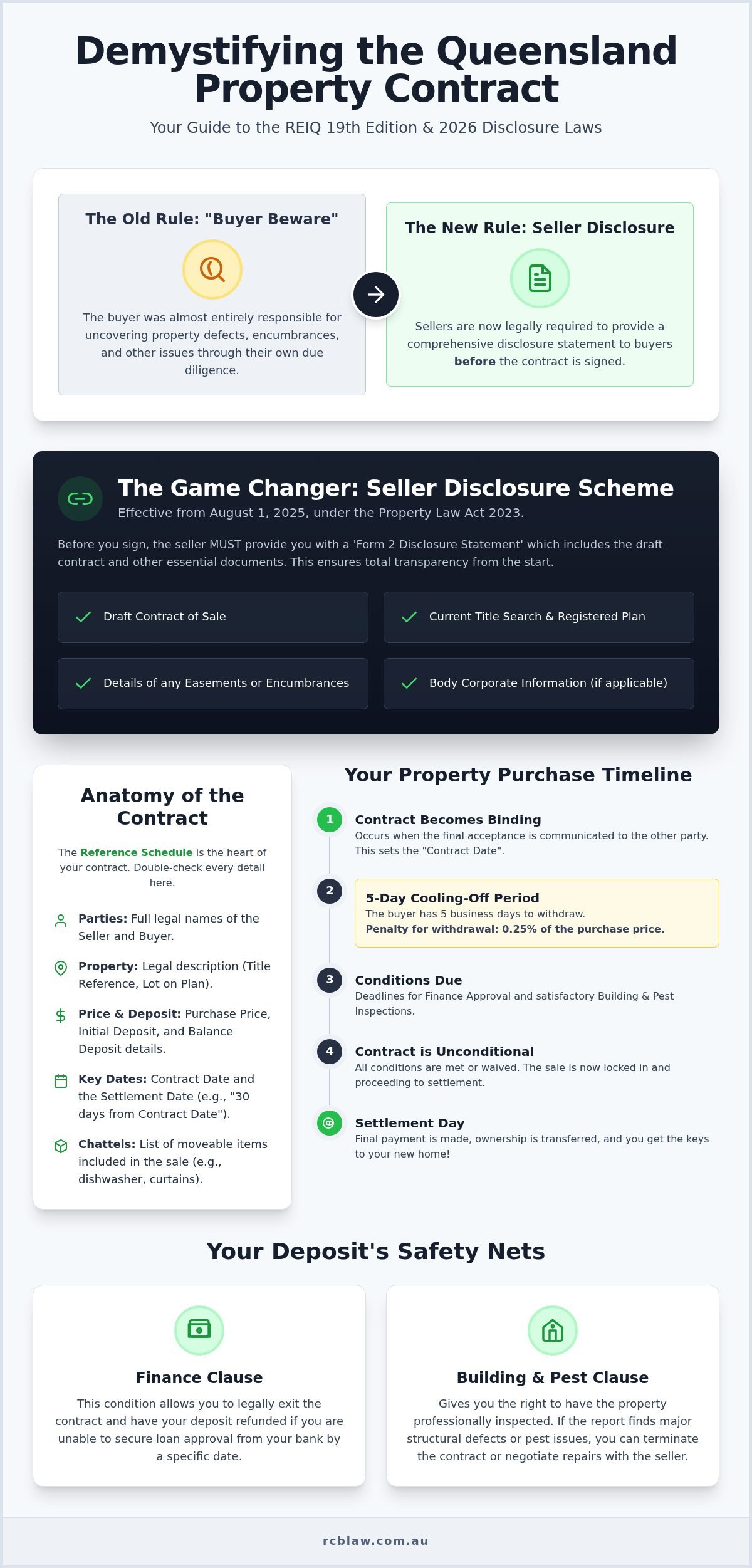
The 2026 Seller Disclosure Scheme (Property Law Act 2023)
For decades, Queensland operated under the principle of "buyer beware," placing the entire burden of discovery on the person purchasing the property. That era ended on August 1, 2025, with the commencement of the Property Law Act 2023. This legislation introduced a mandatory Seller Disclosure Scheme that fundamentally changes the process of understanding a contract of sale qld. Sellers are now legally required to provide a signed Form 2 Seller Disclosure Statement (SDS) along with all prescribed certificates before a buyer signs the contract. This shift is designed to remove the "guesswork" and high-pressure uncertainty that often led to litigation in the past.
By forcing transparency at the very beginning of the transaction, the new law aims to reduce pre-settlement disputes. When a buyer has all the facts about a property's legal and physical standing upfront, they can make an informed decision without the fear of discovering a "lemon" halfway through the process. If a seller fails to provide this statement, or if the information provided is materially inaccurate, the buyer gains powerful new rights to protect their investment.
What Sellers Must Reveal in 2026
The disclosure requirements are extensive and go far beyond a simple list of features. Sellers must now provide a comprehensive package of documents that includes:
- Title and Zoning: Current title searches, registered easements, and specific zoning restrictions that might limit how the land is used.
- Strata Information: For units or townhouses, sellers must include body corporate certificates and financial statements.
- Unregistered Encumbrances: Any legal interests not yet on the title, such as certain statutory charges or service provider rights.
- Council Notices: Building warrants or "show cause" notices issued by local councils regarding unapproved structures or safety issues.
The Buyer's Right of Termination
The most significant aspect of the 2026 laws is the leverage it gives to buyers. If the SDS is missing at the time of signing, or if it contains a "material inaccuracy," the buyer may have the right to terminate the contract. This termination window is generous; it typically remains open from the moment of signing until the very minute of settlement. A material inaccuracy is generally defined as a mistake or omission regarding a fact that would have reasonably influenced the buyer's decision to purchase the property at that price.
Identifying these errors requires a trained eye. At RCB Law, we meticulously cross-reference the disclosure pack against independent searches to find hidden deal-breakers that might otherwise go unnoticed. If you have received a disclosure pack and aren't sure what the fine print means for your future, our team can provide a comprehensive disclosure document review to ensure your interests are fully protected. Understanding a contract of sale qld means knowing exactly when the law gives you the right to walk away from a bad deal.
Cooling-Off, Settlement, and the Path to Moving In
Moving from a signed contract to the final handover of keys is often the most emotional part of the property journey. While you've successfully navigated the disclosure scheme and satisfied your conditions, this final stretch requires absolute precision to ensure a smooth transition. Understanding a contract of sale qld involves knowing that you still have a safety net even after the initial signature, provided you act within the statutory timelines. This period is designed to give you a moment of reflection before the deal becomes fully binding.
As you approach the finish line, your legal team manages the complex "adjustments" that ensure you only pay for what you own. This includes calculating pro-rata amounts for council rates, water charges, and land tax. We ensure these figures are accurate so that the seller pays their fair share up until the minute of settlement. For more details on how these calculations affect your final balance, you can view our guide on land tax and property adjustments. Our goal is to remove every point of friction, leaving you with nothing but the excitement of your new home.
Calculating the Cooling-Off Period
In Queensland, residential buyers generally benefit from a five business day cooling-off period. The clock starts ticking the day you receive a copy of the contract signed by both the buyer and the seller. If you decide to withdraw during this window, you can do so for any reason. However, it's important to be aware that the seller is entitled to retain a penalty of 0.25% of the purchase price from your deposit. It's also vital to remember that properties purchased at auction, or within two business days of a failed auction, do not have a cooling-off period. In those cases, you must be completely ready and unconditional before the hammer falls.
The Final Inspection and Settlement Day
Before the money changes hands, you have a legal right to a pre-settlement inspection. This is your chance to ensure the property is in the same condition it was when you signed the contract and that all agreed-upon chattels remain on-site. If a window has been broken or a fixture removed since your last visit, this is the time to raise it. Once the inspection is clear, the actual settlement occurs in a secure digital environment.
The days of physical meetings to swap paper checks and titles are over. Instead, your legal team and the bank enter a secure Digital Settlement Room via PEXA. This technology allows for the near-instantaneous transfer of funds and the digital lodgement of title documents with the Titles Office. This process is significantly more secure than the old manual system, providing you with immediate confirmation that the property is officially yours. Once the digital room closes, the real estate agent is notified, and you can collect your keys to begin your new chapter. With 30 plus years of experience in the Sunshine Coast and Brisbane regions, RCB Law acts as your steady guide to ensure this final day is a celebration, not a source of stress.
Securing Your Future with Confidence
Navigating the Queensland property market in 2026 requires more than just finding the right home; it demands a clear strategy for the legal paperwork that follows. The mandatory Seller Disclosure Scheme has shifted the burden of transparency to the seller, providing you with more information than ever before. However, the strict "Time is of the Essence" rule remains, making every deadline for finance and building inspections a critical milestone. Gaining a deep understanding a contract of sale qld is the first step toward a secure property investment and a stress-free move.
With 30 plus years of experience as specialists in Queensland property law, we've guided thousands of families through these complex transitions. Whether you're buying on the Sunshine Coast or in Brisbane, our team provides the empathetic and professional support you need to sign with certainty. If you need a reassuring expert to review your contract, contact RCB Law today for a stress-free experience. We're here to manage the friction so you can focus on the excitement of your new chapter. You've worked hard to reach this point, and we're here to ensure your journey to settlement is smooth and secure.
Frequently Asked Questions
Can I pull out of a house contract after signing in QLD?
Yes, you can terminate a contract under specific legal circumstances. You have the right to withdraw during the five day cooling-off period, or if a condition like finance or building and pest isn't met to your satisfaction. Additionally, the 2026 disclosure laws allow termination if the seller fails to provide the mandatory disclosure statement. Pulling out outside of these specific windows could result in the loss of your deposit and potential legal action.
What is the standard cooling-off period for property in Queensland?
The standard cooling-off period for residential property is five business days. This period begins the day you receive a copy of the contract signed by both the buyer and the seller. If you receive the document on a weekend, the clock starts on the next business day. While this provides a helpful safety net, terminating during this time incurs a penalty of 0.25% of the purchase price. Auctions do not have a cooling-off period.
What happens if my finance is not approved by the due date?
If your finance isn't approved by 5:00 PM on the due date, you must notify the seller to either terminate the contract or request an extension. Simply staying silent isn't enough; failing to notify them gives the seller the immediate right to terminate the contract themselves. Proactive communication is a vital part of understanding a contract of sale qld and ensures you don't lose your deposit due to a bank delay.
Is a Seller Disclosure Statement mandatory for all QLD property sales in 2026?
Yes, as of August 1, 2025, the Property Law Act 2023 requires a mandatory Seller Disclosure Statement for almost all residential sales. The seller must provide this signed document along with all prescribed certificates before you sign the contract. If they fail to provide it, or if the information is materially inaccurate, you may have the right to terminate the agreement at any time before settlement. This law ensures much needed transparency.
Who pays the transfer duty (stamp duty) in a QLD property transaction?
The buyer is responsible for paying transfer duty in Queensland. This tax is calculated based on the property's purchase price or its market value, whichever is higher. Concessions may be available if you're a first home buyer or if you intend to live in the property as your main residence. Your legal representative will calculate the exact amount and ensure the payment is processed with the Office of State Revenue before your settlement date.
What is 'Time is of the Essence' and why does it matter?
"Time is of the Essence" is a strict legal rule meaning all contract deadlines are absolute. If a condition is due by 5:00 PM, a notification sent at 5:01 PM is considered a breach of contract. Unlike other states, Queensland doesn't offer an automatic grace period. Missing a deadline gives the other party the right to terminate immediately. This rule is why having a steady guide to track your dates is so important.
Can a seller cancel a contract of sale if they get a higher offer?
No, a seller cannot cancel a binding contract just because they received a better offer from another buyer. Once both parties have signed and acceptance is communicated, the seller is legally committed to the sale. They can only terminate the agreement if you breach a condition, such as failing to meet a finance or building and pest deadline. This protection is designed to remove the stress of being gazumped after signing.
Do I need a solicitor or a conveyancer for a QLD property contract?
While you aren't legally required to hire a solicitor, Queensland's property laws are complex and carry high financial stakes. A solicitor provides a higher level of legal protection than a standard conveyancer, particularly if disputes arise over the 2026 disclosure requirements. Having an expert review your documents is a fundamental part of understanding a contract of sale qld. It ensures your interests are guarded by a professional who understands the local regional context.


