
You can leave overseas assets to beneficiaries in an Australian will, but Australian law may not govern every step. What happens to foreign assets in an Australian will depends on where they are held, which country’s rules apply, and whether local authorities recognise the will or require probate there. Some countries also restrict who can inherit or impose inheritance taxes.
It’s understandable to expect one will to cover everything, especially when your family, property or finances cross borders. An Australian will can record your wishes, but the process for dealing with particular assets may depend on the law where they are held and your domicile, or permanent home.
This article explains how foreign probate and recognition work, how domicile can affect estate administration, and why local legal advice may be important. It also outlines how forced-heirship rules and overseas inheritance taxes can affect what beneficiaries receive, helping you identify where planning may reduce uncertainty.
Key Takeaways
- Foreign assets may involve probate or recognition steps in the country where they’re held, with requirements varying by asset type and jurisdiction.
- Domicile can affect which law governs parts of an estate, particularly movable assets such as shares, artwork and bank funds.
- Local legal advice can help identify whether a separate will or other planning is appropriate for assets in another country.
- Forced-heirship rules and overseas inheritance taxes may affect who receives foreign assets and how much they ultimately receive.
Foreign probate and recognition of Australian wills
What happens to foreign assets in an Australian will depends on the asset’s location and the country’s probate requirements. An Australian will can cover overseas assets, but another country may apply its own recognition and succession rules.
Concurrent Wills Across Countries
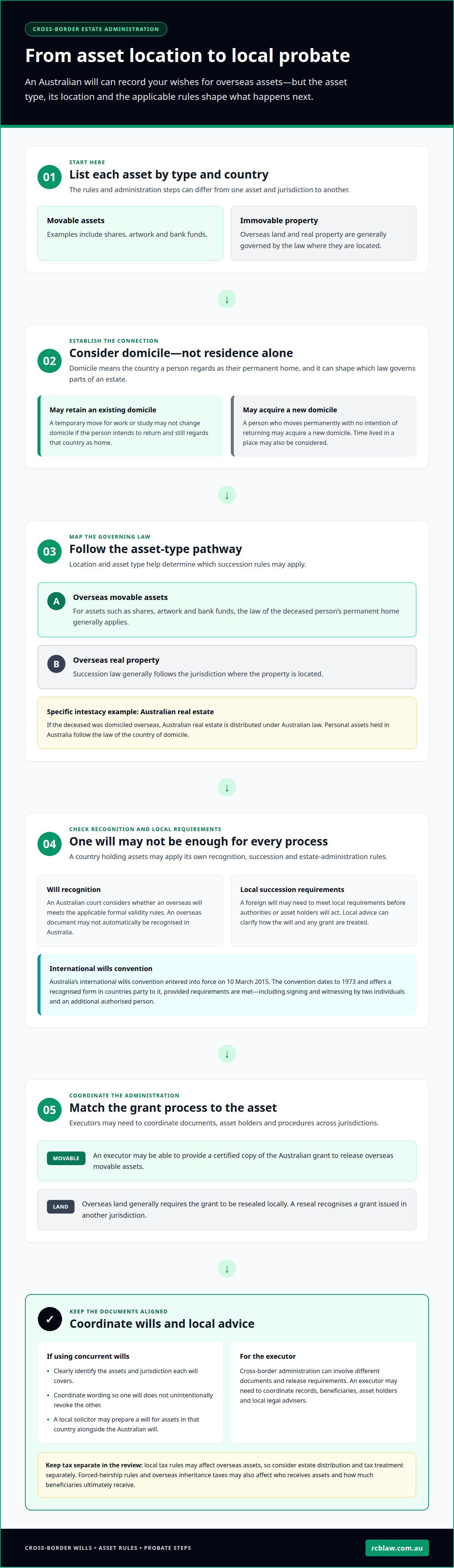
Concurrent wills are separate wills designed to deal with assets in different countries at the same time. They can allow each estate to be administered under the relevant local process, rather than relying on one document everywhere. To reduce conflict, each will should clearly identify the assets and jurisdiction it covers, and its wording should avoid revoking the other will.
For example, an Australian will could cover Australian assets while a will prepared by a solicitor in another country deals only with assets there. The documents need coordinated terms: a broad revocation clause in the later will could unintentionally cancel the earlier one. Clear boundaries help executors understand which will applies to each asset.
Recognition of Overseas Wills
An Australian court considers whether an overseas will meets the formal validity rules that apply to it. The relevant rules depend on the circumstances and jurisdiction, so an overseas document may not automatically be recognised in Australia. This matters because an executor may need a recognised grant before dealing with Australian estate assets. What happens to foreign assets in an Australian will also depends on whether the country holding them recognises the document.
Australia’s international wills convention entered into force on 10 March 2015. The Convention Providing a Uniform Law on the Form of an International Will dates to 1973 and offers a recognised form for countries party to it, provided its requirements are met. The international form includes signing and witnessing by two individuals and an additional authorised person.
Local Succession Requirements
Local succession requirements are the rules a country applies to inheritance and estate administration. A foreign will may need to meet those rules before local authorities or asset holders will act. A separate will prepared by a solicitor in that jurisdiction can address local requirements while operating alongside the Australian will.
Overseas land is immovable property, so succession law generally follows the jurisdiction where the land is located. By contrast, an executor dealing with movable assets may be able to provide a certified copy of the Australian grant to release them, while overseas land generally requires the grant to be resealed locally. A reseal recognises a grant issued in another jurisdiction. These differences make the asset’s location and type central to administration.
Domicile and the jurisdiction administering an estate
Domicile means the country a person regards as their permanent home, and it can shape which law governs parts of an estate. The location and type of each asset also matter.
Local Laws for Foreign Assets
Local estate laws determine how assets in a country are administered and distributed. For overseas movable assets, such as shares, artwork and bank funds, the law of the deceased person’s permanent home generally applies. For overseas real property, the law where the property is located applies. This distinction can affect which will governs an asset and the steps an executor must take.
Residence alone does not settle domicile. Someone who leaves their country of origin temporarily for work or study may keep that domicile if they intend to return and still regard it as home. A person who moves permanently with no intention of returning may acquire a new domicile. Domicile rules may take account of how long a person lived in a place before death.
Australian real estate has a distinct rule in an intestate estate. If the deceased was domiciled overseas, Australian real estate is distributed under Australian law, while personal assets held in Australia follow the law of the country of domicile. Local tax rules may also affect overseas assets, so consider estate distribution and tax treatment separately.
Cross-Border Estate Administration
Cross-border estate administration means settling assets under the requirements of more than one jurisdiction. The executor coordinates the Australian estate with overseas procedures, documents and asset holders. For example, an executor managing Australian bank funds and a foreign shareholding may face different release requirements for each.
Choosing an executor for an international estate involves considering whether they can manage records, communicate with beneficiaries and coordinate administration across borders. A trusted executor may still need to work with local legal advisers where assets are held. That coordination helps establish which jurisdiction’s rules apply and whether a foreign grant or an Australian grant requiring a reseal is relevant.
Where a person dies intestate while domiciled in Australia, the estate is distributed under the law of the Australian state or territory where they were domiciled. The deceased’s location and where most assets are held can also affect where probate is sought. These factors help explain why an international estate may need coordinated administration rather than one process for every asset.
Advice from lawyers in the jurisdiction where assets are located
Legal advice in the country holding an asset can clarify which succession rules apply and how an Australian will is treated there. This is especially useful for overseas real property, because the law of the place where the property is situated generally governs succession. A local lawyer can explain whether the will meets that jurisdiction’s formal requirements and whether its courts will recognise an Australian grant of probate.
Advice can also help identify the appropriate structure for multiple wills. For substantial foreign assets, separate wills in the countries where assets or income are held may be worth considering. Each document needs a clearly defined scope. Otherwise, a later will could unintentionally revoke an earlier one or create uncertainty about which executor handles an asset.
A local lawyer can explain the administration requirements for a specific asset. For example, a bank may require a certified Australian grant, prescribed forms or a local grant before releasing funds. An executor dealing with land may face a different process from one transferring shares. The location assigned to shares can affect which legal procedures apply.
Local advice can also clarify whether the jurisdiction is a signatory to the international wills convention and whether its requirements affect recognition. The convention provides a form of will recognised by countries that are party to it when the required formalities are met. It does not remove every local administration step or replace advice about succession rules for property.
Tax is another reason to seek advice that takes the asset’s location into account. A country may tax an inheritance or impose reporting obligations, while Australia does not impose inheritance tax or estate duty. The applicable rules depend on the asset, beneficiary and relevant jurisdictions. Coordinated advice helps the executor understand the documents, recognition process and tax obligations before distributing overseas assets.
Forced heirship and inheritance taxes
Foreign inheritance rules can affect both who receives overseas assets and how much beneficiaries retain. Some countries have forced-heirship laws that reserve inheritance rights for family members. An Australian will may name different beneficiaries, but local succession rules can affect assets located in that country. This distinction matters when planning distributions across borders.
For example, a will-maker may intend to leave overseas property to one beneficiary. If the country where the property is located applies forced heirship, certain family members may have rights under its law. The executor must account for those rules when administering the asset. An Australian will does not automatically override another jurisdiction’s succession laws.
Tax treatment is separate from inheritance rights. Australia does not impose inheritance tax or estate duty, but some countries tax inheritances involving overseas assets. A beneficiary’s residence, the asset’s location and the estate’s structure can affect the applicable tax rules. An Australian resident inheriting foreign property may therefore face a different tax outcome from a beneficiary living elsewhere.
Australian tax can also matter when estate assets pass to a non-resident beneficiary. Under section 104-215 of the Income Tax Assessment Act 1997, CGT Event K3 may arise when assets pass to a non-resident. An estate may also lose the 50% capital gains tax discount generally available when selling taxable Australian property. These consequences can affect the net amount distributed, even where Australia charges no inheritance tax.
Before appointing beneficiaries, consider how forced heirship, residence and tax rules interact in each relevant country. A will should express the intended distribution in accordance with applicable requirements, while accounting for possible local limits and tax treatment. For Australian will planning that accounts for overseas beneficiaries, discuss your will arrangements.
RCB Law: Will Drafting
RCB Law can help you prepare an Australian will that clearly records your wishes for your estate. Will Drafting is a practical next step if you own overseas assets, have beneficiaries in different countries or need to consider how your Australian will works alongside another will.
Planning can include identifying the assets your Australian will covers, clarifying the executor’s role and reducing the risk of conflicting documents. If overseas property is involved, local succession rules may also affect how it can be dealt with. Clear drafting sets out your intentions while recognising that foreign probate and inheritance requirements are governed by the relevant jurisdiction.
For guidance on preparing or updating your Australian will, contact RCB Law.
Make your next estate-planning decision with clarity
Understanding what happens to foreign assets in an Australian will can help you set clearer priorities for estate planning. A useful next step is to gather an up-to-date picture of your overseas assets, beneficiaries and existing wills. This provides a practical starting point for discussing how to document your wishes and where separate advice may be relevant.
Review your arrangements when your circumstances change, such as acquiring property overseas or moving your permanent home. A considered update can help keep your documents aligned with your intentions. RCB Law’s Will Drafting supports this planning, while its Residential Conveyancing, Commercial Property Law and Business Law services address related property and business matters.
For guidance on preparing or updating your Australian will, Contact RCB Law for advice. Taking a clear first step can make future decisions easier to manage.
Frequently Asked Questions
Can You Leave Your Estate to Overseas Beneficiaries?
Yes, you can name overseas beneficiaries in an Australian will. The practical outcome may depend on the asset’s location and the rules affecting that inheritance. For example, a beneficiary may receive an overseas bank account under your will, while local law affects who can inherit foreign property. Consider possible inheritance tax and any family rights recognised where the asset is held.
Do other countries honour Australian Wills?
Some countries recognise Australian wills, while others apply local formalities or succession rules before an executor can act. Recognition of the document and authority to collect assets are separate issues. For example, a share registry may require specific estate documents even when it accepts the will. A local solicitor can explain the requirements that apply to the asset and jurisdiction.
What happens to my will if I have properties and assets overseas?
Your Australian will can remain effective for Australian assets while overseas property follows the procedures of the country where it is situated. For instance, a will may name one executor, yet local authorities may require additional documents before that executor can transfer foreign land. Keeping an up-to-date asset record and clearly defining each will’s scope can help reduce uncertainty during administration.
Does an Australian will cover assets located overseas?
An Australian will can include overseas assets, but that does not ensure every country will administer them under Australian procedures. A foreign bank, land authority or company may require a local grant or other estate documents. For example, the will can express your intended beneficiary for overseas shares, while the company’s jurisdiction determines the documents needed to transfer them.
Which country's law governs foreign assets when someone dies in Australia?
The answer depends mainly on the asset type and the deceased person’s domicile. The law of the permanent home generally governs movable assets, such as bank funds or shares. The law where foreign land is located generally governs that property. For example, an Australian-domiciled person’s overseas bank account and foreign apartment may therefore be treated under different legal systems.
Do foreign countries require a separate will for local assets?
Some countries may require or strongly favour a separate will for assets located there, particularly where local succession procedures differ. A locally prepared will can address those rules, but it should be coordinated with the Australian document. For example, each will can cover assets in a defined country, while carefully worded revocation provisions help prevent one document from unintentionally cancelling the other.


