
Keeping an inheritance separate can matter as much as deciding who receives it. A financial agreement can support protecting a child's inheritance from their future divorce by setting out how assets, including an inheritance, are to be treated if a relationship ends. For married and de facto couples, financial agreements are provided for under the Family Law Act 1975 (Cth), according to the Federal Register of Legislation.
It’s understandable to want an inheritance intended for your child to remain theirs, especially when their future circumstances are uncertain. But an inheritance is not automatically excluded from a property settlement. How it is held, used and documented can affect how it is considered.
This article explains what financial agreements can do, how future inheritances and separate assets may be considered, and why estate planning can also matter. You’ll learn about options such as a testamentary trust and the role of clear records, so you can better understand how different arrangements may help protect your child’s inheritance.
Key Takeaways
- A testamentary trust can give a trustee control over when and how inheritance is distributed, while clear instructions help express your intentions.
- A financial agreement can set out how an inheritance or other assets will be treated if a couple separates.
- A future inheritance may be considered as a financial resource, depending on how certain and imminent it is.
- Keeping inherited funds and property separate, with clear records of contributions, can help show where assets came from and how they were used.
1. What is a Financial Agreement?
A financial agreement is a written document setting out how certain assets may be dealt with if a couple separates. A prenup is one type, made before marriage; agreements can also be made during a relationship or after it ends. For a child in a marriage or de facto relationship, an agreement may address how an inheritance is treated rather than leaving the question open.
A testamentary trust is created through a will and takes effect only after the will-maker dies. The trustee holds the inheritance and distributes assets to beneficiaries according to the will. Parents can use this structure to set out how and when a child may benefit, rather than transferring every asset directly to them. A letter of wishes can also explain the parent’s intentions to the trustee.
A discretionary trust gives its trustee authority to decide how and when trust assets are distributed among eligible beneficiaries. A family trust can limit access to people chosen by the person who established it. These structures may help manage an inheritance, but they do not automatically protect it from consideration in a family law property settlement. How a trust was established, controlled and used can affect how it is treated.
An estate-planning lawyer can prepare a will that establishes a testamentary trust, sets out its beneficiaries and distribution terms, and records the parent’s wishes. The lawyer can also explain how the estate documents fit alongside a financial agreement, so the documents express consistent intentions about the inheritance.
A declaration of trust can record a child’s contribution to an asset. For example, if inheritance funds help buy a home, documenting the amount and purpose can help show where the contribution came from. Keeping the inheritance identifiable matters: funds mixed with joint assets or used for household expenses may be harder to trace. These steps may help protect a child’s inheritance from their future divorce, but they cannot guarantee how assets will be treated in a settlement.
2. Estate-planning agreements to obtain a future financial agreement
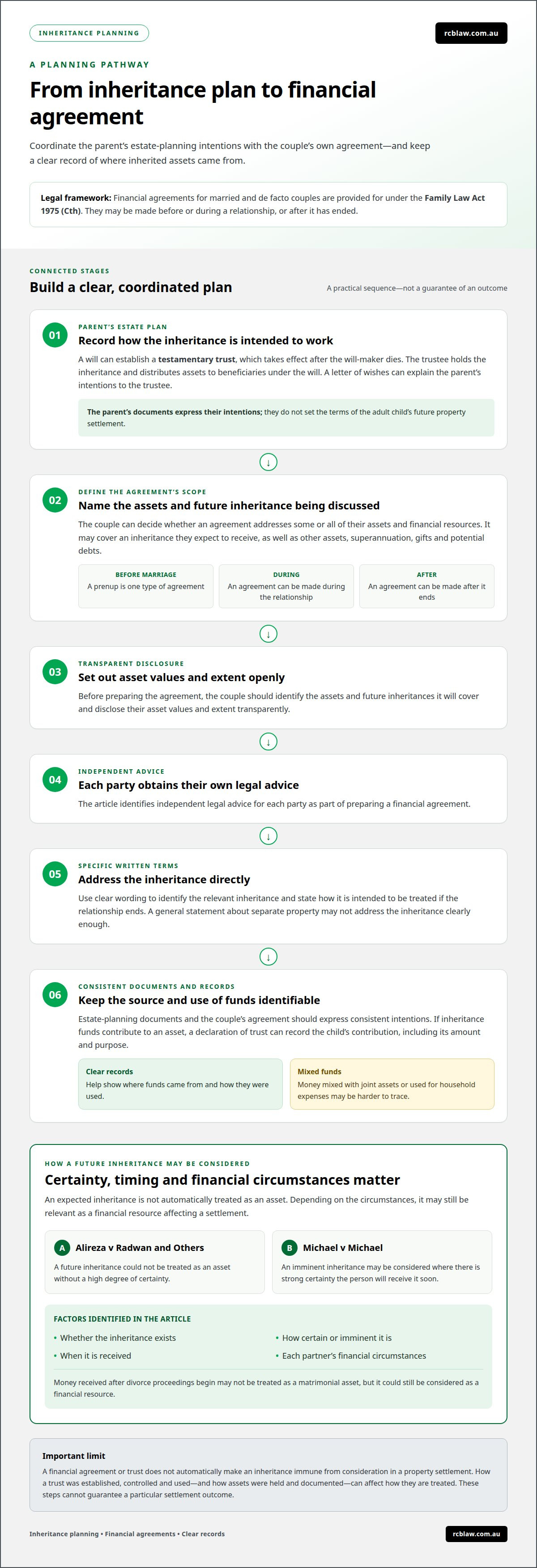
Parents can discuss inheritance planning with their adult child before a marriage or de facto relationship begins. Estate planning can clarify the parent’s intentions, while the child and their partner decide whether to make a separate financial agreement. A parent’s will or testamentary trust cannot set the terms of a couple’s future property settlement.
In Australia, financial agreements for married and de facto couples are provided for under the Family Law Act 1975 (Cth), according to the Federal Register of Legislation. These agreements can be made before or during a relationship, or after it has ceased. They set out how some or all of a couple’s assets and financial resources will be dealt with if the relationship breaks down.
A child and their partner can use an agreement to address an inheritance, including one they expect to receive, and specify how it should be treated if they separate. The document can also cover other assets, superannuation, gifts and potential debts. For example, it could state that an inheritance received by one partner is intended to remain separate. A financial agreement may help protect a child’s inheritance from their future divorce, but it does not automatically make the inheritance immune from a settlement.
To prepare, the couple should identify the assets and future inheritances covered by the agreement, disclose their asset values and extent transparently, and obtain independent legal advice for each party. Clear wording matters: the document should address the inheritance directly rather than rely on a general statement about separate property. Estate-planning documents should also express consistent intentions, particularly when a trust is intended to hold assets for a child.
A parent can discuss these intentions with an estate-planning lawyer and record them in the will. The child and partner can then consider a financial agreement as their own arrangement. For help aligning a will with inheritance plans, explore estate planning.
3. Future inheritance as a financial resource
An expected inheritance isn’t automatically treated as an asset in an Australian property settlement. In Alireza v Radwan and Others, a future inheritance could not be treated as an asset without a high degree of certainty. Michael v Michael recognised that an imminent inheritance may be considered when there is strong certainty the person will receive it soon.
After separation, the timing and certainty of an inheritance can matter. Money received after divorce proceedings begin may not be treated as a matrimonial asset, but it could still be considered as a financial resource affecting the settlement. Inheritances and financial gifts can therefore be relevant, depending on the circumstances and the couple’s overall financial position.
Parents should distinguish an inheritance already received from one intended for the future. For example, a parent may leave assets to a child through a will, but the child’s future entitlement remains uncertain while the parent is alive. A financial agreement between the child and their partner can address how an inheritance should be treated if the relationship ends. Clear wording should identify the relevant asset or expected inheritance, rather than assume every future gift will be treated the same way.
Recent reforms do not create a blanket rule that every inheritance is excluded from a settlement. Relevant questions include whether the inheritance exists, how certain or imminent it is, when it is received, and how it affects each partner’s financial circumstances. Legal advice can help parents and adult children understand these factors and consider estate planning and agreement terms suited to their situation.
The cost of setting up a testamentary trust or financial agreement depends on the work involved. A will-based trust and a couple’s agreement require different documents, drafting and advice, while the complexity of the assets and proposed terms can affect the work required. Parents can discuss the intended inheritance and trust structure; the couple can seek separate legal advice about an agreement.
4. Keeping inherited funds and property separate
A clear record of inherited wealth can help explain what happened to it after separation. If a daughter receives an inheritance, records can show its source, when it was received and where the funds went. Keep bank statements, transfer records, estate documents and property transaction records together. These details can help distinguish inherited money from income or savings accumulated during the relationship.
Mixing funds can make that distinction harder. For example, using inherited money for a family home, mortgage payments or household expenses may make the contribution harder to identify in a divorce settlement. If inheritance funds help buy an asset, record the contribution and ownership arrangement at the time. A declaration of trust can document how much inheritance went towards property and help show that the contribution came from the beneficiary.
Ownership shares also matter. In Australia, tenants-in-common owners don’t have to hold property equally at 50/50. Each owner’s share is subject to their will when they die, rather than passing directly to the other owner. Recording each person’s share can clarify who owns what, while a will can direct where that share goes. This may be relevant when parents want wealth to remain with chosen beneficiaries across generations.
Records should also cover family financial support, business interests and investment activity. For example, document a loan from parents as a loan, rather than describing it differently in later records. Assets acquired after separation may still be included in the property pool, depending on the circumstances. Clear documentation helps explain contributions and ownership, but it does not determine the settlement on its own.
If an inheritance involves commercial property, discuss its ownership structure and property records with a legal professional. A consistent record of the source, use and ownership of each asset gives beneficiaries a clearer account of what was intended and why.
RCB Law
RCB Law can help parents put their wishes for a child’s inheritance into a clear estate plan. If you’re considering a testamentary trust, reviewing an existing will or deciding how property should pass to beneficiaries, RCB Law’s Will Drafting service can document those intentions. Clear estate documents give your family a practical reference point when circumstances change.
It may be helpful to seek advice while planning an inheritance, after acquiring property intended for a child, or when existing arrangements no longer reflect your wishes. RCB Law also assists with property matters through Residential Conveyancing, Commercial Property Law and Business Law when these relate to the assets involved. A financial agreement between a child and their partner is a separate family law matter, so consider the estate plan alongside that arrangement.
For advice on documenting your estate-planning intentions, contact RCB Law.
Take the next step with a clear plan
A thoughtful approach to protecting a child’s inheritance from their future divorce starts with deciding what you want the inheritance to achieve. Consider whether your priority is preserving a particular asset, supporting your child over time or keeping family wealth within chosen beneficiaries. That intention can guide the estate-planning decisions to make now.
Before making changes, gather the relevant will, trust and property ownership documents. A clear view of how assets are held helps a legal professional identify where your intentions may need to be recorded or aligned. If the inheritance involves property or business interests, RCB Law’s Residential Conveyancing, Commercial Property Law and Business Law can assist with those related matters.
You don’t need to resolve every future possibility at once. A conversation about your family’s circumstances can help clarify a practical next step. Contact RCB Law to discuss your options and move forward with greater clarity.
Frequently Asked Questions
What is a Financial Agreement?
A financial agreement is a written arrangement about how a couple’s financial matters will be handled if their relationship ends. It can cover selected assets rather than everything the couple owns. For example, partners might address an inheritance separately while setting out agreed terms for their other property. Agreements can be made before, during or after a relationship.
Is an inheritance received before or during marriage included in the asset pool in Australia?
An inheritance is not automatically excluded from a property settlement because it was received before or during marriage. It may be considered alongside the couple’s other financial circumstances. For example, an inheritance kept separate may be assessed differently from funds used to pay a joint mortgage or household costs. The source, timing and use of the money provide relevant context.
How do Australian courts assess whether an inheritance is a financial contribution to a marriage?
Courts can consider where an inheritance came from, when it was received and how it was used during the relationship. Records help explain its role. For example, bank statements tracing inherited funds into a property purchase show a different contribution history from funds deposited into a shared account and spent on family expenses. The inheritance is considered within the broader settlement.
Can a child protect an inheritance from a future spouse using a testamentary trust in Australia?
A testamentary trust can help manage how an inheritance is held and distributed, but it is not an absolute defence against a property claim. A trustee controls distributions under the will, yet the trust’s structure and operation can matter in a settlement. For instance, regular distributions used to meet shared expenses may be relevant to how the inheritance supported the couple.
Does keeping inherited money in a separate bank account protect it in an Australian divorce?
A separate account can help trace inherited money, but having a separate account alone does not ensure the money will be excluded from a settlement. If funds are transferred into a joint account or used for shared expenses, their history becomes more complex. Transaction records can help show the source and destination of funds, including whether they remained separate or contributed to an asset used by both partners.
What risks can make an inheritance more likely to be divided in an Australian divorce?
Risks include using inherited money for joint property, mortgage payments or household expenses, and losing records that show its source. A trust also needs careful attention if the beneficiary receives and uses distributions. For example, an inheritance used to renovate a jointly owned home may be harder to distinguish from the couple’s shared contributions in a later settlement.


