
Buying property can change what your Will needs to cover. A purchase is a good reason to review your Will, but it doesn’t automatically mean every part must change. If you’re considering updating your will after buying property in Queensland, check whether your ownership arrangements, beneficiaries and estate plans still reflect your wishes. The Queensland Public Trustee recommends reviewing a Will every two to three years and after a major life event.
It’s understandable to focus on the purchase and leave estate planning for later, but a new home or investment property can affect how your assets are dealt with. This article explains when life changes may call for a Will review, what to consider about property ownership, and how to revisit beneficiaries and executors. It also covers how other assets fit into your estate plan, helping you identify details that may need attention after a major change.
Key Takeaways
- Marriage, relationship changes, new children and significant asset changes can all prompt a Will review, but their effects differ under Queensland law.
- Revisit who will inherit and who can act as executor, especially if a named person’s circumstances have changed.
- Property ownership matters: whether a home is held as joint tenants or tenants in common can affect how your share is dealt with.
- Queensland Legislation sets a 9-month deadline from death for an eligible person to file a family provision claim.
When does a life event require a will update in Queensland?
Buying or selling property is a practical reason to review your Will because a new asset or changed ownership may affect what your estate includes. Updating your Will after buying property in Queensland can clarify who should receive your interest and how it fits with other gifts. Marriage generally revokes an existing Will unless it was made in contemplation of that specific marriage. Divorce can revoke gifts and appointments to a former spouse, while separation alone doesn’t change the Will. The birth or adoption of children also doesn’t automatically update it.
A solicitor can compare your Will’s property gifts and executor instructions with the registered ownership details for your Queensland property. They can identify whether the title is held jointly or as tenants in common, then explain how that ownership affects what the Will can distribute. This review helps align your estate instructions with the legal interest recorded on the title.
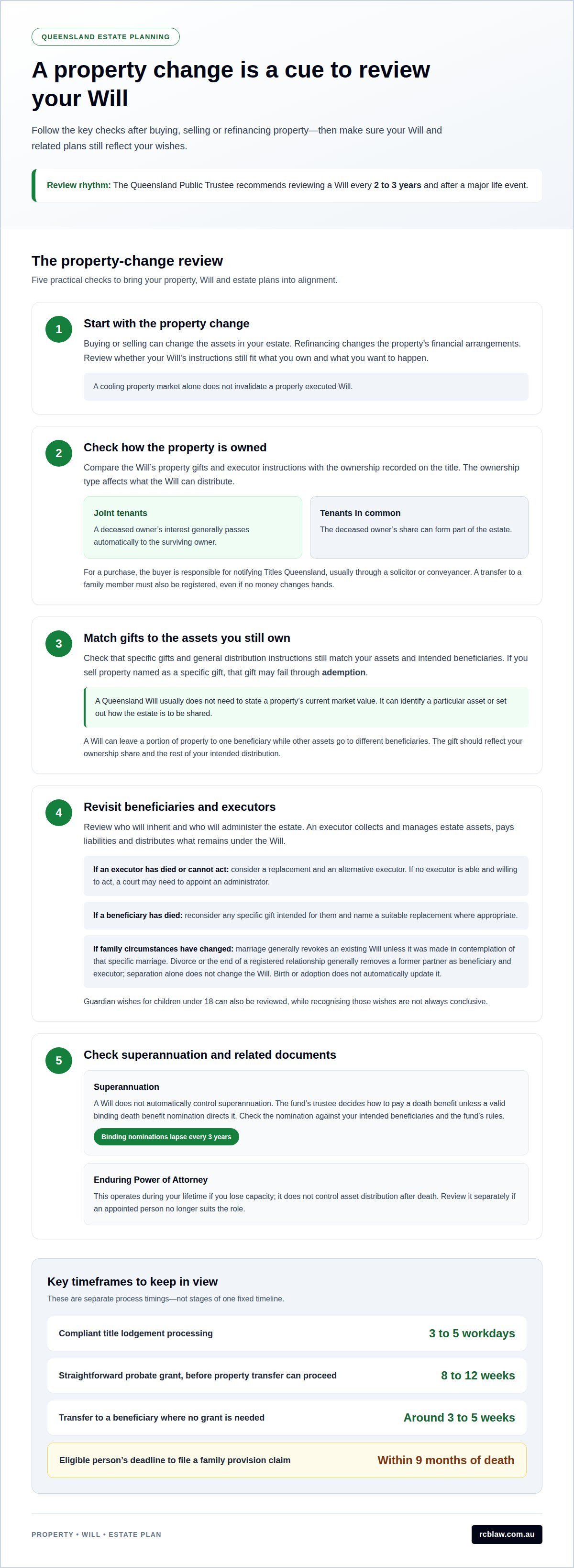
For a purchase, the buyer is responsible for notifying Titles Queensland of the ownership change, usually through a solicitor or conveyancer. The solicitor prepares and lodges the transfer documents with Titles Queensland, which examines the lodgement and registers the change when requirements are met. A compliant title lodgement takes 3 to 5 workdays to process. A transfer to a family member must also be registered, even when no money changes hands. After buying or selling, the Will review should account for the property interest that remains in your name.
Ownership type affects what happens after death. A joint tenant’s interest generally passes automatically to the surviving owner, while a tenant in common’s share can form part of the estate. If a deceased-estate transfer requires probate, a straightforward grant usually takes 8 to 12 weeks before the property transfer can proceed. Where no grant is needed, the transfer to a beneficiary typically takes around 3 to 5 weeks. Queensland’s Succession Act also allows eligible people to seek provision from an estate. According to Queensland Legislation, an eligible person must file a family provision claim within 9 months of death. Changes to property, children, divorce or superannuation can therefore prompt a broader Will review.
Changing beneficiaries and executors
A property purchase may change the balance of your estate, so review who receives each asset and who administers it. A Will can leave a specific portion of property to a beneficiary, but the gift should reflect your ownership share and other intended distributions. For example, you might leave your share to a family member while giving other assets to different beneficiaries. Clear wording helps the executor understand how each gift fits into the estate.
Review the executor’s role alongside your beneficiaries. An executor collects and manages estate assets, pays liabilities and distributes what remains under the Will. If the person named has died or cannot act, nominate a replacement and consider an alternative executor. Otherwise, if no executor is able and willing to act, a court may need to appoint an administrator. A solicitor can also update guardian wishes for children under 18, while recognising that those wishes are not always conclusive.
Superannuation needs separate attention. A Will doesn’t automatically control superannuation; the fund’s trustee decides how to pay a death benefit unless a valid binding death benefit nomination directs it. Check that the nomination still reflects your intended beneficiaries and the fund’s rules. Binding nominations with superannuation funds lapse every three years, so their validity can change even when your Will stays the same.
Relationship changes can affect appointments and gifts. In Queensland, divorce or the end of a registered relationship generally removes a former partner as beneficiary and executor, while other Will provisions may remain. Separation alone does not change the Will. Review the whole document rather than assuming one relationship change updates every instruction. When a beneficiary or executor has died, name a suitable replacement and reconsider any specific gift intended for them. A professional Will review can help bring these choices together as your circumstances change.
Reviewing a Will after buying or selling property
A property transaction can change which assets your Will needs to address. A review can also identify instructions that no longer reflect your wishes.
Reviewing a Will After Property Changes
Review your Will after buying, selling or refinancing a home or investment property. A sale may leave a specific gift referring to property you no longer own, which can fail through ademption. A purchase can also change the balance of your estate and the assets available to beneficiaries. Refinancing changes the property’s financial arrangements, so consider whether the Will’s instructions still suit your circumstances. A cooling property market alone doesn’t invalidate a properly executed Will.
Updating Assets in a Will
Reviewing your assets means checking that gifts and general distribution instructions still match what you own and whom you intend to benefit. A Queensland Will usually doesn’t need to state a property’s current market value. Instead, it can identify a particular asset or set out how your estate is to be shared. For example, if you sell an investment property, your solicitor can consider whether a specific gift should be revised to reflect your changed assets and wishes.
Review related documents too. An Enduring Power of Attorney operates during your lifetime if you lose capacity; it doesn’t control asset distribution after death. It can authorise an appointed attorney to make financial, personal and health care decisions. If your spouse or another appointed person no longer suits that role, review the document separately from your Will. A guardian named for children in a Will is a separate appointment concerning their care.
Keep the distinction clear: your Will sets out estate arrangements after death, while an Enduring Power of Attorney addresses decisions during your lifetime. A property purchase or refinance doesn’t update either document. A solicitor reviewing both can consider whether the property, debts, nominated attorney and stated wishes remain consistent, then prepare appropriate changes through the required legal process.
Including property and other assets in a Will
A Queensland Will can cover property, personal belongings and specific gifts, but it should reflect what you own and whom you intend to benefit. If you own property as a tenant in common, your share can form part of your estate. The Will can direct that share to a beneficiary, while a joint tenant’s interest generally passes to the surviving owner. Clear instructions help the executor understand which assets are available for estate administration.
Consider more than land and bank accounts. A Will can leave personal or family items, including belongings with sentimental value, to named beneficiaries. If a family member needs to remain in your home, a Will may establish a trust allowing them to live there after your death. A lawyer can help describe the intended gift or use clearly.
Digital assets also deserve attention. These may include online accounts, files, photographs or cryptocurrency. Record what exists and how the executor can locate relevant access information, without putting sensitive passwords directly in the Will. An executor who cannot identify or access a digital asset may have difficulty dealing with it during administration. Review these records when your assets or account arrangements change.
Overseas property and other foreign assets need careful planning. A Queensland Will may not automatically cover assets in another country, and a separate Will that meets that country’s requirements may be needed. Coordinate documents to reduce the risk of conflicting instructions or unintentionally revoking another Will. Marriage, a new property purchase or a change in family circumstances can also affect whether your documents still match your wishes. For help preparing a Will that addresses property and other assets, arrange a Will review.
RCB Law: Commercial Property Law
RCB Law can help align your property arrangements and Will through Commercial Property Law and Will Drafting. Turn to the firm after buying, selling or refinancing property, or when your estate instructions no longer reflect your wishes. Reviewing the property transaction alongside your Will can clarify how your ownership interest fits into your wider estate plan.
For a home purchase, Residential Conveyancing can address the transaction and title transfer. For business or commercial assets, Commercial Property Law and Business Law can help with the legal arrangements involved. Will Drafting can put your intended estate arrangements into a formal document.
If you’d like support reviewing your Will after a property change, contact RCB Law.
Make your next property change a planning moment
Your Will can keep pace with your life when you treat estate planning as an ongoing part of owning property. Updating your Will after buying property in Queensland is an opportunity to document your intentions clearly, not simply to add another address. A useful next step is to bring your current Will and questions about your property arrangements to RCB Law for a focused legal discussion.
Consider what you want your arrangements to achieve, including who should benefit and who should manage your estate. Clear priorities give the review a practical starting point and help shape a document around your circumstances. If your property or family situation changes again, you’ll have a clear reason to revisit those instructions.
Discuss your Will with RCB Law and take a considered next step towards keeping your plans current. A little clarity now can make future decisions easier for the people you care about.
Frequently Asked Questions
Can a solicitor update my will without changing the existing document?
Yes, a solicitor can prepare a codicil to amend specific provisions, but it must meet Will formalities and refer to the original document. For broader changes, preparing a replacement Will that revokes the earlier one is generally preferable. Don’t write changes on the signed original or rely on an unsigned draft. In Queensland, a Will must be signed before two witnesses.
Do I need a solicitor to update a will in Springfield or Ipswich QLD?
The rules for updating a Will don’t change because you live in Springfield or Ipswich. A solicitor isn’t the only way to make a Will, but legal help can be useful if you’re changing property gifts, several beneficiaries or executor appointments. Queensland’s Public Trustee cautions against DIY Will kits because mistakes may make a Will invalid. Clear, properly executed documents matter.
Does the value of the property need to be stated in the Will?
No, a Queensland Will usually doesn’t need to state the property’s current market value. Property values can change, so naming a dollar figure could make an otherwise clear gift harder to interpret later. The Will can instead identify the property or describe how your estate is to be distributed. For example, it may leave your share of a named property to a beneficiary.
Do I need to update my will after buying property in Queensland?
Buying property doesn’t automatically require a new Will, but it’s a sensible time to review your plans. Updating your Will after buying property in Queensland can help ensure the new asset and your ownership share fit your intended gifts. Consider whether the purchase changes what remains for other beneficiaries or whether a specific gift in your existing Will needs different wording.
How does buying property affect an existing will in Queensland?
A purchase can change the assets your Will needs to deal with, but it doesn’t itself cancel a properly executed Will. The effect depends partly on ownership and any specific gifts. For instance, a gift naming a property you later sell may fail because that asset is no longer part of your estate. Review the wording alongside the ownership arrangement and intended distribution.
What happens to Queensland property if I die without updating my will?
If you die without a valid Will, you’re considered to have died intestate, and Queensland’s statutory rules determine how estate assets are distributed. A tenant in common’s share generally forms part of the estate; a joint tenant’s interest usually passes to the surviving owner. Intestacy rules may not match your preferred beneficiaries, so the outcome can differ from the arrangements you would have chosen.


