
A single administrative oversight can legally void a property deal before settlement ever arrives. If you are buying or selling a strata property, getting your body corporate disclosure statement qld right is your primary legal safeguard against contract cancellation. Strata transactions often feel overwhelming, particularly with Queensland's statutory seller disclosure scheme replacing older routines with strict pre-signing duties. It is completely natural to feel anxious about unrecorded building defects, surprise special levies, or technical paperwork errors that give buyers a legal exit.
You deserve clarity, calm, and total confidence when preparing your contracts. This guide explains exactly what documents sellers must deliver under Queensland law, how to spot financial red flags such as sinking fund shortfalls, and when buyer termination rights take effect under the Property Law Act. We will walk through the mandatory body corporate certificates, statutory deadlines, and essential due diligence steps you need to protect your transaction and ensure a secure settlement.
Key Takeaways
- Understand the modern body corporate disclosure statement qld requirements under Queensland's statutory framework, ensuring all mandatory certificates are served before contract signing.
- Discover what vital financial records, scheme by-laws, and levy schedules must be formally attached to prevent invalidating a property sale.
- Learn the correct statutory process for ordering prescribed certificates directly from strata managers without causing costly administrative settlement delays.
- Identify the exact material defects and omitted details that grant a buyer legal rights to terminate a contract and recover their full deposit.
- Recognize how pre-signing conveyancing due diligence uncovers hidden building defects, ongoing scheme disputes, and looming special levies before commitments bind.
What Is a Body Corporate Disclosure Statement in QLD?
Purchasing a townhouse, apartment, or commercial unit involves far more than inspecting the interior walls. It means buying into a shared financial ecosystem. A body corporate disclosure statement qld is a mandatory statutory disclosure package that sellers must give prospective buyers before any contract of sale is signed. Governed by the Body Corporate and Community Management Act 1997 (BCCMA) alongside Queensland's statutory seller disclosure laws, this documentation ensures complete transparency around scheme governance.
Crucially, it helps purchasers understand the wider strata title property framework, separating individual private property from collective obligations. Through these disclosures, purchasers can clearly evaluate:
- Current annual administrative and sinking fund levy amounts
- Exclusive use areas, such as allocated car spaces or private storage courtyards
- Shared property insurance policies and building replacement coverage values
The Legal Role of Section 206 Disclosures
For decades, Queensland property law handled this requirement through a standalone Section 206 statement under the BCCMA. While legislative updates have modernized how this information is formally delivered, the legal objective remains identical. The body corporate disclosure statement qld exists to prevent sellers from concealing building liabilities, legal actions, or administrative fund deficits.
This statutory protection applies across every community titles scheme, including residential units, master-planned developments, duplexes, and commercial strata complexes. Sellers can't contract out of these disclosure duties, which ensures that buyers make commitments with their eyes wide open.
When Must the Statement Be Delivered to Buyers?
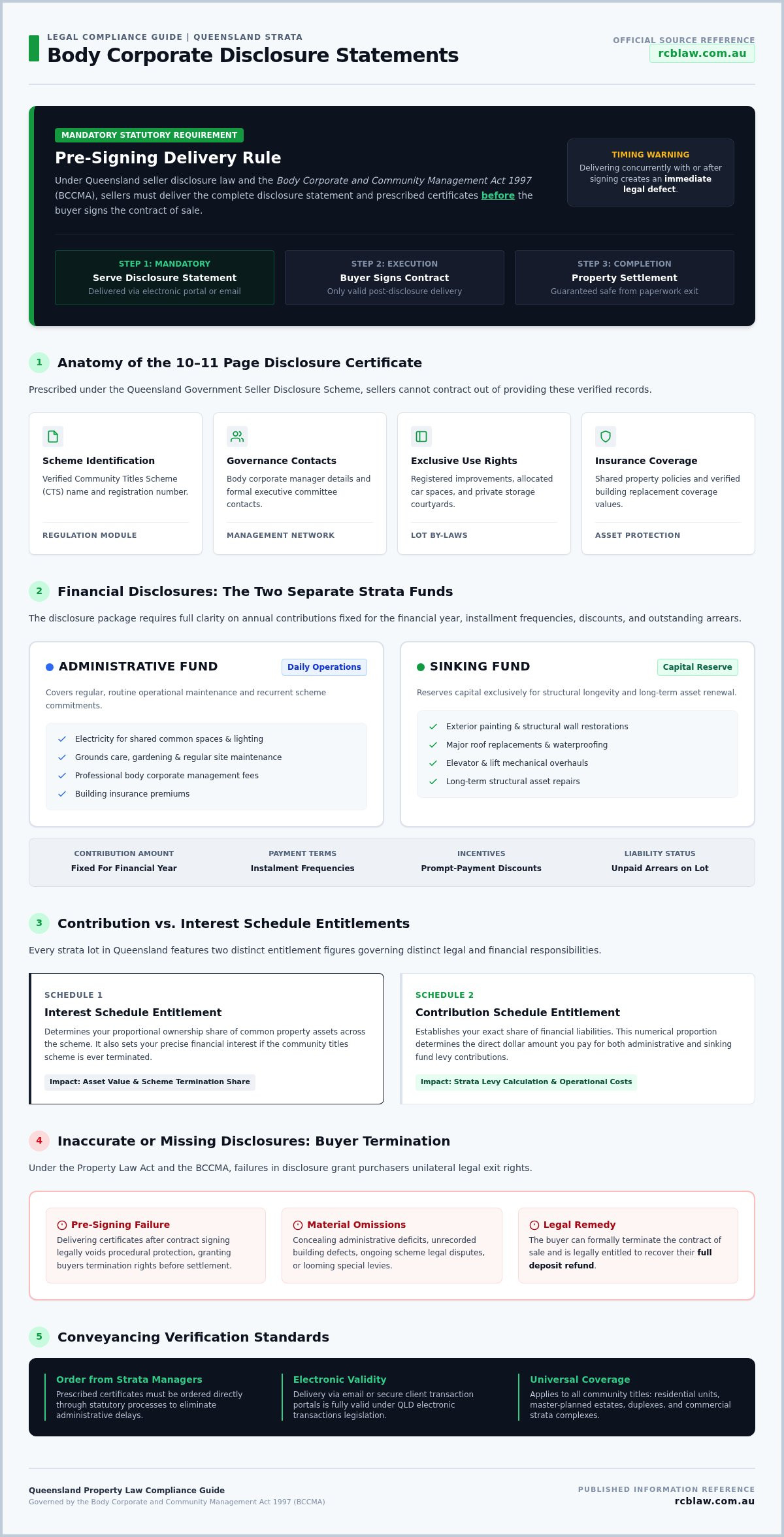
Timing is everything in Queensland conveyancing. The seller must deliver the complete disclosure statement and its prescribed body corporate certificates to the buyer before the buyer signs the contract of sale. Delivering documents simultaneously with the contract, or shortly after signing, creates an immediate legal defect.
Electronic delivery is legally valid under Queensland electronic transactions legislation, allowing sellers to provide documents through email or secure portals. Understanding how these pre-signing rules connect with what is conveyancing ensures that both parties move through the transaction smoothly, protecting everyone from unnecessary settlement friction.
What Must Be Included in a Queensland Disclosure Statement?
A compliant disclosure document is far more than a simple formality. Under the Queensland Government Seller Disclosure Scheme, the required body corporate certificate contains 10 to 11 pages of precise legal and financial records. For a fully compliant body corporate disclosure statement qld, sellers must provide verified details identifying the scheme name, CTS registration number, and the specific regulation module governing the complex.
The documentation must also detail key management infrastructure, identifying the body corporate manager, executive committee contacts, and any registered improvements or exclusive use by-laws benefiting the lot.
Administrative Fund vs Sinking Fund Contributions
Understanding where strata levies actually go protects buyers from sudden financial shocks. The disclosure package separates annual contributions into two distinct funds:
- Administrative Fund: Covers routine operational expenses, including electricity for common spaces, grounds maintenance, professional management fees, and building insurance premiums.
- Sinking Fund: Reserves money for long-term capital replacements, such as exterior painting, roof restorations, and lift replacements.
Sellers must outline the exact contribution amounts fixed for the financial year, instalment frequencies, prompt-payment discounts, and any unpaid levy arrears outstanding on the lot.
Contribution and Interest Schedule Lot Entitlements
Every strata lot features two entitlement figures that govern ownership responsibilities. The interest schedule determines your proportional ownership share of common property assets and sets your interest upon scheme termination. The contribution schedule dictates your share of regular levies and special calls.
When an entitlement schedule is uneven, an owner can face an unexpectedly steep share of annual community outgoings, making pre-purchase entitlement verification essential.
Special Levies, Latent Defects, and Pending Litigation
Extraordinary expenses represent the greatest financial worry for strata buyers. While a seller must disclose all special levies formally passed by resolution, statutory disclosure certificates carry recognized blind spots. By law, they rarely disclose unvoted capital liabilities, structural building defects, combustible cladding notices, or pending tribunal disputes.
Because statutory forms omit these hidden liabilities, arranging a contract and strata review with RCB Law's residential conveyancing specialists helps buyers uncover potential building disputes before contracts become binding.
How to Obtain and Prepare an Accurate Disclosure Statement
Preparing disclosure documentation requires strict adherence to statutory timelines and official registers. Sellers can no longer fill out informal template questionnaires themselves. Instead, assembling a valid body corporate disclosure statement qld involves obtaining prescribed certificates directly from strata managers and cross-referencing records against official property titles.
To avoid unexpected contract cancellations or delays, sellers and their conveyancers follow a methodical approach to gather every mandatory attachment:
- Order the formal certificate under Section 205 of the Body Corporate and Community Management Act 1997 (Qld)
- Download an up-to-date Community Management Statement (CMS) from Titles Queensland
- Attach the state-approved Form 2 seller disclosure document
Engaging the Body Corporate Manager for Records
Only the body corporate or its appointed manager holds legal authority to issue the required Form 33 certificate (or Form 34 for duplexes). For standard applications, the prescribed statutory fee is $86.95, and managers have up to 5 business days to produce the document. If time is short before an open home or auction, sellers can pay an optional priority surcharge of $31.00 for a guaranteed 24-hour turnaround.
This certificate confirms active building insurance policies, policy replacement values, and currency dates, proving the complex is properly protected.
Conducting Thorough Pre-Purchase Strata Searches
Because statutory certificates deliberately exclude defect histories and ongoing disputes, prudent buyers commission an independent strata roll search before signing. A specialist inspector reviews at least two years of committee and general meeting minutes, uncovering unvoted maintenance levies, building leaks, and acoustic complaints. Identifying unresolved disputes early also helps buyers assess broader property risks, such as an unexpected caveat affecting title ownership.
Seller Verification Checklists Before Marketing Property
Sellers must ensure their paperwork matches the physical reality of the lot before listing. Confirm that all past additions, like air-conditioning condenser units or balcony awnings, have formal committee approvals. Check that car parking bays match registered exclusive use plans in the CMS, and settle any outstanding council water or statutory land tax assessments to prevent last-minute settlement hold-ups.
Inaccurate or Missing Disclosures: Rights and Buyer Termination
When disclosure documents contain serious omissions, Queensland property law gives purchasers powerful cancellation remedies. If a seller fails to provide an accurate body corporate disclosure statement qld alongside the contract before the buyer signs, the purchaser may hold a statutory right to terminate the agreement in writing at any point prior to settlement.
Contract termination brings the transaction to an immediate halt. The seller must refund the purchaser's deposit in full, including any accrued interest. For vendors, a botched disclosure can mean losing a high-value sale weeks into the conveyancing journey, while buyers risk inheriting unforeseen financial obligations if mistakes pass unnoticed.
The Legal Test for Material Prejudice
A buyer cannot walk away over a trivial clerical error. Under Queensland law, terminating a contract for an inaccurate disclosure requires satisfying a clear statutory test. The buyer must establish that:
- The omitted or inaccurate detail relates to a material matter affecting the lot or common property
- The buyer was genuinely unaware of the accurate situation when signing
- The buyer wouldn't have entered the contract had the truth been disclosed
A sudden, undisclosed special levy for elevator replacement or serious concrete cancer repairs will easily meet the test for material prejudice. Conversely, an incorrect spelling or outdated phone number for the committee secretary won't justify termination.
Statutory Warranties Implied into Every Strata Contract
Queensland legislation writes specific statutory warranties directly into every strata sales contract. Sellers legally warrant that there are no latent structural defects affecting common property and no active or threatened body corporate disputes, unless those matters were explicitly disclosed in writing prior to signing.
If a buyer uncovers a breach of these statutory warranties before completion, they can seek financial compensation or terminate the contract entirely. To safeguard your sale or verify an incoming disclosure package before signing, consult RCB Law's conveyancing team for clear, proactive legal guidance.
Securing Your Strata Purchase with Conveyancing Due Diligence
Buying into a community titles scheme should be an exciting milestone, not a source of sleepless nights. While reviewing a body corporate disclosure statement qld gives you an essential baseline, statutory certificates only tell part of the story. Engaging a property lawyer for a pre-signing contract review allows you to uncover hidden legal restrictions, assess structural liabilities, and draft protective special conditions before your signature legally binds you.
A focused conveyancing review examines the fine print across multiple documents, helping you verify:
- Registered exclusive use allocations for car parks, courtyards, and storage cages
- Body corporate by-laws that affect your day-to-day lifestyle or investment plans
- Pending committee motions that could trigger unbudgeted special levies post-settlement
Analyzing Community Management Statement By-Laws
The Community Management Statement (CMS) contains the governing rules for your complex. While Queensland legislation now prevents blanket bans on pets, by-laws can still regulate pet approvals, size guidelines, and common property access. Similarly, schemes can enforce strict bans on smoking or vaping across common property and private outdoor balconies.
Your lawyer will also verify visitor parking restrictions, noise guidelines, and whether the complex enforces short-term letting policies that could disrupt permanent residents.
Why Local Queensland Conveyancing Experience Matters
Every region presents distinct property considerations. Navigating high-density towers in Brisbane requires a different legal approach than reviewing low-rise coastal schemes on the Sunshine Coast or Redland Bay. Local conveyancing solicitors understand regional council regulations, common strata disputes, and how to spot title irregularities quickly.
With over 30 years of Queensland property law experience, the legal team at RCB Law guides buyers and sellers through every stage of the conveyancing process. Our comprehensive pre-signing reviews identify disclosure omissions and title defects early, giving you complete reassurance and a calm, seamless path to settlement.
Take the Stress Out of Your Strata Property Transaction
Preparing or reviewing a body corporate disclosure statement qld isn't just a routine administrative step; it's the foundation of a safe, successful property transfer. Ensuring every prescribed certificate is accurate and served before contract signing protects sellers against contract cancellation. For buyers, looking beyond basic statutory forms with thorough due diligence prevents unexpected financial liabilities, unrecorded defects, and strata disputes from derailing your plans.
Backed by over 30 years of dedicated Queensland property law experience, RCB Law supports buyers and sellers across Brisbane, the Sunshine Coast, and Redland Bay. Our residential conveyancing specialists provide comprehensive pre-signing contract reviews that uncover title defects and disclosure gaps early, removing friction from your journey. Before you sign or issue contract paperwork, speak with RCB Law for expert Queensland conveyancing and take the next step toward settlement with complete confidence.
Frequently Asked Questions
What is the purpose of a body corporate disclosure statement in QLD?
The primary purpose of a body corporate disclosure statement qld is to provide prospective buyers with full legal and financial visibility before they sign a contract. It reveals annual administrative and sinking fund levies, active insurance policies, and exclusive use allocations. This mandatory document ensures buyers clearly understand their ongoing financial liabilities and shared community obligations before making a legally binding commitment to purchase a strata property.
Can a buyer terminate a contract if the disclosure statement is incorrect?
Yes, a buyer can terminate the contract if the disclosure documents contain inaccurate or missing information regarding a material matter. Under Queensland property law, the buyer must show that they were genuinely unaware of the accurate circumstances when signing and wouldn't have completed the purchase had they known the truth. Upon valid termination, the buyer receives a full refund of their deposit without financial penalty.
How much time does a buyer have to cancel a contract over disclosure errors?
A buyer has the legal right to terminate the contract in writing at any time before settlement occurs. If the seller failed to deliver the disclosure package prior to signing, or provided materially inaccurate records, the right remains active right up until the final transfer of funds. Once settlement completes, however, statutory rights to terminate end, leaving only potential compensation claims for warranty breaches.
What happens if a body corporate special levy is issued before settlement?
Liability for a special levy depends strictly on when the body corporate formally passes the resolution to strike it. Under standard standard conveyancing terms, the seller must pay any special levy struck before the contract date. If the body corporate passes a new levy between the contract date and settlement, the buyer generally becomes responsible, unless your lawyer negotiated specific special conditions protecting you from unbudgeted calls.
Is a seller legally responsible for body corporate arrears after settlement?
No, because outstanding arrears must be resolved at settlement. During the settlement process, conveyancers perform a formal check and adjust the final purchase price to account for unpaid contributions. The seller must clear all accumulated debts and levy arrears from their sale proceeds on settlement day. If an arrears balance remains unaddressed, the incoming buyer risks inheriting that debt directly under strata legislation.
Can a seller prepare a body corporate disclosure statement without a lawyer?
While sellers can fill in basic seller disclosure questionnaires themselves, they cannot create the statutory body corporate certificate. Queensland law mandates that only the body corporate manager or committee can legally prepare and issue the prescribed Form 33 certificate. Engaging a conveyancing solicitor ensures that all registered management statements and disclosure certificates are correctly compiled, preventing technical defects that could allow buyers to cancel.
What is the difference between an administrative fund and a sinking fund?
An administrative fund covers routine, day-to-day operating expenses for the strata complex, such as regular gardening, cleaning, common property power, and annual insurance premiums. In contrast, a sinking fund operates as a long-term capital reserve. It collects funds systematically to pay for substantial periodic repairs and major structural improvements, including building painting, lift replacements, and roof restorations over the life of the property.


