
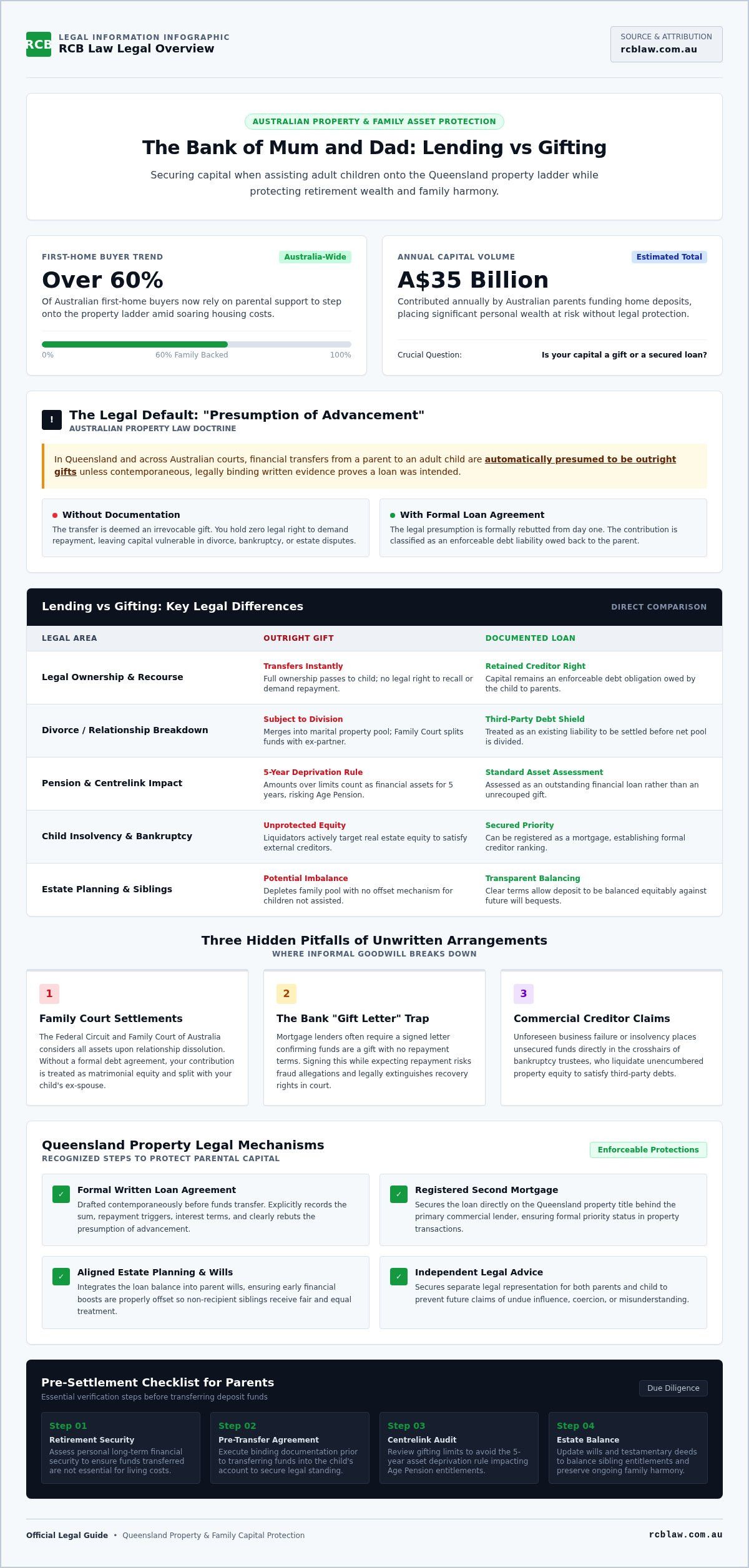
Over 60% of Australian first-home buyers now turn to family support to step onto the property ladder, with parents contributing an estimated A$35 billion each year. Watching your child struggle with soaring Queensland house prices makes wanting to help completely natural. Yet, informal generosity often carries unintended risks, from bank mortgage complications to relationship breakdowns that could jeopardize your retirement funds. Securing practical legal advice for parents lending money for a house deposit ensures your goodwill never compromises your own future security.
You shouldn't have to choose between backing your child and protecting your hard-earned wealth. In this guide, you will discover how to legally protect your financial gift or loan while helping your child secure their first home. We'll walk through the legal distinction between gifts and secured loans, unpack bank gift letters, and explain how clear documentation protects your family capital against future disputes.
Key Takeaways
- Understand why Australian property law often presumes family transfers are outright gifts, and how formal documentation protects your true intentions.
- Obtaining independent legal advice for parents lending money for a house deposit helps shield your capital against future divorce proceedings or creditor claims.
- Explore recognized Queensland property mechanisms, including formal loan agreements and registered mortgages, to establish enforceable repayment terms.
- Learn how to balance family harmony by aligning any financial contribution with your broader estate planning and will drafting.
- Follow a pre-settlement checklist to evaluate your personal retirement security before transferring any funds to your child.
Lending vs Gifting: The Crucial Legal Distinction Every Parent Must Know
Transferring deposit funds to your child feels like a straightforward family gesture. In Queensland property law, however, the structure of that transfer determines whether you retain any legal claim over the capital. Australian courts operate under a longstanding principle known as the "presumption of advancement." Under this doctrine, any financial contribution from a parent to an adult child is automatically assumed to be an outright gift unless contemporaneous evidence proves otherwise. Without written, legally binding evidence, recovering your funds during an unexpected future dispute becomes an uphill battle.
Engaging dedicated legal advice for parents lending money for a house deposit gives you absolute clarity on how the law treats these funds. While a loan creates an enforceable debt obligation, the legal definition of a gift centers on an irrevocable, unconditional transfer of property with no expectation of repayment. Choosing between the two affects your control, your tax standing, and your long-term family wealth.
The Legal Consequences of Choosing an Outright Gift
Handing over funds as a true gift relinquishes your ownership instantly. The money becomes your child's absolute property the moment it clears into their account. While this simplicity appeals to many, the practical risks can be substantial:
- Loss of legal recourse: If your child faces personal hardship or your family dynamic fractures, you cannot demand repayment later.
- Exposure to relationship breakdown: Gifted equity merges into your child's matrimonial property pool, leaving it vulnerable to division in divorce proceedings.
- Impact on pension entitlements: Under Centrelink gifting rules, transfers exceeding allowable limits remain assessed as financial assets under deprivation provisions for five years, potentially reducing your Age Pension.
Why a Documented Loan Protects the Family Bank
Establishing an enforceable loan agreement legally rebuts the presumption of advancement from day one. Rather than treating your hard-earned funds as equity, the law records the sum as a genuine liability owed by your child to you. This distinction serves two protective functions. First, it ensures that your capital remains a recognized debt that must be settled, rather than divisible marital property subject to third-party claims. Second, it maintains transparency across the broader family. By clearly establishing the terms of repayment, you protect equity that can later be balanced fairly among other siblings who did not receive an early deposit boost.
The Hidden Risks of the Bank of Mum and Dad
Informal handshakes work well right up until unexpected life events intervene. When helping your child buy a home, unwritten arrangements leave family capital vulnerable to third-party claims, commercial exposure, and personal friction. Getting experienced legal advice for parents lending money for a house deposit ensures your goodwill doesn't unravel when circumstances change.
Relationship Breakdown and Family Court Property Settlements
If your child separates from a spouse or de facto partner, the Federal Circuit and Family Court of Australia assesses the entire asset pool. Without a formal loan in place, the court treats parental contributions as outright equity. This means your hard-earned funds get divided between the separating parties. Documenting a valid loan contract establishes you as a legitimate third-party creditor. Taking this step isn't about mistrusting a partner; it's a sensible measure that preserves family capital for everyone involved.
Mortgage Lender Requirements and the Danger of Gift Letters
Commercial lenders apply strict serviceability calculations and frequently demand a signed "gift letter" confirming deposit funds carry no repayment terms. Signing this document while privately expecting repayment creates serious exposure to allegations of fraud and legal misrepresentation. If you sign away your rights to appease a bank, Australian courts will take that declaration at face value, extinguishing your ability to recover the funds. If you want to assist without gifting capital directly, weigh your options carefully and evaluate the risks of going guarantor before securing a child's loan against your own home.
Child Bankruptcy, Creditor Claims, and Financial Hardship
Unexpected business failure or financial stress can hit anyone. If your child encounters commercial insolvency, unsecured deposit funds vanish. In bankruptcy proceedings, liquidators actively target real estate equity to satisfy business liabilities. Without registered legal security over the property title, your capital sits at the bottom of the priority ladder, treated merely as an unsecured contribution that cannot be shielded from outside creditors.
Legal Mechanisms to Secure Your Investment in Queensland Property
Protecting family capital requires formal instruments recognized by the Queensland Titles Registry. Rather than relying on good intentions, families can choose from several proven property law tools to safeguard contributed funds. Choosing the right mechanism early in the purchasing process ensures your interests remain legally protected throughout settlement and beyond.
Engaging professional What is Conveyancing? Your Complete Guide to Buying & Selling Property in QLD resources highlights how crucial timing is. Seeking clear legal advice for parents lending money for a house deposit allows these legal protections to be drafted and executed alongside standard purchase contracts, removing uncertainty before settlement occurs.
Drafting a Comprehensive Family Loan Agreement
A professionally drafted loan agreement serves as the foundation of your protection. This contract must clearly define the principal sum, whether interest applies, repayment schedules, and specific default events. Trigger events often include the sale of the real estate, relationship separation, or the borrower's bankruptcy. Crucially, ensuring both you and your child obtain independent legal advice prevents any future claims of undue influence, ensuring the contract remains fully enforceable.
Registering a Second Mortgage vs Lodging a Caveat in QLD
To secure a loan against Queensland land, parents can register a second mortgage on the freehold title. This requires the primary bank's written consent through a formal Deed of Priority, confirming how proceeds will be distributed if the home is sold. In situations where a registered mortgage isn't immediately practical, lodging a caveat can offer an alternative form of notice. To understand how temporary notices function on title, review What is a Caveat? A Plain English Guide for Property in Queensland.
Purchasing as Tenants in Common as an Alternative Strategy
Rather than acting as an external lender, you can take a direct equity share on the property title as tenants in common. Unlike a joint tenancy, this structure lets you own a specific, documented percentage representing your initial contribution. Key factors to consider include:
- Clear equity recognition: Your fractional ownership is recorded publicly on the Queensland title.
- Independent control: You can leave your share to beneficiaries in your will rather than having it automatically pass to the co-owner.
- Ongoing responsibilities: Co-owners must establish how council rates, maintenance costs, and eventual capital gains tax liabilities are divided.
Estate Planning and Family Harmony: Treating All Children Fairly
Providing substantial financial support to one child inevitably reshapes your wider estate plan. While helping a son or daughter secure property brings immediate relief, unequal lifetime financial backing often becomes a source of deep friction among siblings later. Integrating proper testamentary planning with experienced legal advice for parents lending money for a house deposit preserves family harmony long after settlement.
Equalization Clauses and Hotchpot Provisions in Your Will
When one child receives early capital, your will should clearly account for that advance. Will drafting often incorporates "hotchpot" or equalization clauses to bring lifetime gifts or loans back into the estate calculation. The executor mathematically adds the advance back into the net asset pool before distributing equal shares, ensuring non-borrowing siblings aren't shortchanged. You can learn more about structuring your testamentary documents in our detailed guide on Why You Need a Will: A Comprehensive Guide for Queenslanders.
Loan Forgiveness Upon Death vs Continued Debt Obligations
Your will must expressly outline what happens to any remaining balance if you pass away before the debt is repaid. You can formally forgive the debt, treating the remaining sum as a testamentary gift, or instruct your executors to collect repayment on behalf of the estate. Leaving this silent forces executors into legal uncertainty, often causing bitter disputes between the borrowing child and co-beneficiaries over whether the funds were meant to be repaid.
Minimising the Risk of Contested Estates and Family Provision Claims
Under the Queensland Succession Act 1981, eligible children can bring a family provision application if they believe they haven't received adequate provision for their proper maintenance and support. Secret or undocumented financial transfers to one sibling often trigger these costly claims. Transparent documentation, coupled with open family conversations, demonstrates that lifetime advances were considered carefully and factored into your total distribution. To safeguard your estate and ensure every child is treated equitably, contact our will drafting team to review your family lending strategy.
Essential Checklist: Steps to Take Before Handing Over the Deposit
Transferring significant funds before completing legal formalities creates substantial financial exposure. Once money enters a real estate agent's trust account or settles into your child's bank balance, altering the legal terms becomes remarkably difficult. Following a sequential plan protects family capital before purchase contracts turn unconditional:
- Step 1: Audit your retirement reserves. Determine how much you can comfortably lend without compromising your personal lifestyle, emergency funds, or superannuation planning.
- Step 2: Liaise with the mortgage broker. Check how the incoming lender views borrowed versus gifted family funds to prevent loan rejection during formal assessment.
- Step 3: Secure independent legal advice. Obtain tailored legal advice for parents lending money for a house deposit to draft an enforceable agreement and determine whether registering a second mortgage or lodging a caveat is appropriate.
- Step 4: Update testamentary arrangements. Align your will to account for the outstanding debt, ensuring equitable treatment across all children.
Aligning Legal Agreements with the Queensland Property Contract
Standard REIQ residential contracts run on strict timeframes. In Queensland, critical milestones like the finance approval date and the building and pest condition determine when a buyer becomes irrevocably committed. Your private loan agreement must align with these deadlines and the ultimate settlement workspace in PEXA. Arranging paperwork during the conditional period ensures that private loan proceeds arrive exactly when the electronic settlement requires them, preventing costly delay interest or contractual default.
Engaging Independent Legal Representation for Peace of Mind
Both generations benefit when parents and children retain separate legal representation. Lenders often require a formal Certificate of Independent Legal Advice before accepting third-party contributions. This legal certificate verifies that each party understood the terms freely, extinguishing future arguments about undue influence or family pressure. Taking this structured approach keeps the conversation professional, allowing your family to celebrate the new home purchase with total confidence.
Securing Your Family Wealth with Confidence
Helping your child buy a home in Queensland is a rewarding milestone, but generosity should never place your financial independence at risk. Putting structured loan agreements in place ensures that your capital remains legally protected against future relationship breakdowns or commercial claims. At the same time, updating your will preserves harmony among siblings by treating lifetime contributions fairly across the family.
Navigating these property transactions requires practical experience. For over 30 years, our team has assisted Queensland families through complex property settlements. With specialist conveyancing teams based in Brisbane and the Sunshine Coast, we integrate residential conveyancing with meticulous estate planning to ensure your assets stay secure. Before transferring funds, speak with our experienced Queensland property conveyancing team at RCB Law for dependable legal advice for parents lending money for a house deposit. You can empower your child's homeownership dreams while keeping your own future firmly protected.
Frequently Asked Questions
Can I lend money to my child for a house deposit without paying tax in Australia?
Lending capital to your child does not trigger income tax or capital gains tax in Australia, provided you only recover the original sum lent. If you charge interest on the loan, however, that interest represents taxable income and must be declared on your annual tax return. Repayments of the principal loan balance remain entirely tax-free.
Will a parental loan affect my child's ability to get a bank home loan?
Yes, a parental loan can directly impact borrowing capacity. Commercial mortgage lenders evaluate all existing liabilities during serviceability calculations. If your family agreement mandates regular monthly repayments, the bank factors those obligations into your child's debt-to-income ratio. Structuring the debt with deferred repayment terms often resolves these serviceability hurdles.
What happens to the money I lent if my child gets divorced or separates?
If you put a legally enforceable loan contract in place, the debt is recognized as a genuine liability of the relationship and must generally be repaid before the net property pool is divided. Seeking dedicated legal advice for parents lending money for a house deposit ensures the transaction is not mistaken for divisible equity during property settlement proceedings.
Is it better to gift or lend money to my child for a property purchase?
Lending money offers significantly higher asset protection than gifting. While gifts are simple and satisfy bank policies easily, you lose all legal control once the funds clear. A secured loan shields family capital from divorce, outside commercial creditors, and future bankruptcy, while enabling you to preserve equity for other children.
Do I need a formal contract if I trust my child completely?
Yes, because formal contracts protect against outside circumstances rather than broken family trust. Even with complete goodwill between parent and child, unexpected life events like severe illness, business liquidations, or relationship breakdowns happen. A written contract provides external parties, banks, and the courts with indisputable proof of your financial intentions.
Can a bank refuse to allow parents to register a second mortgage on the property?
Yes, commercial lenders can refuse consent to register a second mortgage over the title. The primary mortgagee holds first ranking rights and must approve any subordinate security through a Deed of Priority. If the bank declines, alternative instruments such as caveatable interests or formal unsecured loan agreements still provide meaningful legal protection.
How does lending money to one child affect my will and estate planning in Queensland?
Lending funds alters your net estate and can trigger disputes if your will fails to mention the debt. Seeking comprehensive legal advice for parents lending money for a house deposit allows you to incorporate equalization clauses. These provisions direct your executor to balance the outstanding debt against that child's ultimate inheritance, keeping distributions fair.


