
What if the most significant financial risk in buying a coastal property isn't the purchase price, but an unexpected five-figure repair bill buried in body corporate records? Engaging thorough strata conveyancing Sunshine Coast buyers rely on is essential, because buying a unit means inheriting a share in collective building maintenance, legal disputes, and sinking fund debts. You deserve the confidence that your new coastal lifestyle won't be overshadowed by costly, inherited surprises.
In this guide, you will discover how specialized strata conveyancing protects your Sunshine Coast unit purchase from hidden body corporate liabilities and surprise special levies. We walk through the vital legal checks required under Queensland property laws, including auditing financial statements, reviewing committee minutes, and identifying red flags like coastal concrete cancer. Here is the step-by-step clarity you need to confirm building health, protect your savings, and achieve a smooth, risk-free settlement.
Key Takeaways
- Understand the legal boundaries between private lot ownership and shared common property within Queensland community titles schemes.
- Engaging dedicated strata conveyancing Sunshine Coast buyers trust ensures an independent audit of financial ledgers, insurance registers, and committee minutes beyond standard disclosure forms.
- Learn how to uncover looming special levies tied to coastal maintenance hazards, including concrete spalling and waterproofing failures, before contract conditions end.
- Follow a structured due diligence framework to evaluate sinking fund forecasts and identify undisclosed building disputes prior to settlement.
- Discover how experienced Queensland property legal support removes settlement friction, giving you complete confidence in your coastal investment.
What is Strata Conveyancing on the Sunshine Coast?
Strata conveyancing manages the formal transfer of a lot within a community titles scheme (CTS). While standard property settlements handle land and standalone dwellings, purchasing an apartment or townhouse introduces shared ownership structures. Engaging specialized conveyancing ensures you acquire clean title to your private dwelling while protecting you from inheriting collective building liabilities, disputes, and unbudgeted historical debts.
The Sunshine Coast property market presents distinct strata dynamics. Many beachfront complexes balance long-term owner-occupiers alongside active holiday letting pools. This operational mix impacts everything from insurance costs to common facility wear. Navigating these factors requires clear legal oversight so you know precisely what financial obligations accompany your ownership.
Strata Title vs Freehold: Understanding Shared Ownership
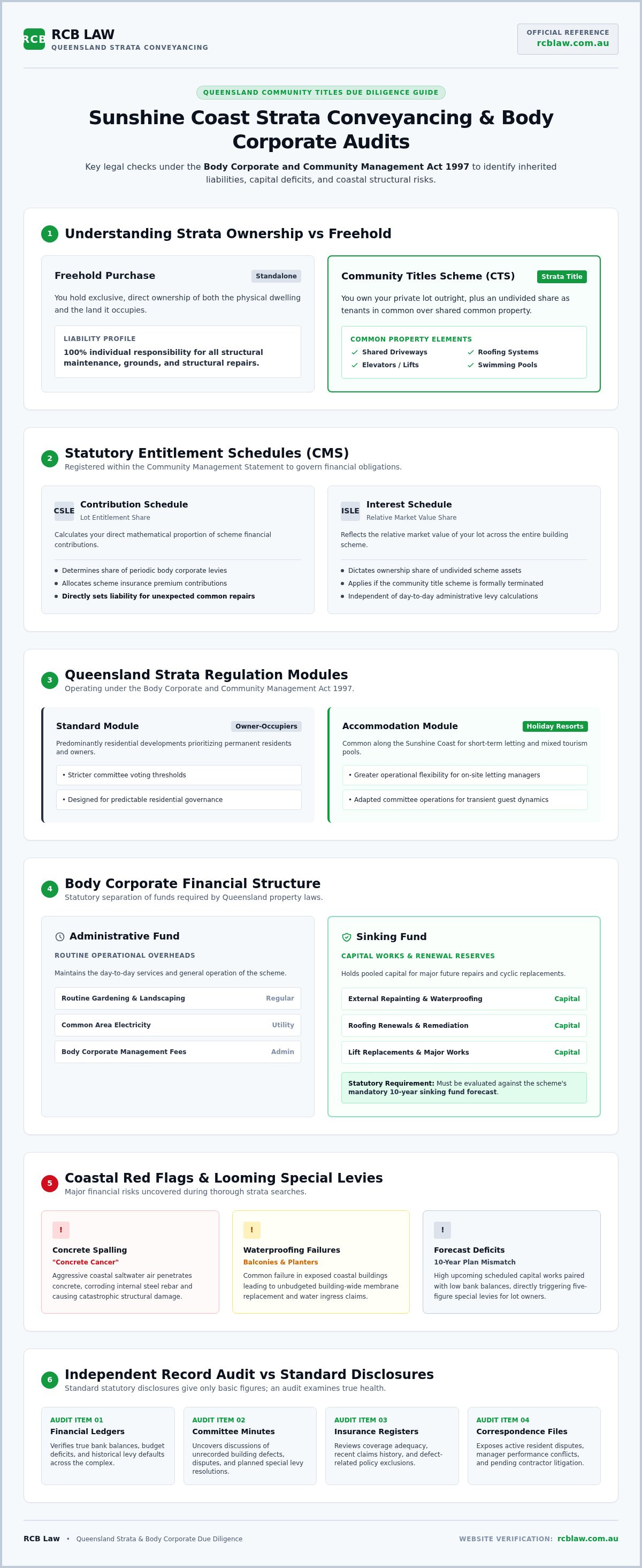
Understanding what is strata title requires looking beyond the boundary walls of your unit. In a freehold purchase, you own the land and structure entirely. In a community titles scheme, you acquire individual ownership of your specific lot, combined with shared ownership as tenants in common over common property such as driveways, roofs, lifts, and swimming pools.
Your ongoing obligations depend on two statutory schedules registered on the Community Management Statement (CMS):
- Contribution Schedule Lot Entitlements (CSLE): Determines your exact percentage share of body corporate levies, insurance contributions, and common maintenance costs.
- Interest Schedule Lot Entitlements (ISLE): Reflects the relative market value of your lot, dictating your share of undivided assets if the scheme ever terminates.
A higher contribution entitlement means paying a larger portion of every common repair, making an entitlement audit an essential component of professional strata conveyancing Sunshine Coast property purchasers rely upon.
The Legal Framework: Queensland Body Corporate Legislation
Queensland strata schemes operate under the Body Corporate and Community Management Act 1997 (BCCM Act). This legislation sets administrative standards, meeting procedures, and financial management rules across all registered schemes.
Every scheme operates under a specific regulation module suited to its community design:
- Standard Module: Common in predominantly residential schemes, prioritizing long-term owner-occupiers with stricter committee voting thresholds.
- Accommodation Module: Designed for holiday resorts and short-term letting, giving greater flexibility to on-site letting managers and committee operations.
Under Queensland property legislation, sellers must deliver a formal Body Corporate Information Certificate and statutory disclosures before you enter a binding contract. These disclosures outline ongoing administration contributions, current sinking fund levels, and registered community by-laws, creating essential transparency before your cooling-off period concludes.
Why Body Corporate Searches Are Crucial for Sunshine Coast Buyers
Statutory disclosure statements provide only a basic snapshot of a scheme's financial affairs. Relying solely on this initial summary leaves you exposed to hidden structural liabilities and unrecorded debts. Engaging diligent strata conveyancing Sunshine Coast specialists recommend ensures an independent audit of the records, giving you absolute clarity before completing your purchase.
A comprehensive search reviews the scheme's records, including financial ledgers, insurance certificates, correspondence files, and meeting minutes. These documents expose the true operational culture of the complex, highlighting issues that standard building and pest inspections cannot identify.
Administrative Fund vs Sinking Fund Health Checks
A healthy scheme maintains a clear separation between operational overheads and capital works reserves:
- Administrative Fund: Covers day-to-day running costs, such as routine gardening, common area electricity, and management fees.
- Sinking Fund: Holds capital to fund major structural repairs, lift replacements, external repainting, and roofing renewals.
Our review evaluates the mandatory 10-year sinking fund forecast against current bank balances. If the forecast indicates substantial future capital spending while account balances remain low, owners inevitably face steep special levies to bridge the shortfall.
Uncovering Secret Disputes, By-Law Restrictions, and Defect Claims
Committee minutes reveal historical grievances and compliance patterns that never show up on title deeds. Reviewing past annual and extraordinary general meeting records highlights ongoing noise disputes, insurance claim rejections, and unauthorized lot alterations. Best-practice strata managers align with standards set by the Strata Community Association (SCA), maintaining comprehensive ledgers that record every active grievance.
We examine scheme by-laws to verify pet approvals, vehicle parking allocations, and short-term letting conditions. Unresolved building defect actions against the original developer are also uncovered, protecting you from purchasing an apartment entangled in costly Queensland Civil and Administrative Tribunal (QCAT) proceedings.
Assessing Property Title Encumbrances and Restrictive Rights
Securing private enjoyment of ancillary spaces requires examining exclusive use allocations on the registered Community Management Statement. Car spaces, storage cages, and outdoor courtyards are often common property with exclusive use rights rather than titled lots. If these allocations lack correct registration, you risk losing access to them entirely.
Our audit also identifies statutory notices and registered easements that impact ownership rights. When complex title disputes or unrecorded third-party claims emerge during contract reviews, understanding options like lodging a caveat helps protect your financial interest. Partnering with seasoned property lawyers at rcblaw.com.au provides the experienced oversight needed to navigate these technical title intricacies smoothly.
Evaluating Special Levies: Risk Analysis and Financial Exposure
Special levies present one of the most substantial financial surprises facing prospective apartment owners. A body corporate strikes a special levy when unpredicted capital expenses or emergency building repairs outstrip the existing sinking fund reserves. Without specialized strata conveyancing Sunshine Coast purchasers can easily inherit substantial debt commitments that turn an otherwise sound investment into an ongoing financial strain.
Managing this risk begins with identifying the physical conditions that trigger unexpected levies. Coastal environments expose property infrastructure to severe wear, making proactive legal scrutiny essential to safeguarding your settlement.
Common Triggers for Sunshine Coast Special Levies
The subtropical, marine climate across Caloundra, Mooloolaba, and Noosa accelerates structural deterioration. High airborne salt concentrations corrode internal reinforcing steel, resulting in concrete spalling, commonly known as concrete cancer. When steel rusts, it expands, causing the surrounding concrete to crack and break away from external walls, facades, and cantilevered balconies.
Remediating structural concrete cancer routinely generates repair invoices reaching tens or even hundreds of thousands of dollars across a complex. Other recurring drivers of sudden capital calls include:
- Balustrade structural failures and coastal salt degradation requiring full complex replacement.
- Waterproofing membrane breakdowns causing persistent moisture ingress across rooftop penthouses and podium gardens.
- Escalating communal building insurance premiums following severe East Coast low storms and regional cyclone events.
- Aging lift mechanics and swimming pool filtration systems requiring urgent overhaul.
Determining Liability: Who Pays Struck vs Proposed Levies?
Under standard Queensland standard conditions of sale, liability hinges directly on the precise date the body corporate formally passes the levy motion. As guided by the Queensland Government Body Corporate and Community Management regulations, if a levy is formally struck at a general meeting before the contract date, the seller remains liable for paying it in full.
A serious legal trap emerges when a major capital expenditure has been actively debated in committee meetings or tabled on an upcoming Extraordinary General Meeting (EGM) notice paper, but has not yet been formally voted on. If the motion passes after the contract date, that substantial financial burden shifts entirely to the incoming purchaser at settlement.
Experienced strata conveyancing Sunshine Coast legal teams protect buyers by inserting bespoke special conditions into the contract. These clauses require the seller to warrant that no upcoming works are under committee consideration. If any special levies are proposed or struck prior to settlement, the seller must discharge them entirely at closing, insulating your personal savings from inherited repairs.
Step-by-Step Strata Due Diligence for Sunshine Coast Purchases
Purchasing a unit shouldn't feel like a leap into the dark. Following a structured due diligence roadmap turns uncertainty into calm reassurance. By implementing methodical strata conveyancing Sunshine Coast buyers protect their equity at every critical juncture, moving smoothly from the initial offer through to key handover.
A disciplined legal process eliminates surprises. Here is how specialized strata oversight guides you through each phase of your transaction.
Step 1 to 3: From Pre-Signing Scrutiny to Record Inspection
Due diligence begins before any legally binding commitments are finalized:
- Step 1: Pre-Signing Contract and Disclosure Review: Before signing a standard REIQ contract, an independent review of the seller disclosure statement is crucial. This step checks lot entitlement ratios, confirms exclusive use allocations, and verifies the registered Community Management Statement.
- Step 2: Scheme Record Inspection: During the cooling-off period or dedicated due diligence window, an exhaustive search of body corporate books is commissioned. This inspects accounting ledgers, insurance registers, and committee correspondence to uncover hidden structural or legal concerns.
- Step 3: Coordinated Inspections within Statutory Windows: Physical building and pest findings must be compared against scheme boundaries. If an inspector identifies water ingress or cracked masonry, cross-referencing body corporate records confirms whether the lot owner or the collective scheme is legally liable for remediation.
Step 4 to 5: Custom Drafting to Digital Settlement via PEXA
The final phases transform investigative findings into enforceable legal protections and a smooth closing:
- Step 4: Tailored Special Conditions: When searches identify underfunded reserves or pending capital works, tailored contract conditions safeguard your position. These clauses give you the right to renegotiate the purchase price, require the seller to discharge upcoming special levies, or walk away without penalty if severe non-compliance exists.
- Step 5: Settlement Apportionment and PEXA Transfer: As completion approaches, exact adjustments are calculated for administrative and sinking fund levies, ensuring you pay only for your precise days of ownership. The transaction is then settled securely through PEXA, coordinating directly with your financier to complete the transfer without friction.
To safeguard your upcoming unit or townhouse purchase before signing, contact our conveyancing team at RCB Law for dedicated pre-contractual guidance.
Why Choose RCB Law for Your Sunshine Coast Strata Conveyancing
Buying an apartment or townhouse represents an exciting milestone, yet the legal nuances of community titles can easily create unnecessary stress. High-volume conveyancing factories often treat unit purchases like standard house settlements, overlooking subtle scheme liabilities that lead to costly surprises. Choosing experienced, local legal representation ensures your transition is supported by meticulous care, clear advice, and steady advocacy.
At RCB Law, we remove friction from your transaction. Our team provides calm, attentive legal guidance, protecting your capital so you can move forward with total confidence.
Decades of Queensland Property and Strata Mastery
With over 30 years of legal practice in Queensland property law, RCB Law offers the depth of insight needed for coastal acquisitions. Our legal team understands how local schemes function, whether you're purchasing an apartment in a high-density mixed-use development, a holiday-let resort along the beach, or a townhouse in a boutique scheme.
Intricate community title statutes require experienced oversight. We review every disclosure document and title record with an eye for hidden risks. By pinpointing underfunded capital reserves, unapproved structural alterations, and unresolved developer disputes before your contract becomes unconditional, we ensure you don't inherit someone else's expensive problems.
Proactive Support from Contract Review to Settlement
Clear communication is the foundation of a low-stress property transfer. We translate dense body corporate records, complex financial statements, and committee resolutions into straightforward, actionable advice. You'll never be left wondering where your purchase stands or what steps come next.
From drafting protective special conditions during pre-signing reviews to coordinating final transfers securely through PEXA, our team handles the legal heavy lifting. When you need thorough strata conveyancing Sunshine Coast buyers trust for complete peace of mind, our dedicated team across the Sunshine Coast and Brisbane is ready to assist. Secure your investment by contacting the team at RCB Law Conveyancing Specialists today.
Secure Your Coastal Investment with Total Confidence
Stepping into Sunshine Coast unit ownership should bring excitement and relief, not financial anxiety. Verifying sinking fund reserves, auditing registered by-laws, and uncovering pending capital works early transforms an otherwise complex purchase into a secure, predictable transaction. Clear legal oversight ensures you protect both your coastal lifestyle and your hard-earned equity before settlement conditions end.
Backed by over 30 years of established Queensland legal experience, RCB Law guides you through every stage of community title transfers. Delivering the meticulous strata conveyancing Sunshine Coast buyers trust, our Sunshine Coast and Brisbane specialists conduct comprehensive due diligence to shield you from hidden body corporate liabilities and surprise levies. You don't have to navigate property law alone. Protect your property purchase with trusted Sunshine Coast conveyancing from RCB Law and take your next step with genuine peace of mind.
Frequently Asked Questions
What is the difference between a strata inspection report and a standard building inspection?
A standard building inspection checks only the physical condition inside your private unit and immediate structural surrounds. In contrast, an independent strata records inspection examines the legal and financial history held by the body corporate manager. This includes historical maintenance ledgers, 10-year sinking fund forecasts, insurance claim histories, and committee meeting minutes that reveal widespread structural issues across the entire complex.
Can I keep a pet in my Sunshine Coast strata apartment under Queensland laws?
Yes, bodies corporate in Queensland cannot enforce blanket bans against keeping pets. Under amendments to the Body Corporate and Community Management Act 1997, by-laws completely prohibiting animals are invalid. Committees can still impose reasonable conditions regarding pet size, supervision in common hallways, or cleaning standards, making it essential to review registered community rules before signing your purchase contract.
What happens if a special levy is proposed before settlement but voted on after?
Under standard standard conditions of sale, the buyer is liable for any special levy formally passed after the contract date. If an extraordinary general meeting is scheduled to vote on substantial repairs during your settlement window, you inherit that debt unless your solicitor inserts specific special conditions. Thorough strata conveyancing Sunshine Coast specialists provide ensures clauses are drafted requiring the seller to pay any pending levies discussed prior to completion.
How much are typical body corporate fees on the Sunshine Coast?
Strata levies vary widely depending on building age, common facilities, and on-site management structures. Boutique walk-up complexes with minimal common property generally have lower quarterly fees. High-rise developments with multiple lifts, heated pools, gyms, and on-site letting managers require significantly higher contributions to service ongoing operational costs, extensive common property insurance, and proactive long-term capital replacement funds.
Can a body corporate prevent me from holiday letting my unit on Airbnb?
A body corporate cannot restrict the type of residential tenancy if your lot is lawful for short-term accommodation under local council planning schemes. Queensland strata by-laws that attempt to ban short-term letting outright are invalid under Section 180(3) of the BCCM Act. However, local Sunshine Coast Council planning town plans and complex zoning designations still govern whether short-stay accommodation is legally permitted on the site.
What are lot entitlements and why do they affect my strata levy payments?
Lot entitlements are numeric values allocated to each lot on the Community Management Statement. Contribution Schedule Lot Entitlements dictate your exact proportional share of administrative and sinking fund levies, as well as communal building insurance premiums. If your prospective unit has a higher contribution entitlement than neighboring lots, your ongoing financial share of common maintenance and future special levies will be proportionally higher.
Is an initial seller disclosure statement legally binding in Queensland?
Yes, the statutory seller disclosure statement forms a legally binding document under Queensland property statutes. Under current legislation, sellers must provide prospective buyers with a formal Body Corporate Information Certificate alongside the disclosure statement before the contract of sale is signed. If the seller provides inaccurate or materially incomplete financial information about existing body corporate liabilities, the buyer may hold statutory termination rights before settlement.
Why do I need a property solicitor instead of an automated conveyancing service?
Automated conveyancing platforms process standard administrative tasks but cannot interpret nuanced body corporate minutes or draft protective clauses. Relying on dedicated strata conveyancing Sunshine Coast legal teams ensures experienced property solicitors audit complex financial statements, identify latent building defect disputes, and negotiate tailored special conditions. This high level of legal scrutiny protects your capital from unforeseen liabilities, giving you complete reassurance throughout settlement.


