
Imagine standing at the finish line of a long, emotionally draining separation, only to be met with a mountain of complex paperwork from Titles Queensland. For many couples in Brisbane and across the Sunshine Coast, the technical process of a spousal transfer of property qld feels like one hurdle too many, especially when communications with an ex-partner are strained. It's completely natural to worry that a single administrative error might trigger an unexpected A$20,000 transfer duty bill or stall your path to a fresh start.
We understand that this transition is about more than just changing a name on a title; it's about securing your future and finding peace of mind. You deserve a process that removes friction rather than adding to your stress. This guide shows you how to navigate the legal requirements of a spousal transfer smoothly while ensuring you claim every eligible stamp duty exemption under current 2026 regulations. We'll walk through the mandatory Form 2 Seller Disclosure Statement, the role of PEXA in modern electronic settlements, and how to protect your property rights without the need for unnecessary conflict.
Key Takeaways
- Learn how to legally change ownership between married or de facto partners while maximizing eligible stamp duty exemptions under the QLD Duties Act 2001.
- Discover how utilizing legally binding frameworks can reduce direct friction and ensure compliance with agreed timelines, even when dealing with an uncooperative ex-partner.
- Master the step-by-step sequence required for a smooth spousal transfer of property qld using secure digital settlement networks like PEXA.
- Understand how partnering with a dedicated Queensland residential conveyancing specialist can protect your property rights and safely handle the final title transfer stage.
Understanding Spousal Transfer of Property in QLD
A spousal transfer of property qld isn't a typical real estate transaction. You aren't listing a home on the open market, hosting inspections, or negotiating with strangers. Instead, you're adjusting the legal interests between two people who share a significant personal bond. This process involves updating the official records managed by Titles Queensland to reflect a new ownership structure, ensuring your property rights are clearly defined and protected.
In 2026, many property owners choose to restructure their assets for tax efficiency or to reflect major life changes. Whether you're moving from sole ownership to a joint tenancy or distributing assets after a separation, the legal mechanism must be precise. Unlike a standard sale, these transfers often qualify for specific exemptions, but the paperwork remains rigorous and requires a specialized approach to avoid future complications.
What is a Spousal Property Transfer?
At its core, this is the legal process of moving a portion or the entirety of a land title from one partner to another. This applies to both married couples and those in de facto relationships across Queensland. Navigating a spousal transfer of property qld requires more than just goodwill; it demands formal documentation that satisfies both state revenue requirements and land registry standards. You can't simply change a name on a utility bill and expect the land registry to follow suit.
The Family Law Act 1975 provides the overarching framework for how these assets are divided during relationship transitions. A property lawyer ensures the transaction is executed safely, protecting you from future claims and ensuring the title is indefeasible. By managing the technical details, we help you transition through this phase with confidence, knowing the legal heavy lifting is handled by experts who understand the personal weight of the situation.
Common Scenarios for Restructuring Property Ownership
Most transfers fall into three primary categories, each requiring specific legal steps to ensure the outcome is binding. We often assist clients who are entering a new chapter of their lives and need their property titles to reflect their current reality. Common situations include:
- Adding a partner to a title after marriage to create a joint tenancy, ensuring the property passes automatically if one person passes away.
- Shifting from joint tenants to tenants in common to better manage an investment portfolio or reflect different financial contributions.
- Removing a spouse from a title following a formal relationship breakdown to ensure financial independence and asset protection.
Informal handshakes or verbal promises fail to change legal land titles, leaving you vulnerable to future disputes and significant tax liabilities. Using a structured legal process is the only way to ensure your ownership is recognized by the state and protected against unforeseen claims.
Navigating Transfer Duty and Stamp Duty Exemptions in QLD
In Queensland, transferring property usually triggers a significant financial obligation known as transfer duty. For a residential property valued at A$800,000, the standard duty can exceed A$20,000, which is a heavy burden to carry during a major life transition. However, a spousal transfer of property qld often qualifies for specific exemptions under the Duties Act 2001 (QLD). These provisions are designed to ensure that partners restructuring their lives don't face unfair tax penalties, provided the paperwork is handled with precision.
Failing to structure the transfer correctly can result in unexpected tax invoices from the Queensland Revenue Office (QRO). The state authorities require clear, legally binding documentation to justify why a transaction should be exempt from tax. Without this evidence, the QRO will treat the transfer as a standard market sale, potentially leading to thousands of dollars in unnecessary costs and long delays in the settlement process.
The Relationship Breakdown Exemption
The most common path to a zero dollar duty bill is the relationship breakdown exemption. This state based tax relief works in conjunction with Section 90 of the Family Law Act 1975. For married couples, the process is relatively direct when a court order or a binding financial agreement is in place. The exemption also extends to de facto relationships, though the evidentiary requirements can be more rigorous. Unregistered de facto couples must typically demonstrate they lived together for at least two years before the QRO will grant the concession.
You can't simply notify the tax office of a separation and expect an automatic waiver. A formal separation agreement or court order is mandatory to anchor the claim. Without these legal pillars, the transaction lacks the necessary framework to satisfy the Duties Act, making it vital to have your documents drafted by a professional who understands the intersection of property and family law.
Requirements for a Valid Duty Exemption Claim
Securing your exemption requires a specific sequence of lodgments. The QRO demands that the transfer aligns exactly with the terms of your property settlement. If a court order stipulates a transfer to one party but the actual title application includes a third party, the exemption will likely be denied. Precision is everything. Every detail on the transfer forms must mirror the underlying legal agreement to avoid triggering an audit or a full duty assessment.
Modern settlements in Queensland are processed through secure digital networks. A specialist conveyancer ensures all tax declarations and supporting evidence are lodged correctly via PEXA. This digital precision prevents the friction often associated with manual paper filings and ensures the OSR doesn't flag your file for manual review. If you're feeling overwhelmed by the technical requirements, our team at RCB Law can guide you through the stamp duty lodgment process to ensure you don't pay a cent more than necessary.
Managing a Property Settlement with a Difficult Ex-Partner
Completing a spousal transfer of property qld is often the final hurdle in a long journey toward independence. When an ex-partner is uncooperative, this technical step can feel like an impossible bottleneck. High-pressure transitions often lead to delays, especially if one party feels they can leverage the property title to stall the process. We recognize that this creates significant anxiety; our role is to provide a steady hand and a clear path forward, ensuring your rights are protected regardless of the other party's behavior.
A specialized property lawyer acts as a vital buffer during this stage. By managing the formal exchange of documents and coordinating with the other party's legal representative, we significantly reduce the need for stressful direct communication. This professional distance helps remove the friction that often derails settlements. We focus on the technical execution of the title transfer, allowing you to focus on your personal transition without the burden of administrative conflict.
Consent Orders vs Binding Financial Agreements (BFAs)
Securing a robust legal framework is the best way to manage a difficult ex-partner. Consent Orders are approved by the Family Court and carry the weight of a judicial ruling, making them highly effective for forcing compliance with agreed timelines. If one party fails to act, the court has the power to intervene directly. Binding Financial Agreements (BFAs) are private contracts that don't require court filing but still provide a legally enforceable map for the property division. Both documents are essential for triggering the stamp duty exemptions we discussed earlier.
Once your property settlement is finalized, it's a natural time to look at your broader future. Significant life changes like a property transfer usually necessitate an update to your estate planning to reflect your new assets. You can learn more about this in our guide on Why You Need a Will: A Comprehensive Guide for Queenslanders, which helps ensure your hard-won property remains secure for your loved ones.
Protecting Your Property Interests During Friction
If you fear an ex-partner might try to sell or mortgage the home before the transfer is complete, we can use strategic legal tools like caveats. A caveat acts as a formal "freeze" on the title registry, preventing any dealings with the land without your knowledge. This provides an immediate layer of security while the final details of the spousal transfer of property qld are being settled. Modern electronic platforms like PEXA further enhance this security by ensuring that funds and title deeds are exchanged simultaneously, leaving no room for manual errors or last-minute withdrawals.
In cases where a party remains entirely non-compliant and refuses to sign mandatory forms, the court can authorize a registrar to sign the transfer documents on their behalf to ensure the settlement proceeds. This ensures that a difficult partner cannot hold your future hostage indefinitely.
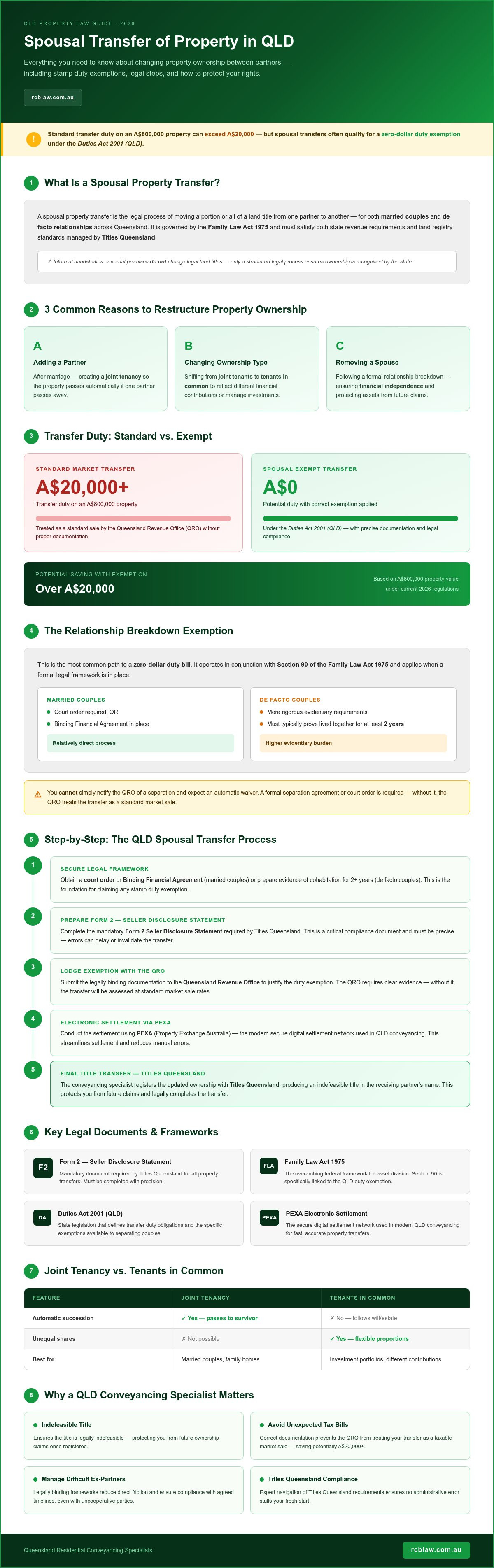
Step-by-Step Guide to the QLD Spousal Transfer Process
Executing a spousal transfer of property qld requires a structured legal sequence to avoid costly delays or compliance penalties. While the emotional agreement might happen at the kitchen table, the legal reality unfolds through a precise digital framework. Missing a single step can lead to title defects that take months to rectify. Engaging a specialized conveyancing lawyer protects your interests, ensuring that every document satisfies the strict requirements of state authorities from the very beginning.
The timeline for a transfer usually spans 30 to 90 days, depending on your financial arrangements. This duration allows for the systematic resolution of mortgage requirements and tax assessments. Understanding this progression helps reduce the anxiety of the unknown, transforming a complex administrative burden into a manageable, transparent journey toward your new financial structure.
Step 1 to 3: Agreements, Finance, and OSR Lodgement
The initial phase focuses on establishing the legal foundation and securing the necessary financial clearings. This phase requires meticulous attention to detail before any data enters the digital settlement environment. The steps include:
- Step 1: Finalising the formal agreement. You must have your Consent Orders approved by the Family Court or have a signed Binding Financial Agreement (BFA) that explicitly details the property distribution.
- Step 2: Managing the finance. If the person retaining the property is taking over the existing loan, they must secure formal bank finance approval. The departing partner's bank must also prepare a mortgage discharge.
- Step 3: Lodging for tax assessment. Your conveyancer will submit the transfer documents alongside the formal separation agreement to the Queensland Revenue Office to secure your stamp duty exemption.
Step 4 to 5: PEXA Settlement and Title Registration
Once the tax exemptions are approved and the banks are ready, the transaction moves into the digital space. Queensland property transfers rely heavily on secure digital settlement networks to complete transactions across Australia without manual paperwork friction. For a broader look at how these mechanisms operate, you can read our foundational guide on What is Conveyancing? Your Complete Guide to Buying & Selling Property in QLD.
Step 4 involves creating the digital workspace in PEXA. Here, the incoming and outgoing banks coordinate with your conveyancer to verify the title details, exchange funds electronically, and sign the digital transfer forms safely. Step 5 is the final electronic lodgement. PEXA instantly submits the transfer to Titles Queensland, creating an indefeasible title that updates the public registry and legally finalizes your new ownership status. If you are ready to begin this process, contact RCB Law today to start your spousal transfer smoothly.
How a QLD Conveyancing Specialist Secures Your Settlement
Finalizing a property division is a significant milestone that marks the end of a difficult chapter. At RCB Law, we provide a reassuring, empathetic approach to the final stages of your transition. Our team understands that the technicalities of a spousal transfer of property qld are often the last thing you want to worry about when navigating personal change. We position ourselves as your steady guide, using our 30+ years of Queensland property law experience to ensure your title transfer is legally airtight and completed without unnecessary delay.
We manage the entire administrative burden, from coordinating with Titles Queensland to overseeing the digital exchange in PEXA. By taking this off your shoulders, we allow you to focus on rebuilding your life while we handle the complex regulatory requirements. Specialized conveyancing is about more than just moving a name on a title; it's about protecting your financial future and ensuring your assets are secured within a legally recognized framework. We focus on tangible outcomes, giving you the resolution you need to step into your next phase with confidence.
Removing the Friction from Title Transfers
One of the most significant benefits of engaging our professional team is the removal of direct contact with an ex-partner. We manage all communications with their legal representative directly, acting as a buffer that prevents emotional friction from stalling the transaction. This professional distance is crucial for maintaining a sense of calm and moving the process forward methodically. It ensures that personal history doesn't interfere with the legal necessity of the transfer.
We also ensure that all moving parts, such as mortgage discharges and specific bank requirements, align perfectly for settlement day. This coordination is vital to avoid last-minute hiccups that can cause additional stress. To provide further peace of mind, we offer clear, fixed-fee clarity. Knowing your costs upfront allows you to plan your finances with certainty during a major life transition, removing the fear of hidden tax liabilities or surprise invoices.
Secure Your Property Future in Queensland
Acting quickly after a relationship breakdown is a strategic move to prevent future asset valuation disputes. As property markets in Brisbane and the Sunshine Coast fluctuate, delaying a spousal transfer of property qld can lead to disagreements over the current value of the home. Finalizing the transfer now locks in your ownership and provides the legal certainty you need to move forward. We’ve helped thousands of Queenslanders navigate these transitions by combining technical mastery with a supportive, client-centric approach.
Getting started with our experienced property lawyers is a simple, low-friction process. We prioritize proactive communication and brief, direct assistance to counter the confusion often associated with land title transfers. Our local expertise ensures that your settlement meets all regional standards while maximizing your eligibility for duty exemptions. Ready to finalise your property settlement? Contact the compassionate team at RCB Law today to secure your property rights.
Take Control of Your Property Future
Securing your financial independence is a vital step toward long-term peace of mind. By following a structured legal path, you ensure that your spousal transfer of property qld is not only compliant with 2026 regulations but also maximized for all eligible tax exemptions. This technical closure provides the stability needed to move forward without the lingering weight of administrative uncertainty or potential future disputes.
Our specialist residential conveyancing team brings over 30 years of trusted Queensland property law expertise to every settlement across Brisbane and the Sunshine Coast. We focus on providing compassionate, low-friction legal guidance that removes the burden from your shoulders and places it in the hands of seasoned professionals. You don't have to navigate this complex transition alone.
Streamline your spousal property transfer with the trusted specialists at RCB Law today to ensure your title is protected. We're here to help you turn the page with clarity and confidence.
Frequently Asked Questions
Do I have to pay stamp duty on a spousal transfer of property in QLD?
No, you generally don't have to pay stamp duty if the transfer meets specific exemption criteria under the QLD Duties Act 2001. For a separation or divorce, the transaction must give effect to a formal court order or a binding financial agreement. For couples who remain together, the property must be their principal place of residence and the transfer must be a gift that results in equal shares.
Can I transfer property to my spouse if there is still a mortgage on it?
Yes, you can transfer the property, but the existing mortgage must be addressed before the land title can be updated. The bank must formally approve a transfer of mortgage or a complete refinance of the loan. The incoming owner must prove they can meet the financial obligations independently, and the bank will issue a mortgage discharge for the departing partner at settlement.
What happens if my ex-partner refuses to sign the spousal transfer documents?
If your ex-partner remains entirely non-compliant, you can apply to the Family Court for enforcement. The court has the authority to appoint a registrar or another court official to sign the transfer forms on behalf of the uncooperative party. This legal mechanism ensures that your property settlement and the final title change can still proceed through the registry despite their refusal.
How long does a spousal property transfer take to complete in QLD?
A standard spousal transfer of property qld typically takes between 30 and 90 days to complete from start to finish. This timeline depends heavily on how quickly your financial institution processes the mortgage discharge or refinance papers. Once the bank and the tax office clear the documentation, the actual electronic settlement and title update happen almost instantly through the digital network.
Can a de facto partner claim the same stamp duty exemptions as a married couple?
Yes, de facto partners are eligible for the same transfer duty exemptions under Queensland law, provided they meet specific evidentiary standards. For a relationship breakdown, you must show a formal separation agreement or court order. The Queensland Revenue Office requires proof that a genuine de facto relationship existed for at least two years before they will grant the tax concession.
Do I need a family lawyer or a conveyancing lawyer for a spousal transfer?
You generally need both at different stages, as they handle entirely separate legal mechanisms. A family lawyer drafts the initial Consent Orders or financial agreements that outline how your assets are divided. A specialized conveyancing lawyer like RCB Law is then required to execute the technical, legal transfer of the land title and safely manage the electronic lodgement process through the state registry.
What is the role of PEXA in a Queensland spousal property transfer?
PEXA operates as the secure electronic lodgement platform that completely replaces old paper based settlements in Queensland. Your conveyancer uses this digital workspace to coordinate with both incoming and outgoing banks simultaneously. PEXA ensures that mortgage discharges, title transfers, and any necessary funds are exchanged securely at the exact same moment, which eliminates manual errors and protects your property rights.


