
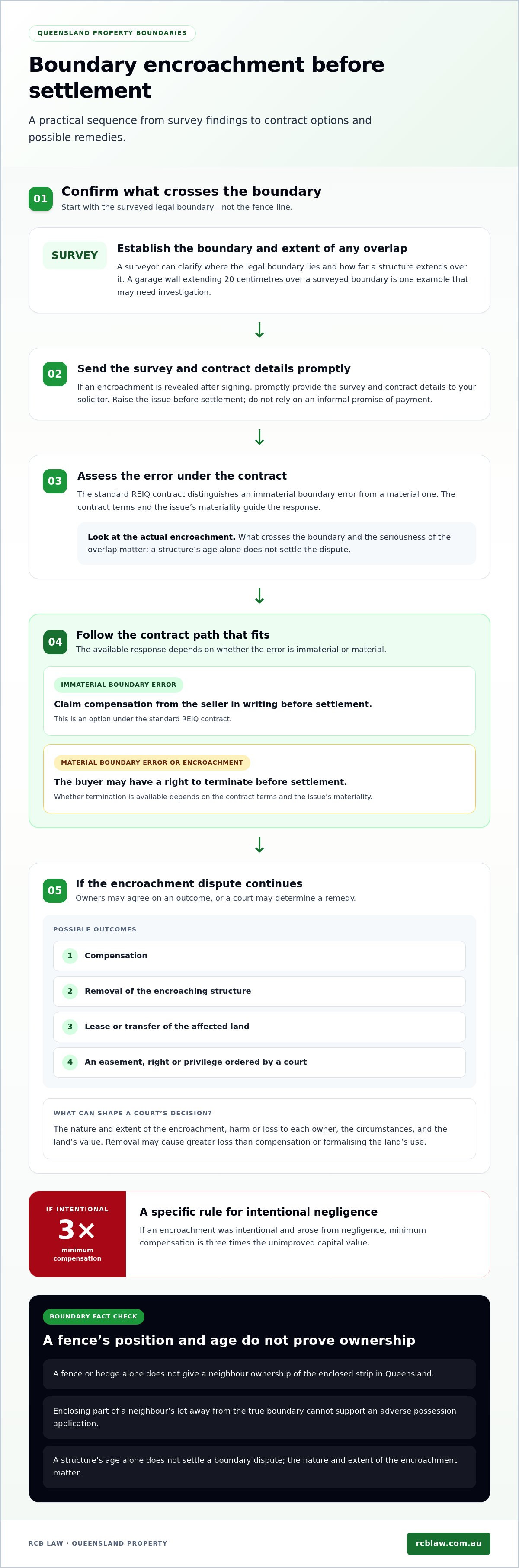
A fence in the wrong place does not automatically change who owns the land. In Queensland, a fence or hedge enclosing part of a neighbour’s lot away from the true boundary cannot support an adverse possession application. Under the standard REIQ contract, a buyer dealing with an immaterial boundary error can claim compensation from the seller in writing before settlement. A material boundary error or encroachment may give the buyer the right to terminate before settlement.
A misplaced fence, garage or retaining wall can raise real concerns when you are buying a property. The consequences depend on what crosses the legal boundary and the seriousness of the encroachment, not simply how long the structure has been there.
This article explains what can happen when a structure crosses a Queensland boundary, how an encroachment dispute may be resolved, and how adverse possession applications are handled. It also explains why a boundary encroachment before settlement in QLD needs prompt attention, while your contract rights may still be available.
Key Takeaways
- A court may resolve a building encroachment through compensation, removal, a lease or a land transfer, weighing the impact on both owners and the circumstances.
- Adverse possession applications in Queensland involve specific possession requirements and evidence, including declarations from at least two disinterested people.
- A structure’s age alone doesn’t settle a boundary dispute; the nature and extent of the encroachment matter.
- A boundary survey can clarify where the legal boundary lies, while residential conveyancing advice can help you understand the property issues affecting your purchase.
Can a fence in the wrong place give rise to an adverse possession claim in Queensland?
A fence alone does not give a neighbour ownership of the enclosed strip in Queensland. If a fence or hedge encloses part of a neighbour’s lot away from the true boundary, it cannot support an adverse possession application.
Resolving Encroachment Through Agreed Options
Owners may resolve an encroachment through compensation, removal, a lease or transfer of the affected land. Removal may cause greater loss than agreeing on payment or formalising the land’s use. A court may order compensation, a lease or transfer instead of removal, taking account of the encroachment, the harm to each owner, the circumstances and the land’s value. Surveying costs depend on the boundary issue and work required. Resolution time depends on the survey, negotiations and whether the matter proceeds to court.
Building on Land by Genuine Mistake
A genuine mistake may explain how a building or retaining wall crossed a boundary, but it does not settle the owners’ rights. A court may consider the circumstances of construction when choosing a remedy, along with the extent of the structure and the losses to both neighbours. If an encroachment was intentional and arose from negligence, minimum compensation is three times the unimproved capital value.
Land Excluded from Adverse Possession
Enclosing a neighbour’s land with a misplaced fence or hedge cannot support an adverse possession application in Queensland. The Property Law Act 2023 also prevents interests in land under the Land Title Act 1994 or Land Act 1994 from arising simply through prescription or the doctrine of lost modern grant. A fence’s position and age therefore don’t, by themselves, establish a right to the enclosed land.
Buyer Steps Before Settlement
If a survey reveals an encroachment after you sign, promptly give the survey and contract details to your solicitor. For a boundary encroachment before settlement in QLD, the standard REIQ contract allows a buyer to claim compensation from the seller in writing before settlement for an immaterial error. A material boundary encroachment before settlement in QLD may allow termination. The contract terms and the issue’s materiality guide the response. Raise the matter before settlement rather than relying on an informal promise of payment.
Applying for adverse possession through Titles Queensland
Queensland applications depend on the land title, the history of possession and the supporting evidence. The process also distinguishes adverse possession claims from rights created by prescription.
Prescription and Adverse Possession
Prescription concerns rights claimed through long use, while adverse possession concerns possession of land itself. The distinction matters for neighbours relying on a fence, access track or retaining walls to assert rights. Queensland’s Property Law Act 2023 prevents interests in land under the Land Title Act 1994 or Land Act 1994 from arising simply through prescription or the doctrine of lost modern grant. A private right of way cannot be created by long use alone. An access arrangement must be formalised as a registered easement to bind future owners. A licence records permission to use land, not an automatic transfer of ownership.
Adverse Possession Time Limits
Time limits affect whether an owner can bring an action to recover land and whether an applicant may establish possession. Under Queensland’s Limitation of Actions Act 1974, an action to recover land generally cannot be brought more than 12 years after the cause of action arose. Titles Queensland states that most adverse possession applicants will need to establish 30 years of possession in practice. If the original owner was under a disability when the limitation period began, the outer time limit is 30 years. These periods serve different roles, so the situation and evidence matter.
An application through Titles Queensland requires evidence of the claimed possession, including declarations from at least two disinterested people. The process includes public notice and an opportunity to object. Titles Queensland sets a caveat-objection day at least two months after the last public notice, giving an affected owner time to object. A fence alone does not establish a claim, and enclosing a neighbour’s lot away from the true boundary cannot support an application.
For general information about how an encroachment affects property rights, consider obtaining Queensland property legal advice before relying on an informal boundary arrangement.
How does Queensland law deal with a building that crosses a boundary?
Queensland law provides remedies when a substantial, permanent building crosses onto another owner’s land. The structure’s age alone does not settle the dispute.
Meaning of a Building Encroachment
A building encroachment occurs when a substantial, permanent building, or part of it, extends onto another person’s land. Under Part 11 of the Property Law Act 1974, the definition of a building helps determine whether the structure qualifies. Section 184 concerns building encroachments. For example, a garage wall extending 20 centimetres over a surveyed boundary may raise an issue requiring investigation. A surveyor can clarify where the legal boundary lies and the extent of the overlap.
Remedies for Building Encroachments
Queensland courts can order removal, compensation, transfer of affected land, or grant an easement, right or privilege. The suitable remedy depends on the circumstances, including the encroachment’s nature and extent, losses to both owners, and land value. A court may favour compensation where removal costs more than the reduction in the affected property’s value. In Shadbolt v Wise [2002] QSC 348, compensation was awarded instead of removal, given the limited impact on land value and the cost of destroying a significant asset.
Seller Disclosure of Boundary Encroachments
A Queensland seller who learns of a boundary issue through a survey may face a misrepresentation claim for damages if they fail to disclose it to a later buyer. A known garage, retaining wall or other structure crossing a boundary is therefore relevant to a purchase. Buyers should raise survey findings through their conveyancer before settlement. Disclosure and the contract terms can affect how the parties address the property interest at stake.
Responsibility for Resolving an Encroachment
Responsibility depends on the structure, the affected land and the remedy agreed or ordered. Owners can negotiate removal, compensation or a formal land arrangement. A court may order a remedy after considering the encroachment’s circumstances and the losses to both parties. The building owner may face removal or payment, while a land transfer can resolve the overlap on just terms. A survey and legal advice can clarify the issue before the owners settle on an agreement.
Neighbouring structures crossing a Queensland property boundary
A neighbour’s structure can cross a boundary in ways that range from a roof overhang to a garage or retaining wall. A boundary survey establishes the legal line and can show how much land is affected. The difference matters: a 50-millimetre roof overhang and half a garage crossing the boundary present very different circumstances. The outcome turns on the extent and nature of the encroachment, not simply its appearance.
Fences raise a separate property law question. Queensland’s Neighbourhood Disputes (Dividing Fences and Trees) Act 2011 deals with dividing fences between adjoining owners. A fence on the common boundary is generally recognised as owned equally by those owners. If its position is disputed, Queensland legislation provides a process involving cadastral surveyors to determine the common boundary for dividing-fence purposes. That process helps distinguish a fence dispute from a building encroachment claim.
Retaining walls aren’t treated as dividing fences under this legislation. QCAT notes that a retaining wall may benefit one property more than the other, so the dividing-fence rules don’t cover it. A wall built across a boundary may instead raise an encroachment issue under the Property Law Act 1974. A court can weigh the affected owners’ losses, the circumstances of construction and the land’s value when considering the remedy.
The Queensland Supreme Court’s decision in Wardanski v Mawby (No 2), [2023] QSC 237, shows why details matter. A garage and retaining wall crossed onto the neighbours’ land by about 8.25 m², and the court ordered transfer of the encroached land for compensation of three times its value. Where an encroachment was intentional and arose from negligence, minimum compensation is three times the unimproved capital value. Intent and the evidence surrounding construction can therefore affect the financial outcome.
Keep survey findings and neighbour communications in writing, then consider whether a documented agreement can resolve access, use or ownership. For a commercial property boundary issue, seek commercial property law advice on the legal interests and options involved.
RCB Law: Residential Conveyancing
RCB Law helps buyers understand how a boundary encroachment may affect a Queensland property purchase. Its Residential Conveyancing service is relevant when a survey identifies a misplaced fence, garage or retaining wall, or when contract rights and settlement options need careful consideration. Early legal advice can clarify the issue, explain available remedies and support informed decisions before settlement. The appropriate response depends on the contract, the nature of the encroachment and the evidence available.
For guidance with a property purchase affected by a boundary issue, contact RCB Law.
Make your next property decision with clarity
A boundary issue can affect more than the physical use of a strip of land. It may influence plans for access, renovations, financing or future resale. Before deciding how to proceed, gather the relevant contract, survey findings and any written discussions with the neighbour. These details provide a clearer basis for weighing the practical and legal consequences of a boundary encroachment before settlement in Queensland.
RCB Law provides Residential Conveyancing for property purchases, as well as Commercial Property Law and Business Law. If a boundary concern arises during your purchase, legal advice can help you understand the contract and weigh your options against the available evidence. Contact RCB Law to discuss the issue before settlement and decide on an informed next step.
Discuss your boundary issue with RCB Law and move forward with greater clarity.
Frequently Asked Questions
What Can Happen When a Building Encroaches?
A structure crossing a boundary can lead to a claim for removal, compensation, a lease, an easement or transfer of the affected land. Practical effects may include restricted driveway use, limited access for repairs or uncertainty about future renovations. For example, a roof overhang may have a different impact from a garage wall occupying usable yard space. The structure and its consequences shape the available options.
Does a Title Search Show an Encroachment?
A title search may show registered interests affecting a property, but it does not establish where a fence, wall or building sits physically. A structure can cross a boundary without the issue appearing in the title record. A boundary survey compares the site with the legal boundary and can identify an overlap. Consider survey information alongside title documents, as each reveals different aspects of the property.
What Is a Boundary Encroachment?
A boundary encroachment occurs when a structure or improvement occupies land beyond its owner’s legal boundary. Examples include a garage wall, roof overhang, fence or retaining wall crossing onto adjoining land. The visible structure may not reveal the precise extent of the overlap. A survey can clarify whether a feature crosses the boundary and distinguish an encroachment from an apparent alignment issue.
How Do You Know Where the Legal Boundary Is?
A boundary survey by a cadastral surveyor can establish the common boundary and locate structures in relation to it. Do not treat a fence line or garden edge as definitive proof, particularly at an older property. Survey findings can show whether a garage, retaining wall or other feature extends across the legal boundary. Keep the survey plan with the property records, as it can help explain the boundary to neighbours or future buyers.
My Neighbour Built on My Land, What Now?
Begin by recording what you have observed and discussing the concern calmly with your neighbour. A survey can establish whether the structure crosses the boundary, while photographs and written communications preserve a clear record. Avoid removing or altering the structure while ownership and the relevant rights remain disputed. If direct discussions do not resolve the matter, legal advice can help assess the options in light of the survey and circumstances.
Should a Buyer Add a Special Condition?
A tailored special condition may help address a known boundary concern in the purchase contract. It can specify what information must be provided, how the parties will respond to survey findings, and whether a remedy or further agreement is required. Raise the issue with your conveyancing solicitor before signing, because the contract wording affects the rights and options available if the concern remains unresolved.


