
A handshake alone is usually not enough to enforce a property sale in Queensland. Under the Property Law Act 2023 (Qld), an agreement for the sale, disposition or transfer of land must be in writing to be enforceable, so buying property with a verbal agreement in QLD can leave both parties uncertain about their rights.
It’s understandable to think a clear conversation and shared intention should settle a property deal. But the terms discussed, records made and actions taken afterwards can all matter. Part performance may also affect whether an alleged agreement can be enforced.
This article explains when verbal discussions may show an intention to buy or sell, why a written contract matters, and how evidence such as emails, payments or work on the property may be considered. It also outlines practical ways to reduce uncertainty before a Queensland property transaction proceeds.
Key Takeaways
- Clear offer, acceptance and essential terms matter, but conversations alone can leave uncertainty about price, conditions and timing.
- Emails, notes and other records can help show what the parties discussed, while renovations may be interpreted differently depending on the surrounding evidence.
- Part performance may be relevant to an enforcement claim, but actions need to be considered in the context of the alleged agreement.
- A properly prepared written contract can clarify each party’s obligations before the transaction proceeds.
Are oral contracts for the sale of property enforceable?
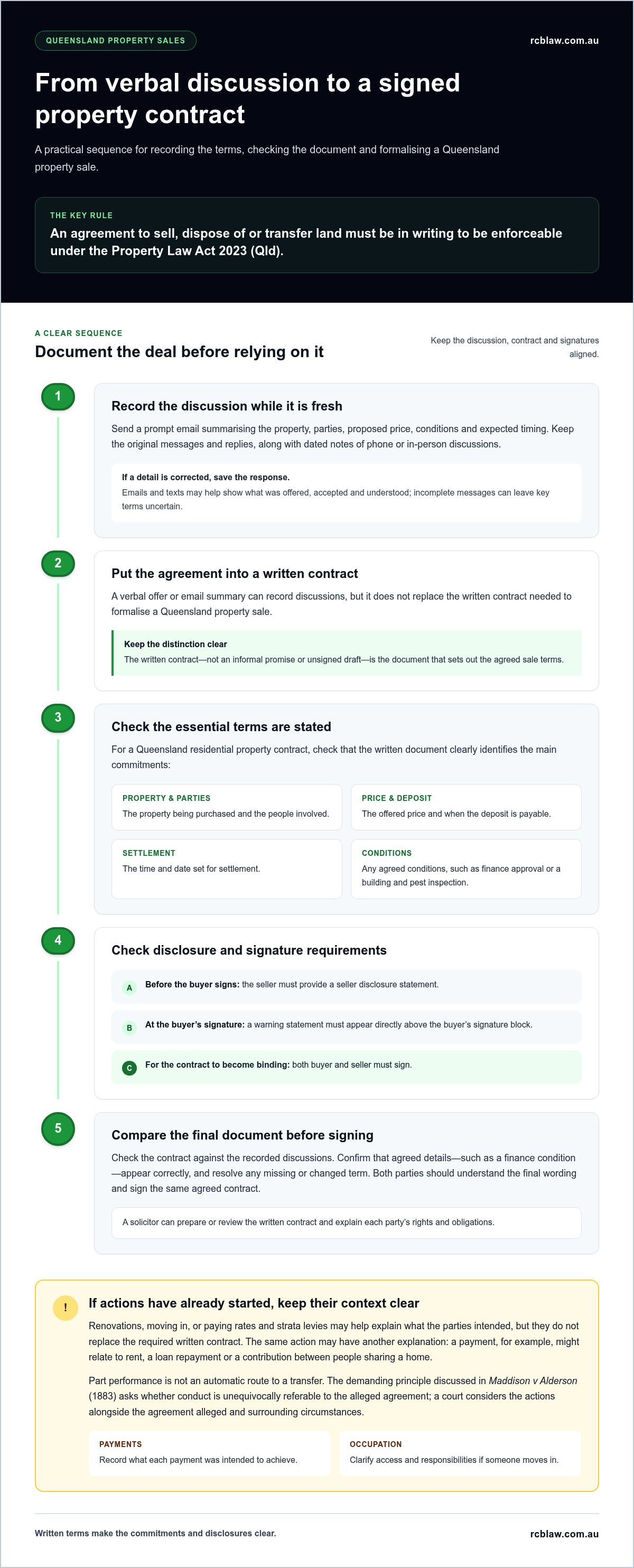
In Queensland, an agreement to sell, dispose of or transfer land must be in writing to be enforceable under the Property Law Act 2023 (Qld). Renovations, possession and payments may help explain what the parties intended, but they don’t replace the required written contract.
Evidence of Agreement Through Conduct
Conduct means actions that may support or challenge a claim that the parties agreed to a property sale. Renovating, moving into the property, or paying rates and strata levies may provide context. Their significance depends on whether they fit the alleged sale or have another reasonable explanation.
Those actions were relevant evidence, but the younger brother said the payments related to a life interest, not a sale. The dispute shows why conduct alone may not establish what the parties agreed.
Evidence of Agreed Terms
Evidence of agreed terms includes records showing what each person offered, accepted and understood. Emails and text messages can help establish the proposed price, conditions and timing, particularly when sent close to the discussion. Contemporaneous notes and witness testimony may also clarify what was said.
A useful record identifies the property and the parties, then captures the terms discussed. For example, an email summarising a proposed price and settlement date may help show what each person understood. Objective evidence matters because a court considers what the parties communicated and did, not undisclosed intentions. If they disagree about a condition or timeline, incomplete messages may leave key details uncertain.
Writing and Signature Requirements
For a Queensland residential property contract, the agreement must be in writing to be enforceable. The contract of sale must state the offered price, when the deposit is payable, and the time and date of settlement. Both buyer and seller must sign before the contract becomes binding.
The seller must provide a seller disclosure statement before the buyer signs, and a warning statement must appear directly above the buyer’s signature block. These requirements set out key terms and disclosures in the signed document. A verbal offer can start discussions, but it does not replace the written contract or signatures. Conditions such as finance approval or a building and pest inspection should also be included in the signed contract.
Advice to document property transactions in writing
In Queensland, move from discussion to a written contract before either party relies on informal promises. A prompt email can record what was discussed, but it cannot replace the signed contract needed to formalise the sale. This distinction helps prevent later disagreement about what the buyer and seller intended.
Document the proposed terms while the discussion is fresh. Email a summary of the property, proposed price, conditions and expected timing. Keep the original messages and replies, along with dated notes of phone or in-person discussions. If either party corrects a detail, save that response rather than relying on memory.
A solicitor can prepare or review the written contract and explain each party’s rights and obligations. The document should make the main commitments clear, including:
- The property being purchased and the parties to the transaction.
- The offered price and when the deposit is due.
- The time and date set for settlement.
- Any agreed conditions, such as finance approval or a building and pest inspection.
Before signing, compare the final document with the recorded discussions. If the buyer and seller discussed a finance condition, for example, check that it appears in the contract. A missing or changed term can create uncertainty even when earlier emails seem clear. Both parties should understand the final wording and sign the same agreed contract, rather than treating an unsigned draft as final.
For commercial transactions, legal advice can help address terms suited to the property and deal. RCB Law’s Commercial Property Law offering is relevant when documenting a commercial property purchase. Clear written terms give both sides a shared record to rely on as the transaction proceeds.
Part performance of an oral property agreement
Part performance is an argument that actions taken under an alleged oral agreement can support a claim for relief. The principle discussed in Maddison v Alderson (1883) focuses on whether the conduct is unequivocally referable to that agreement. The test is demanding: an action that fits several arrangements may not clearly point to a property sale.
Context matters. A payment might be rent, loan repayment, or a contribution between people sharing a home. The timing and purpose of each action can help distinguish these possibilities. Conduct that began before the alleged agreement, for example, may be less persuasive evidence that the parties later agreed to transfer the property.
Paying a deposit or moving into a Queensland property before signing carries practical risks. Without written terms, the parties may disagree about whether money was a deposit or another kind of payment, and what rights came with occupying the property. If the transaction stops, those disagreements can persist even if one person believes their actions showed commitment to the sale.
Keep a clear record of what each action was intended to achieve. A payment record should state its purpose, while an occupation arrangement should clarify access and responsibilities. These details can help distinguish performance of a sale agreement from a separate arrangement. Part performance is not an automatic route to a transfer: a court assesses the conduct alongside the alleged agreement and surrounding circumstances.
Whether verbal agreements are binding in Queensland property transactions
In Queensland, verbal discussions can show an intention to negotiate, but they usually do not create an enforceable land sale contract. The key distinction is between an informal understanding and completing the written, signed agreement.
Binding Verbal Agreements by Sale Type
The writing requirement applies to agreements for the sale, disposition or transfer of real estate, regardless of how the property is sold. A private sale, auction purchase or commercial property transaction still needs a written contract for the land agreement to be enforceable.
An auction has a different cooling-off position, not an exemption from the writing requirement. A verbal offer can start discussions, but it does not replace the contract. For commercial property, the same distinction applies: discuss proposed terms, then record them in the written agreement.
When a Sale Contract Becomes Binding
A Queensland property sale contract becomes binding when both buyer and seller have signed it. A contract can still contain conditions, so binding doesn’t necessarily mean unconditional. It becomes unconditional when the required conditions, such as finance approval, are satisfied or waived under the contract.
Check the signed terms to identify each condition and its deadline. For example, a finance condition means the purchase remains conditional until the contract’s requirements are met or waived. A verbal assurance about approval does not change the written condition.
For residential purchases in Queensland, the cooling-off period is 5 days, except for purchases at auction. A buyer who terminates during that period must pay a termination penalty of 0.25% of the purchase price.
These rules make the sale method and contract wording important before you commit. If you’re unsure how a condition affects your obligations, seek legal advice about your property contract before acting.
RCB Law: Residential Conveyancing
RCB Law can help clarify the next steps when a property purchase began with verbal discussions or a proposed contract needs review. Through its Residential Conveyancing service, the firm can prepare or review property documents and explain the rights and obligations set out in the agreement.
Advice before signing can help you identify whether the written terms reflect what you and the seller discussed, including conditions and settlement details. For a commercial property transaction, RCB Law also provides Commercial Property Law advice to help document the deal.
For guidance on your property transaction, contact RCB Law.
Make your next property decision with clarity
If you’re buying property with a verbal agreement in Queensland, start by making a clear record of where discussions stand. Gather relevant correspondence, notes and any documents already exchanged to identify the proposed terms and unresolved points. This gives you a practical starting point before signing or taking further action.
RCB Law’s Residential Conveyancing and Commercial Property Law services support property transactions, while Business Law may assist with related business matters. The right focus depends on what you’re purchasing and the issue you need resolved.
For advice on your circumstances, contact RCB Law and discuss the property agreement and documents with the firm. A considered next step can help you move forward with greater confidence.
Frequently Asked Questions
Are Handshake Agreements Legally Binding?
A handshake may signal a serious agreement, but it does not settle whether the parties intended to create legal obligations. Courts assess the circumstances, including whether the arrangement was a commercial deal or a casual favour. If someone negotiated for a company, their authority to bind the business may also matter. For example, a handshake with an unauthorised employee may not bind the company.
Are Verbal Contracts Legally Enforceable?
Some verbal contracts can be enforceable, but formal requirements apply to certain transactions. For example, in Queensland, a guarantee or indemnity generally needs a signed written record of its terms to be enforceable in a proceeding. Consumer lending arrangements can also have formal requirements under the National Consumer Credit Protection Act 2009 (Cth) and National Credit Code. The type of agreement determines which rules matter.
Conveyancing in Cairns - Are Verbal Agreements Binding?
A property’s location in Cairns does not create a separate set of contract rules from the rest of Queensland. Identify where the property is, rather than relying only on where the parties spoke or live. If the land is in Cairns, tell your solicitor at the outset and provide any relevant correspondence, draft documents and payment records for review.
How Do Courts Determine Whether a Verbal Contract Exists?
Courts assess the whole situation rather than relying on a single conversation or document. To make a dispute easier to understand, arrange records in date order and distinguish what was said from what each person later did. Note who took part in each discussion and whether anyone represented a business. This chronology can reveal missing information, changed terms or disagreement about when an understanding arose.
What Happens If a Verbal Contract Is Breached?
A claim for breach of contract may seek damages, including reasonable expenditure wasted in reliance on promised performance. For example, someone who paid for preparatory work may seek to recover that expense if expected profit cannot be established. Most Queensland breach-of-contract actions have a six-year limitation period, although exceptions and the date the claim accrued can affect the calculation. Keep invoices and payment records.
What Happens If the Verbal Deal Falls Through Completely?
If no enforceable contract exists, a party who provided work or another benefit may still have a claim for its reasonable value. A Queensland court or QCAT may allow recovery where the other party accepted the benefit and keeping it without payment would be unjust. Records of the work completed, its value and the recipient’s acceptance can help explain the claim.


