
A Queensland duplex has two separate living units in one building, but that does not automatically mean each side can be bought or sold separately. It may have one or two titles. A single-title duplex must be bought or sold as a whole. The key legal considerations when buying a duplex in Queensland are its title and whether it forms part of a community titles scheme.
It is easy to focus on the layout and overlook how ownership affects shared areas, insurance and ongoing costs. Understanding the legal structure early helps you assess what you will own and the responsibilities that come with it.
This guide explains what counts as a duplex and what to examine before you buy. You will learn how title arrangements and body corporate rules affect ownership, and what to consider for inspections, insurance and recurring expenses.
Key Takeaways
- A duplex can have one or two titles, and its title structure determines whether you can buy or sell one side separately.
- Check whether the property is part of a community titles scheme, because its Community Management Statement sets out important rules for shared areas and responsibilities.
- Review body corporate records, levies and any Lot Owners Agreement to understand existing obligations and potential costs.
- Arrange an inspection that covers both dwellings and shared areas, and understand how insurance must address shared walls, roofs and common property.
- Budget beyond the purchase price for ownership costs such as rates, utilities, insurance and ongoing maintenance.
Insurance for shared walls, roofs and common property
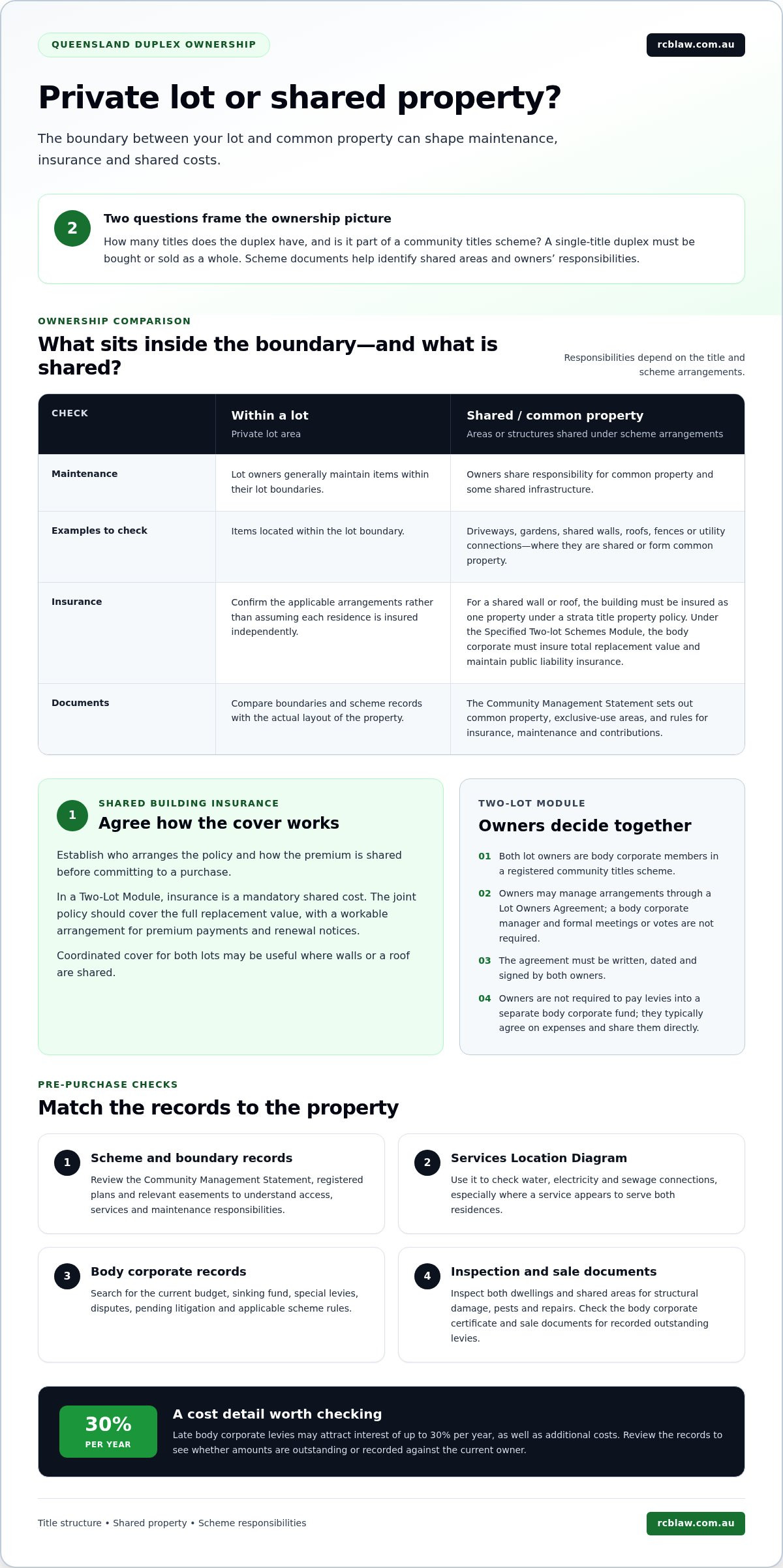
Insurance arrangements depend on how a Queensland duplex is titled and which structures the owners share. If the two units have a common wall or roof, the building must be insured as one property under a strata title property policy. Before committing to a purchase, establish who arranges the cover and how the premium is shared.
The body corporate must insure the building for its total replacement value, including common property and body corporate assets, under the Specified Two-lot Schemes Module Regulation 2011. It must also maintain public liability insurance. These requirements make insurance a shared ownership responsibility, not simply a choice for each resident to handle independently.
For a duplex with shared walls or a roof, it may be useful to discuss coordinated insurance cover for both lots with the other owner. The joint policy should cover the full replacement value. In a Two-Lot Module, insurance is a mandatory shared cost, so both owners need a workable arrangement for paying premiums and responding to renewal notices.
What legal risks arise from shared driveways, utilities, fences or easements at a Queensland duplex? Unclear access rights or service arrangements can lead to disputes about who may use shared areas and who pays for repairs. Check the Community Management Statement, registered plans and any relevant easements to understand access, services and maintenance responsibilities.
A Community Management Statement sets out the scheme’s legal structure, common property, exclusive-use areas, and rules for insurance, maintenance and contributions. A Services Location Diagram can show water, electricity and sewage connections. Compare these records with the property’s actual layout, especially if a driveway, fence or utility connection appears to serve both residences.
Common property is shared, while an exclusive-use area is allocated for one lot’s use under the scheme arrangements. This distinction can affect who maintains a driveway, garden or other space. Lot owners generally maintain items within their lot boundaries, but share responsibility for common property and some shared infrastructure.
Before purchase, arrange a building inspection covering both units and shared areas, such as driveways and gardens. Ask the inspector to assess structural damage, pest activity and repair needs. Compare the findings with the maintenance responsibilities in the scheme documents, so a defect in a shared roof or wall does not become an unexpected ownership dispute.
For rental income planning, include shared insurance and repair contributions alongside each lot’s other expenses. Queensland Revenue Office says the first home concession applies only to a home valued under A$800,000 and can save you up to A$24,525. That concession concerns purchase costs, so assess eligibility separately from the duplex’s insurance obligations.
Body corporate membership and owners’ responsibilities
In a Queensland duplex registered as a community titles scheme, both lot owners are members of its body corporate. Fees, by-laws and responsibilities depend on the scheme’s module, Community Management Statement and any Lot Owners Agreement.
Two-Lot Body Corporate Arrangements
A Two-Lot Module is a body corporate structure for a community titles scheme with two lots, commonly used for duplexes. Both owners make decisions together, often through a Lot Owners Agreement rather than formal committee meetings. For buyers, this means a neighbour’s cooperation can affect shared expenses and maintenance decisions.
Queensland introduced the Specified Two-Lot Scheme Module regulation in 2011 to let duplex owners manage arrangements through an agreement. Owners don’t have to appoint a body corporate manager or hold formal meetings or votes. A Lot Owners Agreement must be written, dated and signed by both lot owners.
If no agreement exists, either owner may request one in writing, stating the proposed details. This can help clarify how owners will manage shared costs, upkeep and decisions. For the agreement to operate under the Two-Lot Module, the Community Management Statement must identify that module.
Legislation, Fees and By-Laws
The Body Corporate and Community Management Act 1997 applies to registered Queensland community titles schemes. Its requirements operate alongside the scheme’s applicable regulation module and Community Management Statement. These documents help define how owners share responsibility and what rules apply to their lots and common property.
In a Two-Lot Module, owners are not required to pay levies into a separate body corporate fund. They typically agree on expenses and share them directly. By-laws and scheme documents can affect everyday use of the property. Owners remain responsible for maintaining most items within their lot boundaries, and share responsibility for common property and some shared infrastructure.
Late body corporate levies may attract interest of up to 30% per year, as well as additional costs. A buyer’s situation may also involve outstanding levies owed by the current owner. Reviewing the body corporate certificate and sale documents can clarify whether an amount is recorded and how it may affect the purchase.
Searching Body Corporate Records
A body corporate records search reviews the scheme’s documents and financial position before purchase. It can reveal the current budget, sinking fund, special levies, disputes or pending litigation, as well as the rules in the Community Management Statement. These records help buyers assess obligations beyond the purchase price.
Compare meeting records and financial information with the property’s condition and any planned maintenance. For example, a recorded special levy or unresolved dispute could affect the owners’ ability to agree on repairs. A body corporate certificate can provide information about the lot and scheme, including levy details relevant to the sale.
Review the records alongside the title documents and contract, rather than treating them as a separate formality. Council rates and property information may also help build a fuller picture, while body corporate records explain scheme-level obligations. A careful review helps buyers understand how shared decisions, expenses and by-laws apply to their plans to live in or rent out the property.
Queensland title arrangements and recurring costs
A Queensland duplex may have one or two titles, and that structure shapes how ownership costs are shared. For a clear purchasing budget, consider setup, transfer duty, utilities, insurance and rental expenses together.
Single and Separate Title Arrangements
A single-title duplex is one property, while a dual-title duplex has a separate title for each side. This distinction matters because a single-title property can only be bought or sold as a whole, although each residence can be rented separately.
With separate titles, each side can be bought and sold individually. Separate titles also mean separate fees for rates, water and insurance. Before purchasing, compare the title records with the Community Management Statement and check whether the arrangement supports your intended use, such as living in one side and renting out the other.
Body Corporate Setup and Utility Costs
A two-lot body corporate arrangement can involve costs and time for the survey plan and Community Management Statement. The council must seal the survey plan, and the statement must be registered with the Queensland Land Titles Registry. These steps can delay setup, so allow for them when considering a newly created scheme.
A Two-Lot Module does not require a body corporate manager or formal meetings and votes. Owners typically agree on expenses and share them directly. Utility arrangements depend on the property configuration: water and electricity connections can vary, and each residence may need its own heating, cooling and water-heating systems.
For an existing duplex, distinguish shared running costs from individual bills. The Community Management Statement and services layout can help clarify which connections serve each residence. This matters when estimating ongoing ownership costs, especially if one side will generate rental income.
Purchase and Rental Costs
Transfer duty depends on the purchase and the buyer’s circumstances, so include it in the acquisition budget alongside legal fees and ongoing maintenance. The applicable first home concession can also affect the purchase-cost calculation.
Dual-title ownership may make each side easier to sell separately, but it can also bring separate rates, water and insurance expenses. For rental planning, assess comparable nearby rents, demand and vacancy rates.
Potential rental income should not be assessed in isolation. Property management fees, repairs and maintenance also affect the return. Before buying in Queensland, review the title and scheme documents alongside a budget covering acquisition, utilities and ongoing costs. This makes it easier to compare a duplex with other property options on a like-for-like basis.
Whether a Queensland duplex is part of a community titles scheme
A Queensland duplex may form part of a community titles scheme, but its appearance alone does not establish that status. To buy one half under a scheme, that half must be a separately titled lot available for sale, with scheme documents setting out shared obligations.
Community Titles Scheme Status
A community titles scheme exists when lots are registered as a scheme with Titles Queensland and have a CTS number. Both lot owners then belong to the body corporate. Confirming registration matters because the scheme’s records and rules affect ownership, shared areas, costs and decisions.
Check the title search and registered Community Management Statement, or CMS, to understand the legal structure. The CMS identifies the regulation module and records scheme arrangements, including common property and exclusive-use areas. Queensland schemes use one of five associated regulation modules, so the applicable module matters when interpreting the owners’ responsibilities.
A duplex with two residential lots may use the Specified Two-Lot Module only when its CMS identifies that module. The number of dwellings alone does not establish which module applies. Compare the registered CMS with the title and survey plan to confirm that the documents describe the same lots and scheme.
Buying One Half Under a Scheme
Buying one half under a community titles scheme means purchasing a separate lot, rather than an informal share of a whole property. The lot’s title gives the buyer ownership of that lot, while scheme membership brings shared responsibilities. This distinction affects both day-to-day use and future selling options.
Before signing, match the lot number in the contract with the title, survey plan and CMS. Read the boundaries and any exclusive-use arrangements carefully. For example, a courtyard may be allocated for one lot’s use but remain subject to scheme rules. The CMS also helps explain how shared areas and expenses are managed.
Queensland’s seller disclosure scheme applies to body corporate property sales from 1 August 2025. The seller must provide a Form 2 disclosure document before the contract is signed. Body corporate property buyers should also receive information about the lot and scheme, including a body corporate certificate and seller disclosure statement.
Review the certificate for scheme information and recorded financial obligations, then compare it with body corporate records. Check for outstanding levies, special levies, disputes and pending litigation. These details can affect the cost and practical experience of owning the lot, even when its title is separate.
In a two-lot scheme, the other owner’s decisions can affect shared maintenance and expenses. Read the CMS and any Lot Owners Agreement before purchasing, and identify how the scheme handles shared decisions. This helps clarify the obligations attached to the lot before you commit to buying or later selling it.
What is the difference between a duplex on one title and a duplex with separate titles in Queensland?
A Queensland duplex may be held under one title or two separate titles. That distinction determines whether the property can be sold as a whole or each side can be transferred individually. Before signing, compare the contract’s lot description with the title search and registered plan.
With a single title, the two residences form one property for buying and selling. The owner can rent each side separately, but can only sell the duplex as a whole. For example, a buyer seeking one residence cannot purchase just that side if both units remain on one title.
Separate titles identify each side as its own lot. A buyer can purchase one lot, and its owner can later sell that side individually. Separate titles can make it possible to sell each side individually, depending on the property’s arrangements. The registered plan and title search should identify the lot being transferred, rather than merely describing it as one half of a duplex.
Separate titles do not remove shared obligations. If the lots are part of a community titles scheme, the Community Management Statement sets out the scheme’s structure, common property and rules. A shared roof, driveway or other infrastructure may still involve responsibilities between owners, even though each side has its own title.
When reviewing a purchase, match the property description across the contract, title search, survey plan and Community Management Statement. Confirm the lot number, boundaries and any exclusive-use areas. If the documents describe different arrangements, the mismatch can affect what the contract transfers and which areas the buyer may use.
Title structure can also shape ownership costs. Separate-title duplexes incur separate fees for rates, water and insurance. A single-title owner holds the property as one parcel, while each side may still be rented separately. Compare ongoing expenses with your intended use, such as occupying one residence and leasing the other.
For an existing duplex, do not assume its current use proves that both sides can be sold separately. Check the registered titles and plan to establish the legal arrangement. If individual sale matters to your plans, make it a key point in your document review before signing the contract.
Queensland conveyancing assistance can help you assess the title and contract together. Get help reviewing duplex title documents before you commit to a purchase, particularly where the contract’s lot description or shared property arrangements need careful interpretation.
RCB Law: Residential Conveyancing
RCB Law provides residential conveyancing for buyers assessing a Queensland duplex purchase. Turn to the firm when you need help understanding how the contract, title documents and community titles scheme records fit together before signing. Clear advice can help you identify the lot being transferred and understand the legal obligations attached to it.
Whether you plan to live in one residence, rent it out or buy both sides, the ownership structure matters. Conveyancing support can help you understand the transaction’s legal details and next steps.
For guidance with a Queensland property purchase, contact RCB Law about Residential Conveyancing.
Make your next property decision with clarity
A duplex purchase is also a decision about how you want to own and use property over time. Before proceeding, consider whether your plans may change: you might later rent out a residence, sell a lot or hold the property alongside a business interest. Aligning the purchase with those aims can help keep your next steps practical and informed.
RCB Law can assist with the legal considerations involved in buying a duplex in Queensland through residential conveyancing. If your plans involve commercial property or a business structure, its commercial property law and business law services may also be relevant. The right advice can help you understand how the transaction fits your broader property plans while keeping the immediate purchase in focus.
For guidance tailored to your duplex purchase, contact RCB Law about your purchase. Take the next step with a clearer understanding of the decision ahead.
Frequently Asked Questions
What is a duplex?
A duplex is a residential building in Australia containing two separate living units within one structure. Each unit can provide a separate household space, but that does not automatically mean each can be owned independently. For example, two households may occupy the residences while one owner holds the whole property. The title and registered plans show whether ownership is divided into separate lots.
Purchasing a duplex as an investment property in Brisbane or Moreton?
A duplex can provide rental income from one or both residences, but assess each side as a separate rental proposition. Compare nearby rents, tenant demand and vacancy rates, then factor in property management, repairs and maintenance. In Brisbane or Moreton, location, layout and condition can affect tenant appeal. Buyers searching “buying a duplex qld legal considerations” for an investment can use these factors to assess rental suitability.
Are there body corporate fees in a Two-Lot Module?
A Two-Lot Module does not require owners to pay levies into a separate body corporate fund. Instead, the two owners typically agree how to share expenses directly. Insurance remains a mandatory shared cost, and owners may need to contribute to repairs or other agreed work. Before buying, review the current arrangements and any written Lot Owners Agreement to understand how shared costs are handled.
How does the Two-Lot Module apply to duplexes in the Sunshine Coast?
The Two-Lot Module applies on the Sunshine Coast when a community titles scheme has two residential lots and its Community Management Statement identifies that module. Location alone does not determine whether it applies. Compare the registered statement with the title documents to see which module governs the scheme. This clarifies how the owners share decisions, insurance and maintenance responsibilities.
What if the two duplex owners disagree on property matters?
Start by reviewing the Community Management Statement and any Lot Owners Agreement, since these set out the scheme’s arrangements. A lot owner may request a Lot Owners Agreement in writing, with the proposed details. The agreement must be written, dated and signed by both owners. For example, it can clarify how owners will manage a shared repair or divide an agreed expense.
What is a Two-Lot Module in Queensland?
A Two-Lot Module is a body corporate structure for a Queensland community titles scheme containing two lots, commonly used for duplexes. It allows the owners to manage the scheme through arrangements such as a Lot Owners Agreement, without requiring a body corporate manager or formal meetings and votes. The registered Community Management Statement must identify the module for it to apply.
What legal checks should buyers make before purchasing a duplex in Queensland?
The legal considerations when buying a duplex in Queensland include reviewing the title, scheme documents and inspection findings. Compare the contract with the title search and survey plan to establish what is being transferred. Review seller disclosure documents and the body corporate certificate for scheme information. Building and pest inspections should cover both residences and shared areas. Also consider zoning, easements, insurance, outstanding levies and proposed shared work.
How can I confirm a Queensland property is legally approved as a duplex?
Review the local council’s planning and building records alongside the title search and registered survey plan. Council records can help establish whether the approved use and development match the property’s two-residence layout. Titles show registered ownership, but do not by themselves establish planning approval. If records, the current layout and seller documents differ, resolve the discrepancy before relying on the property’s presentation as a duplex.


