
In Queensland conveyancing, time is of the essence means the parties must meet the deadlines set out in their contract. If a deadline is missed, the other party may have a right to terminate, depending on the obligation and contract terms. An extension may be possible, but don’t assume one applies without a contractual right or the parties’ agreement.
A missed date can seem like a small delay, especially when finance, inspections or settlement arrangements are involved. But under time-is-of-the-essence rules in QLD conveyancing, an unexpected setback does not automatically change a contractual deadline.
This article explains which deadlines matter, what may happen if one is missed, and how an extension can be requested or agreed. It also explains why the contract wording matters, helping you understand your position and the practical options when a date is at risk.
Key Takeaways
- Queensland property contracts often make deadlines strict, so identify the obligations and dates set out in your contract.
- Missing a deadline can put the contract at risk and may expose the defaulting party to financial consequences.
- An extension may be available under the contract or by agreement, but don’t assume a request changes the deadline.
- The consequences can differ for buyers and sellers, depending on who failed to perform and what the contract requires.
- Understanding the contract terms can help you respond promptly when finance, inspections or settlement are delayed.
What does “time is of the essence” mean in Queensland property conveyancing?
Queensland property contracts commonly make time essential, so contractual dates can carry serious consequences. The wording, deadline and any extension rights determine what happens if a party performs late.
Meaning of Time Being of the Essence
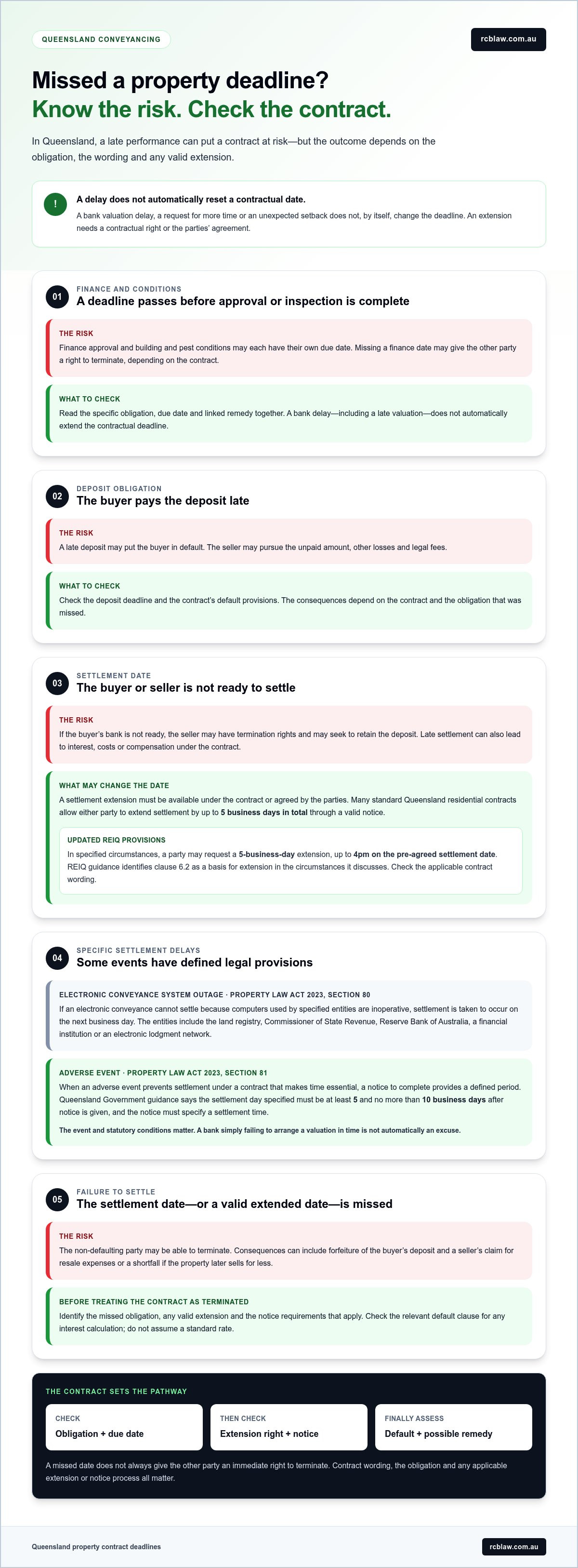
In Queensland, “time is of the essence” requires each party to meet contractual deadlines. Late performance may give the other party a right to terminate. Deadlines can apply to deposits, finance approval, building and pest conditions, and settlement. These obligations bind buyers and sellers, so a missed date can affect either side. A bank valuation delay does not by itself reset a contractual deadline. The contract wording and date calculations are central to assessing the risk.
Deadlines Without an Express Time Clause
Without an express term making time essential, a party will generally have a reasonable time to perform. That differs from a contract with strict dates, but it does not remove any express termination rights. Wording that allows termination if a specified deadline is missed can also make punctual performance essential. For example, a finance approval date may carry consequences if the contract links it to a right to terminate. The obligation, due date and remedy all matter. Missing a date does not automatically give the other party a right to terminate.
Contractual Settlement Extensions
A settlement extension changes the agreed settlement date under a contractual right or an agreement between the parties. Many standard Queensland residential contracts allow either party to extend settlement by up to five business days in total through a valid notice. Under the updated REIQ residential contract provisions, a party may request an extension of five business days in specified circumstances, up to 4pm on the pre-agreed settlement date. REIQ guidance identifies clause 6.2 as a basis for extending settlement in the circumstances it discusses. Check the applicable contract wording: an extension right isn’t necessarily available for every delay or obligation.
Making Time of the Essence
A buyer or seller can make time essential by agreeing to an express contract term that identifies the obligation and deadline. Wording that expressly permits termination when a time stipulation is missed may have the same effect, even without the exact phrase “time is of the essence.” Queensland residential contracts commonly already contain time-essential clauses. If the parties negotiate a change, clear written terms identify which date applies and what follows from non-performance. Read the deadline, any notice and the relevant extension provision together before treating the contract as terminable.
What Happens if you miss a deadline?
A missed deadline can put a Queensland property contract in default and expose the party at fault to claims. For a settlement delayed by an adverse event, according to Queensland Government, the notice to complete must set a settlement day at least 5 and no more than 10 business days after notice is given. It must also specify a settlement time.
Deposit, Finance and Settlement Obligations
Deposit payment, finance approval and settlement are separate obligations, each with its own contractual deadline. A late deposit may put the buyer in default, while the seller may pursue the unpaid amount, other losses and legal fees. If finance approval is not obtained by its due date, the other party may have a right to terminate. A bank delay, including a late valuation, does not automatically change the specified date.
Settlement is the final performance point: the buyer pays the balance and the seller completes the transfer. If the buyer’s bank is not ready, the seller may have termination rights and may seek to retain the deposit. The contract determines the consequences and any applicable notice process.
Protections for Settlement Delay
Sections 80 and 81 of Queensland’s Property Law Act 2023 address particular settlement delays. Under section 80, if an electronic conveyance cannot settle because computers used by specified entities are inoperative, settlement is taken to occur on the next business day. Those entities include the land registry, Commissioner of State Revenue, Reserve Bank of Australia, a financial institution or an electronic lodgment network.
Section 81 applies when an adverse event prevents settlement under a contract that makes time essential. The required notice gives a defined period to complete, rather than treating every delay as an immediate end to the contract. The event and statutory conditions matter; a bank simply not arranging a valuation in time isn’t automatically an excuse.
Penalty Interest and Delayed-Settlement Losses
Late settlement can create financial exposure beyond the deposit. The contract’s default provisions determine whether interest applies and how it is calculated, so check the relevant clause rather than assume a standard rate. A party in default may also be liable for the other party’s costs and compensation.
For example, a seller who incurs additional expenses because a buyer cannot settle may seek to recover losses under the contract. Keep records of the delay, notices and expenses, as these details help explain what happened and support any claim. A request for more time is not an agreed change to the settlement date.
Termination After Failure to Settle
If settlement does not occur on the settlement date or an applicable extended date, the non-defaulting party may be able to terminate immediately. Consequences can include forfeiture of the buyer’s deposit and a seller’s claim for resale expenses or a shortfall if the property later sells for less.
Before treating the contract as terminated, identify the missed obligation, any valid extension and the notice requirements that apply. For commercial property transactions, advice on commercial property contracts can help clarify default provisions and the consequences of delayed performance.
Does the other party have to agree to an Extension Notice?
It depends on the contract: some extension rights can be exercised by valid notice, while other changes require agreement between the parties. A request alone does not change a due date, so distinguish a formal notice under a clause from a proposal to vary the contract.
Requesting an Extension in Writing
A written extension request asks the other party to agree to a new date or time for a specified obligation. Identify the current deadline, the extra time sought and the reason, such as a lender’s delayed finance approval. Send the request before the existing due date where possible, and keep the response with the contract records. Until the change is agreed, treat the original date as operative.
Where the contract gives a party the right to extend settlement by notice, the notice must meet the clause’s requirements. Check who may give it, when it must be given, how it must be served and the maximum extension allowed. A message seeking extra time is not automatically a valid Extension Notice. For example, a buyer asking for a later settlement date still needs an available contractual right or the seller’s agreement.
Mutual Agreement to Extend Time
When no applicable clause gives one party a unilateral extension right, the parties may change a contractual date by mutual agreement. Both sides must agree to the proposed change: silence or an unanswered request does not establish agreement. Set out the new deadline and the obligation it affects, such as settlement or delivery of documents. Clear written terms help prevent disagreement about whether the original date still applies.
In Akrawe v Culjak, the deadline for documents for a proposed new contract was extended by agreement to 12.00pm on 11 March 2021. That example shows the value of recording the precise replacement time, not simply saying “more time.” If the parties agree to a new date, retain the written confirmation and ensure both sides understand what has changed.
Queensland residential contracts may also provide a specific settlement extension mechanism. REIQ guidance identifies clause 6.2 as a basis for extending settlement by up to five business days in the circumstances it addresses. That contractual right is different from requesting a negotiated change: where the clause applies and its notice requirements are met, the other party’s agreement may not be needed. The wording and conditions still control.
For any extension, check the relevant clause, the deadline for giving notice and the method of service. If the other party declines a request, the original date remains important unless a contractual extension right applies. Legal advice can clarify whether a proposed notice meets the contract’s requirements, particularly when settlement or a condition deadline is close.
Meaning of time being of the essence in Queensland conveyancing
In Queensland, settlement dates and times matter because the contract sets when each party must perform. The practical effect depends on the contract wording, the settlement appointment and any applicable extension.
How Settlement Deadlines Operate
A settlement deadline is the contractual point by which the buyer and seller must complete their agreed obligations. Under standard Queensland sale conditions, settlement must occur between 9 am and 5 pm on the Settlement Date. The contract may also state a specific settlement time. That detail matters because parties need to coordinate funds, documents and mortgage arrangements within the period the contract allows.
For a deadline that falls on a date, the relevant requirement is generally due by 5 pm that day. A party should distinguish the Settlement Date from an earlier appointment arranged between representatives. An appointment change does not necessarily amend the contractual date or time. Read the contract and any written variation together before treating a changed appointment as a changed deadline.
Settlement Timing in Queensland
Queensland property settlements generally take place between 2 pm and 4 pm, within the contractual window of 9 am to 5 pm. The actual appointment can be important, but the contract’s terms remain central. A delay in preparing a mortgage release, for example, can affect the ability to complete at the arranged time. Parties should keep communication flowing as documents and funds are coordinated.
The Queensland Court of Appeal considered settlement timing in Caprice Property Holdings Pty Ltd v McLeay & Anor [2013] QCA 125. The parties had agreed on settlement at 3 pm on the Settlement Date. The Court found settlement before 5 pm did not breach the time-essential requirement described in the case.
In that dispute, the seller was ready, willing and able to settle by 3:30 pm. The buyer refused to return ten minutes after the agreed 3 pm time, when the seller had obtained a mortgage release. The case shows why an agreed appointment and the contractual deadline must be considered separately. A short delay may still create a dispute about performance.
For buyers and sellers, identify three details in the signed contract: the Settlement Date, any specified time and the applicable settlement conditions. Then compare these terms with later written agreements and notices. If an appointment shifts, confirm whether the parties changed only the meeting time or formally extended the settlement deadline. This distinction determines whether a delay is logistical or a failure to perform on time.
Buyer and seller default consequences
A breach can affect either side of a Queensland property transaction, not just the buyer. The financial and legal consequences depend on the obligation missed, the contract terms and what the other party does next. A late deposit, unmet finance approval condition or failure to settle can each create a different default. Identify who was required to perform, what the contract required and whether the other party has exercised a contractual right.
When the Buyer Defaults
A buyer who pays a deposit late may face termination and claims relating to the unpaid amount. The seller may also seek other losses and legal fees. If a buyer fails to settle because finance is not ready, the seller may terminate and claim the deposit. If the property is resold for less than the original price, the seller may also claim the shortfall and resale expenses.
These outcomes can be serious, but they are not interchangeable. A late deposit concerns a payment obligation, while failure to settle concerns completion of the whole transaction. The contract identifies the relevant breach and any notice process. Keep payment records, lender communications and notices together so the timeline and reason for the failure are clear.
When the Seller Defaults
A seller can also breach the contract by failing to perform an obligation required for completion. Depending on the terms and circumstances, the buyer may have contractual rights that include enforcing the agreement or terminating it. A seller’s failure to provide what is needed for settlement can disrupt the buyer’s plans and have financial consequences. Distinguish a temporary issue from a failure that triggers a contractual remedy.
For either party, termination is not the only possible response to breach. A party may seek compensation or enforcement, while the contract may set out notice requirements and other remedies. For instance, a buyer facing a seller’s failure to complete should consider the available contractual options before treating the transaction as ended. The facts, documents and communications help establish which response is available.
Assessing the Consequences
Start by comparing the missed obligation with the signed contract and any written variation. Then gather evidence of the due date, attempted performance, communications and losses. A buyer waiting for finance approval should preserve lender updates; a seller alleging late payment should retain deposit records. These materials help distinguish a genuine breach from a misunderstanding about dates or an agreed change.
Don’t assume that an unexpected delay removes responsibility or that termination automatically resolves every financial claim. Each party’s rights follow from the contract and the conduct surrounding the breach. For a clear assessment of default risks in a property transaction, seek legal advice about your property contract.
RCB Law: Residential Conveyancing
RCB Law provides residential conveyancing for buyers and sellers dealing with contract deadlines, settlement arrangements and extension questions. If a date is approaching or has already passed, legal advice can clarify the contract terms, the steps taken by each party and the available options.
Bring the signed contract, any written extension or notice, and relevant communications about the delay. These documents help identify the obligation involved and whether the contract provides an extension right or another response. If you have a property deadline concern, contact RCB Law to discuss your circumstances.
Take the Next Step With Clarity
A property transaction is also a planning decision. Keep the contract, correspondence and key dates together, and make sure everyone involved understands who is handling each outstanding task. This makes it easier to spot a developing issue before it disrupts your plans.
Understanding time is of the essence in QLD conveyancing can help you approach a deadline with greater confidence. If a contract date is approaching or a delay has created uncertainty, early advice can clarify the terms shaping your options. RCB Law assists with residential conveyancing, commercial property law and business law, including property matters where contractual timing needs careful attention.
Contact RCB Law for conveyancing advice and discuss the next step for your property matter. With clear guidance, you can move forward with a better understanding of your position.
Frequently Asked Questions
Buying a Qld Property?
Before signing, make sure you understand the contract dates and what you must do by each one. Note when the deposit is due, when finance approval must be addressed and how building and pest conditions operate. Ask your conveyancing solicitor to explain any clause you do not understand before you commit. Keep lender, inspection and contract communications together so you can respond promptly if a transaction date becomes difficult to meet.
Can either party extend settlement by five business days?
Either party can use a five-business-day settlement extension where the applicable Queensland residential contract gives that right and its notice requirements are met. Under updated REIQ residential contract provisions, a party may request the extension in specified circumstances, up to 4pm on the pre-agreed settlement date. Check the contract’s edition and clause, the total extension already used, and how notice must be given. A request outside the contractual mechanism needs agreement.
Can the seller charge penalty interest?
A seller can claim penalty interest only if the contract provides for it and the relevant default conditions are met. The applicable clause determines when interest starts, how it is calculated and whether a valid extension changes the period. For example, a buyer should distinguish a settlement delay covered by an effective extension from a failure to settle by the operative date. Review the signed contract and any written variation to identify the basis for a claim.
Does an extension mean the delaying party is in default?
No, an effective extension changes the applicable deadline, so completing by the extended date is not late solely because the original date has passed. The written notice or agreement should clearly identify the obligation and replacement date. For instance, extending settlement does not necessarily extend a separate finance or inspection deadline. Check which specific date changed and whether other contractual obligations remain in force. Keep the extension with the contract so both parties can refer to the same terms.
Is there an automatic grace period?
No, a missed date does not create a general grace period for Queensland property contracts. Extra time must come from an applicable contractual extension, a valid agreement or a specific legal provision. For example, an electronic settlement outage involving specified systems can engage a statutory settlement rule, but that does not create extra time for every delay. Treat each deadline as operative unless a valid extension or relevant provision changes it.
What Happens if a Buyer or Seller Cannot Settle on Time in Queensland?
The party who cannot settle should promptly tell their conveyancer and identify the cause, such as an unavailable loan payout or missing settlement funds. The other party’s rights depend on the contract, any effective extension and whether a statutory protection applies. Failure to settle can lead to termination and claims for financial loss. Preserve lender messages, settlement communications and notices, as they help establish what prevented completion and when each party knew.
What are the practical implications for your contract?
Your contract sets the tasks, deadlines and remedies that shape what happens next. Check whether the issue concerns a condition date, deposit payment or settlement, because an extension for one obligation does not automatically change another. Compare the signed terms with later notices and written variations. For example, a changed settlement appointment is not necessarily a changed settlement date. Keep dated communication records to help identify the operative terms.
What does “time is of the essence” mean in a Queensland conveyancing contract?
It means the parties must perform specified contractual obligations by their due dates, and late performance can give the other party rights under the contract. In time-is-of-the-essence QLD conveyancing, the exact obligation and wording matter: a deposit deadline and a settlement date can have different remedies. Read the relevant clause alongside any notice or variation. A delay outside a party’s control does not by itself change a strict contractual deadline.


