
A jointly owned property doesn’t always pass to a partner in the same way. What happens to a jointly owned property if one partner dies depends on the title: a joint tenant’s interest generally passes to the surviving owner, while a tenant in common’s share usually forms part of their estate. If both owners die, the order of death and the state or territory can affect who inherits the property.
It’s understandable to expect a shared home to pass automatically to the other owner, especially when both partners contributed to it. But the outcome depends on how the property is legally held, and a will may not override the right of survivorship that applies to joint tenants.
This article explains the difference between joint tenants and tenants in common, what happens to a deceased owner’s share, and how simultaneous deaths can affect the result across Australia. You’ll also learn what to look for on the property title and why the ownership structure matters when planning an estate.
Key Takeaways
- Find out whether the title records joint tenancy or tenancy in common, as that distinction shapes what happens to an owner’s interest.
- Understand why a will may not control a joint tenant’s share, while a tenant in common’s share can form part of their estate.
- Learn how the order of death and the state or territory can affect jointly owned property when both owners die.
- See what the title can reveal about ownership type and, for tenants in common, each owner’s share.
- Explore how conveyancing and will drafting can help clarify ownership and support estate planning.
What Happens to a Jointly Owned Property If One Owner Dies in Australia?
In Australia, the title determines whether a deceased owner’s interest passes to another owner or to their estate. The key distinction is between joint tenancy and tenancy in common.
Joint Tenancy and Survivorship
Joint tenancy gives two or more owners equal rights to the entire property, with survivorship determining what happens when one owner dies. The surviving joint tenant receives the deceased owner’s interest automatically, rather than through the deceased’s estate. A deceased joint tenant’s interest usually can’t be passed under their will, so the title’s ownership type matters more than the will’s directions about the property.
For example, where two joint tenants each hold an equal interest, the surviving owner becomes the sole owner when the other dies. In the Australian example, the surviving joint tenant received the deceased joint tenant’s 50% interest. The survivor generally needs to make a survivorship application to have the title updated. For capital gains tax purposes, a deceased joint tenant’s interest is treated as passing in equal shares to the surviving joint tenants. A surviving joint tenant may also be entitled to the main residence exemption for an acquired interest if the property was the deceased’s main residence.
Tenants in Common Ownership
Co-ownership arrangements can give each person a separate share, and those shares need not be equal. Unlike joint tenancy, a deceased owner’s share forms part of their estate, so it can pass under their will or be dealt with by the estate’s legal personal representative. This distinction matters when an owner wants their share to go to a beneficiary rather than automatically to a co-owner.
For example, tenants in common might own a property in a 60/40 split, or one owner might hold 70% and another 30%. An owner with an 80% share can leave that interest to a named beneficiary, as in the example where Anita’s share passed to her son Isaac. In Queensland, owners can change joint tenancy to tenancy in common, or the reverse, if everyone agrees and registers the change with Titles Queensland. Legal advice can help clarify how that change affects each owner’s estate plan.
Mortgages and Other Debts
A mortgage adds the lender’s interest to the ownership question, so both the title and loan records matter after an owner dies. If jointly owned Australian property has a mortgage, the lender must update its records after a joint tenant dies. Survivorship determines who receives the deceased owner’s interest; the mortgage remains a separate consideration when managing the property.
Other debts also need to be considered alongside the ownership structure. A tenant in common’s share enters their estate, where the legal personal representative can deal with it, including transferring or selling the interest. By contrast, a joint tenant’s interest passes to the surviving owner rather than under the deceased’s will. The title and the deceased owner’s estate are therefore central to understanding how debts relate to the property.
Sole ownership, joint tenants or tenants in common?
The title identifies who owns a property and how a deceased owner’s interest passes. In Australia, sole ownership, joint tenancy and tenancy in common lead to different outcomes after a death.
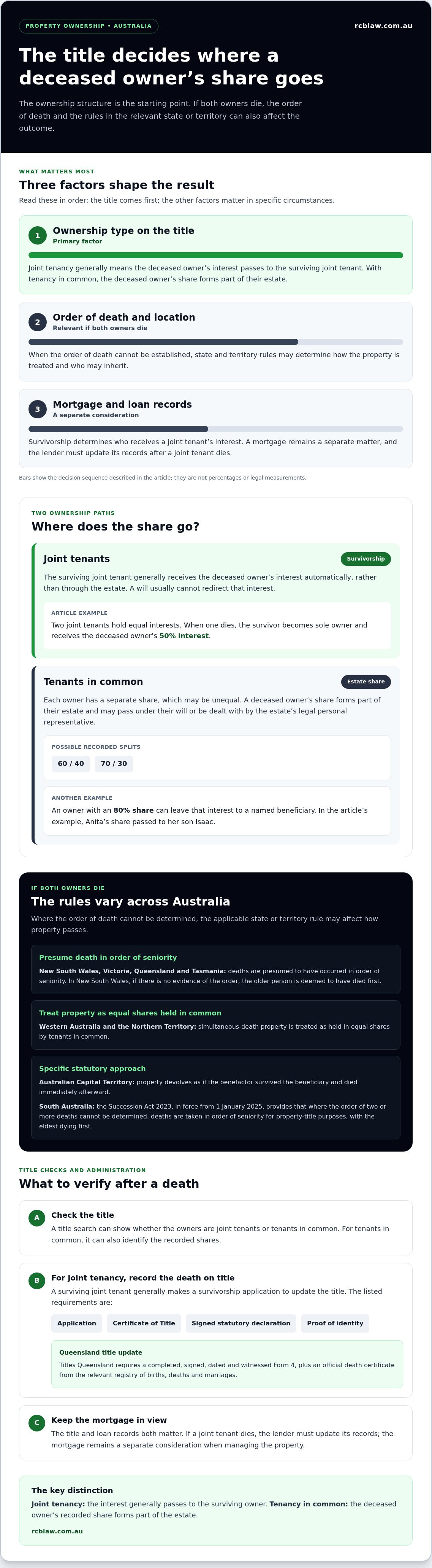
A surviving joint tenant generally receives the deceased owner’s interest through survivorship, rather than under their will. To update the title, the surviving joint tenant must make a survivorship application. The listed requirements are an application, the Certificate of Title, a signed statutory declaration and proof of identity. These documents support changing the title from the deceased owner’s name to the surviving owner.
In Queensland, recording a joint tenant’s death requires a completed, signed, dated and witnessed Form 4, plus evidence of death. Titles Queensland requires an official death certificate from the relevant registry of births, deaths and marriages. A Queensland title search can show whether owners hold the property as joint tenants or tenants in common, and identify shares for tenants in common.
- A survivorship application records the deceased joint tenant’s death on title.
- A title search identifies the registered ownership type and, for tenants in common, the recorded shares.
Presumptions about who died first can affect how property passes between people who die in the same event. In New South Wales, if there’s no evidence of the order of death, the older person is deemed to have died before the younger person. In the Australian Capital Territory, property devolves as if the benefactor survived the beneficiary and died immediately afterward.
Western Australia and the Northern Territory treat property in simultaneous-death cases as held in equal shares by tenants in common. New South Wales, Victoria, Queensland and Tasmania presume deaths occurred in order of seniority. South Australia’s Succession Act 2023 came into force on 1 January 2025. It provides that when the order of two or more deaths can’t be determined, deaths are taken in order of seniority for property-title purposes, with the eldest dying first.
If the surviving owner and the deceased owner’s beneficiaries disagree, the title type determines the starting point. A joint tenant’s interest generally passes to the surviving joint tenant, not under the deceased’s will; a tenant in common’s share forms part of the estate and may pass to beneficiaries.
For property held as tenants in common, each owner’s recorded share is central to understanding the estate’s interest. For jointly held assets, the survivorship rules and the applicable state or territory’s order-of-death presumption matter. These distinctions help clarify which interests are affected before decisions are made about the property.
Where the property is commercial, Commercial Property Law can help address legal questions about ownership and title. The relevant jurisdiction, registered ownership type and any recorded shares shape the issues to consider.
Effect of simultaneous death on jointly owned property
If co-owners die in the same event and there’s no evidence establishing who died first, the applicable state or territory’s rules can affect how the property is transferred. The result matters because joint tenancy normally depends on one owner surviving another, while the order of death can determine which estate receives an interest.
In New South Wales, Victoria, Queensland and Tasmania, deaths are presumed to have occurred in order of seniority. The eldest is treated as dying first, followed by the younger person. For joint tenants, that assumed sequence can affect whether an interest passes to a surviving co-owner before entering an estate. The order can therefore shape which beneficiaries ultimately receive the property.
Western Australia and the Northern Territory apply a different approach in simultaneous-death cases: the property is deemed held as tenants in common in equal shares. Each owner’s share can then be dealt with through their estate. This differs from survivorship between joint tenants, because the property is allocated in equal interests rather than passing through an assumed sequence of deaths.
South Australia’s Succession Act 2023 came into force on 1 January 2025. It provides that when the order of two or more deaths cannot be determined, deaths are taken to have occurred in order of seniority for purposes affecting property title, with the eldest dying first. That prescribed sequence can determine which estate receives an interest and how a later transfer is handled.
The Australian Capital Territory has a rule for property passing between people who die at the same time: the benefactor is treated as surviving the beneficiary and dying immediately afterward. This sequence affects how the benefactor’s property devolves. For example, if one co-owner was to inherit from another, the legal order can determine whether that interest enters the inheriting owner’s estate or passes elsewhere under the applicable arrangements.
These differences between jurisdictions make the property’s location important. A family’s understanding of who died first may not settle the title outcome when evidence cannot establish the order. The registered ownership arrangement, applicable presumption and each owner’s will can all affect how shares are dealt with. A lawyer reviewing the title and estate documents can explain how the rules interact in the circumstances.
For example, where joint tenants die and the state presumes the eldest died first, the younger owner may be treated as surviving them. Under that sequence, the property interest can then be considered part of the younger owner’s estate. In Western Australia or the Northern Territory, equal shares are treated as tenancy-in-common interests instead. The different rules can change which beneficiaries receive the property.
When planning for jointly owned property, owners can consider whether their title arrangement reflects their intended inheritance outcomes. The relevant state or territory’s rule may determine the result if both owners die and the order cannot be proven. Reviewing ownership and estate documents together helps clarify how a transfer and each estate’s interests may be handled.
What happens to a deceased owner’s interest
The type of ownership determines whether a deceased person’s property interest enters their estate. A joint tenant’s interest generally passes to the surviving joint tenant, while a tenant in common’s separate share becomes part of the deceased owner’s estate. That distinction affects whether the will can direct who receives the property interest.
For joint tenancy, survivorship means the deceased owner’s interest passes to the surviving owner rather than being distributed under the deceased person’s will. The will may address other assets, but it usually can’t redirect that jointly held property interest. The surviving owner must still have the title updated to reflect the death and resulting ownership.
A tenant in common owns a distinct share, which may be equal or unequal to another owner’s share. When that owner dies, their interest can be dealt with under their will or applicable state legislation. The estate’s legal personal representative may transfer the share to a beneficiary, sell it, or otherwise dispose of it while administering the estate.
For Australian real estate in a deceased estate, the property generally needs to be transferred into the executor’s or administrator’s name before it can be transferred to beneficiaries. A beneficiary named in a will does not necessarily become the registered owner immediately. The executor or administrator handles the estate’s legal steps before making the later transfer to the beneficiary.
That process differs from survivorship. If the deceased held the property as a joint tenant, the surviving joint tenant’s interest passes through survivorship, rather than as a share distributed by the executor. If the deceased held a share as a tenant in common, that share remains part of the estate. The title’s ownership type therefore guides the next transfer.
Solely owned real estate also usually forms part of the deceased person’s estate. If there’s a will, distribution follows its directions, subject to estate administration. If the person dies without a will, state legislation determines who inherits. The executor or administrator connects those inheritance rules with the property’s registration and transfer.
A property rented out by a deceased landlord illustrates how estate administration affects others. The lease continues between the tenant and the executor or administrator. The landlord’s death does not itself end the tenancy; the estate representative takes the landlord’s place in the lease relationship while administering the property.
Survivorship also applies to jointly held real estate, bank accounts and other assets. However, each asset’s ownership arrangement determines whether it passes to a survivor or enters the estate. For example, a jointly held bank account may follow survivorship, while a deceased person’s separately owned investment can form part of their estate.
When reviewing property ownership, identify the registered owners, the ownership type and any stated shares. Then compare those details with the will and the estate administration. This helps distinguish property that passes through survivorship from an interest an executor or administrator must handle for beneficiaries.
How does joint tenancy differ from tenants in common in Australia when an owner dies?
The central difference is whether an owner has a separate share that can pass through their estate. Joint tenancy links the owners’ interests, while tenants in common hold defined percentages. That distinction affects inheritance, estate planning and what a co-owner can do with their interest during their lifetime.
Joint tenants have equal rights to the entire property, rather than individually identified portions. If one joint tenant dies, the right of survivorship generally means their interest passes to the surviving joint tenant. A will usually can’t redirect that interest to someone else. For partners who want the survivor to become the owner, this structure can align with that intention.
Tenants in common own separate shares, which may be equal or unequal. For example, Queensland owners could hold 50/50 shares or a 60/40 split. If a tenant in common dies, their share forms part of their estate and can be left to a beneficiary. The survivor doesn’t automatically receive that separate interest just because they co-owned the property.
Compare the outcomes using a 60/40 ownership arrangement. If the owners are tenants in common and the 40% owner dies, that 40% interest enters their estate. Their will can direct it to a beneficiary, and the surviving co-owner retains their 60% share. Under joint tenancy, owners don’t hold those separate percentages; survivorship governs the deceased owner’s interest.
- Joint tenancy: survivorship generally passes the deceased owner’s interest to the surviving joint tenant, rather than under their will.
- Tenants in common: each owner’s percentage is separate, and a deceased owner’s share can pass through their estate.
Separate ownership can also affect decisions during an owner’s lifetime. A tenant in common may often sell, mortgage or lease their share without the other tenants’ agreement, unless an agreement provides otherwise. That flexibility matters if an owner wants to deal with their interest independently. Joint tenancy instead connects ownership to the other joint tenants through survivorship.
In Queensland, a title search from Titles Queensland can show the ownership type and, for tenants in common, the registered shares. If all owners agree, they can change joint tenancy to tenancy in common, or the reverse, by registering the change with Titles Queensland. The intended inheritance outcome should guide consideration of the arrangement and each owner’s will.
If you’re reviewing a property arrangement or considering a change, get advice about property ownership before taking action. The title, co-ownership arrangement and estate intentions determine which ownership structure fits the circumstances.
RCB Law: Residential Conveyancing
RCB Law assists with residential conveyancing when a death affects property ownership, including title matters and the transfer of an interest. This can clarify the next steps when a surviving owner needs the title updated or an executor is handling a tenant in common’s share. Will drafting can also help owners prepare estate plans that account for how their property is held.
The right approach depends on the registered ownership type, the property title and the estate documents. Understanding these details can make decisions about a property transfer clearer during a difficult time.
Contact RCB Law to discuss your property circumstances.
Take the Next Step With Confidence
Understanding what happens to a jointly owned property if one partner dies can prompt a wider question: does your current ownership arrangement reflect the future you intend? Consider reviewing the property title alongside your estate documents, especially after a relationship, financial or business change. Clear planning can help reduce uncertainty for the people who may need to manage your affairs.
RCB Law assists with property matters through residential conveyancing and commercial property law, as well as related business law considerations. The right focus depends on whether the property is residential or commercial and how it connects with your broader plans.
For a considered discussion about your property and estate arrangements, discuss property and estates with RCB Law. A clear next step can help you plan with greater confidence.
Frequently Asked Questions
How does a joint tenancy transfer work?
A joint tenancy transfer records the surviving owner’s title after a co-owner dies. In Queensland, the death is recorded using a completed, signed, dated and witnessed Form 4, with evidence of death. Titles Queensland requires an official death certificate from the relevant registry of births, deaths and marriages. The title record is then updated to reflect the survivor’s ownership. Requirements and forms can differ between Australian states and territories.
What does this mean for the joint assets of couples that die ‘simultaneously’?
If evidence cannot establish which partner died first, the relevant state or territory’s rules may determine how jointly held assets are treated. Joint assets can include real estate, bank accounts and investments, but property-title rules may not answer every question about each asset. For example, New South Wales presumes the older person died first when the order cannot be established. The applicable rules can affect which estate receives an interest.
What happens in South Australia to jointly held assets if you and your spouse die at the same time?
In South Australia, the Succession Act 2023 provides that, when the order of two or more deaths cannot be determined, deaths are taken in order of seniority for purposes affecting property title, with the eldest dying first. The Act came into force on 1 January 2025. This presumed sequence can affect which estate receives a property interest. The title arrangement and other jointly held assets still need separate consideration.
What is right of survivorship?
Right of survivorship is the feature of joint tenancy that gives the surviving joint tenant the deceased owner’s interest. It applies to jointly held assets such as real estate, bank accounts and investments. For a property, the survivor uses a survivorship application to have the title reflect the change. A will generally can’t control a joint tenant’s interest, so the registered ownership arrangement matters when planning who should receive an asset.
In Australia, what happens to jointly owned property when one owner dies?
The answer to what happens to a jointly owned property if one partner dies depends on the title’s ownership type. A joint tenant’s interest generally passes to the surviving joint tenant, while a tenant in common’s share becomes part of their estate. For instance, an owner with a distinct 20% share as a tenant in common has a separate interest that can be dealt with through the estate. The relevant state or territory also matters.
What happens to a deceased owner's share in an Australian property held as tenants in common?
The deceased owner’s share becomes part of their estate rather than automatically passing to the other co-owner. The will may leave the share to a beneficiary; if there’s no will, state legislation determines who inherits. The estate’s legal personal representative can transfer the interest to a beneficiary, sell it or otherwise dispose of it. Real estate in a deceased estate generally needs to be transferred into the executor’s or administrator’s name before passing to beneficiaries.
Can a will override property ownership survivorship rights in Australia?
A will generally can’t redirect a joint tenant’s property interest because survivorship determines where that interest passes. A tenant in common’s share is different: it forms part of the deceased owner’s estate and can be bequeathed under their will. For example, an owner who wants a property share to pass to someone else may need to consider how the title is held alongside their estate plan. Ownership type is central to that distinction.
How can you check whether Australian property is held as joint tenants or tenants in common?
Review the property title or obtain a title search to identify the registered ownership type. In Queensland, a search from Titles Queensland can also show the shares held by tenants in common. In Victoria, the title describes whether co-owners hold property as joint owners or tenants in common. If the record shows tenants in common, note each registered share, since those percentages affect how an owner’s interest may be handled after death.


