
In NSW, property contracts are commonly not subject to finance. If a buyer goes unconditional and the home loan later falls through, the deposit may be at risk. Getting your deposit back if finance fails after going unconditional is difficult unless the contract gives you a right to end it, such as a negotiated finance condition, and you meet its requirements.
A loan refusal can feel like a clear reason to withdraw, but once a contract is unconditional, both parties are generally obliged to complete the sale. If you can’t settle, you could lose your deposit and face a claim for further losses.
This guide explains how NSW finance conditions work, what reasonable steps to obtain approval can involve, and why timing and written notice matter. It also covers how tailored clauses can address valuation or lender requirements, and the risks of proceeding without finance protection.
Key Takeaways
- A negotiated finance condition can provide a path to end the contract and recover the deposit, but only if you meet its requirements and give notice on time.
- Promptly applying for the loan, supplying requested documents and responding to lender questions can help show you took reasonable steps to obtain approval.
- If you can’t settle after going unconditional, the consequences may extend beyond losing the deposit to a vendor claim for damages.
- Tailored finance clauses can address specific hurdles, such as a property valuation or guarantor arrangements, rather than relying on a broad condition.
- Understand the contract’s finance protections before exchange, because proceeding without them can leave you exposed if lending falls through.
Does my NSW contract usually have a finance condition?
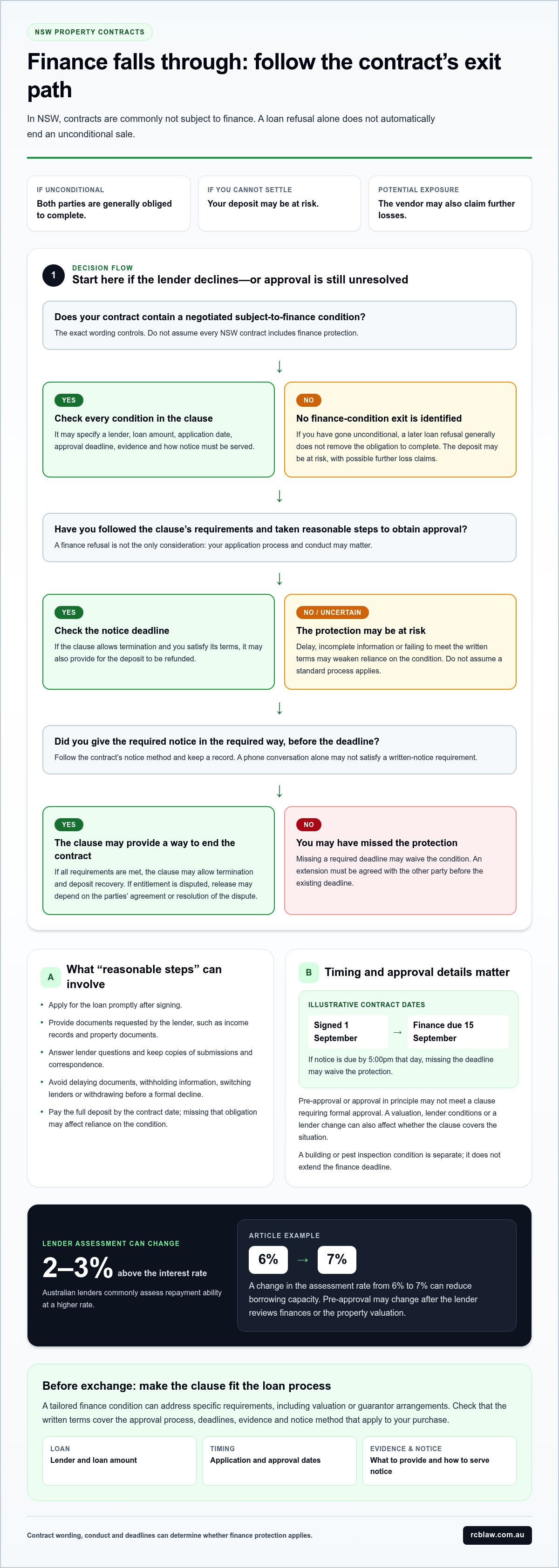
In New South Wales, property contracts are commonly not subject to finance. A buyer who signs unconditionally may still have to complete if a lender later declines the loan. A negotiated subject-to-finance special condition can provide a way out, but the exact wording controls. It may require a formal loan application, a lender’s decision by a stated deadline, and written notice to the vendor. If the buyer meets those requirements, the clause may allow them to terminate and recover the deposit.
In Australian property sales, the deposit is paid to the stakeholder named in the contract and held while the sale proceeds. If the contract ends under a valid finance condition, the clause may require the deposit to be refunded. If entitlement is disputed, the holder may need the parties’ agreement or resolution of the dispute before releasing it.
Read the special condition alongside the rest of the contract. It may specify the lender, loan amount, application date, approval deadline, evidence required, and how notice must be served. A clause naming one lender may not cover a later switch to another. Likewise, a condition requiring formal approval may not be satisfied by pre-approval or approval in principle. Follow the written terms rather than assuming a standard process applies.
Deadlines matter. For example, a hypothetical contract signed on 1 September could set finance as due on 15 September. If the clause requires notice by 5:00pm that day, missing the deadline may waive the protection. An extension must be negotiated with the other party and agreed before the existing deadline. A phone conversation alone may not meet a written-notice requirement, so follow the contract’s delivery method and keep a record.
The buyer’s conduct also matters. A purchaser seeking to end the contract because finance was refused must apply promptly and do everything reasonably required to obtain approval. That includes providing documents requested by the lender and responding to queries. Delaying the application, changing lenders, withholding information, or withdrawing before a formal decline may put the protection at risk. A building or pest inspection condition is separate and does not extend the finance deadline.
Pay the full deposit by the date stated in the contract. Missing that obligation may affect your ability to rely on the finance condition. Once conditions are met or waived, both parties are generally obliged to complete. Before signing, confirm that a tailored subject-to-finance condition covers the loan approval process and any valuation requirements. If finance is uncertain, going unconditional can put the deposit at risk before settlement funds are ready.
Applying for finance and taking reasonable steps to obtain approval
Start the finance application promptly after signing, because the contract deadline may arrive before the lender completes its assessment. Under a finance condition, a purchaser must make an immediate loan application and do everything reasonably required to obtain approval. This includes providing requested income records, answering lender questions, and supplying property documents. Keep copies of submissions and lender correspondence so the timeline is clear if approval is refused.
Pre-approval is not the same as unconditional loan approval. A lender’s approval in principle relies on assumptions and may be withdrawn if those assumptions prove incorrect. For example, a lender may reassess borrowing capacity after reviewing income, debts, expenses, or the property valuation. Australian lenders commonly assess repayment ability at a rate 2-3% above the interest rate. A change in the assessment rate from 6% to 7% can reduce borrowing capacity.
The property’s suitability as security can also affect the outcome. Approval subject to valuation remains conditional, and the lender may reject the loan if the property does not provide adequate security. A finance clause can allow time for the valuation and outstanding approval conditions, but only if its wording covers the relevant process. A purchaser who proceeds unconditionally before those matters are resolved takes on the settlement obligation without that contractual exit.
If the deadline is approaching, seek an extension before it passes. The parties must negotiate and agree to an extension; the buyer cannot extend the date alone. Put the proposed new date and agreement in writing, and keep the response. A request made after expiry may not restore an expired protection. The available time can be especially tight if the buyer has only just started the loan process.
For example, a purchaser who signs while still gathering payslips and bank statements should lodge the application promptly and respond to each lender request without delay. Switching lenders, delaying documents, or withdrawing the application before a formal decline may weaken reliance on the finance condition. What matters is whether the purchaser took the reasonable steps required by that clause, not simply whether the bank ultimately declined the loan. Getting a deposit back if finance fails after going unconditional is much harder when no finance protection remains.
After a contract becomes unconditional, the lender still has final loan steps, including preparing formal documents and funds for settlement. Delaying mortgage paperwork can hold up settlement, even where approval has been granted. If the clause, lender conditions, or timing create uncertainty, advice on property contract terms can help clarify the obligations before a deadline passes.
Can I get my deposit back if a sale falls through?
Deposit and default rules vary across Australia: NSW, Victoria and Queensland have distinct contract provisions and cooling-off rules. If finance is declined after an unconditional purchase, the buyer generally can’t recover the deposit solely because the loan failed. The contract terms and any remaining right to end it are what matter.
Buyer Default and Deposit Forfeiture
Buyer default occurs when a purchaser fails to meet a contract obligation, such as completing settlement on time. In NSW, a buyer who cannot settle may face termination, loss of the deposit, and a vendor’s damages claim. This risk applies even if a genuine lender decision caused the funding problem. Review the signed contract before missing settlement: the deposit is not automatically returned if the purchase cannot proceed.
An auction purchase in NSW is unconditional when the hammer falls, so finance failure does not itself cancel the sale. A private treaty contract exchanged with a Section 66W certificate is also unconditional on exchange. In either situation, the buyer must be prepared to complete. A deposit equal to 10% of the purchase price may be at stake, although the precise exposure depends on the contract and the buyer’s actions.
Vendor Claims After Failed Settlement
A vendor damages claim seeks compensation for loss caused by a buyer’s failure to complete the sale. In NSW, if the property is resold for less within 12 months, the vendor may claim the resale loss. The original deposit may not be the only financial exposure: a purchaser who defaults on an unconditional contract may lose the deposit and face a separate claim for damages.
The vendor may also claim an amount equal to 10% of the purchase price, even if the buyer paid only a smaller deposit. That figure describes a possible claim, not an automatic outcome in every failed sale. The contract, the default and resulting loss all matter. A buyer facing a formal default notice should treat the settlement date and the vendor’s stated demands as urgent issues.
Deposit Rules Across Australian States
Deposit and default outcomes depend on the state or territory where the property sits and the contract signed by the parties. In NSW, a buyer who rescinds during the cooling-off period forfeits 0.25% of the purchase price to the vendor. That cooling-off route is different from ending an unconditional contract after finance is refused.
Victoria has separate rules: under the standard sale contract, a vendor’s written default notice usually gives the buyer 14 days to remedy the default. A 10 per cent deposit is commonly treated as usual for an established residential sale there. Queensland also has its own cooling-off framework, so NSW rules should not be assumed to apply to another state’s estate transaction.
Finance Declined After Going Unconditional
After a contract becomes unconditional, a lender’s refusal generally does not release the buyer from the obligation to complete. Getting your deposit back if finance fails after going unconditional depends chiefly on an applicable contract right, such as a negotiated finance condition that remains available and has been followed.
If no such right applies, the vendor may terminate following default, keep the deposit, and pursue damages. Review the signed contract, identify any special condition or notice requirements, and respond promptly to the vendor’s formal correspondence. A finance decline explains the funding problem, but does not by itself reverse an unconditional sale.
Custom finance clauses for valuation or guarantor issues
A tailored finance clause can address lending conditions that a broad subject-to-finance term may not cover. Its wording matters because a valuation shortfall or guarantor delay can affect approval before settlement.
Protection From a Subject-to-Finance Clause
A subject-to-finance clause makes the purchase conditional on the buyer obtaining loan approval under the terms written into the contract. It may provide a way out if the lender declines the application, provided the buyer meets the clause’s requirements and gives notice correctly. If valuation is a concern, the clause should address whether approval must be unconditional or may remain subject to the lender’s valuation.
A lender may reject a loan if the property does not provide adequate security, making the valuation important. A tailored clause can specify what happens if the valuation affects the approved loan amount or leaves a condition outstanding. Compare the clause with the lender’s actual requirements, including any named lender, loan amount, application obligations, evidence, and notice deadline.
Guarantor arrangements can create a separate timing issue. If approval depends on a guarantor completing documents or meeting lender conditions, the clause can describe the relevant approval requirement and deadline. Clear drafting distinguishes a delay in guarantor paperwork from a formal loan refusal. It also clarifies what the purchaser must do if the mortgage process falls behind.
Finance-Clause Timeframes and Subject-to-Sale Terms
Finance clauses in Australian property contracts commonly allow 7 to 21 days from signing for loan approval. The time needed depends on the lender’s assessment, valuation and outstanding conditions. A buyer whose application has only just started may need more time than someone close to formal approval. The contract deadline should reflect the actual loan process, not simply a preferred settlement timetable.
A seller may reject or negotiate an offer with a finance clause if they want a faster or unconditional sale. A shorter finance period may appeal to the seller, but leave too little time for valuation or guarantor requirements. Weigh the commercial appeal of a shorter deadline against the risk of being unable to satisfy the special condition in time.
A subject-to-sale clause makes the purchase conditional on the buyer selling an existing property within an agreed period. In Queensland, these clauses commonly run for 30 to 60 days, though that timeframe is not a NSW rule. For a NSW transaction, the parties need to set the period and conditions in the contract. A conveyancing review can clarify how a finance clause, sale condition and settlement obligations work together.
Risks of going unconditional without a finance clause
In NSW, going unconditional shifts the finance risk to the buyer. If the lender later refuses the loan, the seller can still expect the buyer to complete under the contract. The risk is clearest at auction, where the purchase is unconditional when the hammer falls. A private treaty contract exchanged with a Section 66W certificate is also unconditional on exchange. In either case, a lender’s earlier statement of likely approval doesn’t provide a contractual exit.
The deposit is only one possible exposure. If a buyer defaults on an unconditional contract, the vendor may claim an amount equal to 10% of the purchase price, even when the buyer paid a smaller deposit. The buyer may lose the deposit and face a separate damages claim. In NSW, if the property is resold for less within 12 months, the vendor may claim the resale loss.
Consider a buyer who accepts a lender’s approval in principle, then signs unconditionally before the valuation is complete. If the lender decides the property does not provide adequate security, it can reject the loan. The buyer still has to fund settlement, and the seller is not required to treat the lender’s refusal as a cancellation. A verbal update or preliminary approval is not the same as finance protection written into the contract.
Before signing, confirm the lender’s remaining requirements and compare them with the contract deadline. Check whether valuation, guarantor documents, formal approval, or mortgage paperwork are outstanding. If any step could prevent the funds from being ready for settlement, negotiate a finance clause or another written condition before the seller accepts the offer. You cannot simply add a finance clause later to an unconditional contract.
A seller may prefer an unconditional offer or negotiate against a finance clause because it reduces uncertainty about completion. That commercial pressure does not remove the buyer’s funding risk. If you proceed without a clause, first understand the lender’s conditions, deposit obligations, and consequences of default. Getting your deposit back if finance fails after going unconditional is much harder when the contract gives you no finance-based right to withdraw.
If the contract is already signed, preserve lender statements, notices and messages, and read the default provisions before responding to the seller. The contract’s wording and the timeline of events matter when assessing the buyer’s position. Get advice on your NSW property contract before a finance deadline or settlement problem becomes harder to manage.
RCB Law: Residential Conveyancing
RCB Law provides residential conveyancing to help buyers understand property contract terms, finance conditions, and deposit obligations. Before signing, a contract review can clarify what a special condition requires, how notice must be given, and which deadlines shape your options. If finance has failed after the contract became unconditional, the contract wording, lender correspondence, and settlement timeline are important to assessing your next steps.
Gather the signed contract and relevant finance communications so the key terms and events can be considered together. This can help clarify your obligations and how to respond to the vendor. For guidance on a NSW property contract or conveyancing matter, contact RCB Law.
Choose your next step with clarity
If you’re facing a lender refusal or a settlement deadline, avoid making further commitments until you understand your position under the signed contract. Getting your deposit back if finance fails after going unconditional depends on the contract terms and steps already taken. Focused advice can help you decide how to respond.
RCB Law assists with residential conveyancing, including advice on property contracts and deposit obligations. The firm also provides commercial property law and business law. Whether you’re preparing to buy or responding to a finance problem, understanding your obligations can help you approach the next decision with greater confidence.
Contact RCB Law about your contract to discuss your circumstances and possible next steps. Taking time to understand the contract can help you move forward with a steadier plan.
Frequently Asked Questions
Is finance approved?
Not necessarily. Pre-approval or approval in principle is not unconditional loan approval. It relies on assumptions the lender may reassess after reviewing your finances and the property. For example, a valuation may affect whether the property provides adequate security for the mortgage. Read the lender’s written decision and outstanding conditions rather than treating an early indication as confirmation that funds will be available for settlement.
Can a court order a forfeited deposit to be returned?
In Victoria, a court has power under section 49(2) of the Property Law Act 1958 to order repayment of a deposit. That power doesn’t mean a refund happens automatically; the court considers the circumstances before making an order. This Victorian provision shouldn’t be assumed to govern a NSW sale. The property’s location, contract terms and events leading to forfeiture are central to the question.
Does a vendor have to warn me before forfeiting my deposit?
There isn’t one warning rule that applies to every Australian property contract. The contract and the law applying in the property’s state or territory determine what notice must be given and what happens next. For example, a Victorian standard contract’s written default notice usually gives the buyer 14 days to remedy the default. Check the notice provisions in your own signed contract before assuming the vendor can forfeit the deposit immediately.
How contract termination conveyancing can help when a contract falls through?
Conveyancing assistance can help identify the contract’s termination procedure, relevant deadlines, and documents needed to support your position. For example, if a buyer relies on a finance condition, the notice and lender correspondence may need to show that its requirements were met. A conveyancer can also communicate with the other party’s representative about termination and deposit release. Keep the signed contract, notices, and lender records together for review.
How long does a finance clause last?
Finance clauses in Australian property contracts commonly allow 7 to 21 days from signing for loan approval. The actual deadline is the date written into your contract, not a general market timeframe. Check whether it falls on a business day, what counts as approval, and how notice must be delivered. If the lender needs more time, an extension requires agreement with the other party before the existing deadline expires.
Is using cooling off, finance, or inspection rights a default?
Using a contractual right is not, by itself, a default if you meet its conditions and give notice as required. For example, a buyer who validly ends a contract under a finance condition is exercising an agreed right, not simply refusing to settle. The same principle applies to cooling-off or inspection provisions, but each clause has its own limits and process. Missing a deadline or failing to meet a condition can change the outcome.
What does going unconditional mean in an Australian property purchase?
Going unconditional means the contract’s conditions have been met or removed, leaving both parties obliged to complete the sale. For example, if finance and inspection conditions are satisfied or waived, a later change in the buyer’s circumstances does not automatically undo the agreement. The buyer must still prepare for settlement under the contract. Check the signed document to identify which conditions applied and whether any remain outstanding.
What does an Australian property contract say about deposit forfeiture if the buyer cannot settle?
The contract sets out the buyer’s deposit obligations and the consequences of failing to complete, alongside any conditions that may allow termination. In NSW, a buyer who defaults on an unconditional sale may lose the deposit and face a vendor’s damages claim. A vendor may also claim an amount equal to 10% of the purchase price, even if the buyer paid a smaller deposit. Review the default and notice clauses promptly.


