
The vote count alone doesn’t tell the whole story. To understand how to read body corporate meeting minutes, check the motion’s exact wording and the recorded votes for and against it. In Queensland, committee minutes must include both. The voting method depends on the resolution type and the rules that apply in that state or territory.
Formal terms or gaps in the record can make it hard to tell how a decision was reached. Start by matching each motion to its outcome, then check who was eligible to vote, whether the meeting had a quorum, and whether the decision was final or interim.
This guide explains how votes are recorded, what to look for in supporting documents and meeting details, and how quorum can affect decisions. It also explains why minutes don’t need to reproduce every discussion and what an interim decision means in Victoria, helping you understand what the record says and what may happen next.
Key Takeaways
- Match each recorded vote to the exact motion wording to see what owners or committee members actually decided.
- Use references to tabled correspondence and reports to understand what information informed a decision, then identify relevant records if you need more context.
- Check the meeting details, attendees, proxies and any recorded debate to understand how the minutes describe the proceedings.
- Read quorum notes alongside the decision: in Victoria, an AGM without a quorum can make interim decisions rather than final ones.
- Distinguish committee minutes from general meeting minutes, as each records decisions made in a different setting.
How does voting work?
Voting records show which motions were considered and whether they passed. Across Australia, the voting method depends on the resolution and the rules in the relevant state or territory.
Recording Motions and Outcomes
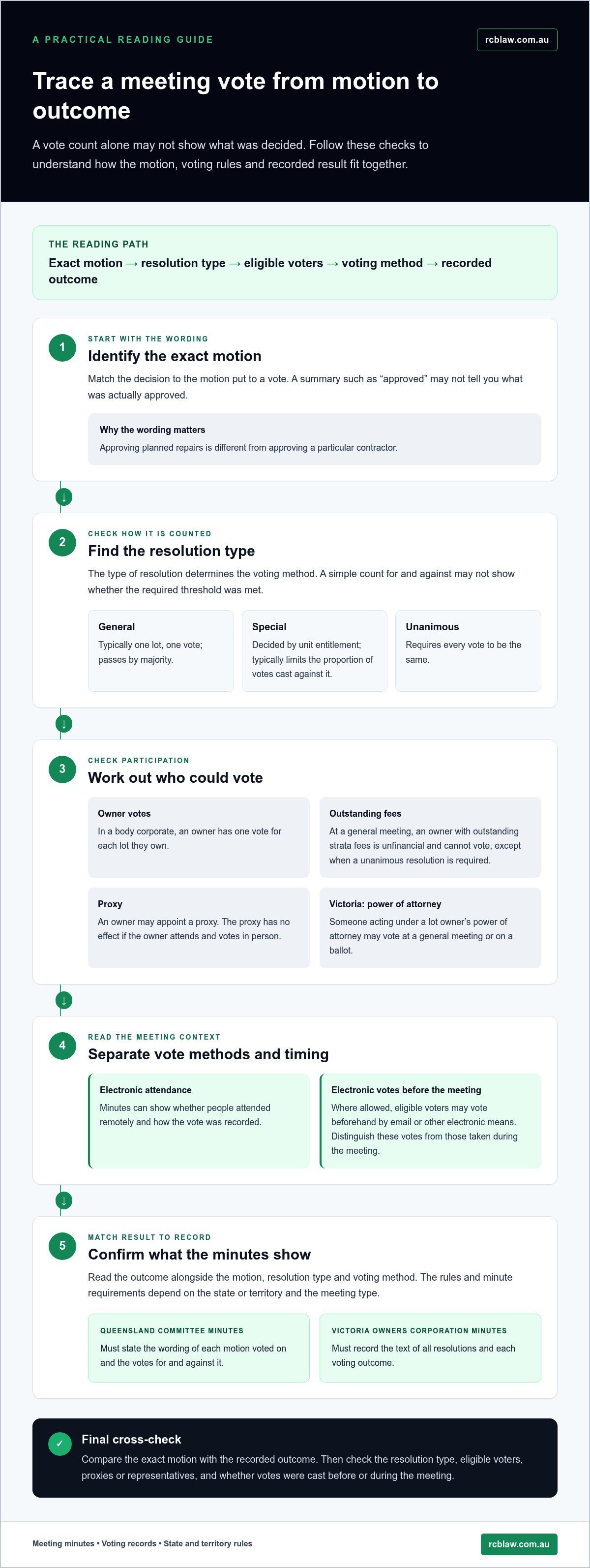
Minutes record the motion put to a vote and its outcome, so you can match the decision to its wording. Queensland committee minutes must state the wording of each motion voted on and the votes for and against it.
Compare the motion and its result rather than relying on a summary such as “approved.” For example, approving planned repairs is different from approving a particular contractor. Victoria’s owners corporation minutes must record the text of all resolutions and each voting outcome. These details show what the committee or owners actually decided.
Electronic Attendance and Voting
Depending on the community and applicable requirements, owners may be able to attend an AGM electronically. Minutes can show whether people attended remotely and how the vote was recorded.
Owners corporations and strata committees may also allow electronic votes before a meeting, by email or other electronic means. Eligible voters can then cast their votes outside the meeting. When reviewing the minutes, distinguish votes lodged beforehand from those taken during the meeting. This context helps explain how the resolution was considered and decided.
Voting Types and Resolutions
A resolution is a formal decision put to a vote, and its type determines how votes are counted. In a strata community, a general resolution typically uses one lot, one vote and passes by majority.
A special resolution is decided by unit entitlement and typically limits the proportion of votes cast against it. A unanimous resolution requires every vote to be the same. Check the resolution type in the minutes, then assess the outcome using the relevant voting method. A simple count of votes for and against may not show whether a special resolution met its threshold.
Owners’ Voting Rights
In a body corporate, an owner has one vote for each lot they own. At a general meeting, an owner with outstanding strata fees is unfinancial and cannot vote, except when a unanimous resolution is required.
An owner can appoint a proxy to vote on their behalf, but the proxy has no effect if the owner attends and votes in person. In Victoria, someone acting under a power of attorney for a lot owner may vote at a general meeting or on a ballot. These distinctions can help explain who voted and whether the minutes record proxy or representative participation.
For a buyer, use this sequence: identify the motion, note its resolution type, and compare the outcome with the applicable voting method. Check whether the minutes distinguish votes for and against, and whether they record electronic, proxy or power-of-attorney participation. This helps clarify how a decision was reached without treating a brief outcome label as the full record.
Recording tabled correspondence and documents
Minutes may refer to records that explain the background to a decision, even when those documents aren’t attached. Access rules and processes vary across Australia, so first identify the state or territory and meeting type.
For a buyer, related records can clarify what the committee considered, how spending was presented and what information supported a decision. Minutes can point you to relevant documents, but they aren’t always a substitute for those documents.
Tabled Documents and Correspondence
In Queensland, committee minutes must detail correspondence, reports, notices or other documents tabled, under Standard Module section 55(5)(e). This record helps you identify information the committee considered before making a decision.
Parkwood Villas, QBCCMCmr 521 (2010), concerns recording documents tabled at committee meetings. Valley Terraces Echohamlets, QBCCMCmr 314 (2012), addresses whether every item of correspondence received must appear in minutes. A copy of every tabled document need not accompany the minutes. However, The Astor Centre, QBCCMCmr 477 (2013), relates to providing tabled documents to an interested person on request, because they form part of body corporate records.
Financial Reports and Budget Figures
Financial reports and budgets show planned spending and reported financial activity. Compare the figures and explanations with the motion or report they relate to, such as a proposed repair or ongoing maintenance.
A budget sets out planned income and expenditure; financial reporting describes activity that has been recorded. If the minutes refer to a report but don’t explain a figure, identify the document and reporting period before drawing conclusions. This helps you distinguish an approved plan from a decision about actual spending.
Meeting and minute requirements differ across Australian states and territories, each with its own legislation and processes. Queensland’s Standard Module and Victoria’s owners corporation framework are distinct systems, so apply the rules for the property’s location.
If you disagree with a recorded decision, compare the minutes with the motion and documents considered, then state the specific error or concern in writing to the body corporate or manager. Pelican Heights, QBCCMCmr 167 (2011), concerns minute accuracy in relation to what happened during the meeting or vote.
In Queensland, section 205 of the Body Corporate and Community Management Act 1997 provides for access to records. An interested person must make a written request and pay the applicable fee to inspect or obtain copies. The body corporate must provide access within seven days after receiving both. The copying fee is 65 cents per page, and access may be refused if the body corporate reasonably believes a document contains defamatory material.
To search records, use the meeting date and motion wording to identify the relevant papers. Section 231 of Queensland’s Standard Module sets out records to keep and disposal rules. Some meeting materials may be disposed of after two years unless still current; meeting notices and papers may be disposed of after six years unless still current. Australian Taxation Office requirements may mean some records need longer retention. For a property purchase, understanding the legal implications of records and decisions can be part of reviewing a property purchase.
Minimum details required in meeting minutes
The details required depend on the jurisdiction and meeting type. For a buyer, the date, attendees and recorded decisions help put each issue in context.
Essential Minute Details
Essential meeting details show when a meeting took place, who attended and what was decided. In Victoria, owners corporation minutes must record the meeting’s date, time and location. They must also name the lot owners present, lot owners who provided proxies, and proxies who attended.
Use these details to orient your review. Match the date and location to the relevant general meeting, then check whether the attendance record identifies proxy participation. This can help show who was present when owners considered a resolution.
Minutes aren’t necessarily a transcript. The Cannery decision, QBCCMCmr 17 (2008), states that committee minutes need not reproduce every discussion. Focus instead on the recorded motion, outcome and material details, while treating a concise summary as different from a verbatim account.
Levies and Fee Increases
Minutes can show how owners considered a levy, special levy or fee increase, but the wording matters. Look for the proposal and its stated purpose, the recorded resolution, and whether the minutes say it was approved, amended or deferred.
For example, distinguish a motion to increase regular levies from a separate proposal to fund a specific repair. A budget or financial report may provide context, but its mention doesn’t establish that owners approved a levy. Compare the motion and outcome with any supporting papers named in the minutes.
When reviewing levies, note the amount and timing only if they appear in the minutes or referenced documents. Then distinguish proposed charges from decisions actually recorded. This helps prevent a discussion or recommendation from being mistaken for an approved fee change.
To identify unresolved issues, conflicts of interest or possible errors, compare the motion and outcome with related documents and earlier minutes. Look for items described as deferred, subject to further information or still under discussion. These phrases indicate that the record may not show a final decision.
For a possible conflict, look for a recorded disclosure and how the meeting handled it. For a possible error, pinpoint the date, wording or outcome that appears inconsistent. For example, if the minutes say a motion passed but don’t record a matching result, note the discrepancy and raise it with the body corporate for clarification.
During a purchase review, link each concern to a specific meeting date and document. This makes it easier to distinguish an unresolved proposal from a completed decision, and a brief summary from the formal record.
Required details in committee meeting minutes
Queensland keeps committee meeting minutes separate from general meeting minutes. Reviewing the committee record helps show who considered an issue and what followed.
Committee Minute Requirements
Queensland committee minutes are records of committee proceedings governed by the Body Corporate and Community Management Act 1997 and related Modules. They must be full and accurate, including a full and accurate record of each motion voted on.
Check for the meeting date, time and place, attendees and their capacity, proxies tabled, closing time, next scheduled meeting, and the secretary’s name and contact address. These details put decisions in context. Any recorded discussion, debate or opinions must be presented fairly and accurately.
Committee Reports and Maintenance Decisions
A committee report summarises information considered; a maintenance decision records what the committee decided to do. For a buyer, this distinction separates a recommendation or update from an approved action.
For example, a report about a building defect may describe an assessment, while a separate motion records a decision about repairs. Read the report reference alongside the motion and outcome. If the minutes describe discussion but no vote, don’t treat the discussion alone as a committee decision.
For a maintenance issue, trace the record from the report or correspondence to any motion and its outcome. A reference to a contractor’s report identifies information considered, but doesn’t by itself show that repair work was approved. The motion’s wording and recorded result clarify what action the committee authorised.
Queensland committee meeting minutes must be distributed after 21 days. When reviewing a purchase, compare available committee minutes across meetings to see whether an issue reappears, progresses to a decision, or remains under consideration. A later entry may clarify an earlier report, but keep the meeting dates distinct when following the sequence.
Committee members must have reasonable access to body corporate records without paying a fee. This helps them review the papers behind a committee decision, including reports mentioned in the minutes. The minutes should identify tabled documents so readers can connect a decision with relevant records.
In Queensland, if an owner submits a correct motion for committee consideration, the committee must respond within six weeks. If minutes show a motion awaiting consideration, compare its submission and meeting dates with the recorded response. Reading the motion, minutes and related documents together can help clarify a dispute about what the committee decided.
Quorum requirements and interim decisions
A quorum affects whether a meeting can make binding decisions or only interim ones. The rules below apply to Queensland body corporate meetings under the Body Corporate and Community Management Act 1997, so always verify the framework for the property you are reviewing.
Meeting Quorum Requirements
A quorum is the required level of voting representation for a body corporate general meeting. The quorum record helps you understand the legal status of decisions made at that meeting.
In Queensland, the quorum for a general meeting is generally calculated based on the number of owners present in person, by proxy, or by written voting paper—typically requiring at least 25 per cent of the persons entitled to vote for schemes with more than three lots, or two persons for schemes with three lots or fewer. Look for the minutes' quorum note before treating a recorded outcome as a valid resolution.
Compare the quorum note with the meeting date and matters considered. If the minutes say a quorum was present, read the motions and outcomes in that context. If they record no quorum, check whether the meeting proceeded as an adjourned meeting and whether decisions are described accordingly. This is particularly relevant to maintenance, planned spending, or other issues affecting a purchase.
Interim Decisions and Adjourned Meetings
In Queensland body corporate management, if a quorum is not present within 30 minutes of the scheduled start time of a general meeting, the meeting may be adjourned to the same day in the following week. If a quorum is still not present at the adjourned meeting, the persons who are present in person or by proxy constitute a quorum.
Understanding this adjournment process is vital when reviewing past minutes. Motions passed at a meeting where the quorum requirements are met under these adjournment provisions form valid decisions, but you must trace the timeline to ensure proper notice procedures were followed for the adjourned sitting.
Check whether the minutes clearly record the attendance numbers and whether any procedural challenges were raised by lot owners regarding the lack of an initial quorum. Reviewing subsequent committee minutes or annual general meeting records will show whether these resolutions were later ratified, acted upon, or contested.
For a property purchase review, record the meeting date, quorum status, decision wording, and any subsequent notice references. This creates a clear timeline for each matter and helps distinguish valid outcomes from defective resolutions. Get legal guidance on a property purchase if you need help understanding how a body corporate decision affects the transaction.
RCB Law: Residential Conveyancing
RCB Law can help you understand how body corporate records relate to a residential property purchase. If the minutes raise questions about a decision, levy or unresolved matter, our Residential Conveyancing service can assist with the legal aspects of buying property.
Bring the specific minutes or decisions you’re concerned about into your purchase discussions. Clarifying how these records relate to the transaction can help you consider the property’s legal context alongside the other purchase documents.
For a commercial property purchase, Commercial Property Law may be relevant instead. To discuss your residential purchase, contact RCB Law.
Carry your review into the purchase decision
Minutes are most useful when you connect them to the property decision you’re making. If an owners corporation record leaves you unsure what a decision means for your purchase, note the issue and the documents behind it. Knowing how to read body corporate meeting minutes can help you ask focused questions and keep your review grounded in the written record.
Legal support may be useful when body corporate records raise concerns affecting a transaction. RCB Law provides Residential Conveyancing for residential purchases, as well as Commercial Property Law and Business Law for relevant property or business matters. Legal advice can clarify how an issue fits into the wider transaction while keeping your priorities in view.
Take the next step with the specific minutes or decision you want to understand. Contact RCB Law for advice about your property matter, and move forward with greater clarity.
Frequently Asked Questions
What is a quorum?
A quorum is the required level of voting representation for a meeting to conduct business or make decisions. The test depends on the jurisdiction and meeting type. For example, at a Victorian owners corporation annual general meeting, the quorum test uses available votes or lot entitlements. If the minutes record no quorum, check whether decisions are labelled interim before treating them as final. This distinction can affect how you interpret an issue concerning the property.
What information must body corporate meeting minutes include in Australia?
Required details vary by state or territory and meeting type. In Victoria, owners corporation minutes include the meeting’s date, time, location and attendance, including proxies. In Queensland, committee minutes should include meeting details, attendees and their capacity, proxies tabled, closing time, the next scheduled meeting, and the secretary’s name and contact address. To review a record, first identify the property’s jurisdiction, then compare the minutes with the local requirements.
How do I find motions, resolutions and voting results in body corporate minutes?
Search the minutes for agenda items marked “motion,” “resolution” or “vote,” then compare the wording with the outcome. Queensland committee minutes record each motion’s wording and votes for and against; Victoria’s owners corporation minutes record resolution text and voting outcomes. When reviewing how to read body corporate meeting minutes for a purchase, note the meeting date and whether the entry says approved, rejected, amended or deferred. This helps distinguish a proposal from an actual decision.
How can I tell whether a motion passed by ordinary or special resolution?
Look for the resolution type in the motion or minutes, then consider how the votes were counted. A general resolution typically uses one lot, one vote and passes by majority. A special resolution is decided by unit entitlement and typically limits the proportion of votes cast against it. Don’t infer a special resolution from the vote total alone. The recorded type and applicable jurisdictional rules help show whether the result met the relevant test.
How do I check whether meeting minutes comply with state or territory strata laws?
Start with the property’s state or territory, because meeting rules aren’t uniform across Australia. Then identify whether the record is for a committee meeting or general meeting. In Queensland, these require separate minutes, and committee records are governed by the Body Corporate and Community Management Act 1997 and related Modules. In Victoria, the Owners Corporation Act 2006 sets meeting requirements. Compare the relevant meeting record with the rules applying to that jurisdiction and meeting type.
Where can owners access body corporate minutes and what records can they inspect?
Owners can use the body corporate’s records process to access minutes and related documents. In Queensland, an interested person submits a written request and pays the applicable fee. The body corporate must allow inspection or provide copies within seven days of receiving both. Records may include meeting papers and tabled documents, though access can be refused if the body corporate reasonably believes a document contains defamatory material.


