
You've finally found the perfect home, but that sun-drenched rear deck or converted garage might be hiding a costly legal secret. When buying a house with unapproved structures qld, the initial excitement of a new purchase can quickly be overshadowed by the fear of council-ordered demolitions or future insurance claims being rejected. It's a high-pressure situation, and feeling confused about why a standard building inspection didn't flag these approval issues is a common frustration for many buyers.
We understand that this transition is a significant life event, and you deserve a steady guide to remove the friction from your settlement. This 2026 legal guide will help you navigate these risks and protect your investment with the right contract protections. You'll gain a firm understanding of your legal liability under the latest seller disclosure regime and learn exactly which special conditions to add to your REIQ contract. We'll provide the clarity you need to ensure your settlement is secure, giving you the peace of mind to move forward without the weight of unexpected council fines or structural uncertainty.
Key Takeaways
- Understand the financial risks of unapproved building work, including the possibility of receiving a "Show Cause" notice or a demolition order from the local council.
- Learn how the Property Law Act 2023 has shifted the burden of disclosure onto the seller, providing you with more transparency before you sign the contract.
- Discover why a Council Records Search remains the gold standard for due diligence and how title insurance can act as a modern safety net for your investment.
- Master the use of special conditions in your REIQ contract to ensure you have a clear path to rectify issues or withdraw if the risks are too high.
- See how professional legal guidance can simplify the process of buying a house with unapproved structures qld, protecting your interest from start to finish.
The Hidden Risks of Buying a House with Unapproved Structures
Unapproved structures are more than just a minor oversight; they're a potential legal minefield. In Queensland, any building work completed without the required Council Development Approval or Building Permit is considered unapproved. While the charm of a sunroom or a spacious carport might draw you in, these additions can carry heavy financial burdens. Historically, the principle of Caveat Emptor or "buyer beware" placed the entire burden of discovery on you. Even with modern reforms, buying a house with unapproved structures qld still requires a proactive approach to avoid inherited liabilities. These issues often surface at the worst possible time, creating unnecessary friction during what should be an exciting life transition.
Council Enforcement and Demolition Orders
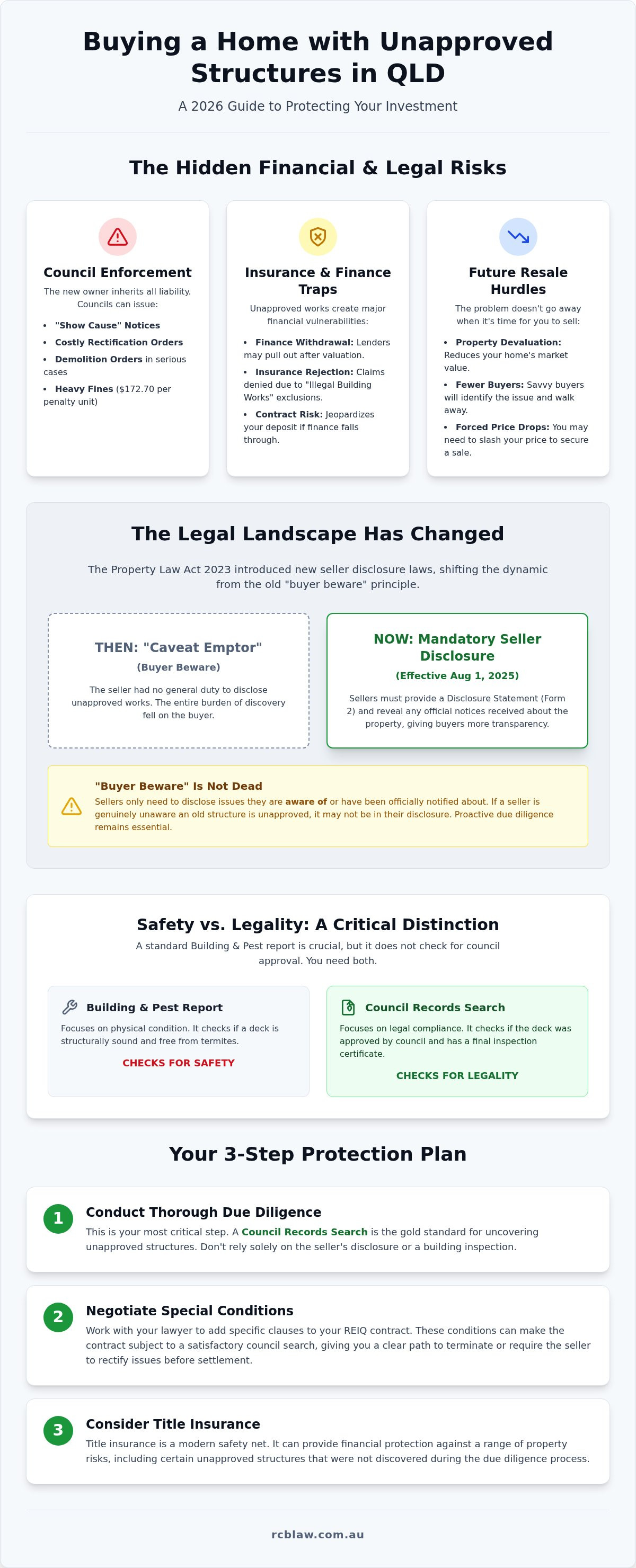
Councils in Brisbane and the Sunshine Coast use sophisticated tools to identify illegal works. They often use high-resolution aerial photography to compare current property footprints against historical records. If a discrepancy is found, you might receive a "Show Cause" notice. This legal document requires you to explain why the council shouldn't take enforcement action. The result is often a costly "regularisation" process or, in extreme cases, a demolition order. Fines for non-compliance are calculated using penalty units, which in Queensland are valued at $172.70 as of July 1, 2026. It's a common misconception that if a structure looks old, it must be legal. In reality, age doesn't grant approval; only a certificate does. As the new owner, you inherit this liability entirely upon settlement.
The Insurance and Finance Complication
The risks extend to your wallet long before a council officer knocks on your door. Lenders are notoriously risk-averse. If a valuation reveals significant unapproved works, your bank may suddenly withdraw finance, leaving you in a high-pressure scramble as settlement dates loom. This is particularly stressful in Queensland where "time is of the essence" for every contract milestone. Missing a deadline by minutes can jeopardize your entire deposit.
Insurance presents another trap. Most Product Disclosure Statements (PDS) contain "Illegal Building Works" exclusions. If a storm damages an unapproved deck, your insurer might reject the entire claim. Many buyers mistakenly rely on a building and pest report for protection. These reports focus on structural integrity, not legal compliance. A building inspector checks if the deck is standing. A council search checks if it's allowed to be there. Finally, consider the resale hurdle. When you eventually sell, savvy buyers will conduct their own searches. Any unapproved work you ignored will likely devalue your property or force you to drop your price to secure a deal.
Caveat Emptor vs. New Seller Disclosure Laws in 2026
For decades, Queensland property law operated under the strict principle of Caveat Emptor, or buyer beware. This meant the seller had no general duty to disclose defects or unapproved works. You had to find them yourself or suffer the consequences. However, the introduction of the New Seller Disclosure Laws under the Property Law Act 2023 has fundamentally changed this dynamic. Since August 1, 2025, sellers must provide a mandatory disclosure statement (Form 2) before a contract is signed. This shift aims to provide more transparency, but it's not a complete shield when buying a house with unapproved structures qld.
What the Seller Disclosure Statement Covers
The mandatory disclosure includes prescribed certificates, such as rates notices and title searches. It also requires sellers to disclose specific notices they've received from authorities. A critical red flag in these documents is the absence of a "Final Inspection Certificate" for known building work. If a seller provides inaccurate information or fails to provide the required documents, you may have a legal right to terminate the contract before settlement. This provides a layer of security that simply didn't exist in the old "buyer beware" era. Knowing how to interpret these forms is vital when buying a house with unapproved structures qld to avoid costly surprises later.
Where "Buyer Beware" Still Bites
Despite these protections, the new regime has limits. Sellers aren't required to disclose the structural integrity of the home or the presence of pests. Crucially, if a seller is genuinely unaware that a patio or shed is unapproved, they might not disclose it because they aren't technically "notified" of the breach. This is where the old rules still apply. Silence doesn't guarantee legality. You still carry the burden of due diligence to ensure the property matches its approved plans. Relying solely on a seller's statement can be risky. To navigate these grey areas, engaging in professional conveyancing is essential to cross-reference disclosure documents with actual council records.
If you're feeling overwhelmed by the paperwork, our team can provide a clear, low-friction path through residential conveyancing to protect your investment.
Essential Due Diligence: Searches and Title Insurance
The due diligence period is often the most high-pressure phase of a property transaction. It's the short window where you must uncover any hidden legal issues before your contract becomes unconditional. When buying a house with unapproved structures qld, you shouldn't rely on luck or verbal promises. You need paper proof. Taking a structured approach to verify the legality of every addition, from the garden shed to the master ensuite, is the only way to protect your investment. We act as your steady guide during this time, ensuring no stone is left unturned before you're legally committed.
The Council Building Records Search
A Council Building Records Search is the gold standard for verifying compliance. This search provides a comprehensive history of the property, including every building development approval and final inspection certificate issued. It also reveals any outstanding "Show Cause" or enforcement notices that might be lurking in the council's files. In regions like the Sunshine Coast and Brisbane, these searches can take anywhere from five to ten business days to return. This timing is critical. Budget "factory" conveyancers often exclude these searches to keep their fees low, but skipping this step leaves you exposed. Your solicitor must review these results before your finance or building and pest condition dates expire. If the search reveals a major issue, you need the legal leverage to negotiate or walk away before you're locked in.
Title Insurance: The Pros and Cons
Title Insurance has become a popular modern safety net for Queensland buyers. It's a one-off premium paid at settlement that protects you against specific risks, including "unknown" unapproved structures. If the council orders a demolition after you move in, the insurer may cover the costs of rectification or the loss in property value. However, it's not a magic fix for every problem. The most significant limitation is the "Known Risk" exclusion. You can't take out a policy to cover an unapproved structure you already know about. If your building inspector or a council search identifies an illegal deck, the insurer won't cover it. Title Insurance is best used when time is too short to wait for full council searches, providing a layer of protection against what you haven't found yet. It doesn't legalize the work, but it mitigates the financial sting if a surprise surfaces later.
How to Negotiate: Special Conditions and Rectification
Negotiating the purchase of a property with known approval issues requires a delicate balance of legal precision and strategic timing. You should never sign an REIQ contract without a specific "Subject to Due Diligence" or "Subject to Council Search" clause. Standard clauses often fall short. They might protect you from termites, but they rarely offer a clear exit path for missing paperwork. By engineering these protections into your contract from the start, you maintain the power to walk away or demand a resolution before your deposit is at risk. We understand the high-pressure nature of these discussions and act as your steady guide to ensure you aren't forced into a settlement you'll later regret.
Drafting the Special Condition
A standard Building and Pest clause is designed to identify physical damage, not legal non-compliance. To ensure your interests are fully protected, we draft watertight special conditions that specifically address council approvals. These clauses give you a broad right to terminate if your searches reveal unapproved structures that weren't disclosed. This is a level of protection you won't find in budget conveyancing packages. Our role is to ensure the wording is precise enough to prevent disputes with the seller. When buying a house with unapproved structures qld, having a solicitor-led firm review these conditions before you sign is the most effective way to remove friction from the process.
The Retrospective Approval Process
If you decide to proceed with the purchase, you may request the seller to "regularise" the work before settlement. This process typically involves engaging a private building certifier to conduct a retrospective inspection. A "Form 15" (Compliance Certificate) may be used during this process to certify that specific components, like the engineering of a deck, meet the required standards. However, if the structure was built poorly, remedial works may be necessary before a final certificate can be issued. Negotiating who pays for these costs is a critical part of the pre-settlement phase. In many cases, a price reduction is a simpler alternative. This provides you with the funds to handle the certification yourself after settlement while accounting for the inherent risk of future council action.
Remember that in Queensland, "Time is of the Essence". Every negotiation must happen within the strict windows defined in your contract. If you miss a deadline by even a few minutes, you could lose your right to terminate or claim compensation. If you've found a property but are worried about its history, contact us for expert residential conveyancing support to ensure your contract is secure.
Why RCB Law is Your Steady Guide in QLD Property
With over 30 years of experience in the Queensland property market, we've seen how a dream home can quickly feel like a burden when unapproved works are discovered. We understand that these transitions are high-pressure events for your family. Our firm acts as a steady guide, using a supportive approach to soothe the anxieties that naturally arise during complex settlements. When buying a house with unapproved structures qld, you need a partner who combines technical mastery with a genuine understanding of your personal journey. We've built our reputation on providing this level of care for clients across Brisbane, the Sunshine Coast, and Redland Bay.
The Solicitor-Led Difference
Choosing a solicitor-led firm offers a level of protection that budget "factory" conveyancing simply cannot match. While a standard conveyancer might process your paperwork, an experienced property lawyer identifies the legal risks hidden within your contract. We're proactive in managing the "Time of the Essence" rules that define Queensland property law. If a deadline is missed, your deposit could be at risk. We ensure every condition is met with precision to keep your settlement on track. As part of our commitment to your long-term security, we also offer a complimentary review of your estate planning documents. Understanding why you need a will is an essential part of protecting your new asset, and we're here to help you navigate that transition with ease.
A Low-Friction Path to Settlement
Our methodical process is designed to identify risks early, giving you the clarity needed to make informed decisions. We don't believe in hidden costs or surprise bills. Our fixed-fee model for residential conveyancing means you get expert legal advice with total price certainty. We use PEXA to provide a secure, digital-first settlement experience, reducing the manual errors that often cause delays. This modern approach, combined with our deep local knowledge of council regulations, ensures a low-friction journey from the initial contract review to the final handover of keys. We focus on the legal complexities so you can focus on your move. Before you commit to your purchase, Contact RCB Law for a fixed-fee quote to ensure your investment is protected by seasoned professionals.
Securing Your Future in Your New Queensland Home
Transitioning into a new home should be a time of excitement, not anxiety over hidden legal issues. While the 2026 seller disclosure rules provide more upfront information, the ultimate responsibility for due diligence still rests with you. Successfully buying a house with unapproved structures qld depends on identifying risks early and ensuring your contract includes specific protections that go beyond standard building and pest clauses. By verifying council records and considering title insurance, you can move forward with confidence.
We're here to act as your steady guide, providing the calm and confidence you need during this high-pressure process. With over 30 years of local experience, our solicitor-led team proactively manages your settlement to remove friction and protect your deposit. You can move forward with peace of mind knowing that our fixed-fee guarantee covers expert risk management without hidden costs. Request a Fixed-Fee Quote for your QLD Property Purchase today and let us handle the legal complexities while you focus on your move.
Frequently Asked Questions
Does a standard building and pest inspection check for council approvals?
A standard building and pest inspection focuses on the physical condition of the property, not its legal status. While an inspector might notice a structure looks poorly built, they don't check council records to see if it's approved. To verify the legality of a structure, you must perform a Council Building Records Search. This is why we recommend a solicitor-led review to ensure your due diligence covers both the physical and legal aspects of the home.
Can I be forced to pull down a shed the previous owner built without a permit?
Yes, local councils have the authority to issue enforcement notices requiring the demolition of illegal building work. When buying a house with unapproved structures qld, you inherit all existing liabilities upon settlement. If the council identifies a shed built without a permit after you move in, you are responsible for the costs of regularising it or removing it entirely. Protecting yourself with specific contract clauses before settlement is the only way to avoid this risk.
What is the new Seller Disclosure Act in QLD and how does it help me?
The Property Law Act 2023 introduced a mandatory seller disclosure scheme that requires sellers to provide a comprehensive disclosure statement before a contract is signed. This document includes certificates and notices that help reveal the property's history. It shifts some burden away from the buyer, but it doesn't replace the need for independent searches. We help you interpret these disclosures to ensure the information provided by the seller matches the reality of the property's approvals.
Is Title Insurance worth it for unapproved structures in 2026?
Title insurance is a valuable safety net for unknown risks that may surface after settlement. It's particularly useful when the contract period is too short to wait for a full council search. However, it won't cover structures you already know are unapproved. If your searches or inspections flag an issue before settlement, you must negotiate a resolution with the seller rather than relying on insurance. We guide you on when this protection is most effective.
What happens if I find an unapproved structure after I have already settled?
Once settlement occurs, you generally become responsible for any unapproved structures on the land. If you discover an issue post-settlement, your options are limited unless the seller provided fraudulent information in their disclosure statement. You may need to engage a private certifier to seek retrospective approval or face potential council fines. This high-pressure situation highlights why conducting thorough searches during the contract period is a vital part of residential conveyancing.
How long does it take to get retrospective council approval in Queensland?
Obtaining retrospective approval, often called regularisation, can take several weeks or even months depending on the complexity of the work. You'll need to engage a private building certifier to assess the structure against current building codes. If the work doesn't meet safety standards, you might have to pay for remedial repairs before a certificate is issued. This process is often more expensive and stressful than getting approval before the building work originally started.
Can I pull out of a contract if I find an unapproved deck during the cooling-off period?
You can terminate a contract during the cooling-off period for any reason, including finding an unapproved deck, but you'll usually forfeit 0.25% of the purchase price. To avoid this financial penalty, it's safer to include a specific "Subject to Due Diligence" clause. This allows you to withdraw without penalty if your searches reveal the deck lacks a final inspection certificate. We draft these conditions to ensure you have a clear, low-friction exit path.
Should I use a local Sunshine Coast conveyancer if I am buying in Noosa?
Using a local expert is highly beneficial because they understand the specific quirks of local council regulations. When buying a house with unapproved structures qld in Noosa or the wider Sunshine Coast, local knowledge helps identify common regional issues faster. Our team has over 30 years of experience navigating these local requirements in Brisbane and the Sunshine Coast. We provide the steady guidance needed to ensure your settlement is secure and your investment is fully protected.


