
That perfect patch of Sunshine Coast dirt isn't actually a home site until the law says it is. Whether you're looking at a coastal block or a hinterland retreat, the legal reality beneath the surface determines if you can actually build your dream. Many buyers feel a deep sense of anxiety about hidden easements, restrictive zoning, or sunset clauses. This is why professional conveyancing for buying vacant land sunshine coast is essential to ensure your vision is protected from the very beginning. You deserve to feel a sense of calm and confidence as you take this significant step toward your future.
We understand that land acquisition involves more than just paperwork; it's about securing your peace of mind. This 2026 guide provides the clarity you need to navigate the latest Sunshine Coast Council infrastructure charges and specific local requirements. We'll show you how to ensure a clear title and a stress-free settlement, so your building project starts on a secure legal foundation. From understanding the $30,000 First Home Owner Grant eligibility to avoiding common pitfalls in land contracts, we've mapped out the path ahead for you.
Key Takeaways
- Understand why vacant land conveyancing acts as a rigorous legal audit of a property’s "build-ability" rather than a standard residential transfer.
- Learn how specialized conveyancing for buying vacant land sunshine coast protects you from hidden easements and restrictive covenants that could compromise your architectural plans.
- Discover the critical contract clauses needed to secure your right to exit a deal if soil tests or council searches return unfavorable results.
- Navigate the 2026 Sunshine Coast Council requirements and infrastructure charges with a clear, step-by-step roadmap for a stress-free settlement.
- Identify the most important pre-contract review steps to ensure your finance and due diligence periods provide the protection you deserve.
Why Conveyancing for Vacant Land on the Sunshine Coast is Unique
Purchasing a block of land represents the first physical step toward a lifelong dream. While buying an established home feels like a transition between two points, land acquisition is an act of creation. However, this transition is often high-pressure and legally complex. Specialist conveyancing for buying vacant land sunshine coast isn't just about transferring a title; it's a comprehensive legal audit of the property's "build-ability." We focus on ensuring that what you see on the surface matches what the law allows you to build.
Standard residential contracts are frequently designed for existing structures, which means they can overlook the specific pitfalls inherent in raw earth. The Sunshine Coast's diverse topography, ranging from sensitive coastal dunes to steep hinterland slopes, introduces unique legal variables. Each landscape carries its own set of environmental overlays and council restrictions that can dictate everything from your floor level to the type of vegetation you're allowed to clear. Without a tailored approach, you might find yourself owning a beautiful view that you legally cannot utilize.
The 'Clean Slate' Fallacy: Why Dirt Needs More Due Diligence
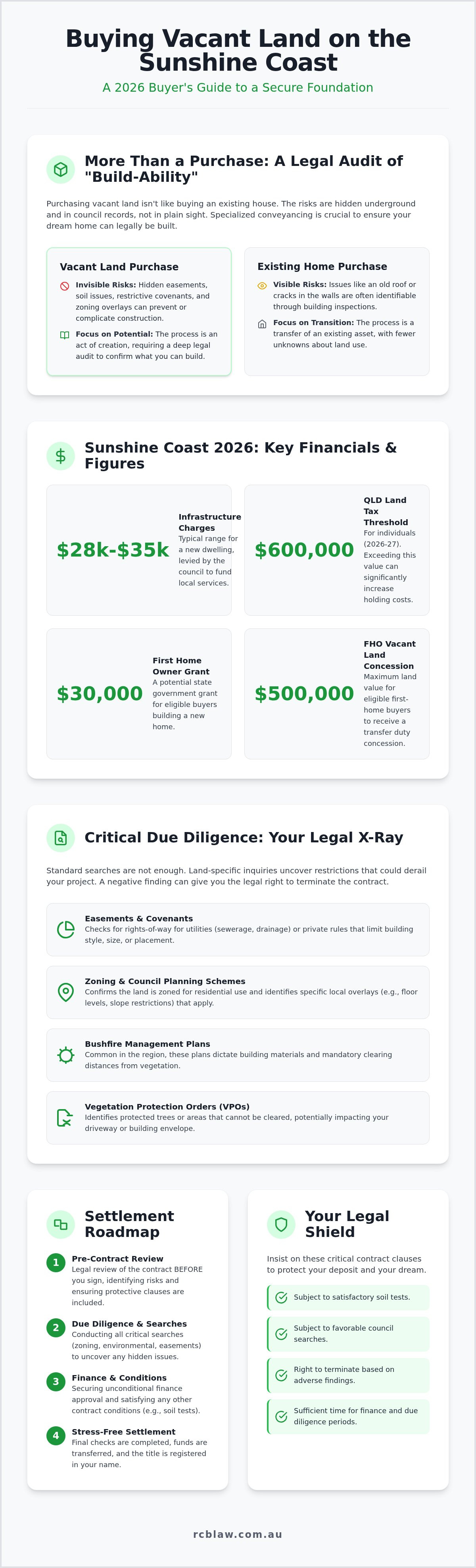
It's a common misconception that a lack of buildings equals a lack of legal encumbrances. In reality, land often hides more than it reveals. When you buy an existing home, you can see the cracks in the walls or the age of the roof. With vacant land, the risks are invisible. Hidden easements for sewerage or drainage, underground cables, or restrictive covenants can severely limit your building envelope. The process of conveyancing for land requires a deep dive into these "unimproved" details. We also consider the land tax implications; the 2026-27 threshold for individuals in Queensland is $600,000. If your land's value exceeds this, your holding costs could be significantly higher than anticipated.
Sunshine Coast Regional Dynamics in 2026
The region is currently experiencing a transformative growth phase. Major developments in areas like Aura and Harmony, alongside boutique hinterland subdivisions, have placed immense pressure on local infrastructure. This rapid expansion impacts everything from council processing times to the complexity of infrastructure charges. For a new dwelling in 2026, these charges typically range between $28,000 and $35,000. Navigating these shifting goalposts requires a partner who understands the local terrain. RCB Law's local heritage provides a distinct advantage here. We act as a steady guide, helping you manage the friction of council searches and settlement timelines so you can focus on the excitement of your upcoming build.
Critical Due Diligence: Sunshine Coast Specific Land Searches
Walking across a potential block of land feels like a moment of discovery, but the most important details remain invisible to the naked eye. Effective conveyancing for buying vacant land sunshine coast relies on a suite of specific searches that act as a legal x-ray for your property. These searches aren't just administrative hurdles; they are your only protection against buying land that cannot support your building plans. If a search reveals an undisclosed encumbrance or a significant restriction, it may provide you with the legal right to terminate the contract and protect your deposit.
Standard searches cover the basics of title and rates, but land-specific inquiries go much deeper. We often recommend optional searches that investigate the Sunshine Coast Council's specific planning schemes and historical land use. This is also the stage where we verify your eligibility for financial benefits like the First home vacant land concession. For eligible buyers, this concession can apply to land valued up to $500,000, significantly reducing the upfront financial burden of your acquisition.
Environmental and Zoning Restrictions
The Sunshine Coast’s natural beauty comes with strict regulatory oversight that can impact your construction costs. Bushfire Management Plans are common in our region and can dictate everything from the distance between your home and the tree line to the specific fire-rated materials your builder must use. Similarly, Vegetation Protection Orders (VPOs) might prevent you from clearing the exact spot you envisioned for your driveway. For those looking at the rolling hills of Maleny or the heights of Buderim, slope stability and landslip searches are non-negotiable. These reports confirm whether the ground is stable enough to support a foundation without requiring tens of thousands of dollars in extra engineering.
Easements and Underground Infrastructure
Infrastructure often dictates design, and specialized conveyancing for buying vacant land sunshine coast ensures you aren't building over vital services. Sewerage and drainage easements are frequent, and building over them is generally restricted to protect Unitywater access rights. If an easement runs through the center of your lot, your dream pool might be a physical impossibility. Beyond government utilities, we also examine developer covenants. These private rules can be surprisingly specific, regulating your roof pitch, external paint colors, or even the type of fencing you can install. To ensure your vision aligns with these local realities, you can request a preliminary search review before your contract goes unconditional.
Navigating the Contract: Key Clauses for Land Buyers
The contract is the definitive roadmap for your property journey, yet its standard terms often fail to account for the specific risks of buying dirt. Effective conveyancing for buying vacant land sunshine coast involves tailoring these legal documents to protect your future build. One of your first safeguards is the Cooling Off Period in QLD, which provides a five business day window to reconsider the purchase, though it's rarely enough time for deep due diligence. Beyond this initial period, we focus on inserting specific conditions that allow you to exit the deal if the land doesn't meet your requirements.
Finance clauses are particularly vital for vacant land. Lenders often view land as higher risk than established homes, which can lead to stricter valuation requirements or lower loan-to-value ratios. We ensure your finance condition is robust enough to cover these specialized land loans. Additionally, sunset clauses have become a primary concern for buyers in 2026. These clauses allow a contract to be terminated if the land isn't registered by a certain date. While they protect developers from indefinite delays, they can leave buyers stranded if property values rise during the wait. We help you negotiate sunset periods that provide certainty rather than anxiety.
Off-the-Plan Land vs. Registered Lots
Buying land that hasn't been titled yet, known as off-the-plan, carries different legal weights than purchasing a registered lot. When you buy off-the-plan, you're essentially purchasing a promise on a "Proposed Plan." Discrepancies often arise between this initial drawing and the final "Registered Plan" after council approval. These changes can affect your lot size or the placement of easements. Managing settlement date uncertainty is a core part of our role in 2026, as infrastructure delays can push out timelines by months. We ensure your contract includes "disclosure statement" protections to manage these shifts effectively.
Soil Tests and Physical Suitability
A "Subject to Satisfactory Soil Test" clause is a non-negotiable requirement for any vacant land contract. The physical composition of the earth dictates your foundation design and, consequently, your total build cost. Soil classifications range from Class S (stable) and M (moderately reactive) to H (highly reactive), E (extremely reactive), or P (problem site). If a test reveals a Class P site, your construction costs could escalate by tens of thousands of dollars before the first brick is laid. Site Classification is the legal bridge between land purchase and construction. By making the contract conditional on these results, you retain the power to walk away if the ground isn't suitable for your budget.
The Step-by-Step Land Settlement Process in Queensland
The journey from a signed contract to owning a piece of the Sunshine Coast follows a strict, time-based rhythm. This methodical progression is designed to remove friction, but missing a single deadline can jeopardize your deposit. Specialist conveyancing for buying vacant land sunshine coast ensures each phase is managed with precision, allowing you to move from uncertainty to security. We act as your steady guide, managing the complex interactions between banks, developers, and the titles office.
Phase 1 begins with the pre-contract review, which we consider the most critical hour of the entire process. This is when we identify the "build-ability" issues discussed earlier. Once you sign, Phase 2 involves meeting your finance and due diligence dates to go "unconditional." Phase 3 shifts toward pre-settlement, where we calculate adjustments for rates and land tax. Phase 4 is the digital settlement itself via PEXA, followed by Phase 5, where we notify the relevant authorities so you can focus entirely on your upcoming build.
Calculating Adjustments and Outlays
Adjusting rates for vacant land is generally simpler than for houses, yet it remains essential for a clear title. You must also account for Transfer Duty; for land valued between $75,000 and $540,000, the 2026 rate is $1,050 plus $3.50 for every $100 over $75,000. If you're building your first home, you may be eligible for the $30,000 First Home Buyer Grant for new builds valued under $750,000. These financial calculations are a core part of our pre-settlement service, ensuring there are no surprises on the day you take ownership.
Digital Settlement: PEXA and Your Peace of Mind
In 2026, Queensland property transfers occur via PEXA, a secure digital platform that has virtually eliminated the risk of settlement failure. This electronic workspace allows your lawyer and bank to coordinate in real-time, ensuring funds are disbursed and titles are transferred simultaneously. It also provides a significant defense against cyber-fraud, as bank details are verified within a closed system. The moment the "settlement" button is clicked, ownership of your block is secured. To ensure your timeline remains on track, you can contact our residential conveyancing team for a detailed settlement roadmap.
Securing Your Future: Why RCB Law is Your Sunshine Coast Partner
Choosing the right legal partner is the most effective way to transform a high-pressure property transition into a milestone worth celebrating. When you engage RCB Law for your conveyancing for buying vacant land sunshine coast, you're partnering with a firm that has spent over 30 years mastering the intricacies of Queensland property law. We've seen the region evolve from quiet coastal pockets into the thriving development hubs of 2026. This depth of experience allows us to act as a steady guide, identifying potential legal friction before it impacts your timeline or your budget.
Every local government area has its own administrative rhythm, and the Sunshine Coast Council is no exception. Our team understands the specific nuances of local infrastructure charges, environmental overlays, and search processing times. We handle the technical complexity of easements and title transfers so you can focus your energy on floorplans and builder consultations. Our goal is to ensure your dream build starts on a foundation of absolute legal certainty, providing you with a clear title and the peace of mind you deserve.
Our Empathetic Approach to Your Property Journey
We believe that professional legal advice should be accessible, not overwhelming. Our team is dedicated to removing the friction of legal jargon, providing brief and direct assistance that keeps you informed at every stage. We don't just react to events; we proactively anticipate land-specific issues such as vegetation orders or drainage access rights. With a physical presence in both the Sunshine Coast and Brisbane regions, we combine local specialist knowledge with the high standards of a long-established firm. This supportive approach ensures you feel heard and protected throughout the entire settlement process.
Next Steps: Starting Your Land Purchase Today
The most critical window for protection occurs before you put pen to paper. We strongly recommend having your contract reviewed by a specialist before you sign, as this is the only time we can negotiate essential due diligence clauses or sunset period protections. To help you plan with confidence, we provide fixed-price transparency for our residential conveyancing services, ensuring there are no hidden costs during your transition. When you're ready to secure your piece of the Sunshine Coast, our team is here to provide the masterly guidance you need.
Contact RCB Law for a stress-free land purchase experience and take the first step toward your new home with total legal confidence.
Your Sunshine Coast Build Starts with Legal Certainty
Buying land is a creative act, but it requires a rigorous legal foundation to ensure your vision can become a reality. We've explored why standard residential contracts often fall short and how specific regional searches protect you from invisible encumbrances. From navigating complex soil classifications to managing the latest council infrastructure charges, the right preparation ensures your dream home isn't compromised by restrictive covenants or unexpected site costs. Taking these proactive steps now prevents high-pressure surprises during the construction phase.
Expert conveyancing for buying vacant land sunshine coast acts as the vital bridge between a simple plot of dirt and a secure investment. With 30+ years of Queensland property law experience, our local specialists provide the steady, empathetic guidance needed to navigate this transition with ease. We offer fixed-price transparency to remove financial friction, allowing you to focus on the exciting design decisions ahead. Secure your Sunshine Coast land with a specialist contract review from RCB Law and take your first step toward building with absolute confidence. Your future on the Coast is waiting; let's make sure it's built on solid ground.
Frequently Asked Questions
Do I need a different type of conveyancing for vacant land compared to a house?
Yes, conveyancing for buying vacant land sunshine coast requires a more rigorous focus on the land's physical and legal capacity for construction. While house conveyancing centers on the existing structure, land conveyancing prioritizes "build-ability." We examine vegetation protection orders, bushfire overlays, and drainage easements that don't always appear in a standard residential check. These details ensure you aren't buying a block where your architectural plans are legally impossible to execute.
What is a sunset clause and why should I care when buying land?
A sunset clause is a provision that allows either party to terminate the contract if the land title isn't registered by a specific date. This is vital when buying off-the-plan subdivisions. If the developer faces infrastructure delays, you don't want your deposit tied up indefinitely. We review these clauses to ensure the timeframe is reasonable and that you aren't left in legal limbo while property prices continue to fluctuate.
How much does conveyancing for vacant land on the Sunshine Coast cost?
Professional fees for land conveyancing are often structured as fixed-price arrangements to provide you with financial certainty. While we don't provide a specific dollar amount here, your total costs will include professional legal fees plus "outlays." Outlays are third-party costs for essential Sunshine Coast Council searches and title registrations. We provide a transparent breakdown of these costs during your initial consultation so you can budget accurately for your dream build.
Can I build whatever I want on my land once settlement is complete?
No, your rights are managed by the Sunshine Coast Council planning scheme and private developer covenants. Zoning laws dictate house height, site coverage, and setbacks from boundaries. Additionally, many modern estates have design guidelines that restrict external colors, roofing materials, and even landscaping choices. It's essential to have these documents reviewed before settlement to ensure your specific home design is actually permitted on the site you've chosen.
What happens if the soil test comes back 'unfavourable' after I sign the contract?
If your contract includes a specific "subject to soil test" condition, you may have the right to terminate or negotiate a price reduction. An unfavourable test, such as a Class P (problem) classification, often means significantly higher foundation costs. Without this specific clause, you might be legally bound to complete the purchase regardless of the underground conditions. We ensure these protections are inserted into your contract before you sign to safeguard your construction budget.
Is there land tax on vacant land in Queensland?
Yes, land tax applies in Queensland if the total unimproved value of your landholdings exceeds certain thresholds. For the 2026-27 financial year, the threshold for individual owners is $600,000. It's important to remember that land tax is an ongoing annual cost, not a one-off payment at settlement. We help you identify if your new purchase will trigger this liability so you can manage your long-term holding costs effectively.
How long does a typical land settlement take on the Sunshine Coast?
Settlement timeframes vary significantly depending on whether the land is already registered. For a standard block with an existing title, a 30 to 60 day settlement is typical. However, off-the-plan land in new estates can take months or even years to reach settlement while the developer completes civil works. We coordinate with all parties to manage these timelines and provide clear updates as your specific registration date approaches.
Should I get a survey done before I settle on my vacant land?
Yes, we highly recommend a boundary survey before settlement to confirm the land's exact dimensions. Fences in older subdivisions aren't always placed accurately on the legal boundary line. A survey ensures you aren't paying for land you can't use or, conversely, that you aren't encroaching on a neighbor's property. This simple step provides absolute certainty for your builder and prevents expensive boundary disputes after your construction has already begun.


