
What if your property title update could save you thousands in transfer duty just by choosing the right ownership structure? When you decide to change how you hold property with a partner or family member, the paperwork can quickly feel like a minefield of potential costs. Most Queenslanders worry about the high price of stamp duty or the confusion of choosing between joint tenants and tenants in common. It's a high-pressure transition, and feeling a bit overwhelmed by the 2026 regulations is completely normal.
We understand that these changes represent significant life events, and you deserve a path that's both clear and cost-effective. This guide provides the expert clarity you need for a transfer of title between co-owners qld, ensuring your update is legally compliant while protecting your financial interests. We'll walk you through the latest QRO exemptions, the nuances of different ownership types, and the practical steps to coordinate with your bank for a seamless result. By the end of this guide, you'll have a structured breakdown of how to move forward with confidence and ease.
Key Takeaways
- Determine whether Joint Tenancy or Tenants in Common best suits your situation to protect your property interests and future inheritance rights.
- Identify specific transfer duty concessions available for a transfer of title between co-owners qld to help minimize your financial burden.
- Master the 2026 digital lodgement process, including mandatory eConveyancing and identity verification steps required by the Titles Registry.
- Learn how to coordinate with your lender to secure bank consent and manage mortgage updates without unnecessary stress or friction.
- Leverage 30 years of local Queensland property law experience to ensure your ownership change is legally compliant and professionally handled.
Understanding Transfer of Title Between Co-Owners in QLD
A transfer of title between co-owners qld is the legal process of adjusting ownership shares between people who already hold an interest in a property or adding and removing parties from the record. This movement is strictly governed by the Queensland Land Title Act 1994, which provides the framework for how property interests are recorded and protected. Transfer of Title is the formal registration of a change in legal interest with Titles Queensland. Whether you're adjusting shares with a business partner or adding a spouse to your home, the process ensures the public record accurately reflects who owns what.
Life changes often trigger the need for these updates. Common situations include relationship breakdowns where one partner buys out the other, or marriage and de facto additions where a homeowner wants to share equity with their partner. Investors also use this process for restructuring their portfolios to better manage tax or liability. At its core, this involves managing a Concurrent estate, where multiple parties hold legal rights to the same piece of land simultaneously.
When is a Title Transfer Necessary?
A partial transfer of interest differs significantly from a standard property sale. In a full sale, the entire property changes hands to a third party. In a co-owner transfer, you're usually only moving a specific percentage of the interest. Many families engage in 'love and affection' transfers, where a portion of the property is gifted or transferred for a nominal amount rather than a market price. Another frequent scenario involves the transition from a deceased estate to a surviving co-owner, which requires specific documentation to ensure the title remains clear and valid. These transitions can be emotionally heavy, and we focus on removing the friction from the paperwork so you can focus on your family.
The Role of a Conveyancing Specialist
Attempting a DIY title transfer often leads to 'requisitions' from the Titles Office. These are formal notices of errors that can delay your registration, increase costs, and cause unnecessary stress. A specialist ensures the conveyancing process is handled correctly from the start. This is particularly vital in non-arm's length transactions, where the parties know each other well. We provide the independent legal advice necessary to protect your interests, ensuring that the agreement you make today doesn't cause legal friction years down the line. Our 30 years of experience in Brisbane and the Sunshine Coast means we've seen every complexity, allowing us to guide you through these transitions with a sense of calm and confidence.
Joint Tenants vs Tenants in Common: Structural Changes
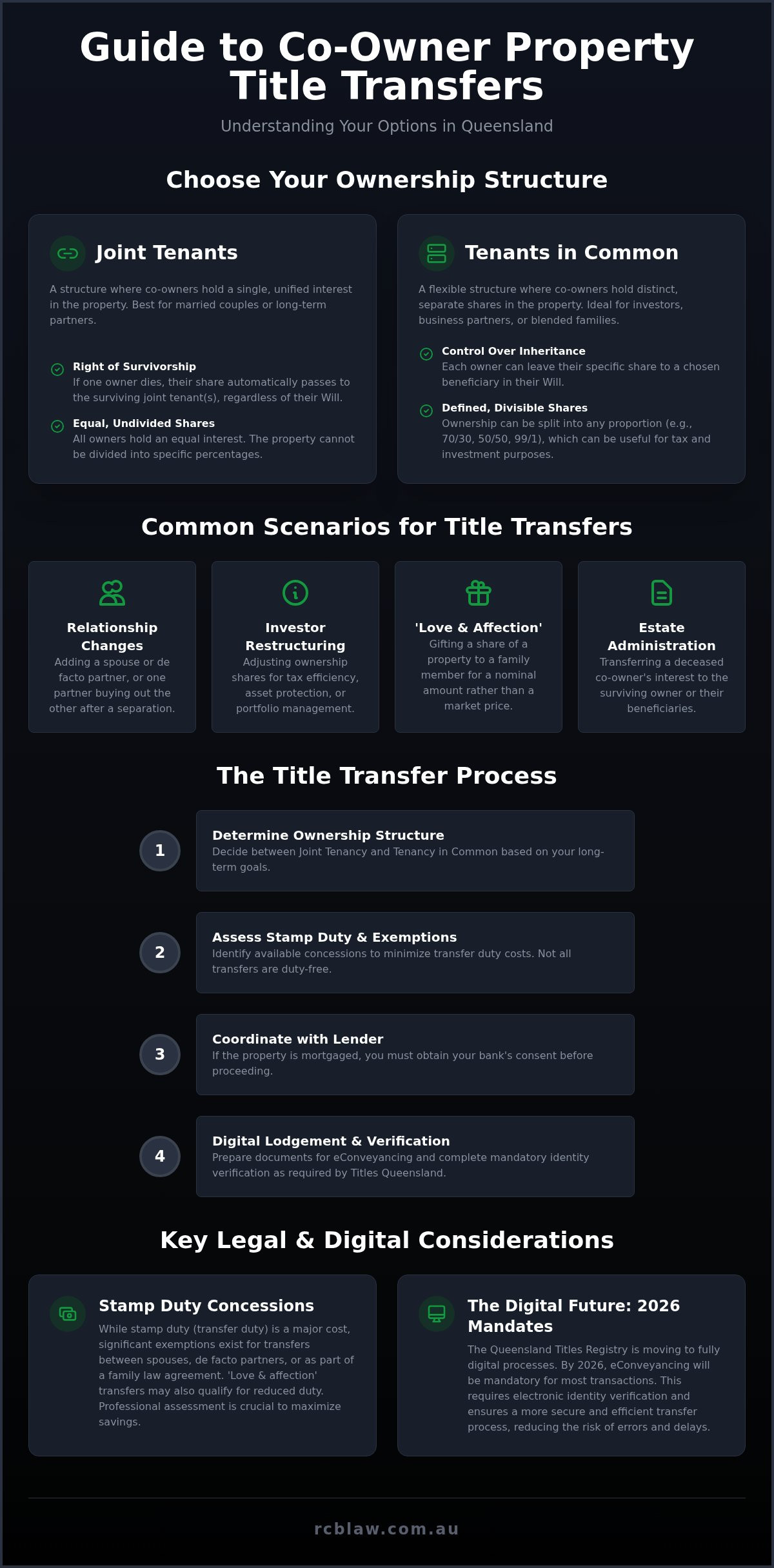
Deciding who appears on your property title is only half the battle. The legal structure you choose is just as important as the names themselves. In Queensland, you generally choose between Joint Tenancy and Tenancy in Common. Joint Tenancy includes the 'Right of Survivorship,' meaning if one owner passes away, their interest automatically transfers to the surviving owner. This is common for couples but can be restrictive for business partners or blended families. Tenancy in Common allows for divisible shares, where each person owns a specific percentage that they can deal with independently.
A transfer of title between co-owners qld is often used to 'sever' a joint tenancy. This process converts the ownership into a Tenancy in Common, giving each party the freedom to leave their share to a chosen beneficiary in their estate. Understanding these legal nuances is a critical part of registering a transfer of freehold land. Making this change ensures your property interests align with your current life circumstances and long-term goals.
Choosing the Right Ownership Structure
Your choice of structure impacts tax liabilities, future inheritance, and capital protection. Investors almost always prefer Tenants in Common because it allows for specific share percentages, like a 70/30 split, which can be tax-effective. This decision directly interacts with your will. If you hold property as joint tenants, your share cannot be gifted to others via your will. Seeking professional legal support ensures your structure reflects your true intentions.
Changing Ownership Shares
Sometimes, the goal is simply changing the weight of ownership. Moving from a 50/50 split to a 99/1 split is a common strategy for tax optimisation. However, you must clearly document your intention to satisfy the Queensland Revenue Office. We always recommend a fresh Title Search to confirm any existing mortgages that require bank consent. A transfer of title between co-owners qld requires precision to avoid future disputes and ensure a smooth registration.
Stamp Duty Implications and Concessions for Co-Owner Transfers
The most common concern we hear from clients is the fear of being taxed on their home's entire value during a restructure. It's a valid anxiety, but the reality is often much more manageable. When you facilitate a transfer of title between co-owners qld, Transfer Duty (historically known as stamp duty) is generally calculated only on the 'unencumbered value' of the specific share being transferred. If you're moving a 50% interest to a partner, the Queensland Revenue Office (QRO) assesses the duty based on half the property's market value, not the total. This distinction can save you thousands in unnecessary costs.
It's vital to understand that the QRO is the governing body for these assessments. Even if you're gifting a share of a property for 'love and affection' and no money changes hands, duty is still applicable. The QRO views the transaction based on what the interest is worth on the open market. We focus on providing a structured breakdown of these costs early in the process, replacing uncertainty with a sense of calm and financial clarity.
Common Concessions and Exemptions
Queensland law provides several pathways to minimize or eliminate duty. The 'Matrimonial Exemption' is perhaps the most significant, allowing for duty-free transfers following a divorce or de facto separation, provided the transfer is made under a court order or formal financial agreement. For couples simply wanting to share their home, a specific exemption exists for transferring an interest in a principal place of residence to a spouse. Additionally, a change of tenure between joint tenants and tenants in common is typically exempt from duty if the value of each owner's interest remains the same. These concessions, such as the home concession which can save buyers up to $7,175, are designed to support families through major life transitions.
Calculating the Real Cost of Transfer
The QRO requires evidence of 'Fair Market Value' for any transfer that isn't a standard arm's length sale. This usually necessitates a formal valuation from a registered valuer rather than a simple real estate agent's appraisal. While this is an upfront cost, it prevents the QRO from issuing a reassessment or applying the 12.43% unpaid tax interest rate later. You should also consider how the transfer might impact your land tax obligations. If the ownership change alters the property's primary use or exceeds tax-free thresholds, your annual liabilities could change. We've spent 30 years helping Brisbane and Sunshine Coast residents navigate these complexities, ensuring every transfer of title between co-owners qld is handled with professional precision and empathy.
The Step-by-Step Process of Title Lodgement in Queensland
Moving from a personal agreement to a legally registered change is a structured journey that requires professional oversight. In 2026, this path is entirely digital, providing a more secure and efficient experience for property owners. A transfer of title between co-owners qld now follows a strict sequence to ensure every legal and financial requirement is satisfied before the public record is updated. PEXA has replaced paper-based lodgements for transfer of title in Queensland as of 2026. This shift removes manual friction, though it demands precise coordination between your legal representative and your bank.
Before your application reaches the Titles Registry, you must complete the Verification of Identity (VOI) process. Stricter Anti-Money Laundering (AML) and Counter-Terrorism Financing laws took effect on 1 July 2026, making these checks more rigorous than in previous years. We manage this process for you, ensuring your identity is verified to the highest standards to prevent title fraud. The standard sequence for a successful transfer includes:
- Finalising the transfer agreement or deed of gift.
- Obtaining formal consent from your current mortgagee.
- Submitting documents to the Queensland Revenue Office for duty assessment.
- Creating a digital workspace in PEXA for all parties to sign.
- Executing the final lodgement and paying the Titles Registry fee, which is $248.04 for the first lot as of July 2026.
The Bank and Mortgagee Consent Hurdle
Most delays in property transfers occur because of the bank consent process. If a mortgage is currently registered against the property, your lender must 'produce' the title in the digital environment for any change to occur. This often involves varying your existing mortgage or refinancing entirely to reflect the new ownership shares. Banks may refuse consent if the new structure changes their risk profile or if a party being added don't meet their lending criteria. We act as your proactive communicator, working directly with your bank's settlements team to clear these hurdles before they become roadblocks.
Digital Lodgement via PEXA
The 2026 digital environment has significantly reduced the risk of 'settlement failure' that used to plague paper-based systems. Within the PEXA workspace, your solicitor coordinates with the other party’s legal representative and your bank to ensure all documents are ready for simultaneous signing. This coordination is the key to a low-friction transition. Once lodged, the title update is processed rapidly, and you'll receive an official notification of the change. If you're ready to start this process, you can contact our specialist conveyancing team to ensure your lodgement is handled with 30 years of local expertise.
How RCB Law Simplifies Your Property Title Transfer
Changing property ownership is rarely just about the paperwork. It often marks a significant life transition, whether you are welcoming a new partner into your home or restructuring an investment portfolio. We understand that these moments can feel high-pressure. Our role is to act as your steady guide, replacing uncertainty with a sense of calm and confidence. With 30 years of Queensland property law experience, we've refined a low-friction approach to every transfer of title between co-owners qld.
Complexity doesn't have to mean confusion. We prioritize clear communication and direct assistance, ensuring you understand every step without getting lost in legal jargon. Our fixed-fee conveyancing options provide financial certainty from the start, so you don't have to worry about hidden costs during an already stressful time. We focus on the practical application of the law, managing the technical details so you can focus on the personal significance of the change.
Regional Expertise: Brisbane to the Sunshine Coast
Local knowledge is essential when dealing with Titles Queensland. Our deep roots in the Brisbane and Sunshine Coast markets mean we understand the specific nuances of regional property transitions. While we are local specialists, our digital-first approach allows us to handle transfers remotely for clients across Australia. You get the personal touch of a dedicated local firm combined with the efficiency of modern legal practice. This regional insight ensures that your transfer complies with all local requirements while moving as quickly as the digital environment allows.
Getting Started with Your Transfer
Initiating your transfer is a straightforward process. During our initial consultation, we'll ask for basic documentation such as your current title details, any existing mortgage information, and the details of the parties involved. From day one, we provide a clear roadmap of costs and timelines. We proactively communicate with your bank and the other party's legal representatives to ensure the journey remains smooth. We take pride in ensuring every transfer of title between co-owners qld is handled with professional precision and empathy. If you are ready to move forward, you can Contact RCB Law for a stress-free title transfer today.
Moving Forward with Your Property Transition
Managing a transfer of title between co-owners qld is a significant step toward aligning your property ownership with your current life goals. Whether you're adjusting shares for tax benefits or protecting a partner's future, the process requires a balance of legal precision and empathetic guidance. By understanding the latest 2026 digital requirements and exploring available duty concessions, you can navigate this transition without the friction of unexpected delays or costs. This proactive approach ensures your property interests are secure and your family's future is protected.
At RCB Law, we bring 30+ years of experience as dedicated conveyancing specialists to every transaction. As local experts in Brisbane and the Sunshine Coast, we focus on providing a low-friction experience that prioritizes your peace of mind and financial clarity. We handle the technical complexities so you can focus on the next chapter of your journey. Secure your property's future with RCB Law's expert conveyancing team today. You don't have to navigate these changes alone; we're here to help you move forward with confidence and ease.
Frequently Asked Questions
Do I pay stamp duty if I transfer half my house to my spouse in QLD?
You generally don't pay transfer duty when moving an interest in your principal place of residence to your spouse, provided the property is held as joint tenants or equal tenants in common. This exemption is designed to support couples in shared home ownership. You must still lodge the correct concession forms with the Queensland Revenue Office to claim this benefit. We help you identify if your specific situation qualifies for this common and reassuring exemption.
How long does a transfer of title take in Queensland?
A standard transfer typically takes between three to six weeks to complete. This timeline depends on how quickly your bank provides mortgagee consent and the speed of duty assessment by the QRO. Since the 2026 shift to mandatory eConveyancing via PEXA, the actual lodgement and title update are nearly instantaneous once all parties sign digitally. Preparing the documentation and identity checks remains the most important and time-consuming phase of the legal process.
Can I transfer property title without a lawyer in QLD?
While you can technically attempt a DIY transfer, it's increasingly difficult due to the mandatory use of eConveyancing platforms like PEXA in 2026. These systems require a digital subscriber, which is usually a lawyer or licensed conveyancer. Attempting a transfer of title between co-owners qld without professional help often leads to errors from Titles Queensland. Our team ensures your transfer is legally compliant, protecting you from future disputes or costly financial penalties.
What is the difference between a transfer and a transmission of title?
A transfer involves a voluntary change of ownership between living parties, such as adding a partner or gifting a share to a family member. In contrast, a transmission occurs when ownership changes due to the death of a joint tenant or through a deceased estate. Transmissions require different Titles Queensland forms and legal evidence, such as a Grant of Probate. Both processes require precise handling to ensure the public record accurately reflects the new ownership status.
Do I need my bank's permission to add someone to my property title?
Yes, you must obtain formal consent from your lender if there's an existing mortgage registered against the property. The bank needs to 'produce' the digital title for the transfer to proceed in PEXA. This usually involves a variation of mortgage or a full refinance to include the new owner's details. Banks will assess the new owner's financial standing before granting permission. We coordinate directly with your lender to manage this often-complex communication hurdle.
What are the Titles Queensland lodgement fees for 2026?
As of 1 July 2026, the standard fee for lodging an instrument that changes ownership is $248.04 for the first lot. If the property value or consideration exceeds $180,000, an additional fee of $46.56 applies for every $10,000 or part thereof over that amount. For recording the death of a joint tenant, the fee is lower at $46.56. These fees are government-mandated and are usually paid through the PEXA workspace at settlement.
How does a relationship breakdown affect my property title?
A relationship breakdown often necessitates a transfer of title between co-owners qld to remove one party from the ownership record. If the transfer is done under a formal financial agreement or court order, you may be eligible for a full transfer duty exemption. This process ensures the person staying in the home has clear legal title. We provide a supportive environment to help you navigate these high-pressure transitions with professional clarity and minimal friction.
Is a valuation required for a family property transfer in QLD?
Yes, the Queensland Revenue Office typically requires a formal valuation from a registered valuer for transfers between related parties. Because these aren't 'arm's length' transactions, the QRO doesn't rely on a sale price to determine duty. They use the valuation to establish the fair market value of the interest being transferred. Providing a professional valuation helps prevent future audits or reassessments, giving you confidence that your tax liabilities have been calculated accurately.


