
Could two wills advertised at very different prices cover very different work? The cost of making a will in Brisbane can depend on more than the document itself, so headline fees are difficult to compare without knowing what each service includes.
It’s reasonable to want a clear idea of the cost before taking the next step, especially if you’re unsure whether your family or financial circumstances could make your will more involved. This guide explains what can shape fees, what to look for in a will-making service, and how to compare options by scope rather than price alone.
You’ll also find practical guidance on what to prepare before discussing your wishes, including details of your assets, beneficiaries and chosen executor. RCB Law drafts wills and assists with estate planning in Brisbane and across the Sunshine Coast region. If you already have a will, RCB Law offers a complimentary review. The firm brings more than 30 years of legal experience to this work.
Key Takeaways
- The cost of making a will in brisbane reflects the work involved in your circumstances, not one standard price for every will.
- Compare what each service covers, from taking instructions and drafting to review, changes and signing arrangements.
- Understand how DIY resources, the Public Trustee and solicitor assistance differ in support and potential suitability.
- Use family arrangements, asset ownership and distribution wishes as prompts for discussing the work your will may require.
- Prepare a clear list of assets, family details, wishes and questions to make a will consultation more focused.
What shapes the cost of making a will in Brisbane?
Comparing will fees can be difficult when one service description is brief and another spells out several stages of work. Think of a fee as the price for a particular service scope, not a universal price for every will. The cost of making a will in Brisbane may reflect the time needed to understand your instructions, prepare suitable wording and provide any follow-up included in the service.
A will records instructions about how a person wants their estate dealt with after death. The broad concept is outlined in Will and testament, but the work involved in preparing an individual document depends on that person’s circumstances and wishes.
Why there is no single Brisbane will-making fee
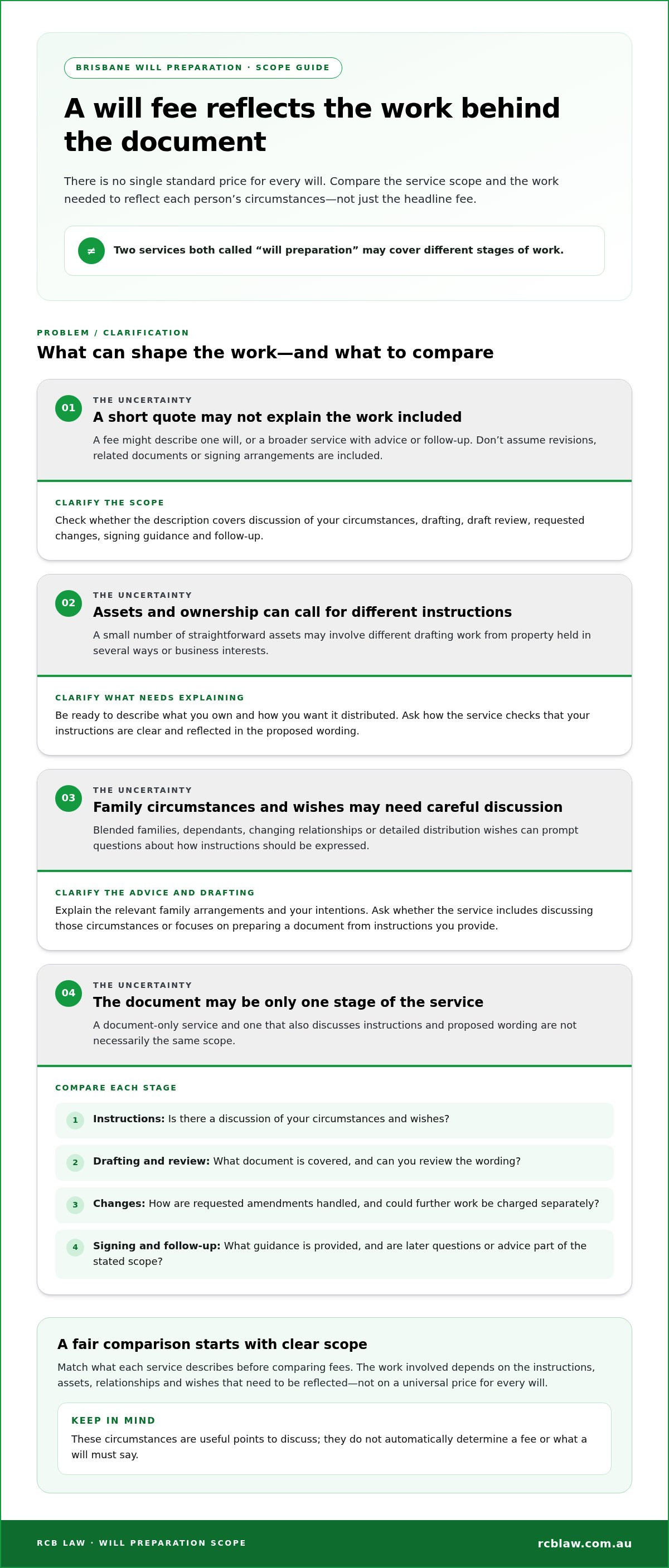
The document is only one part of the work. A legal professional may need to understand your instructions, clarify what you own and how you want it distributed, then draft wording that reflects those directions. The amount of advice and discussion required can vary, so people don’t all need the same level of assistance.
For example, someone with a small number of straightforward assets and clear instructions may need different drafting work from someone with property held in several ways, business interests, or beneficiaries whose circumstances call for careful consideration. Family structure can also matter: blended families, dependants or changing relationships may prompt questions about how instructions should be expressed. These are useful reasons to discuss your situation, not automatic indicators of a fee increase or a legal conclusion about what your will must say.
A straightforward will may involve fewer instructions and simpler distribution wording. A will addressing more assets, relationships or detailed wishes may require additional discussion and drafting. The difference is the work needed to reflect the person’s circumstances accurately.
What a quoted fee may describe
A quoted fee is meaningful only when you know what work it covers. It may refer to preparing one will or describe a broader service involving advice or follow-up. Don’t assume that every quoted amount covers revisions, related documents or signing arrangements. Read the service description as closely as the headline fee.
For a like-for-like comparison, look for clear information about:
- Instructions: whether the service includes a discussion of your circumstances and wishes.
- Drafting: what document the fee covers, including whether it is for one person.
- Review and changes: whether you can review the draft and how requested amendments are handled.
- Signing arrangements: whether guidance or assistance with signing is part of the stated scope.
- Follow-up: whether further advice or work beyond the initial document is described separately.
This checklist helps you see what sits behind a fee without assuming that any item is automatically included. RCB Law provides will-drafting assistance tailored to your stated wishes and circumstances. If you already have a will, a complimentary review can help you consider whether it still reflects your intentions.
What should a will-making service include?
Two services can both be described as “will preparation” yet cover different stages of work. To compare them fairly, match their scope before comparing fees. Look at what happens between your first discussion and receiving the final document, and note which steps are described separately or excluded from the stated work.
A useful comparison separates the process into stages. Check whether the service description covers taking your instructions, preparing a draft, giving you an opportunity to review it, making requested changes, and explaining signing arrangements. Treat these as points to clarify, not inclusions to assume, because each service defines its scope differently.
Questions to clarify when comparing service scope
Before deciding whether two offers are comparable, identify the work each one describes. The answers can help you understand what the cost of making a will in Brisbane represents, rather than treating a low headline fee as equivalent to a broader service.
- Advice: Does the described service include discussion of your circumstances and wishes, or focus on preparing a document from instructions you provide?
- Instruction review: How will your instructions be checked for clarity, and how can you review the proposed wording?
- Amendments: How are requested changes handled, and does the service explain whether further work may be charged separately?
- Signing arrangements: Does the description explain what guidance or assistance is provided at this stage?
- Follow-up: What happens if you have questions after receiving the draft or document, and is that work part of the stated scope?
These questions bring practical detail into the comparison. A document-only service and a service that also discusses your instructions and proposed wording are not necessarily the same scope, even if both result in a will. Clear descriptions make it easier to understand what you are paying for and where further work may sit.
A will is not the same as every estate-planning document
A will sets out instructions for dealing with a person’s estate after death. An enduring power of attorney is a separate legal document that can authorise another person to make certain decisions on their behalf while they are alive, subject to its terms and applicable law. Don’t assume that preparing one is part of a will-drafting fee. Other estate-planning documents may also be separate services.
For broader Queensland context on the purpose of a will and related planning, see Why You Need a Will: A Comprehensive Guide for Queenslanders. Keeping each document’s purpose and scope distinct can help you identify what you need to discuss, instead of comparing bundled descriptions as though they cover the same work.
RCB Law provides Brisbane will-drafting assistance tailored to your stated wishes and circumstances.
DIY, Public Trustee, or solicitor: how do the options compare?
Each pathway offers a different balance of support and independence. A lower upfront fee alone doesn’t show whether a service fits your circumstances or covers the help you need. To compare the cost of making a will in Brisbane meaningfully, consider the process, access to tailored guidance and what you may need to do yourself.
| Pathway | Potential fit | Points to understand |
|---|---|---|
| DIY resource or online tool | Someone whose wishes and circumstances seem straightforward and who is comfortable preparing a document independently. | You provide and organise the instructions. Consider how you’ll handle uncertainty, changes or wording you don’t understand. |
| Public Trustee Queensland | Someone considering a public will-making pathway. | Review the current official information to understand its service scope, process and any relevant fees or charges. |
| Private solicitor | Someone who wants legal assistance to discuss their circumstances and prepare a will reflecting their instructions. | Compare the advice and drafting work described, plus how review, amendments and signing arrangements are addressed. |
When a DIY approach may seem attractive
DIY can appeal if your situation appears simple and you want to work through your instructions at your own pace. But “simple” can be harder to assess when your wishes are unsettled, your assets are held in different ways, or family circumstances have changed. A form or online tool may not resolve questions about expressing your intentions. If you’re unsure what a question means, pause rather than guess. This section doesn’t determine whether a particular document is valid.
What to compare in public and solicitor-assisted services
Public and private services can differ in who provides assistance, how instructions are gathered and what the process covers. For the Public Trustee Queensland’s latest details, use its current fee schedule and service information rather than relying on an old summary. For solicitor assistance, focus on the advice and drafting process described, including whether the scope explains review, changes or follow-up. Don’t assume every service includes the same steps.
Before choosing a pathway, consider what support would help you feel confident that your wishes have been clearly recorded. For example, if you have questions about how family arrangements or asset ownership affect your instructions, tailored advice may be important to you. If you already have a will, a review can help you assess whether it still reflects your wishes.
RCB Law provides will-drafting assistance tailored to your stated wishes and circumstances, and offers a complimentary review of existing wills. Explore Brisbane will-drafting assistance.
Which circumstances can make will preparation more involved?
The work needed to prepare a will can depend on how your family, assets and intended gifts fit together. These details are discussion prompts, not automatic fee surcharges or legal conclusions. Sharing them early can help a legal professional understand what you want the will to address and what may need further discussion.
Family and distribution wishes
Think about who you intend to benefit and how you want your assets distributed. Consider whether you have a blended family, dependants or particular instructions for different beneficiaries. For example, you might want a specific item or amount to go to one person, with the rest distributed differently. Unusual or detailed wishes may call for more discussion before the wording is settled, but family structure alone does not determine the work involved.
Note any questions or decisions you haven’t resolved. If you’re unsure how to express a wish, describe the outcome you hope to achieve rather than trying to draft legal wording yourself. Clear instructions about your family circumstances, intended beneficiaries, particular gifts and reasons for specific directions can make discussions with a legal professional more focused.
Assets, ownership, and wider planning
Make a practical list of what you own and how it is held. Include property, business interests, company or trust connections, and assets with particular ownership arrangements. The aim isn’t to reach a legal conclusion about how each item should be dealt with. It’s to give the professional preparing your will enough context to identify matters that need careful consideration.
Some assets may need separate consideration rather than being assumed to follow the same instructions as everything else. For instance, owning a business interest or holding property jointly can raise questions about ownership and what you intend to happen. Describe the arrangement as you understand it and bring relevant information if available. Don’t assume that listing an asset in your instructions means it can be distributed in the way you expect.
To prepare for a discussion, note:
- Family circumstances: relevant relationships, dependants and intended beneficiaries.
- Distribution wishes: who should receive particular gifts and how you want the remainder handled.
- Asset details: property, business interests and any ownership arrangements you know about.
- Open questions: decisions you haven’t made or instructions you’re not sure how to express.
This preparation won’t determine the cost of making a will in Brisbane on its own, but it can help clarify the work and advice your circumstances call for. RCB Law provides tailored will-drafting assistance to reflect your stated wishes and circumstances. Discuss your will-drafting needs with RCB Law.
How to prepare for a Brisbane will consultation and next steps
A little preparation can make a conversation about your will more focused. You don’t need to have every decision settled before seeking guidance. Gather the information you have, note what you’re unsure about, and describe the outcome you want. This also gives you a clearer basis for comparing service scope and understanding what work a fee covers.
A practical checklist before discussing your will
Use this short sequence to organise your thoughts before a consultation:
- List your assets and ownership details. Note property, accounts, business interests and other significant assets, including how you understand each is owned. You don’t need to make legal assumptions about how an asset should be treated.
- Record relevant family or business circumstances. Note intended beneficiaries, dependants, blended-family arrangements or business interests that may affect your instructions.
- Write down your wishes. Identify who you hope to benefit, any particular gifts you have in mind, and questions about how the rest of your estate should be distributed. Mark any decisions you haven’t made yet.
- Prepare questions about the service. Ask what the described work covers, how you can review the draft, how proposed changes are handled, and what signing guidance is provided.
Bring an existing will or other relevant documents if they help explain your current arrangements. Keep sensitive personal and financial details private. Don’t post them in public comments or send them through an unsecured channel; use an appropriate secure method when sharing information for legal assistance.
Make the next step feel clear
Before comparing the cost of making a will in Brisbane, summarise your situation in a few lines: what you want your will to achieve, which circumstances may need discussion, and where you need advice. Then compare services by the work described, including instruction-taking, drafting, review, amendments and signing arrangements. This keeps the focus on your needs rather than a headline fee in isolation.
If you already have a will, RCB Law offers a complimentary review of existing wills. A review can help you consider whether your current document still reflects your wishes and circumstances. You can also discuss will drafting and estate-planning assistance tailored to your stated instructions.
You don’t need to arrive with every answer. A clear outline of your wishes and questions is enough to begin a practical discussion about the service scope that may suit you. Explore RCB Law's legal services.
Make your next decision with greater confidence
Choosing how to prepare a will is a personal decision. Rather than trying to settle every detail at once, identify the kind of support that would help you move forward. You might want guidance turning your wishes into clear instructions, or simply want to understand the scope behind a quote. Keeping that need in focus can make the cost of making a will in Brisbane easier to assess against the work involved.
If you already have a will, reviewing it can help you consider whether it still reflects your wishes. RCB Law offers a complimentary review of existing wills, alongside will-drafting and estate-planning assistance. For a considered next step, explore RCB Law's legal services.
You don’t need to have every answer before you begin. A clear idea of what matters to you is a strong place to start. Contact RCB Law to discuss will drafting or arrange a complimentary review of your existing will.
Frequently Asked Questions
How much does it cost to make a will in Brisbane?
There isn’t one standard fee for every will. The cost of making a will in Brisbane depends on the service scope and the work required to understand your instructions. Before deciding, get a clear description of the work covered and how extra advice or changes are treated. For example, compare whether the service includes a discussion of your wishes or only document preparation, and check current fees rather than relying on old online figures.
Is it cheaper to use the Queensland Public Trustee to make a will?
The Public Trustee Queensland provides a free will-making service, but whether it suits you depends on your needs and the service scope. Check its current official information and fees-and-charges schedule before comparing it with other options. Also consider what happens if the Public Trustee is appointed to administer the estate, as estate administration may involve commission fees. Compare the complete service and any potential later charges, not only the upfront cost of making the will.
Can I make a will without a lawyer in Queensland?
Yes, some people use a DIY resource or online tool, especially if their instructions seem straightforward. However, the document still needs to meet applicable Queensland requirements, and a template may not help resolve uncertainty about wording or circumstances. If you’re unsure how to express a particular gift, don’t guess. Check current Queensland requirements and consider tailored legal advice. This general information can’t determine whether a specific will is valid.
Does a will include an enduring power of attorney?
No, a will and an enduring power of attorney are separate documents. A will concerns instructions for an estate after death, while an enduring power of attorney relates to decision-making during a person’s lifetime in relevant circumstances. Treat them as distinct pieces of work when reviewing a service description. Check whether the stated scope concerns the will alone or also addresses any additional estate-planning documents you want prepared.
How often should I review or update my will?
Review your will when a meaningful change in your life or wishes could affect its instructions. Examples include a new relationship, separation, a change in who you want to benefit, or buying or selling a significant asset. The change doesn’t automatically mean the document needs amendment, but it’s sensible to assess whether it still reflects your intentions. Avoid relying on assumptions; get advice about how your particular circumstances affect the document.
Does a will cover every asset I own?
Not necessarily. The way an asset is owned or held can affect how it is dealt with, so don’t assume that naming it in a will settles the issue. For example, note whether property is held in your name alone, jointly, or through another arrangement. Some assets may be subject to separate arrangements. Prepare an asset list with ownership details and seek advice about how each item should be considered under current Queensland law.
What happens if I die without a will in Queensland?
If you die without a valid will, Queensland’s intestacy rules may determine how your estate is distributed. The result may differ from the choices you would have made, and the people involved may need to establish relevant family and asset details during estate administration. The rules can depend on individual circumstances, so don’t rely on a general example to predict an outcome. Seek legal advice about your situation and check current Queensland law.
Can I change my will after it has been made?
Yes, you can review your will as your wishes or circumstances change, but any alteration should be made in a way that meets current Queensland requirements. Don’t assume that crossing out wording or adding a handwritten note will have the intended effect. Instead, write down what you want changed, why it matters, and whether other instructions may be affected. A legal professional can advise on an appropriate way to update your document.


