
The date a special levy is due may not decide who ultimately bears the cost. If you're asking who pays special levy buyer or seller qld, the answer depends on when the levy was decided and how the sale contract allocates responsibility.
It’s easy to focus on the contract date, the body corporate decision date or the payment deadline, particularly when an unexpected levy could affect your settlement budget. Under standard REIQ contract terms, a levy notified on or before the contract date is generally the seller’s responsibility, while one imposed later may fall to the buyer. The wording of the signed contract, including any special conditions and provisions for instalments, can change that allocation.
This guide explains which dates and terms to compare, what body corporate records may reveal about proposed or approved works, and what to review before committing to a purchase. It also explains the difference between raising concerns about a levy decision and resolving a disagreement about payment under the sale contract. Clear conveyancing advice can help you understand your position before settlement.
Key Takeaways
- To understand who pays special levy buyer or seller qld, compare when the levy was decided with the contract terms and any settlement adjustments.
- Separate the body corporate’s right to collect a levy from any agreement between buyer and seller about who ultimately bears the cost.
- Review meeting minutes and body corporate records for proposed works, even if a levy hasn’t yet been approved.
- Identify whether your concern is about the levy decision itself or the contract’s payment allocation. These involve different processes.
- Have the contract, levy notices and relevant records reviewed early so you can clarify outstanding questions before settlement.
What Is a Body Corporate Special Levy in Queensland?
A body corporate special levy in Queensland is an additional contribution owners may be required to pay for a community titles scheme expense that isn’t covered by its existing budget or funds. Unlike routine contributions, a special levy addresses a particular expense. For buyers and sellers, reviewing its purpose and the decision behind it can help establish what has been approved and which records to examine.
This section concerns Queensland community titles schemes, which are governed by the Body Corporate and Community Management Act 1997 (BCCM Act). In a community titles scheme, owners hold individual lots and share responsibility for common property and scheme costs. The general concept of this ownership arrangement is explained in Strata Title in Australia.
How does a special levy differ from regular body corporate levies?
Regular contributions are generally budgeted for the scheme’s ongoing and future needs. The administration fund supports day-to-day costs, such as common-area cleaning, insurance and routine maintenance. The sinking fund is set aside for planned capital works and longer-term needs, such as replacing shared building components.
A special levy is an additional contribution, not another name for either fund. It may be raised when an expense exceeds the available funds or approved budget. Its purpose and amount depend on the scheme’s circumstances and the relevant body corporate decision.
Why might a Queensland body corporate raise a special levy?
Some expenses are difficult to predict. Urgent repairs after damage, unexpected building defects or capital works that exceed the funds available can leave a scheme needing additional money. For example, if a shared structure needs repairs sooner than expected, the body corporate may need to consider how to fund the work.
A special levy doesn’t automatically mean the body corporate was poorly managed or failed to plan. A scheme may face an unforeseen expense, or the necessary work may turn out to be more extensive than earlier estimates suggested. The circumstances matter, as do the scheme’s governing requirements and the process used to decide the contribution.
For an owner, the reason for the levy is useful context, but it doesn’t by itself answer who pays special levy buyer or seller qld. The levy’s purpose, decision and timing may all matter when a lot is sold. Keep the body corporate contribution separate from the question of how the sale contract allocates its cost. This helps avoid treating every special levy as a routine periodic contribution or assuming that the payment date alone determines responsibility.
Who Pays the Special Levy: Buyer or Seller Under the QLD Contract?
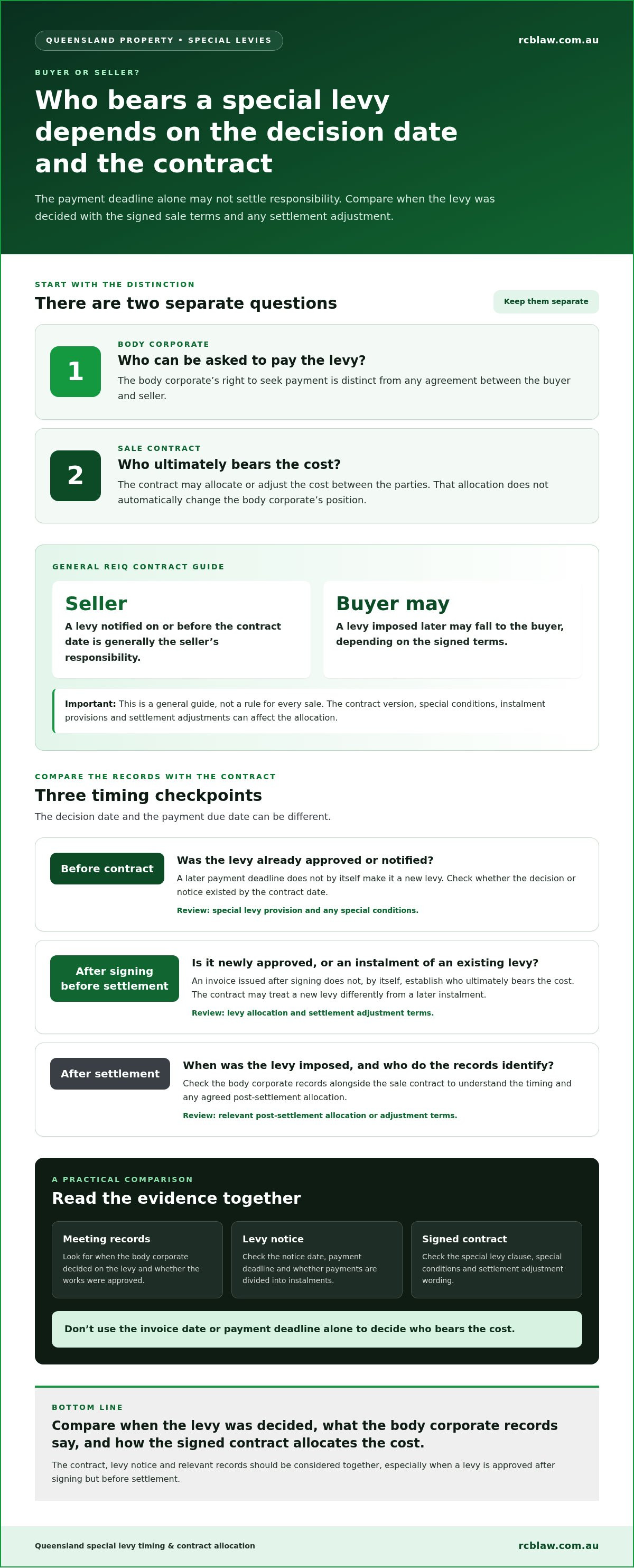
No single timing rule decides every sale. Responsibility depends on when the levy was approved or imposed, the applicable sale contract and any settlement adjustment. Under the standard REIQ contract, the special levy clause generally treats a levy notified on or before the contract date differently from one imposed afterwards. The exact contract version and any special conditions matter, so check the signed terms rather than relying on a general rule.
Keep two questions separate. The body corporate’s right to seek payment is one issue. The buyer and seller’s agreement about who bears that expense is another. A settlement adjustment may allocate or reimburse a cost between the parties, but it doesn’t automatically change the body corporate’s position. This distinction matters when the levy affects the settlement amount or an instalment falls due later. ABC News has reported on the Impact of Special Levies in Queensland, illustrating why the cost can matter to owners during a property transaction.
Does the levy decision date or payment due date matter more?
The decision date and payment due date can differ. A body corporate may approve or impose a levy before the contract is signed, while setting a later deadline or allowing payment by instalments. An invoice issued after signing doesn’t, by itself, establish who must ultimately bear the cost. Compare the meeting records, levy notice and contract wording to identify when the levy was decided and how the contract allocates it.
Relevant timing | Likely issue to investigate | Contract clause to review
Before the contract date | Was the levy already approved or notified, even if payment is due later? | The special levy provision and any special conditions.
After signing, before settlement | Is this a newly approved levy or an instalment of an existing one? | The levy allocation and settlement adjustment terms.
After settlement | When was the levy imposed, and how do the body corporate records identify the owner responsible? | Any relevant post-settlement allocation or adjustment terms.
What if the levy is approved after signing but before settlement?
Don’t assume the due date decides responsibility. The signed contract and any settlement adjustments determine the buyer-seller position. Establish whether the decision creates a new levy or sets another payment date for a levy already imposed. The contract may treat those situations differently.
Before finalising settlement calculations, have the contract, levy notice and relevant body corporate records reviewed together. A conveyancer can help interpret the wording and identify any questions that need resolving. RCB Law provides Queensland residential conveyancing advice for property transactions across Brisbane, the Sunshine Coast and Redland Bay.
Can You Challenge a Special Levy Decision in Queensland?
An owner may be able to challenge a body corporate decision through the relevant dispute-resolution process, but first identify the specific concern. This is separate from a buyer and seller disagreeing about who bears the cost under their sale contract. A contract dispute concerns the parties’ agreement; a body corporate dispute concerns the scheme’s decision or process.
Disagreeing with a levy, or believing it is unfair, doesn’t automatically cancel it or pause a payment obligation. Don’t assume that withholding payment protects your position. Check the applicable requirements and get advice about any payment deadline while considering how to raise the concern.
What should you check before disputing the levy?
Start with the records showing how the decision was made and what it covers. Review the meeting notice, proposed motion, minutes and levy notice, including the stated purpose, amount and due date. Check the scheme’s Community Management Statement and applicable regulation module under Queensland’s body corporate framework. Then distinguish a concern about the decision or process from a question about how the levy is allocated under a sale contract.
Work through the issue in a clear order:
- Obtain the records. Gather the meeting notice, motion, minutes, levy notice and relevant scheme documents. Keep copies and note the dates.
- Pinpoint the concern. For example, you may be unsure whether owners received appropriate notice, whether the motion and minutes explain the decision, or how the amount was calculated.
- Raise the issue appropriately. Set out the specific concern and the records it relates to, then use the body corporate’s applicable process. A focused question is easier to assess than a general objection.
- Consider formal resolution. If the issue remains unresolved, check the current dispute-resolution options, eligibility requirements and time limits before applying.
What dispute-resolution options may be available?
Queensland body corporate disputes may have formal pathways through the Office of the Commissioner for Body Corporate and Community Management. Depending on the issue and eligibility requirements, these may include conciliation or adjudication. The Queensland Civil and Administrative Tribunal may also be relevant in some matters. The right route depends on the dispute, the scheme’s regulation module and current procedural requirements, so confirm the applicable steps before proceeding.
For example, an owner might question whether the meeting records adequately explain the purpose of a proposed levy. The concern can be raised and assessed, but that doesn’t guarantee the decision will be overturned. The outcome depends on the evidence and applicable requirements.
If you’re buying or selling, keep the two issues distinct. A challenge to the body corporate decision won’t itself determine who pays under the sale contract. Questions about who pays special levy buyer or seller qld require separate review of the contract, levy records and settlement arrangements. Reviewing those documents early can help you understand what needs attention and avoid assuming a challenge will change the transaction’s payment position.
How Buyers and Sellers Can Check a Special Levy Before Settlement
A careful records review can identify levy concerns before they become a settlement surprise. Buyers should request and examine body corporate information early enough to raise questions before committing to the purchase. Sellers should gather relevant notices and records and meet their disclosure obligations under current Queensland law and the contract.
Which body corporate records can reveal a proposed levy?
Start with meeting notices, motions and minutes, then compare them with levy notices, budgets and other available body corporate records. Minutes may mention proposed repairs or capital works before a special levy is formally approved. A proposal is a reason to investigate, not proof that a levy has been made. Read the surrounding discussion and look for later records showing a decision, a revised scope or a funding plan.
For a practical buyer review, look for:
- Recent meeting notices and minutes for discussion of building works, defects, quotes or funding shortfalls.
- Current and proposed budgets to understand available funds and the scheme’s financial position.
- Levy notices and payment details to identify any approved contribution, its stated purpose and due dates.
- Records about planned works that may explain the scale, timing and funding context of an expense.
Read the documents together. A reference to repairs in one set of minutes may be followed by further investigation, a changed plan or a later decision. If records are incomplete or unclear, note what’s missing and raise specific questions before proceeding.
What should a buyer or seller do when a levy appears mid-transaction?
Record the key dates: when the body corporate made its decision, when notice was given, when payment is due and the scheduled settlement date. Those dates help your conveyancer assess the transaction, but don’t decide responsibility on their own. The sale contract and levy records need to be considered together.
If you’re selling, provide relevant levy information in line with your disclosure obligations and the contract. Queensland’s seller disclosure regime under the Property Law Act 2023 commenced on 1 August 2025. The documents and information required can depend on the transaction, so address known levy details through the applicable disclosure process.
If a notice arrives after the contract is signed, promptly send it and the related body corporate records to your conveyancing representative. Buyers should do the same if they receive new information. Avoid assumptions about who will pay or how the amount will be adjusted at settlement until the contract has been reviewed. The question of who pays special levy buyer or seller qld can’t be answered by the notice date alone.
RCB Law’s residential conveyancing advice can help clarify how levy records and contract terms affect a property transaction. Speak with RCB Law about your conveyancing matter.
How Queensland Conveyancing Advice Can Resolve Levy Uncertainty
A special levy notice may not answer every question about a property sale. Conveyancing advice can bring the relevant documents together and explain how the contract, body corporate records and settlement arrangements relate. This helps buyers and sellers identify what needs attention without assuming the levy can be cancelled, reversed or shifted simply by seeking advice.
A conveyancer can review the signed contract, including the special levy provision and any additional conditions, alongside levy notices and available meeting records. This can help establish what decision the records document, whether a notice relates to a newly approved levy or an instalment, and how the contract addresses the cost. It can also identify practical questions to resolve before settlement, such as whether an adjustment needs to be discussed or further records are required.
The answer to who pays special levy buyer or seller qld depends on the transaction details. Advice is particularly useful when the levy decision, notice and due dates fall at different points in the sale process. It can clarify the parties’ contractual position, but it doesn’t determine the body corporate’s separate rights or guarantee a particular outcome.
What documents should you have ready for a conveyancing review?
Having the paperwork together makes it easier to understand the timeline and identify gaps. Provide the documents relevant to your role and transaction, including:
- The signed sale contract and any special conditions or variations.
- Levy notices, meeting notices and relevant body corporate minutes or records.
- Settlement correspondence and any communication about proposed adjustments.
- A short timeline showing the levy decision date, notice issue date, payment due date and expected settlement date.
Also state whether you’re the buyer, seller or current lot owner. That context helps focus the review on the right questions, including whether the concern is about contract allocation, payment timing or information that emerged during the transaction.
When should you get advice about a levy?
Seek a review before signing if the available records refer to proposed works or an approved levy. If new levy information emerges after the contract is underway, share it promptly with your conveyancer, along with the notice and related meeting records. Early review gives the parties more time to understand the contract implications and raise relevant questions before settlement arrangements are finalised.
For broader background on the steps involved in a Queensland property transaction, read RCB Law’s Queensland conveyancing guide. If a levy has created uncertainty in your purchase or sale, speak with RCB Law about your property transaction. RCB Law brings over 30 years of legal experience to residential conveyancing matters across Brisbane, the Sunshine Coast and Redland Bay.
Move Forward With a Clearer View of Your Transaction
A levy question doesn’t have to leave you uncertain about your next step. Before settlement, make sure the relevant dates, notices and contract terms are considered together, and raise unresolved questions through the appropriate transaction channels. This gives you a clearer basis for understanding your position.
If you’re still weighing up who pays special levy buyer or seller qld, tailored conveyancing advice can help explain how the documents apply to your circumstances. RCB Law provides residential conveyancing support across Brisbane and the Sunshine Coast, drawing on over 30 years of legal experience.
Discuss your Queensland property transaction with RCB Law and take the next step with greater confidence.
Frequently Asked Questions
Who pays a special levy if it is approved before the contract date?
The signed sale contract is central if the levy was approved before the contract date. To assess who pays special levy buyer or seller qld, distinguish a motion that was merely proposed from one formally decided, then compare the recorded decision with the levy notice and contract clause. A notice issued later, for example, may relate to an earlier decision. The due date alone doesn’t settle how the cost is allocated between the parties.
What happens if a special levy is approved after signing but before settlement?
The contract may determine whether the buyer or seller bears the cost, or whether an adjustment is made at settlement. The body corporate’s claim for payment and the parties’ agreement about the expense are separate matters. Send the levy notice and relevant meeting records to your conveyancer promptly. Before agreeing to an adjustment or assuming settlement funds will cover the levy, have the contract terms and timing reviewed together.
Can a buyer cancel a Queensland property contract because of a special levy?
A special levy doesn’t automatically give a buyer the right to end a Queensland property contract. Any right to terminate depends on the contract, the disclosure circumstances and applicable law. If you discover a levy after signing, gather the disclosure documents, levy notice and meeting records, and seek advice promptly. Don’t assume the levy allows you to withdraw, or let a contract deadline pass without understanding your options.
Can I refuse to pay a body corporate special levy if I disagree with it?
Disagreement alone doesn’t necessarily cancel a levy or suspend an obligation to pay. Compare the levy notice with the meeting decision and scheme documents, and keep copies of relevant correspondence. If you believe there was a procedural problem or an error, seek advice about raising it through the appropriate dispute pathway. Don’t assume withholding payment is risk-free, particularly if a due date is approaching.
How can a buyer find out about a special levy before buying a unit in Queensland?
Review the available body corporate records before committing, including meeting papers, minutes, budgets, levy notices and the Community Management Statement. Search meeting records for references to major works, building defects or requests for quotes. A discussion about possible works isn’t necessarily an approved levy, so look for a later decision or notice. If records are unclear, raise questions before signing and have your conveyancer consider the contract implications.
Does the seller have to disclose a special levy in Queensland?
A seller’s disclosure obligations depend on current Queensland requirements and the circumstances of the sale. A levy’s later payment date, or disagreement about who bears its cost, doesn’t by itself mean the information can be left out. Compare the applicable disclosure documents and contract terms with the body corporate records. If a levy is proposed or approved while the sale is underway, get advice promptly about what information must be provided and when.
Is the buyer responsible for a special levy if it is due after settlement?
Not necessarily. A payment deadline after settlement doesn’t alone determine whether the buyer or seller bears the expense under their agreement. A later invoice could relate to a levy decided before the sale, or to an instalment of an existing levy. Compare the decision record with the signed contract and any settlement adjustment. The payment date is relevant context, but shouldn’t be treated as the only deciding factor.


