
What if a clear will could reduce the chance that an inheritance becomes a source of family tension? If you’re searching for how to prevent family arguments over inheritance brisbane, start with a plan that reflects your wishes and gives loved ones fewer reasons to guess what you intended.
It’s understandable to worry that a decision may seem unfair, or that an old will no longer fits your family or financial circumstances. Property, sentimental belongings and vague instructions can all leave room for misunderstanding. No plan can guarantee that disagreements won’t arise, but practical steps now can make your intentions easier to understand and reduce surprises later.
This article explains how to keep your will current, communicate important decisions and consider how your assets are arranged. RCB Law assists Brisbane clients with will drafting and estate planning, and offers a complimentary review of existing wills to help identify whether changing circumstances call for an update.
Key Takeaways
- Understand why grief, differing expectations and sentimental belongings can contribute to inheritance disagreements.
- Use a structured review to check whether your will, family circumstances, asset arrangements and instructions still align.
- Discuss your broad plans calmly, without turning the conversation into a negotiation or vote.
- Use a practical checklist to organise key documents and make your estate plan easier to understand.
- Discover how to prevent family arguments over inheritance brisbane with clearer planning, and when a will review may help.
Why inheritance arguments happen, and how Brisbane families can reduce the risk
Grief can make uncertainty harder to manage. After a death, relatives may be coping with loss while trying to understand decisions they didn’t expect. Old family tensions can resurface, and a lack of clear information may leave people filling gaps with assumptions. Inheritance includes both the transfer of assets and personal belongings, as the general overview of Inheritance explains, so disagreements aren’t always about money.
A distribution that seems unequal can prompt questions if family members don’t understand the reasons behind it. A family home may carry memories as well as financial value. A keepsake might mean a great deal to one person and little to another. Practical decisions about property owned or used by more than one person can also become difficult if the plan doesn’t explain what should happen next.
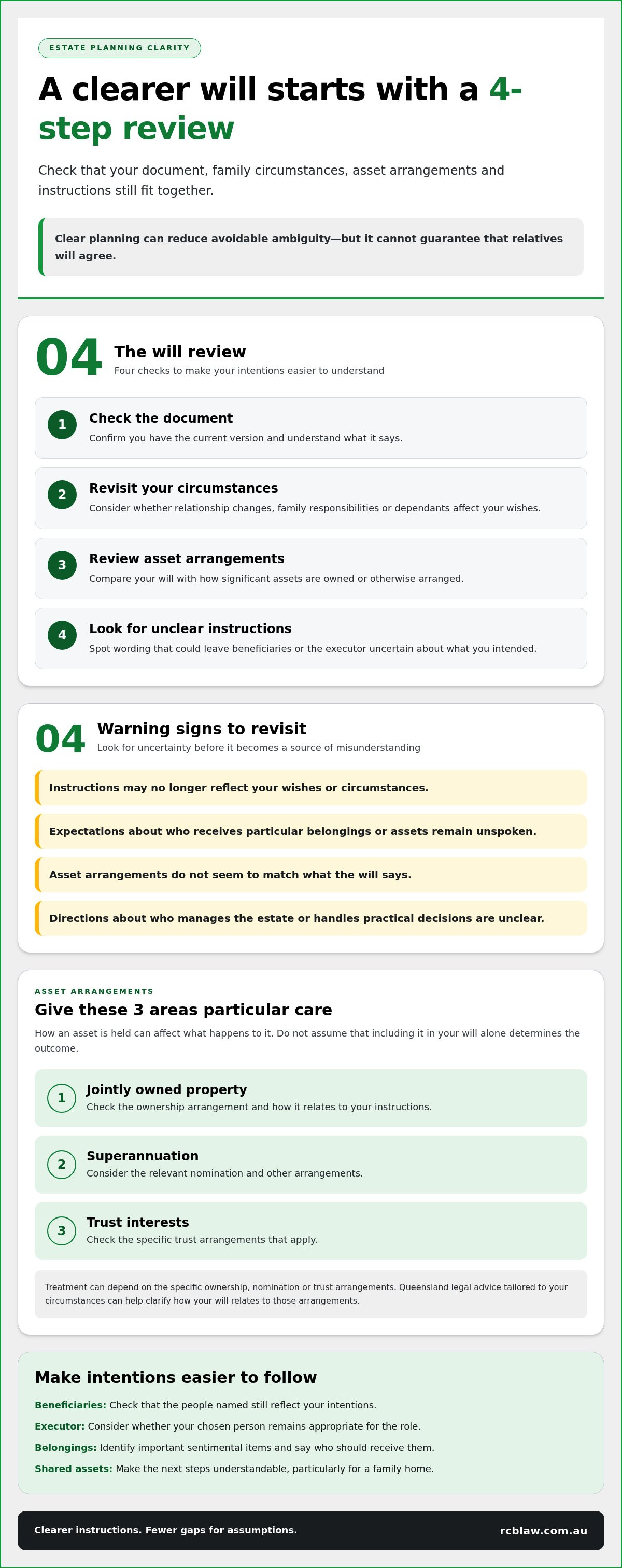
Planning can’t guarantee that relatives will agree, but it can reduce avoidable ambiguity. Warning signs to look out for include:
- Instructions that may no longer reflect your wishes or circumstances.
- Unspoken expectations about who will receive particular belongings or assets.
- Asset arrangements that don’t seem to match what the will says.
- Unclear directions about who should manage the estate or handle practical decisions.
Which inheritance issues commonly create family tension?
Uncertainty about fairness often grows when a will gives beneficiaries different shares but offers no context. You don’t need to justify every private decision to your family, but clear wording can make your intentions easier to follow. Give attention to sentimental items too: identify important belongings and say who should receive them. For shared assets, such as a family home, consider whether the instructions make the next steps understandable.
Questions about an executor can also create strain. Relatives may be unsure how decisions are being made or what happens next, particularly when responsibilities aren’t clear to them. That uncertainty alone doesn’t show misconduct. Clear directions and a suitable choice of executor can help set expectations about estate administration and reduce room for misunderstanding.
Why family circumstances matter in Brisbane estate planning
Family relationships change. A blended family, estrangement, new dependants or a changed relationship may affect who you want to provide for and how you express those wishes. Consider whether your existing instructions still reflect the people and circumstances that matter to you. A distribution that feels right in one family may not suit another, and no arrangement can guarantee acceptance by every relative.
Queensland law is relevant when preparing or reviewing a will in Brisbane, so advice should take account of the state’s legal context and your circumstances. If family relationships or asset arrangements have changed, a will review can help identify where instructions may need attention. For readers considering how to prevent family arguments over inheritance brisbane, the practical aim is to make intentions clearer, not to promise a dispute-free outcome.
Make the will clear, current and consistent with your wishes
A will is more useful when it reflects your present circumstances and gives clear directions. Reviewing it doesn’t mean you need to change every decision. It means checking that the document, your family situation and the way your assets are held still fit together. A will can make your intentions easier to understand, but it can’t guarantee that every relative will agree.
Use this four-step review as a starting point:
- Check the document. Confirm that you have the current version and understand what it says.
- Revisit your circumstances. Consider whether changes to relationships, family responsibilities or dependants affect your wishes.
- Review asset arrangements. Compare the will with how significant assets are owned or otherwise arranged.
- Look for unclear instructions. Identify wording that could leave beneficiaries or the executor uncertain about what you intended.
What to review when checking an existing will
Check that named beneficiaries still reflect your intentions and that your chosen executor remains an appropriate person for the role. Look for broad phrases that could be interpreted in different ways, especially around valuable belongings or who should receive a particular item. Relationship changes, new family responsibilities or a substantial change in assets are sensible prompts to review your plan. If the will is old or your circumstances have materially changed, a professional review can help clarify whether it still expresses your wishes.
For a broader explanation of why a valid, up-to-date document matters, see this guide to why Queenslanders need a will.
Match the plan to assets and ownership arrangements
Start by making an inventory of property, bank and investment accounts, valuable personal belongings and other significant assets. Note how each is held and where relevant information is kept. This doesn’t mean every item will pass under your will. The outcome can depend on the ownership structure and the rules or arrangements that apply to a particular asset.
Jointly owned property, superannuation and interests in a trust deserve particular care. Their treatment can depend on the specific ownership, nomination or trust arrangements, so don’t assume that including an asset in your will is enough to determine what happens to it. Queensland legal advice tailored to your circumstances can help you understand how your will relates to those arrangements. Tax matters may also affect estate administration; the Australian Taxation Office explains Australian tax obligations for deceased estates.
Thinking about how to prevent family arguments over inheritance brisbane? Compare your will with your current family and asset circumstances. RCB Law offers a complimentary review of existing wills to help identify whether an update may be worth considering.
Talk about inheritance fairly without creating more family tension
A conversation before a crisis can give relatives helpful context and reduce the shock of unexpected decisions. It can also feel personal, especially if family members already have different expectations. Choose a calm time, away from a major family event or a moment of conflict, and explain that your aim is to make your intentions easier to understand, not to negotiate your will.
There’s a balance to strike. Sharing the broad plan may clarify expectations, but you don’t have to disclose every private detail or invite relatives to vote on your decisions. You might explain which topics you’re willing to discuss, then pause the conversation if it becomes heated. Consider speaking with people individually if a group discussion could create pressure or embarrassment.
How to explain decisions without promising equal shares
Fairness doesn’t mean the same thing to everyone. One person may value equal shares, while another may see a different distribution as appropriate given individual circumstances. Use plain language to explain your intentions without promising that everyone will receive the same amount or agree with your choices. You can offer context while keeping private matters private. A family conversation supports understanding, but it doesn’t replace a clear, properly prepared will or legal advice.
It may help to keep the conversation focused:
- State your purpose: “I’d like you to understand the broad plan, so there’s less uncertainty later.”
- Explain what you’re comfortable sharing: Make clear whether you’re discussing general intentions or specific decisions.
- Listen without making on-the-spot changes: You can consider questions without treating the discussion as a negotiation.
- Keep the written plan aligned: If a conversation leads you to reconsider something, have the formal document reviewed and updated as appropriate.
Reasons for a decision can provide context, but spoken explanations may be remembered differently or lost over time. The will remains the place to record your instructions formally. If you’re unsure whether the document reflects what you now want, consider a review rather than relying on family members to interpret a conversation later.
Plan for sentimental belongings and the family home
Small items can carry large memories. Where appropriate, record the belongings that matter to you and the person you intend to receive each one. Keep the record straightforward and make sure any relevant directions are consistent with your will. Avoid relying on informal promises that may be forgotten or understood differently by different relatives.
A family home can raise practical questions as well as emotional ones. If relevant, think about who might need access, whether anyone expects to keep using the property, and how a decision about sale should be approached. Don’t assume that a family discussion alone settles ownership or resolves the legal position. A simple written record of your intentions, supported by clear estate-planning documents, can make the plan easier to follow.
For guidance on preparing or reviewing a will, RCB Law assists Brisbane and Queensland clients with estate planning. Clear planning can reduce uncertainty, even though no conversation or document can guarantee relatives will agree.
Use a practical checklist to reduce uncertainty before a dispute starts
A short, organised review can make estate planning easier to revisit and help you spot questions before they become points of confusion. Keep a secure record of key documents and asset information, then review the plan after a significant change in your family or financial circumstances. This process won’t guarantee agreement, but it can make your intentions and records easier to understand.
A simple estate-planning review sequence
Work through these steps in order. Gather what you have first, then compare the documents with your current circumstances. If you’re unsure about the legal effect of an ownership arrangement or instruction, note the question rather than relying on an assumption.
- Collect existing documents. Locate your current will and any related estate-planning records. Store them securely and make sure the right person knows how to find them when needed.
- List significant assets. Record property, accounts, investments, valuable belongings and other relevant interests. Note how each asset is owned and where supporting records are kept.
- Compare the plan with your life today. Check that beneficiaries, your chosen executor and your intended outcomes still reflect your circumstances and wishes.
- Write down questions. Make a list of anything you don’t understand, especially where an asset’s ownership or arrangement may affect how it is dealt with.
- Review and communicate carefully. Seek Queensland legal advice on questions that need it, update documents where appropriate, and decide what broad information you want to share with family.
Property can be a substantial part of an estate, so keep ownership records and related paperwork with your other important documents. Understanding the transaction and ownership details can make the asset inventory more useful. RCB Law’s guide to conveyancing in Queensland explains the property process and its documentation.
Keep records in a secure place, whether digitally or in hard copy, and avoid storing sensitive information where it could be accessed casually. Revisit your plan after a major change, such as a new relationship, a change in dependants, buying or selling property, or a material shift in your assets. A review can help identify where the written plan and current arrangements may no longer match.
What to do if relatives already disagree
If concerns have surfaced, keep communication calm and factual. Written messages can help everyone understand what has been asked or explained, but avoid accusatory language or informal promises about estate assets. Preserve relevant documents and records, and don’t alter or dispose of material that may relate to the disagreement. Prompt, situation-specific advice from a Queensland legal adviser can help clarify appropriate next steps without assuming what the outcome will be.
If you’re considering how to prevent family arguments over inheritance brisbane, a well-organised review is a practical place to start. Review your existing will with RCB Law to identify whether changed family or asset circumstances call for attention.
How RCB Law can help Brisbane families prepare with greater clarity
Preparing or reviewing a will can help bring your wishes, family circumstances and asset arrangements into clearer focus. RCB Law assists clients in Brisbane and across Queensland with will drafting and estate planning, drawing on more than 30 years of experience. The aim is to help you understand your options and record your intentions clearly, not to promise that every family member will agree.
A will review can be a practical next step if your circumstances have changed or you’re uncertain whether your current document still reflects your wishes. RCB Law offers a complimentary review of existing wills. It can help identify points that may need attention, such as wording that seems unclear or instructions that no longer fit your family or assets.
When professional will review may be useful
Consider a review after changes to relationships, family responsibilities or significant assets, or if you’re unsure what a particular instruction means. Tailored advice can help you identify questions about your intended plan and consider whether the will needs updating. A review is focused on estate planning. It isn’t a process for resolving an active disagreement between relatives, which may call for advice specific to that situation.
It can help to prepare before discussing your circumstances. Gather your current will and note any changes or concerns you want to raise. For example, you might explain that a beneficiary’s circumstances have changed, that you’ve acquired property, or that you’re unsure whether an instruction is sufficiently clear. This gives the review a practical starting point and helps keep the discussion focused on your wishes.
Take a calm next step with RCB Law
You don’t need to have every answer before seeking guidance. Begin by explaining what matters to you, what has changed and where you feel uncertain. A conversation about will drafting or a review can help you understand the issues to consider and decide what steps may be appropriate for your circumstances.
Clearer planning can reduce uncertainty, but it can’t guarantee a dispute-free outcome. If you’re considering how to prevent family arguments over inheritance brisbane, reviewing your will is one useful step towards making your intentions easier to understand. RCB Law’s complimentary review of existing wills offers a straightforward way to start considering whether your document still reflects your wishes.
Speak with RCB Law about your will and discuss your circumstances with a local team assisting Brisbane and Queensland clients.
Take a thoughtful next step for your family
Estate planning is personal, and you don’t need to resolve every question at once. Start by noting what matters most to you, which decisions feel difficult to explain, and whether your current arrangements still reflect your wishes. A conversation with a legal professional can help turn those concerns into practical questions and identify a sensible next step.
If you’re considering how to prevent family arguments over inheritance brisbane, focus on making your intentions easier to understand while recognising that no plan can ensure relatives will always agree. Reviewing your will can give you a calmer starting point, especially when family or financial circumstances have changed. RCB Law assists with will drafting and estate planning, including a complimentary review of existing wills.
Speak with RCB Law about your will and discuss the questions that matter to you. A little clarity today can help you move forward with greater confidence and care for the people you love.
Frequently Asked Questions
Can a will prevent family arguments over inheritance?
A clear, current will can reduce uncertainty, but it can’t guarantee that relatives will agree. For anyone considering how to prevent family arguments over inheritance brisbane, start by checking whether the document clearly expresses your intentions and fits your current circumstances. Family expectations and how assets are held may also affect how decisions are understood. If you’re unsure whether your will does that, seek Queensland legal advice.
How can I divide an inheritance fairly between my children?
There’s no single division that every family will see as fair, and equal shares aren’t automatically the right choice for every person. Consider what you intend to provide and whether your instructions explain that clearly. For instance, if one child has already received substantial support, you may want advice on how your intended distribution should be documented. A Queensland legal professional can help you understand how to express your wishes without assuming how your children will respond.
Should I tell my family what is in my will?
You can share general intentions without disclosing every detail of your will. If you choose to talk, explain that you’re aiming to reduce uncertainty, not asking relatives to approve your decisions. You might also clarify which matters are private and which questions you’re open to discussing. Avoid relying on a conversation to change your formal instructions. If you reconsider a decision, get advice about recording any change appropriately.
Can a family member challenge a will in Queensland?
A family member may be able to bring a claim in some circumstances, but whether they can do so depends on their relationship to the deceased, the facts and Queensland law. A concern or disagreement alone doesn’t establish what the legal outcome will be. If someone has raised a potential claim, or you’re worried about a particular person’s position, obtain advice promptly. A lawyer can assess the situation and explain relevant options and requirements.
Does a will control all assets after death in Australia?
Not necessarily. The way an asset is owned or arranged can affect whether it passes under a will. For example, jointly owned property, superannuation and trust interests may each need separate consideration. Don’t assume that listing an asset in your will determines who receives it. Keep records of ownership and relevant arrangements, then ask a Queensland estate-planning lawyer how each item fits with your intended plan.
How often should I review my will in Queensland?
Review your will when a change could affect who you want to provide for, who should manage your estate or what you own. Examples include a new family responsibility, a relationship change or acquiring or selling a major asset. You can also check that named people are still appropriate and that you know where the current document is kept. If you’re unsure how a life event affects your will, seek legal advice.
What should I do if my family is already arguing about an inheritance?
If disagreement has started, keep relevant documents and communications together and avoid making rushed promises about estate assets. It may help to write down what the disagreement concerns, such as the meaning of a will instruction or a decision about an asset, so advice can focus on the actual issue. Keep messages factual and respectful. Because the right response depends on the circumstances, seek Queensland legal advice rather than relying on a general checklist.


