
A will doesn’t have to divide an estate equally between children. Across Australia, parents generally have no legal obligation to leave each child the same share, although an unequal distribution can have legal and emotional consequences. A fair way to divide assets between children in a will may mean equal shares or a different balance that reflects each child’s circumstances.
It’s understandable to want your children to feel fairly treated, especially if one has received financial help during your lifetime or has a different connection to the family’s assets. Fairness doesn’t always mean giving everyone identical things, but unclear or unexpected decisions can create tension and may lead to a family provision claim.
This article explains how equal and unequal inheritances work in Australia, what to consider when choosing different shares, and why state and territory laws matter. It also considers practical ways to approach complex assets such as a family business, helping you understand your options and make your intentions clearer.
Key Takeaways
- Australian parents generally aren’t required to leave children equal shares, but an unequal distribution can have legal and family consequences.
- Consider how to balance a business or other hard-to-divide asset with the rest of the estate, including whether an equalising payment could help.
- Explain the reasoning behind different gifts, such as past financial support, while recognising that an explanation can’t prevent a family provision claim.
- Caregiving and other contributions may shape what feels fair; thoughtful planning can make those decisions clearer to your children.
Dividing a family business and other complex assets
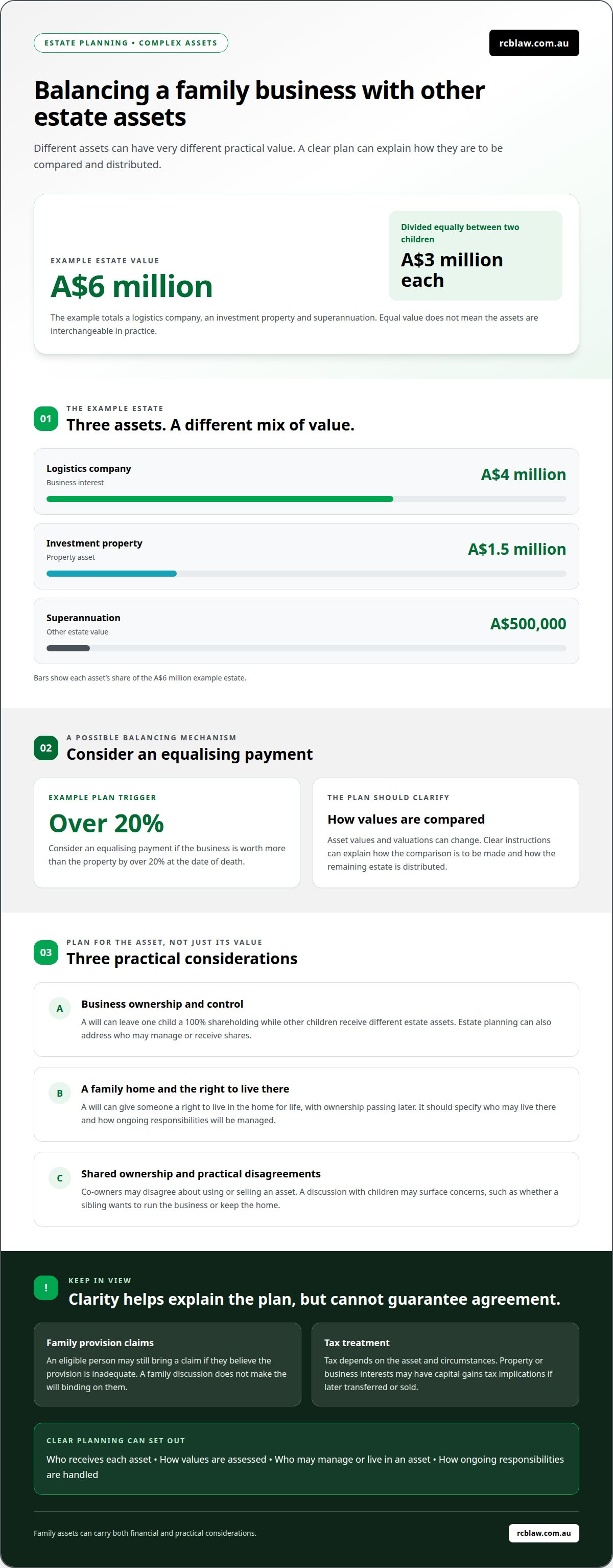
A family business may be difficult to divide fairly because ownership and practical control are connected. A will can leave one child a 100 per cent shareholding, while other children receive different estate assets. For example, an estate with a logistics company worth A$4 million, an investment property worth A$1.5 million and A$500,000 in superannuation totals A$6 million. Divided equally between two children, that represents A$3 million each, but the assets aren’t interchangeable in practice.
One approach is to compare the business’s value with the property and other assets, then consider an equalising payment. The example plan recommends considering one if the business is worth more than the property by over 20 per cent at the date of death. Valuations and asset values can change, so the will should explain how the comparison is to be made. For business interests, estate planning can also address who may manage or receive shares.
A family home can present different challenges. Giving one child ownership may affect where another family member lives, while selling the home and dividing the proceeds may not suit someone who wants to remain there. A will can provide someone with a right to live in the home for life, with ownership passing later. The terms should specify who may live there and how ongoing responsibilities will be managed.
Sharing an asset can preserve family ownership, but co-owners may disagree about how to use or sell it. Discussing a proposed inheritance with your children can reveal practical concerns, such as whether a sibling wants to run the business or keep the home. A conversation doesn’t make the will binding on them, and an eligible person may still bring a family provision claim if they believe the provision is inadequate.
The cost of making or updating a will depends on the case and is given after a quote request; factors include asset complexity, business interests and the extent of changes required.
In Australia, tax treatment depends on the asset and the circumstances. Inheriting property or business interests may have capital gains tax implications if the assets are later transferred or sold, so the timing and structure of those decisions matter.
Does a Will have to be shared equally?
No. In Australia, parents generally aren’t required to leave their children equal shares. A fair way to divide assets between children in a will may mean equal amounts or a distribution shaped by each child’s circumstances.
Equal Distribution and Intestacy
Intestacy means an estate is distributed under the rules that apply when someone dies without a valid will. In Australia, succession is mostly governed by state and territory legislation, so there is no single national formula for children’s inheritances. A surviving spouse’s position and the family structure can affect the outcome. Making a will lets you set out your intended distribution instead of relying on those default rules.
Equal Shares and Needs-Based Inheritance
Equal inheritance gives each child the same share, while needs-based inheritance adjusts provision to reflect individual circumstances. For example, an estate of A$100,000 divided equally among four children gives each A$25,000. A parent may instead consider whether a child facing financial difficulty would benefit more from a larger share. A fair way to divide assets between children in a will can take account of differing needs, while recognising that unequal provision may prompt questions about the reasoning.
Equalising Payments and Flexible Planning
An equalising payment can balance the value of different assets when children receive different property or interests. An estate plan can give the executor instructions on assessing assets and distributing what remains. For instance, one child could receive a particular asset while another receives cash or other property of comparable value. Clear directions on valuation and distribution help explain the intended arrangement and reduce uncertainty during administration.
Inheritance Equality and Dispute Prevention
Equal inheritances may reduce some causes of disagreement, but they can’t prevent every family provision claim or dispute. Parents can discuss their intentions with family members and work through the proposed distribution with a wills lawyer. Useful steps include identifying assets, considering a spouse or blended family, and recording the reasons for unequal gifts. These discussions can give the executor context, while a clear will structure sets out the intended division.
What happens if you leave unequal shares?
Unequal gifts can reflect a parent’s circumstances and wishes, but may raise questions about the distribution. In Australia, an eligible person may challenge a will through a family provision claim if they believe it doesn’t adequately provide for them.
Reasons for Unequal Gifts
Parents may leave different shares because their children have received different support or have different financial needs. For example, one child might receive A$200,000 during the parent’s lifetime to fund postgraduate study overseas. A parent may consider that gift when deciding what each child receives from the remaining estate.
Other reasons for different shares may include a child’s contribution to family responsibilities or a parent’s relationship with each child. A clear explanation can help relatives understand the decision and reduce avoidable conflict. A Statement of Reasons or Letter of Wishes can record the parent’s thinking, but it isn’t legally binding and can’t prevent a family provision claim.
Lifetime Gifts and Estate Restructuring
A lifetime gift is support provided before a parent dies, rather than through the will. After making a substantial gift, parents can review their estate plan and decide whether the will should treat it as an advance on an inheritance or as separate support. The document should state the intended effect clearly, rather than leaving children and the executor to infer it.
For example, if a child receives A$200,000 for overseas study, the will could explain whether that amount should be considered when dividing the remaining estate. Lawyers can help express the parent’s wishes precisely, including what happens if the estate’s assets change before death. Clear wording helps the executor apply the intended distribution.
Unequal Shares and Family Provision
Family provision laws vary across Australia because succession is mostly governed by state and territory legislation. In New South Wales, eligible people may make a claim under the Succession Act 2006 (NSW) if the will doesn’t make adequate provision for them. An unequal share alone doesn’t settle whether a claim will succeed.
A court may consider the claimant’s circumstances and the provision made in the will. A Letter of Wishes may explain the parent’s reasons, but it doesn’t remove an eligible person’s ability to make a claim. Careful drafting can record the intended distribution and the reasons behind it, while recognising that unequal shares can have legal consequences.
Should I Treat My Children Equally in My Will?
Equal shares may seem straightforward, but caregiving, financial support and individual circumstances can affect what feels fair. For adult children, a court can also consider whether the will makes adequate provision.
Caregiving and Financial Contributions
Caregiving and financial contributions can help explain why a parent chooses different shares. For example, a parent who received care from one child during the eight years before death may want to recognise that support. Another child may have contributed money to maintain a family asset. Recording these circumstances in the estate plan gives beneficiaries context for the intended distribution, rather than leaving them to guess why one person received more.
Children’s Financial Needs and Circumstances
Children’s financial needs can differ, even within the same family. One adult child may have stable income and housing, while another faces financial hardship or has dependants. A parent can weigh those circumstances alongside the value of each child’s past support. This may lead to unequal shares, but clear reasoning matters: beneficiaries are more likely to understand a decision when the estate plan explains the parent’s intentions.
Past Assistance and Inheritance
Past assistance can be considered when deciding what children inherit, but the will should explain how each gift affects the final distribution. For example, a parent who gave a daughter A$400,000 during their lifetime to buy a home may intend that gift to count toward her inheritance, or to be separate support. Stating which approach applies helps the executor distribute the estate as intended.
Agreements and Adult Children’s Claims
In a family provision claim, a court assesses whether adequate provision was made and, if not, what provision should follow. The High Court’s decision in Singer v Berghouse established this two-stage approach; Andrew v Andrew shows financial circumstances may justify greater provision. In New South Wales, a person giving up family provision rights needs independent legal advice, and the Supreme Court must approve a Deed of Release under section 95 of the Succession Act.
For help putting caregiving, past support and beneficiaries’ circumstances into a clear estate plan, discuss your will planning.
RCB Law: Will Drafting
RCB Law can help you set out your inheritance decisions in a clear will, including provisions for unequal shares, lifetime gifts and complex assets. Consider will drafting if your family circumstances have changed, you want to recognise a child’s contribution, or your current instructions no longer reflect your wishes.
A family business or valuable property can make an estate plan more complex. RCB Law’s business law, commercial property law and residential conveyancing services can help with plans involving business interests or property ownership. Clear, carefully drafted directions can help your executor understand how you intend the assets to be distributed.
If you’re ready to discuss your will and how you’d like your estate divided, contact RCB Law.
Put your intentions into a clear plan
An inheritance decision can carry meaning long after a will is read. A fair way to divide assets between children in a will should reflect your intentions and avoid leaving important choices open to interpretation. Take time to identify what you want your estate plan to communicate and what changes in circumstances might prompt you to revisit it.
Before drafting, organise your thoughts about who should benefit and why. Consider how changes in family relationships, assets or responsibilities might affect your wishes over time. Clear instructions can give your executor a practical guide and help your children understand your intentions.
RCB Law can help put those wishes into a will, with related Business Law, Residential Conveyancing and Commercial Property Law support for plans involving business or property interests. For a calm discussion about your next step, Discuss your will with RCB Law. A clear plan can make your intentions easier for your family to understand.
Frequently Asked Questions
Should you tell your children what they’re inheriting?
You can discuss your intentions with your children, especially if your plan may surprise them. A conversation could explain why one child is to receive a particular asset or how you’ve considered past support. You don’t have to disclose every detail. A letter of wishes can give the executor context, but it isn’t legally binding and can’t prevent a family provision claim.
The Real Question: What Does “Fair” Actually Mean?
Fairness can mean equal value, recognising different needs, or acknowledging a child’s care and contributions. For example, one family may consider equal shares fair, while another may take account of a child who has already received substantial assistance. Clarifying what fairness means to you can help shape a will that reflects your priorities and gives your executor a clearer guide to your intentions.
The first is legal: what does the law require?
Australian parents generally have no legal obligation to divide their estate equally among their children. Succession is mostly governed by state and territory legislation, and eligible people may be able to seek further provision under applicable family provision laws. In New South Wales, claims are governed by the Succession Act 2006 (NSW). The relevant rules depend on where the estate is administered.
What if You Expect an Estate Challenge?
If you anticipate a challenge, make your reasoning clear and consider who may be eligible to claim under the laws applying to your estate. In New South Wales, an eligible person generally has 12 months from the date of death to commence a family provision claim. A letter of wishes can record your reasons, but it doesn’t prevent a claim or replace the will’s directions.
What if you want to benefit everyone?
Providing for everyone doesn’t always require distributing the estate equally among your children. You could consider whether part of the estate should support a cause important to you while also providing for family members. A welfare-based approach asks how resources can produce the greatest overall benefit. Consider how each choice fits your values, the needs of intended beneficiaries and the practical effect on the estate.
Can a parent leave different amounts to children in an Australian will?
Yes. A parent can generally leave children different amounts, but eligible family members may challenge a will if they believe it doesn’t provide adequately for them. Relevant circumstances can include the claimant’s financial position, relationship with the deceased and the provision made under the will. State and territory laws differ, so the applicable rules depend on the jurisdiction governing the estate.


